
As per Intent Market Research, the Electric Vehicle Charging Port System Market was valued at USD 5.5 Billion in 2024-e and will surpass USD 18.8 Billion by 2030; growing at a CAGR of 22.9% during 2025-2030.
The electric vehicle (EV) charging port system market is rapidly growing as the demand for electric vehicles continues to rise, driven by environmental concerns and governmental incentives aimed at reducing carbon emissions. As more consumers and businesses switch to electric vehicles, the need for efficient, accessible, and fast charging solutions grows. The market is characterized by various types of charging ports, charging speeds, connector types, and applications across different regions. Understanding the dynamics of each subsegment is crucial for stakeholders looking to capitalize on this evolving market.
AC Charging Port Segment Is Largest Owing to Widespread Adoption
The AC charging port segment is the largest in the electric vehicle charging market due to the widespread adoption of AC charging infrastructure globally. AC chargers are typically installed in residential areas, public spaces, and workplaces, where the charging speed requirement is less critical. These chargers are cost-effective and simpler to install compared to DC chargers, making them more accessible for everyday use. The AC charging port also supports the majority of electric vehicles, particularly in regions where overnight charging at home is sufficient for daily driving needs.
As electric vehicle adoption grows and governments push for expanded infrastructure, AC chargers remain the backbone of the EV charging ecosystem. This segment benefits from both private and public investments, with numerous charging stations being installed across cities and residential areas. The simplicity and affordability of AC chargers make them particularly popular in developed markets, where the EV penetration rate is high, and in emerging markets, where demand for affordable charging solutions is expanding.
.JPG)
.JPG) Passenger Vehicles Segment Leads the Market Due to Growing EV Adoption
Passenger Vehicles Segment Leads the Market Due to Growing EV Adoption
The passenger vehicle segment is the largest subsegment within the electric vehicle charging port system market. This is primarily due to the increasing adoption of electric passenger cars across the globe, fueled by rising environmental awareness, government incentives, and improved EV technology. Governments are offering subsidies and incentives for EV buyers, making electric cars more affordable and accessible to a wider audience. Furthermore, the infrastructure for charging passenger vehicles is rapidly expanding, ensuring that consumers have more options for where and how to charge their vehicles.
Passenger vehicles also benefit from advancements in battery technology, which is extending the range of EVs and reducing the frequency of charging, thus enhancing the overall customer experience. With the development of more affordable models and the increased availability of charging infrastructure, the passenger vehicle segment is expected to continue to dominate the electric vehicle charging port system market in the coming years.
Fast Charging Segment Is Fastest Growing Owing to Convenience and Speed
The fast charging segment is the fastest growing in the electric vehicle charging port system market, driven by the demand for reduced charging times. Fast chargers allow electric vehicle owners to recharge their batteries much more quickly compared to standard chargers, making them ideal for public charging stations, highways, and other high-traffic areas. The convenience of fast charging significantly reduces range anxiety—one of the major concerns that potential EV buyers have when considering a switch from internal combustion engine (ICE) vehicles to electric vehicles.
As the charging infrastructure network expands, fast charging stations are becoming more prevalent in urban centers, along highways, and at strategic locations, enabling EV owners to quickly recharge their vehicles and continue their journeys. This growing demand for fast charging is expected to continue as more consumers adopt electric vehicles, and as battery technology improves, enabling even faster charging speeds.
CCS Connector Segment Dominates Due to Standardization
The CCS (Combined Charging System) connector segment is the largest in the electric vehicle charging port system market, owing to its widespread adoption as the global standard for fast charging. The CCS connector allows for both AC and DC fast charging, making it versatile and efficient for various types of electric vehicles. The standardization of the CCS connector across automakers and charging networks has contributed to its dominance, as it ensures compatibility between different EVs and charging stations.
The popularity of the CCS connector is particularly strong in Europe and North America, where automakers have adopted this standard in their electric vehicles, making it the go-to option for consumers. As the adoption of electric vehicles continues to rise, the CCS connector is expected to remain the dominant choice for fast and ultra-fast charging systems globally.
Residential Charging Segment Is Largest Owing to Convenience and Affordability
The residential charging segment is the largest by application, as it provides the most convenient and cost-effective solution for electric vehicle owners. Home charging stations allow EV owners to recharge their vehicles overnight, ensuring that their vehicles are ready for use each morning. Residential charging infrastructure is supported by various government incentives and rebates, making it an attractive option for homeowners looking to transition to electric vehicles.
As the adoption of electric vehicles continues to grow, the residential charging segment will remain the dominant application for charging port systems, especially in regions where home ownership is common. The increasing availability of affordable and easy-to-install home charging solutions further supports the growth of this subsegment.
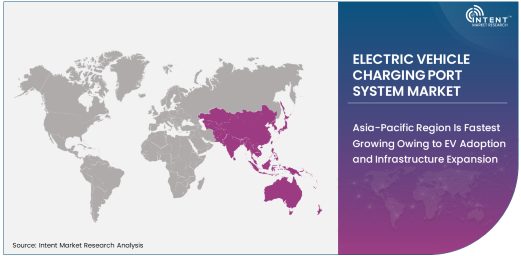
Asia-Pacific Region Is Fastest Growing Owing to EV Adoption and Infrastructure Expansion
The Asia-Pacific region is the fastest growing in the electric vehicle charging port system market. Countries such as China, Japan, and South Korea are leading the charge in electric vehicle adoption, supported by strong government policies, incentives for EV buyers, and ambitious environmental goals. China, in particular, has the largest number of electric vehicles on the road and is rapidly expanding its EV charging infrastructure to accommodate the growing number of EVs.
Governments in the region are heavily investing in the development of charging networks, and automakers are committing to producing more electric vehicles, further driving demand for charging port systems. As a result, the Asia-Pacific region is expected to continue its strong growth trajectory and become a key driver of the global market.
Competitive Landscape and Leading Companies
The electric vehicle charging port system market is highly competitive, with several global players vying for market share. Key companies in this market include Tesla, ChargePoint, ABB, Siemens, Schneider Electric, and Bosch, all of which are investing heavily in the development of charging infrastructure and technology. These companies are focusing on expanding their charging networks, improving charging speeds, and enhancing the user experience to stay ahead of the competition.
The competitive landscape is also shaped by the growing number of startups and regional players that are introducing innovative solutions to address the specific needs of different markets. With the increasing demand for fast and ultra-fast charging solutions, companies that can offer integrated, scalable, and efficient charging solutions are likely to lead the market in the coming years.
List of Leading Companies:
- Tesla
- Siemens
- ABB
- Schneider Electric
- Bosch
- ChargePoint
- Eaton
- Leviton
- Delta Electronics
- Webasto
- Siemens Mobility
- Alfen
- Fastned
- Blink Charging
- Enel X
Recent Developments:
- Tesla has significantly increased the number of its Supercharger stations globally, improving access to fast charging for electric vehicle owners.
- ABB introduced a new ultra-fast EV charger designed to reduce charging time for electric vehicles, aiming to make EVs more convenient for long-distance travel.
- Siemens announced a strategic partnership to increase its footprint in the EV charging market by expanding its charging infrastructure solutions across Europe and North America.
- ChargePoint acquired a leading software company to enhance its platform capabilities, including smart charging and integration with renewable energy sources.
- Enel X unveiled a new smart charging solution that allows users to optimize energy consumption based on grid availability, offering a more sustainable way to charge EVs.
Report Scope:
|
Report Features |
Description |
|
Market Size (2024-e) |
USD 5.5 Billion |
|
Forecasted Value (2030) |
USD 18.8 Billion |
|
CAGR (2025 – 2030) |
22.9% |
|
Base Year for Estimation |
2024-e |
|
Historic Year |
2023 |
|
Forecast Period |
2025 – 2030 |
|
Report Coverage |
Market Forecast, Market Dynamics, Competitive Landscape, Recent Developments |
|
Segments Covered |
Electric Vehicle Charging Port System Market By Type (AC Charging Port, DC Charging Port), By Vehicle Type (Passenger Vehicles, Commercial Vehicles, Electric Two-Wheelers), By Charging Speed (Slow Charging, Fast Charging, Ultra-Fast Charging), By Connector Type (Type 1 Connector, Type 2 Connector, CCS Connector, CHAdeMO Connector), By Application (Residential Charging, Public Charging, Workplace Charging) |
|
Regional Analysis |
North America (US, Canada, Mexico), Europe (Germany, France, UK, Italy, Spain, and Rest of Europe), Asia-Pacific (China, Japan, South Korea, Australia, India, and Rest of Asia-Pacific), Latin America (Brazil, Argentina, and Rest of Latin America), Middle East & Africa (Saudi Arabia, UAE, Rest of Middle East & Africa) |
|
Major Companies |
Tesla, Siemens, ABB, Schneider Electric, Bosch, ChargePoint, Eaton, Leviton, Delta Electronics, Webasto, Siemens Mobility, Alfen, Fastned, Blink Charging, Enel X |
|
Customization Scope |
Customization for segments, region/country-level will be provided. Moreover, additional customization can be done based on the requirements |
|
1. Introduction |
|
1.1. Market Definition |
|
1.2. Scope of the Study |
|
1.3. Research Assumptions |
|
1.4. Study Limitations |
|
2. Research Methodology |
|
2.1. Research Approach |
|
2.1.1. Top-Down Method |
|
2.1.2. Bottom-Up Method |
|
2.1.3. Factor Impact Analysis |
|
2.2. Insights & Data Collection Process |
|
2.2.1. Secondary Research |
|
2.2.2. Primary Research |
|
2.3. Data Mining Process |
|
2.3.1. Data Analysis |
|
2.3.2. Data Validation and Revalidation |
|
2.3.3. Data Triangulation |
|
3. Executive Summary |
|
3.1. Major Markets & Segments |
|
3.2. Highest Growing Regions and Respective Countries |
|
3.3. Impact of Growth Drivers & Inhibitors |
|
3.4. Regulatory Overview by Country |
|
4. Electric Vehicle Charging Port System Market, by Type (Market Size & Forecast: USD Million, 2023 – 2030) |
|
4.1. AC Charging Port |
|
4.2. DC Charging Port |
|
5. Electric Vehicle Charging Port System Market, by Vehicle Type (Market Size & Forecast: USD Million, 2023 – 2030) |
|
5.1. Passenger Vehicles |
|
5.2. Commercial Vehicles |
|
5.3. Electric Two-Wheelers |
|
6. Electric Vehicle Charging Port System Market, by Charging Speed (Market Size & Forecast: USD Million, 2023 – 2030) |
|
6.1. Slow Charging |
|
6.2. Fast Charging |
|
6.3. Ultra-Fast Charging |
|
7. Electric Vehicle Charging Port System Market, by Connector Type (Market Size & Forecast: USD Million, 2023 – 2030) |
|
7.1. Type 1 Connector |
|
7.2. Type 2 Connector |
|
7.3. CCS Connector |
|
7.4. CHAdeMO Connector |
|
8. Electric Vehicle Charging Port System Market, by Application (Market Size & Forecast: USD Million, 2023 – 2030) |
|
8.1. Residential Charging |
|
8.2. Public Charging |
|
8.3. Workplace Charging |
|
9. Regional Analysis (Market Size & Forecast: USD Million, 2023 – 2030) |
|
9.1. Regional Overview |
|
9.2. North America |
|
9.2.1. Regional Trends & Growth Drivers |
|
9.2.2. Barriers & Challenges |
|
9.2.3. Opportunities |
|
9.2.4. Factor Impact Analysis |
|
9.2.5. Technology Trends |
|
9.2.6. North America Electric Vehicle Charging Port System Market, by Type |
|
9.2.7. North America Electric Vehicle Charging Port System Market, by Vehicle Type |
|
9.2.8. North America Electric Vehicle Charging Port System Market, by Charging Speed |
|
9.2.9. North America Electric Vehicle Charging Port System Market, by Connector Type |
|
9.2.10. North America Electric Vehicle Charging Port System Market, by Application |
|
9.2.11. By Country |
|
9.2.11.1. US |
|
9.2.11.1.1. US Electric Vehicle Charging Port System Market, by Type |
|
9.2.11.1.2. US Electric Vehicle Charging Port System Market, by Vehicle Type |
|
9.2.11.1.3. US Electric Vehicle Charging Port System Market, by Charging Speed |
|
9.2.11.1.4. US Electric Vehicle Charging Port System Market, by Connector Type |
|
9.2.11.1.5. US Electric Vehicle Charging Port System Market, by Application |
|
9.2.11.2. Canada |
|
9.2.11.3. Mexico |
|
*Similar segmentation will be provided for each region and country |
|
9.3. Europe |
|
9.4. Asia-Pacific |
|
9.5. Latin America |
|
9.6. Middle East & Africa |
|
10. Competitive Landscape |
|
10.1. Overview of the Key Players |
|
10.2. Competitive Ecosystem |
|
10.2.1. Level of Fragmentation |
|
10.2.2. Market Consolidation |
|
10.2.3. Product Innovation |
|
10.3. Company Share Analysis |
|
10.4. Company Benchmarking Matrix |
|
10.4.1. Strategic Overview |
|
10.4.2. Product Innovations |
|
10.5. Start-up Ecosystem |
|
10.6. Strategic Competitive Insights/ Customer Imperatives |
|
10.7. ESG Matrix/ Sustainability Matrix |
|
10.8. Manufacturing Network |
|
10.8.1. Locations |
|
10.8.2. Supply Chain and Logistics |
|
10.8.3. Product Flexibility/Customization |
|
10.8.4. Digital Transformation and Connectivity |
|
10.8.5. Environmental and Regulatory Compliance |
|
10.9. Technology Readiness Level Matrix |
|
10.10. Technology Maturity Curve |
|
10.11. Buying Criteria |
|
11. Company Profiles |
|
11.1. Tesla |
|
11.1.1. Company Overview |
|
11.1.2. Company Financials |
|
11.1.3. Product/Service Portfolio |
|
11.1.4. Recent Developments |
|
11.1.5. IMR Analysis |
|
*Similar information will be provided for other companies |
|
11.2. Siemens |
|
11.3. ABB |
|
11.4. Schneider Electric |
|
11.5. Bosch |
|
11.6. ChargePoint |
|
11.7. Eaton |
|
11.8. Leviton |
|
11.9. Delta Electronics |
|
11.10. Webasto |
|
11.11. Siemens Mobility |
|
11.12. Alfen |
|
11.13. Fastned |
|
11.14. Blink Charging |
|
11.15. Enel X |
|
12. Appendix |
A comprehensive market research approach was employed to gather and analyze data on the Electric Vehicle Charging Port System Market. In the process, the analysis was also done to analyze the parent market and relevant adjacencies to measure the impact of them on the Electric Vehicle Charging Port System Market. The research methodology encompassed both secondary and primary research techniques, ensuring the accuracy and credibility of the findings.
.jpg)
Secondary Research
Secondary research involved a thorough review of pertinent industry reports, journals, articles, and publications. Additionally, annual reports, press releases, and investor presentations of industry players were scrutinized to gain insights into their market positioning and strategies.
Primary Research
Primary research involved conducting in-depth interviews with industry experts, stakeholders, and market participants across the Electric Vehicle Charging Port System ecosystem. The primary research objectives included:
- Validating findings and assumptions derived from secondary research
- Gathering qualitative and quantitative data on market trends, drivers, and challenges
- Understanding the demand-side dynamics, encompassing end-users, component manufacturers, facility providers, and service providers
- Assessing the supply-side landscape, including technological advancements and recent developments
Market Size Assessment
A combination of top-down and bottom-up approaches was utilized to analyze the overall size of the Electric Vehicle Charging Port System Market. These methods were also employed to assess the size of various subsegments within the market. The market size assessment methodology encompassed the following steps:
- Identification of key industry players and relevant revenues through extensive secondary research
- Determination of the industry's supply chain and market size, in terms of value, through primary and secondary research processes
- Calculation of percentage shares, splits, and breakdowns using secondary sources and verification through primary sources
.jpg)
Data Triangulation
To ensure the accuracy and reliability of the market size, data triangulation was implemented. This involved cross-referencing data from various sources, including demand and supply side factors, market trends, and expert opinions. Additionally, top-down and bottom-up approaches were employed to validate the market size assessment.
NA