
As per Intent Market Research, the Women’s Healthcare Market was valued at USD 27.8 billion in 2023 and will surpass USD 62.9 billion by 2030; growing at a CAGR of 12.3% during 2024 - 2030.
The women's healthcare market is expanding rapidly, driven by the growing focus on women's health, advancements in medical technology, and the increasing demand for gender-specific healthcare services. This market encompasses a broad range of products and services aimed at addressing the unique health needs of women across various life stages, including reproductive health, menopause management, gynecological care, and cancer treatment. With rising awareness of women's health issues, coupled with an increasing incidence of conditions like breast cancer, infertility, and menstrual disorders, the demand for specialized healthcare products is on the rise. As healthcare systems across the globe evolve to provide more personalized and comprehensive care, the women's healthcare market continues to see sustained growth, especially in the areas of contraception, pregnancy care, and cancer prevention.
Technological innovations, such as advancements in diagnostic tools for cancer screening and fertility treatments, are also contributing to market growth. Additionally, the growing trend of self-care and preventive health is driving the adoption of products like contraceptive devices, menstrual health products, and fertility monitors. As women become more empowered to manage their health proactively, there is a marked shift towards a more holistic approach to women's healthcare, ensuring better quality of life and overall well-being for women worldwide.
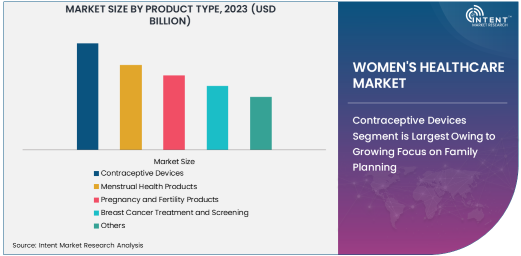
Contraceptive Devices Segment is Largest Owing to Growing Focus on Family Planning
The contraceptive devices segment is the largest within the women’s healthcare market, driven by the growing emphasis on family planning and reproductive health. Contraceptive methods, including intrauterine devices (IUDs), birth control pills, and implants, have become widely accessible, providing women with reliable options to manage their fertility. The increasing awareness of reproductive rights and women’s ability to control their reproductive health is propelling the demand for these devices globally. Governments and health organizations have been encouraging family planning initiatives, particularly in developing regions, to address issues related to overpopulation and maternal health.
Moreover, the shift toward long-acting reversible contraceptives (LARCs), such as IUDs and implants, is further boosting the growth of this segment. These methods offer a more convenient and effective solution for long-term birth control, aligning with the growing preference for non-hormonal, low-maintenance contraceptive options. The wide availability of contraceptive devices through healthcare providers and pharmacies is also contributing to the segment’s growth, making these products easily accessible to women worldwide.
Pregnancy and Fertility Products Segment is Fastest Growing Owing to Increased Focus on Fertility Solutions
The pregnancy and fertility products segment is the fastest growing in the women’s healthcare market. With rising awareness of infertility issues and an increasing number of women opting for delayed pregnancies, there is a growing demand for fertility monitoring and pregnancy-related products. Fertility monitors, ovulation prediction kits, and pregnancy test kits are in high demand, allowing women to track their fertility cycles and confirm pregnancies early. Additionally, advancements in assisted reproductive technologies (ART), such as in vitro fertilization (IVF), are contributing to the market's expansion.
This segment is witnessing rapid growth due to the increasing prevalence of conditions such as polycystic ovary syndrome (PCOS), endometriosis, and male infertility, which have led to higher demand for fertility treatments. The rising use of advanced fertility technologies, coupled with greater access to fertility care in both developed and emerging markets, is expected to continue driving the demand for pregnancy and fertility products. Furthermore, the growing trend of home-based testing for fertility and pregnancy management is expanding the market, offering women more convenience and control over their reproductive health.
Reproductive Health Application is Largest Owing to High Prevalence of Family Planning and Fertility Services
The reproductive health application is the largest in the women’s healthcare market, driven by the widespread demand for family planning, contraception, and fertility services. Reproductive health products such as contraceptive devices, fertility monitors, and pregnancy test kits play a vital role in managing women's health. This application is essential for women in various stages of life, from adolescence to menopause, helping them to control their fertility, monitor menstrual health, and manage reproductive disorders. The increasing number of women delaying childbirth and the growing awareness of reproductive health issues are key factors propelling the demand for these services.
Reproductive health also encompasses the management of fertility issues, such as the rising number of women undergoing assisted reproductive technologies (ART), including in vitro fertilization (IVF). With the increasing prevalence of conditions like infertility, the demand for diagnostic and therapeutic solutions, including fertility drugs, ovulation kits, and assisted reproduction services, continues to grow. As women seek to better understand their reproductive health, products and services related to reproductive health are projected to continue dominating the market.
North America is Largest Region Owing to Advanced Healthcare Infrastructure and High Awareness
North America is the largest region in the women’s healthcare market, driven by the advanced healthcare infrastructure, high healthcare spending, and a strong focus on women’s health. The United States, in particular, is a major contributor to the region’s dominance, with widespread availability of women’s healthcare products and services across hospitals, clinics, and retail pharmacies. The region’s high awareness regarding reproductive health, family planning, and cancer screening contributes to the robust demand for women’s healthcare solutions.
Moreover, the region’s well-established healthcare policies, insurance coverage for preventive care, and government programs promoting women’s health further boost market growth. The growing prevalence of health conditions such as breast cancer, cervical cancer, and reproductive disorders also drives the demand for diagnostic tools and treatment options, including breast cancer screenings, fertility treatments, and menopause management products. North America’s healthcare sector continues to evolve, focusing on enhancing women's health and well-being, ensuring the region remains a key player in the global market.

Competitive Landscape
The women’s healthcare market is highly competitive, with numerous players focusing on innovation and expanding their product offerings to meet the growing needs of women’s health. Leading companies in this market include Johnson & Johnson, Bayer AG, Merck & Co., Abbott Laboratories, and Hologic. These companies are leveraging technological advancements, strategic collaborations, and acquisitions to enhance their market position. The development of new products, such as advanced contraceptive devices, fertility monitors, and personalized cancer care treatments, is driving innovation and competition within the market.
Additionally, emerging startups focusing on niche areas such as menstrual health, pregnancy tracking, and home-based diagnostics are gaining traction, further intensifying competition. As women’s health continues to be a priority in both developed and emerging markets, companies are investing in research and development to create innovative solutions. The competitive landscape is expected to evolve, with increasing focus on personalized care, digital health solutions, and expanding accessibility to women’s healthcare products globally.
Recent Developments:
- Johnson & Johnson launched an innovative hormonal therapy treatment to manage severe menopause symptoms.
- Bayer AG entered a partnership with a fertility tech startup to enhance women’s fertility solutions using AI.
- Merck & Co. introduced a new breast cancer treatment regimen for advanced stages, improving patient outcomes.
- Hologic, Inc. received FDA approval for a new at-home test for reproductive health monitoring.
- AbbVie Inc. expanded its women’s health portfolio with the acquisition of a leading fertility and reproductive health company.
List of Leading Companies:
- Johnson & Johnson
- Bayer AG
- Merck & Co., Inc.
- Procter & Gamble
- Pfizer Inc.
- Abbott Laboratories
- Teva Pharmaceuticals
- Hologic, Inc.
- AbbVie Inc.
- Mylan N.V.
- Medtronic
- GlaxoSmithKline plc
- Sanofi S.A.
- Eli Lilly and Company
- Organon & Co.
Report Scope:
|
Report Features |
Description |
|
Market Size (2023) |
USD 27.8 Billion |
|
Forecasted Value (2030) |
USD 62.9 Billion |
|
CAGR (2024 – 2030) |
12.3% |
|
Base Year for Estimation |
2023 |
|
Historic Year |
2022 |
|
Forecast Period |
2024 – 2030 |
|
Report Coverage |
Market Forecast, Market Dynamics, Competitive Landscape, Recent Developments |
|
Segments Covered |
Women's Healthcare Market by Product Type (Contraceptive Devices, Menstrual Health Products, Pregnancy and Fertility Products, Breast Cancer Treatment and Screening), by End-Use Industry (Hospitals, Clinics), by Application (Reproductive Health, Gynecological Health, Menopause Management, Cancer Care) |
|
Regional Analysis |
North America (US, Canada, Mexico), Europe (Germany, France, UK, Italy, Spain, and Rest of Europe), Asia-Pacific (China, Japan, South Korea, Australia, India, and Rest of Asia-Pacific), Latin America (Brazil, Argentina, and Rest of Latin America), Middle East & Africa (Saudi Arabia, UAE, Rest of Middle East & Africa) |
|
Major Companies |
Johnson & Johnson, Bayer AG, Merck & Co., Inc., Procter & Gamble, Pfizer Inc., Abbott Laboratories, Hologic, Inc., AbbVie Inc., Mylan N.V., Medtronic, GlaxoSmithKline plc, Sanofi S.A. and Organon & Co. |
|
Customization Scope |
Customization for segments, region/country-level will be provided. Moreover, additional customization can be done based on the requirements |
|
1. Introduction |
|
1.1. Market Definition |
|
1.2. Scope of the Study |
|
1.3. Research Assumptions |
|
1.4. Study Limitations |
|
2. Research Methodology |
|
2.1. Research Approach |
|
2.1.1. Top-Down Method |
|
2.1.2. Bottom-Up Method |
|
2.1.3. Factor Impact Analysis |
|
2.2. Insights & Data Collection Process |
|
2.2.1. Secondary Research |
|
2.2.2. Primary Research |
|
2.3. Data Mining Process |
|
2.3.1. Data Analysis |
|
2.3.2. Data Validation and Revalidation |
|
2.3.3. Data Triangulation |
|
3. Executive Summary |
|
3.1. Major Markets & Segments |
|
3.2. Highest Growing Regions and Respective Countries |
|
3.3. Impact of Growth Drivers & Inhibitors |
|
3.4. Regulatory Overview by Country |
|
4. Women Health Diagnostics Market, by Product Type (Market Size & Forecast: USD Million, 2022 – 2030) |
|
4.1. Pregnancy Tests |
|
4.2. Ovulation Tests |
|
4.3. Breast Cancer Diagnostic Tests |
|
4.4. Cervical Cancer Diagnostic Tests |
|
4.5. Others |
|
5. Women Health Diagnostics Market, by Technology Type (Market Size & Forecast: USD Million, 2022 – 2030) |
|
5.1. Immunoassay |
|
5.2. Molecular Diagnostics |
|
5.3. Point-of-Care (POC) Diagnostics |
|
5.4. Imaging Diagnostics |
|
6. Women Health Diagnostics Market, by Application (Market Size & Forecast: USD Million, 2022 – 2030) |
|
6.1. Reproductive Health |
|
6.2. Gynecology and Obstetrics |
|
6.3. Cancer Screening |
|
6.4. Infectious Disease Diagnostics |
|
6.5. Others |
|
7. Women Health Diagnostics Market, by End-Use Industry (Market Size & Forecast: USD Million, 2022 – 2030) |
|
7.1. Hospitals |
|
7.2. Diagnostic Laboratories |
|
7.3. Homecare |
|
7.4. Others |
|
8. Regional Analysis (Market Size & Forecast: USD Million, 2022 – 2030) |
|
8.1. Regional Overview |
|
8.2. North America |
|
8.2.1. Regional Trends & Growth Drivers |
|
8.2.2. Barriers & Challenges |
|
8.2.3. Opportunities |
|
8.2.4. Factor Impact Analysis |
|
8.2.5. Technology Trends |
|
8.2.6. North America Women Health Diagnostics Market, by Product Type |
|
8.2.7. North America Women Health Diagnostics Market, by Technology Type |
|
8.2.8. North America Women Health Diagnostics Market, by Application |
|
8.2.9. North America Women Health Diagnostics Market, by End-Use Industry |
|
8.2.10. By Country |
|
8.2.10.1. US |
|
8.2.10.1.1. US Women Health Diagnostics Market, by Product Type |
|
8.2.10.1.2. US Women Health Diagnostics Market, by Technology Type |
|
8.2.10.1.3. US Women Health Diagnostics Market, by Application |
|
8.2.10.1.4. US Women Health Diagnostics Market, by End-Use Industry |
|
8.2.10.2. Canada |
|
8.2.10.3. Mexico |
|
*Similar segmentation will be provided for each region and country |
|
8.3. Europe |
|
8.4. Asia-Pacific |
|
8.5. Latin America |
|
8.6. Middle East & Africa |
|
9. Competitive Landscape |
|
9.1. Overview of the Key Players |
|
9.2. Competitive Ecosystem |
|
9.2.1. Level of Fragmentation |
|
9.2.2. Market Consolidation |
|
9.2.3. Product Innovation |
|
9.3. Company Share Analysis |
|
9.4. Company Benchmarking Matrix |
|
9.4.1. Strategic Overview |
|
9.4.2. Product Innovations |
|
9.5. Start-up Ecosystem |
|
9.6. Strategic Competitive Insights/ Customer Imperatives |
|
9.7. ESG Matrix/ Sustainability Matrix |
|
9.8. Manufacturing Network |
|
9.8.1. Locations |
|
9.8.2. Supply Chain and Logistics |
|
9.8.3. Product Flexibility/Customization |
|
9.8.4. Digital Transformation and Connectivity |
|
9.8.5. Environmental and Regulatory Compliance |
|
9.9. Technology Readiness Level Matrix |
|
9.10. Technology Maturity Curve |
|
9.11. Buying Criteria |
|
10. Company Profiles |
|
10.1. Roche Diagnostics |
|
10.1.1. Company Overview |
|
10.1.2. Company Financials |
|
10.1.3. Product/Service Portfolio |
|
10.1.4. Recent Developments |
|
10.1.5. IMR Analysis |
|
*Similar information will be provided for other companies |
|
10.2. Abbott Laboratories |
|
10.3. Siemens Healthineers |
|
10.4. Hologic, Inc. |
|
10.5. Thermo Fisher Scientific |
|
10.6. Danaher Corporation |
|
10.7. GE Healthcare |
|
10.8. Quest Diagnostics |
|
10.9. Becton Dickinson and Company |
|
10.10. Labcorp Diagnostics |
|
10.11. Bio-Rad Laboratories |
|
10.12. PerkinElmer, Inc. |
|
10.13. Cepheid (Danaher Corporation) |
|
10.14. BioMerieux |
|
10.15. Ortho Clinical Diagnostics |
|
11. Appendix |
A comprehensive market research approach was employed to gather and analyze data on the Women's Healthcare Market. In the process, the analysis was also done to analyze the parent market and relevant adjacencies to measure the impact of them on the Women's Healthcare Market. The research methodology encompassed both secondary and primary research techniques, ensuring the accuracy and credibility of the findings.
.jpg)
Secondary Research
Secondary research involved a thorough review of pertinent industry reports, journals, articles, and publications. Additionally, annual reports, press releases, and investor presentations of industry players were scrutinized to gain insights into their market positioning and strategies.
Primary Research
Primary research involved conducting in-depth interviews with industry experts, stakeholders, and market participants across the E-Waste Management ecosystem. The primary research objectives included:
- Validating findings and assumptions derived from secondary research
- Gathering qualitative and quantitative data on market trends, drivers, and challenges
- Understanding the demand-side dynamics, encompassing end-users, component manufacturers, facility providers, and service providers
- Assessing the supply-side landscape, including technological advancements and recent developments
Market Size Assessment
A combination of top-down and bottom-up approaches was utilized to analyze the overall size of the Women's Healthcare Market. These methods were also employed to assess the size of various subsegments within the market. The market size assessment methodology encompassed the following steps:
- Identification of key industry players and relevant revenues through extensive secondary research
- Determination of the industry's supply chain and market size, in terms of value, through primary and secondary research processes
- Calculation of percentage shares, splits, and breakdowns using secondary sources and verification through primary sources
.jpg)
Data Triangulation
To ensure the accuracy and reliability of the market size, data triangulation was implemented. This involved cross-referencing data from various sources, including demand and supply side factors, market trends, and expert opinions. Additionally, top-down and bottom-up approaches were employed to validate the market size assessment.
NA