
As per Intent Market Research, the Wind Turbine Inspection Drones Market was valued at USD 0.3 billion in 2023 and will surpass USD 0.6 billion by 2030; growing at a CAGR of 10.0% during 2024 - 2030.
The wind turbine inspection drones market is an emerging sector driven by the growing demand for renewable energy and the need to enhance the efficiency of wind farm operations. With the rapid expansion of both onshore and offshore wind farms globally, there is an increasing need for advanced inspection technologies to monitor the health of turbines and ensure operational efficiency. Drones have proven to be an essential tool in this field, as they offer a cost-effective, safe, and efficient way to inspect wind turbines, enabling operators to detect potential issues before they lead to costly repairs or unplanned downtime. Equipped with advanced technologies like LiDAR, thermal imaging, and GPS, these drones have revolutionized how wind turbine inspections are carried out, reducing risks and providing high-quality data for better decision-making.
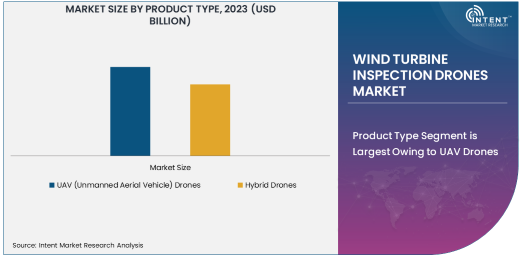
Product Type Segment is Largest Owing to UAV Drones
In the wind turbine inspection drones market, UAV (Unmanned Aerial Vehicle) drones remain the largest product type segment. UAV drones, commonly known as drones, are widely used for inspecting wind turbines due to their ability to easily access difficult-to-reach areas, such as turbine blades and towers, without the need for scaffolding or cranes. These drones can be equipped with various sensors and cameras, such as thermal imaging and high-resolution cameras, to detect issues like cracks, wear, or corrosion, which may not be visible to the naked eye. UAV drones are cost-effective, safe, and provide real-time data that can significantly reduce the time and cost associated with turbine inspections.
The widespread adoption of UAV drones in the wind energy sector is also driven by advancements in battery technology and flight time, which have made drones more efficient and capable of conducting longer inspection flights. Moreover, the ability to perform routine inspections remotely without human intervention is highly appealing to wind farm operators, making UAV drones the dominant product type in this market.
Drone Type Segment is Fastest Growing Owing to Rotary Wing Drones
Among the various drone types used in wind turbine inspections, rotary wing drones are the fastest-growing segment. These drones, often referred to as quadcopters or multirotors, are highly versatile and capable of hovering in place, allowing for precise inspections of wind turbine blades, towers, and other components. Rotary wing drones excel in close-range, detailed inspections, which are critical for identifying issues such as surface damage, wear, and corrosion on turbine blades. They are also adept at capturing high-definition video and images from different angles, providing comprehensive data for analysis.
The growth of rotary wing drones in this market is attributed to their affordability, ease of use, and flexibility compared to fixed-wing drones. They require less space to take off and land, which makes them ideal for the confined spaces often found in wind turbine inspection sites. As drone technology continues to evolve, the demand for rotary wing drones is expected to increase, further boosting the overall growth of this segment.
Technology Segment is Largest Owing to Visual & Thermal Imaging Drones
In the technology segment of the wind turbine inspection drones market, visual and thermal imaging drones are the largest sub-segment. These drones are equipped with specialized cameras that can capture high-resolution visual data as well as thermal images, enabling wind farm operators to detect heat anomalies and identify potential issues like electrical faults, overheating components, or structural problems. Thermal imaging is particularly useful for inspecting wind turbines, as it allows operators to identify problems that may not be visible in normal light conditions, such as overheating components or uneven temperature distribution.
The popularity of visual and thermal imaging drones can be attributed to their ability to provide comprehensive data for both preventive and predictive maintenance. Thermal cameras can detect hotspots or cooling system failures that may indicate impending malfunctions, allowing operators to address these issues proactively before they escalate into more significant problems. As the technology continues to improve, the use of visual and thermal imaging drones in wind turbine inspections is expected to grow significantly, making them the largest technology segment in this market.
End-Use Industry Segment is Fastest Growing Owing to Offshore Wind Farms
In the end-use industry segment, offshore wind farms represent the fastest-growing sub-segment in the wind turbine inspection drones market. Offshore wind farms are increasingly being developed due to their ability to harness higher and more consistent wind speeds compared to onshore locations. However, offshore turbines present unique challenges in terms of inspection and maintenance due to their remote locations and the difficulty in accessing the turbines. Drones equipped with advanced technologies such as thermal imaging, GPS, and LiDAR are becoming essential tools for inspecting these offshore turbines, as they can safely and efficiently perform inspections in harsh marine environments.
The growth of offshore wind farms is being driven by global initiatives to reduce carbon emissions and transition to cleaner sources of energy. As governments and private companies invest more in offshore wind projects, the demand for drones capable of inspecting these turbines will continue to rise. This trend is expected to propel the offshore wind farm sector as the fastest-growing end-use industry in the market.
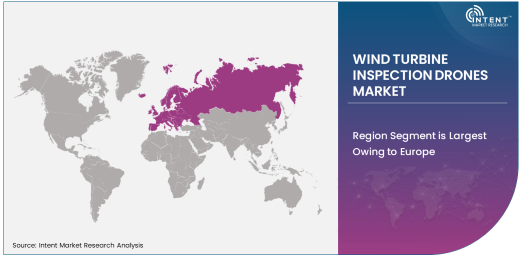
Region Segment is Largest Owing to Europe
Europe is the largest region in the wind turbine inspection drones market. The region has been a global leader in wind energy development, particularly in the offshore wind sector, with countries such as the United Kingdom, Germany, Denmark, and the Netherlands leading the way in terms of installed capacity and ongoing wind farm development. The European market has been at the forefront of adopting drone technology for wind turbine inspections, driven by the need for cost-effective, efficient, and safe solutions for maintaining turbines in both onshore and offshore locations.
The European Union's commitment to renewable energy, coupled with favorable regulations and incentives, has led to the rapid expansion of wind farms across the region. As a result, the demand for advanced inspection technologies, including drones, has surged. Europe’s strong renewable energy policies, coupled with its early adoption of drone technologies, make it the dominant region in the wind turbine inspection drones market.
Competitive Landscape and Leading Companies
The competitive landscape in the wind turbine inspection drones market is highly fragmented, with numerous players vying for market share through technological innovations and strategic partnerships. Leading companies in the market include SkySpecs, Cyberhawk Innovations, DJI Innovations, Kespry, and Aerialtronics. These companies are at the forefront of developing drone-based solutions for wind turbine inspections, offering advanced technologies like thermal imaging, LiDAR, and high-definition cameras.
The competition in the market is intensifying as companies focus on enhancing drone capabilities, such as longer flight times, improved image quality, and autonomous inspection features. In addition, partnerships between drone manufacturers and wind energy companies are becoming more common, with the goal of optimizing drone technologies specifically for wind turbine maintenance. As the market grows, leading players will continue to innovate and compete to meet the increasing demand for efficient, cost-effective, and reliable wind turbine inspection solutions
List of Leading Companies:
- SkySpecs
- Cyberhawk Innovations
- Kespry
- Aerialtronics
- DJI Innovations
- PrecisionHawk
- senseFly
- Delair
- DroneBase
- Vuzix Corporation
- Parrot SA
- Raptor Maps
- Quantum Systems
- Trimble Inc.
- Microdrones GmbH
Recent Developments:
- Cyberhawk Innovations has introduced a new high-performance drone designed for more efficient and precise inspections of offshore wind turbines, featuring enhanced thermal imaging and AI-powered data analysis.
- DJI Innovations has entered into partnerships with leading wind energy companies to deploy their advanced drone technology for large-scale wind farm inspections, aiming to reduce operational costs and improve safety.
- Microdrones has expanded its drone solutions for wind turbine inspections, integrating high-definition cameras and LiDAR technology to provide more accurate and detailed turbine health assessments for both onshore and offshore operations.
- PrecisionHawk announced the acquisition of a drone-based inspection firm specializing in wind turbine maintenance. The acquisition strengthens PrecisionHawk’s position in the renewable energy sector by enhancing its UAV inspection services.
- Aerialtronics has received regulatory approval to use its drones for comprehensive inspections of offshore wind farms in European waters, marking a significant milestone in the deployment of UAVs in the offshore wind sector
Report Scope:
|
Report Features |
Description |
|
Market Size (2023) |
USD 0.3 Billion |
|
Forecasted Value (2030) |
USD 0.6 Billion |
|
CAGR (2024 – 2030) |
10.0% |
|
Base Year for Estimation |
2023 |
|
Historic Year |
2022 |
|
Forecast Period |
2024 – 2030 |
|
Report Coverage |
Market Forecast, Market Dynamics, Competitive Landscape, Recent Developments |
|
Segments Covered |
Wind Turbine Inspection Drones Market By Product Type (UAV (Unmanned Aerial Vehicle) Drones, Hybrid Drones), By Drone Type (Fixed Wing Drones, Rotary Wing Drones), By Technology (LiDAR (Light Detection and Ranging) Drones, Visual & Thermal Imaging Drones, GPS-enabled Drones), By End-Use Industry (Power Generation, Utilities, Offshore Wind Farms, Onshore Wind Farms, Industrial Manufacturing) |
|
Regional Analysis |
North America (US, Canada, Mexico), Europe (Germany, France, UK, Italy, Spain, and Rest of Europe), Asia-Pacific (China, Japan, South Korea, Australia, India, and Rest of Asia-Pacific), Latin America (Brazil, Argentina, and Rest of Latin America), Middle East & Africa (Saudi Arabia, UAE, Rest of Middle East & Africa) |
|
Major Companies |
SkySpecs, Cyberhawk Innovations, Kespry, Aerialtronics, DJI Innovations, PrecisionHawk, senseFly, Delair, DroneBase, Vuzix Corporation, Parrot SA, Raptor Maps, Quantum Systems, Trimble Inc., Microdrones GmbH |
|
Customization Scope |
Customization for segments, region/country-level will be provided. Moreover, additional customization can be done based on the requirements |
|
1. Introduction |
|
1.1. Market Definition |
|
1.2. Scope of the Study |
|
1.3. Research Assumptions |
|
1.4. Study Limitations |
|
2. Research Methodology |
|
2.1. Research Approach |
|
2.1.1. Top-Down Method |
|
2.1.2. Bottom-Up Method |
|
2.1.3. Factor Impact Analysis |
|
2.2. Insights & Data Collection Process |
|
2.2.1. Secondary Research |
|
2.2.2. Primary Research |
|
2.3. Data Mining Process |
|
2.3.1. Data Analysis |
|
2.3.2. Data Validation and Revalidation |
|
2.3.3. Data Triangulation |
|
3. Executive Summary |
|
3.1. Major Markets & Segments |
|
3.2. Highest Growing Regions and Respective Countries |
|
3.3. Impact of Growth Drivers & Inhibitors |
|
3.4. Regulatory Overview by Country |
|
4. Wind Turbine Inspection Drones Market, by Product Type (Market Size & Forecast: USD Million, 2022 – 2030) |
|
4.1. UAV (Unmanned Aerial Vehicle) Drones |
|
4.2. Hybrid Drones |
|
5. Wind Turbine Inspection Drones Market, by Drone Type (Market Size & Forecast: USD Million, 2022 – 2030) |
|
5.1. Fixed Wing Drones |
|
5.2. Rotary Wing Drones |
|
6. Wind Turbine Inspection Drones Market, by Technology (Market Size & Forecast: USD Million, 2022 – 2030) |
|
6.1. LiDAR (Light Detection and Ranging) Drones |
|
6.2. Visual & Thermal Imaging Drones |
|
6.3. GPS-enabled Drones |
|
7. Wind Turbine Inspection Drones Market, by End-Use Industry (Market Size & Forecast: USD Million, 2022 – 2030) |
|
7.1. Power Generation |
|
7.2. Utilities |
|
7.3. Offshore Wind Farms |
|
7.4. Onshore Wind Farms |
|
7.5. Industrial Manufacturing |
|
8. Regional Analysis (Market Size & Forecast: USD Million, 2022 – 2030) |
|
8.1. Regional Overview |
|
8.2. North America |
|
8.2.1. Regional Trends & Growth Drivers |
|
8.2.2. Barriers & Challenges |
|
8.2.3. Opportunities |
|
8.2.4. Factor Impact Analysis |
|
8.2.5. Technology Trends |
|
8.2.6. North America Wind Turbine Inspection Drones Market, by Product Type |
|
8.2.7. North America Wind Turbine Inspection Drones Market, by Drone Type |
|
8.2.8. North America Wind Turbine Inspection Drones Market, by Technology |
|
8.2.9. North America Wind Turbine Inspection Drones Market, by End-Use Industry |
|
8.2.10. By Country |
|
8.2.10.1. US |
|
8.2.10.1.1. US Wind Turbine Inspection Drones Market, by Product Type |
|
8.2.10.1.2. US Wind Turbine Inspection Drones Market, by Drone Type |
|
8.2.10.1.3. US Wind Turbine Inspection Drones Market, by Technology |
|
8.2.10.1.4. US Wind Turbine Inspection Drones Market, by End-Use Industry |
|
8.2.10.2. Canada |
|
8.2.10.3. Mexico |
|
*Similar segmentation will be provided for each region and country |
|
8.3. Europe |
|
8.4. Asia-Pacific |
|
8.5. Latin America |
|
8.6. Middle East & Africa |
|
9. Competitive Landscape |
|
9.1. Overview of the Key Players |
|
9.2. Competitive Ecosystem |
|
9.2.1. Level of Fragmentation |
|
9.2.2. Market Consolidation |
|
9.2.3. Product Innovation |
|
9.3. Company Share Analysis |
|
9.4. Company Benchmarking Matrix |
|
9.4.1. Strategic Overview |
|
9.4.2. Product Innovations |
|
9.5. Start-up Ecosystem |
|
9.6. Strategic Competitive Insights/ Customer Imperatives |
|
9.7. ESG Matrix/ Sustainability Matrix |
|
9.8. Manufacturing Network |
|
9.8.1. Locations |
|
9.8.2. Supply Chain and Logistics |
|
9.8.3. Product Flexibility/Customization |
|
9.8.4. Digital Transformation and Connectivity |
|
9.8.5. Environmental and Regulatory Compliance |
|
9.9. Technology Readiness Level Matrix |
|
9.10. Technology Maturity Curve |
|
9.11. Buying Criteria |
|
10. Company Profiles |
|
10.1. SkySpecs |
|
10.1.1. Company Overview |
|
10.1.2. Company Financials |
|
10.1.3. Product/Service Portfolio |
|
10.1.4. Recent Developments |
|
10.1.5. IMR Analysis |
|
*Similar information will be provided for other companies |
|
10.2. Cyberhawk Innovations |
|
10.3. Kespry |
|
10.4. Aerialtronics |
|
10.5. DJI Innovations |
|
10.6. PrecisionHawk |
|
10.7. senseFly |
|
10.8. Delair |
|
10.9. DroneBase |
|
10.10. Vuzix Corporation |
|
10.11. Parrot SA |
|
10.12. Raptor Maps |
|
10.13. Quantum Systems |
|
10.14. Trimble Inc. |
|
10.15. Microdrones GmbH |
|
11. Appendix |
A comprehensive market research approach was employed to gather and analyze data on the Wind Turbine Inspection Drones Market. In the process, the analysis was also done to analyze the parent market and relevant adjacencies to measure the impact of them on the Wind Turbine Inspection Drones Market. The research methodology encompassed both secondary and primary research techniques, ensuring the accuracy and credibility of the findings.
.jpg)
Secondary Research
Secondary research involved a thorough review of pertinent industry reports, journals, articles, and publications. Additionally, annual reports, press releases, and investor presentations of industry players were scrutinized to gain insights into their market positioning and strategies.
Primary Research
Primary research involved conducting in-depth interviews with industry experts, stakeholders, and market participants across the E-Waste Management ecosystem. The primary research objectives included:
- Validating findings and assumptions derived from secondary research
- Gathering qualitative and quantitative data on market trends, drivers, and challenges
- Understanding the demand-side dynamics, encompassing end-users, component manufacturers, facility providers, and service providers
- Assessing the supply-side landscape, including technological advancements and recent developments
Market Size Assessment
A combination of top-down and bottom-up approaches was utilized to analyze the overall size of the Wind Turbine Inspection Drones Market. These methods were also employed to assess the size of various subsegments within the market. The market size assessment methodology encompassed the following steps:
- Identification of key industry players and relevant revenues through extensive secondary research
- Determination of the industry's supply chain and market size, in terms of value, through primary and secondary research processes
- Calculation of percentage shares, splits, and breakdowns using secondary sources and verification through primary sources
.jpg)
Data Triangulation
To ensure the accuracy and reliability of the market size, data triangulation was implemented. This involved cross-referencing data from various sources, including demand and supply side factors, market trends, and expert opinions. Additionally, top-down and bottom-up approaches were employed to validate the market size assessment.
NA