
As per Intent Market Research, the Weight Loss Services Market was valued at USD 10.2 billion in 2024-e and will surpass USD 20.4 billion by 2030; growing at a CAGR of 12.3% during 2025 - 2030.
The weight loss services market is expanding rapidly as an increasing number of people seek professional guidance and personalized programs to achieve their weight management goals. Driven by rising obesity rates and heightened awareness of the health risks associated with being overweight, individuals are turning to a variety of services designed to support effective weight loss and overall wellness. These services range from in-person counseling and fitness programs to online weight loss platforms and specialized clinics. As more people prioritize health and wellness, the demand for weight loss services continues to grow, fueled by the rise of both traditional and digital solutions.
In particular, with the growing shift toward a more sedentary lifestyle and unhealthy eating habits, the weight loss services market is focusing on providing tailored solutions to meet individual needs. With the advent of technology, online platforms are gaining traction by offering virtual consultations, personalized meal plans, and fitness regimens. At the same time, traditional services like weight loss clinics and fitness programs remain popular, offering in-person support and expertise. This multi-faceted approach to weight loss has led to diverse market growth, with a growing preference for comprehensive programs that address not only weight loss but overall health improvement.
Online Weight Loss Programs Segment is Fastest Growing Owing to Digital Transformation
The online weight loss programs segment is the fastest growing within the weight loss services market, primarily due to the increasing popularity of digital solutions for health and wellness. As consumers become more tech-savvy, they are turning to online platforms for personalized weight loss services that can be accessed conveniently from their homes. Online weight loss programs often offer features such as customized meal plans, fitness tracking, virtual consultations with nutritionists and fitness experts, and access to online communities for motivation and support. This flexibility makes it an attractive option for individuals with busy lifestyles or those who prefer privacy in their weight loss journey.
The growth of online weight loss programs is further driven by the increasing availability of smartphone apps, wearable devices, and health-tracking technologies, allowing users to monitor their progress and stay engaged with their goals. The COVID-19 pandemic accelerated the shift toward online weight loss solutions as individuals turned to digital platforms for remote support during lockdowns and restrictions. As the trend toward online health services continues, online weight loss programs are expected to maintain strong growth, offering consumers easy access to tailored services and support for sustainable weight management.
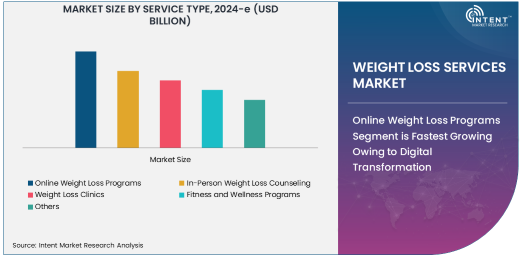
Weight Loss Clinics Segment is Largest Owing to Traditional Demand for Professional Services
The weight loss clinics segment is the largest in the weight loss services market, driven by the enduring demand for in-person, professional weight loss assistance. Many individuals still prefer face-to-face consultations with experts such as dietitians, nutritionists, and weight loss coaches to receive personalized, hands-on support. Weight loss clinics typically offer a range of services, including tailored diet plans, medical weight loss programs, behavioral counseling, and group support, making them an attractive option for people seeking more structured and medically supervised weight loss programs.
Additionally, weight loss clinics are equipped to handle more complex weight loss needs, including those related to obesity or underlying health conditions such as diabetes and hypertension. Clinics often provide access to healthcare professionals who can monitor patients' health throughout the weight loss process, ensuring safe and effective results. With the continued prevalence of obesity and an increasing number of individuals seeking medical assistance, the weight loss clinic segment is expected to remain the dominant contributor to the market for the foreseeable future.
Obesity Treatment Application is Largest Owing to Health Risks
The obesity treatment application is the largest within the weight loss services market, reflecting the growing health concerns associated with obesity. Obesity is a major risk factor for numerous chronic conditions, such as cardiovascular disease, diabetes, and certain cancers, leading to an increasing demand for specialized weight loss services aimed at treating and managing obesity. Weight loss services focused on obesity treatment typically involve a combination of medical supervision, dietary plans, physical activity regimens, and behavioral counseling, all of which are designed to support sustainable weight loss.
As awareness of the risks posed by obesity continues to rise, healthcare providers are increasingly addressing this condition through a variety of professional services. Additionally, many weight loss services are focusing on offering medical weight loss treatments and interventions such as bariatric counseling, prescription medications, and surgery. This growing emphasis on health and wellness, combined with the rising prevalence of obesity worldwide, positions obesity treatment as the leading application in the market, ensuring continued demand for specialized services.
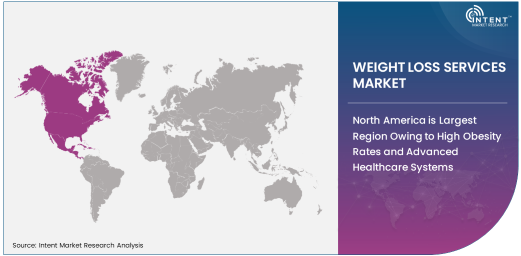
North America is Largest Region Owing to High Obesity Rates and Advanced Healthcare Systems
North America is the largest region in the weight loss services market, largely due to the high prevalence of obesity and a well-established healthcare infrastructure. The United States, in particular, faces one of the highest obesity rates globally, which has significantly boosted the demand for weight loss services. The availability of diverse weight loss programs, ranging from clinics and counseling to digital solutions, contributes to the region’s dominant position in the market. Additionally, the advanced healthcare systems in North America provide access to a wide variety of weight loss services, from medical treatments to fitness programs, catering to different consumer needs.
North American consumers also have high disposable incomes and a growing awareness of the importance of weight management for overall health, which further supports the demand for weight loss services. The presence of leading weight loss service providers, both traditional and online, in this region, ensures that North America will continue to lead the global market. As more individuals seek comprehensive, personalized, and medically supervised weight management solutions, the region is expected to maintain its leadership position.
Competitive Landscape
The weight loss services market is highly competitive, with both established companies and emerging players offering a wide range of solutions to meet the growing demand for weight management services. Key players include WW International (formerly Weight Watchers), Jenny Craig, Nutrisystem, and Medifast, all of which offer diverse programs that cater to different segments of the market, including in-person counseling, fitness programs, and online solutions. These companies have expanded their offerings to include digital platforms, app-based weight management tools, and virtual coaching to cater to the increasing demand for online services.
Additionally, a number of innovative startups are entering the market, offering new technologies, such as AI-driven meal planning, customized fitness routines, and virtual health consultations. With the growing trend of personalized and holistic weight loss programs, competition is intensifying as companies aim to provide more customized and effective solutions. Partnerships with fitness centers, healthcare providers, and e-commerce platforms are becoming more common, as businesses seek to expand their customer base and offer more integrated solutions to consumers. The competitive landscape will continue to evolve, with companies focusing on innovation, digital transformation, and customer engagement to maintain market leadership.
Recent Developments:
- Nutrisystem, Inc. launched a new virtual weight loss program, combining diet plans with fitness coaching for a more integrated approach to weight management.
- Jenny Craig announced an expansion into global markets, offering a new digital platform to support remote weight loss coaching and nutritional counseling.
- Medifast, Inc. introduced a partnership with major healthcare providers to incorporate its weight loss programs into chronic disease management plans.
- Herbalife Nutrition Ltd. rolled out a new line of supplements aimed at enhancing the effectiveness of weight loss services in combination with their meal plans.
- 24 Hour Fitness launched a weight loss-focused fitness program that includes personalized coaching and meal planning, aimed at individuals with specific weight loss goals.
List of Leading Companies:
- Weight Watchers International, Inc.
- Jenny Craig, Inc.
- Medifast, Inc.
- Nutrisystem, Inc.
- Slimming World
- Life Time Fitness, Inc.
- Optavia (Medifast)
- 24 Hour Fitness
- Health and Fitness Corporation (HFFC)
- Fitness First
- Snap Fitness
- LA Fitness
- Curves International
- Planet Fitness
- Herbalife Nutrition Ltd.
Report Scope:
|
Report Features |
Description |
|
Market Size (2024-e) |
USD 10.2 Billion |
|
Forecasted Value (2030) |
USD 20.4 Billion |
|
CAGR (2025 – 2030) |
12.3% |
|
Base Year for Estimation |
2024-e |
|
Historic Year |
2023 |
|
Forecast Period |
2025 – 2030 |
|
Report Coverage |
Market Forecast, Market Dynamics, Competitive Landscape, Recent Developments |
|
Segments Covered |
Global Weight Loss Services Market by Service Type (Online Weight Loss Programs, In-Person Weight Loss Counseling, Weight Loss Clinics, Fitness and Wellness Programs), by End-Use Industry (Healthcare Providers, Fitness Centers, Online Platforms, Retailers), by Application (Obesity Treatment, Weight Management, Chronic Disease Management, Lifestyle and Wellness) |
|
Regional Analysis |
North America (US, Canada, Mexico), Europe (Germany, France, UK, Italy, Spain, and Rest of Europe), Asia-Pacific (China, Japan, South Korea, Australia, India, and Rest of Asia-Pacific), Latin America (Brazil, Argentina, and Rest of Latin America), Middle East & Africa (Saudi Arabia, UAE, Rest of Middle East & Africa) |
|
Major Companies |
Weight Watchers International, Inc., Jenny Craig, Inc., Medifast, Inc., Nutrisystem, Inc., Slimming World, Life Time Fitness, Inc., 24 Hour Fitness, Health and Fitness Corporation (HFFC), Fitness First, Snap Fitness, LA Fitness, Curves International, Herbalife Nutrition Ltd. |
|
Customization Scope |
Customization for segments, region/country-level will be provided. Moreover, additional customization can be done based on the requirements |
|
1. Introduction |
|
1.1. Market Definition |
|
1.2. Scope of the Study |
|
1.3. Research Assumptions |
|
1.4. Study Limitations |
|
2. Research Methodology |
|
2.1. Research Approach |
|
2.1.1. Top-Down Method |
|
2.1.2. Bottom-Up Method |
|
2.1.3. Factor Impact Analysis |
|
2.2. Insights & Data Collection Process |
|
2.2.1. Secondary Research |
|
2.2.2. Primary Research |
|
2.3. Data Mining Process |
|
2.3.1. Data Analysis |
|
2.3.2. Data Validation and Revalidation |
|
2.3.3. Data Triangulation |
|
3. Executive Summary |
|
3.1. Major Markets & Segments |
|
3.2. Highest Growing Regions and Respective Countries |
|
3.3. Impact of Growth Drivers & Inhibitors |
|
3.4. Regulatory Overview by Country |
|
4. Weight Loss Services Market, by Service Type (Market Size & Forecast: USD Million, 2023 – 2030) |
|
4.1. Online Weight Loss Programs |
|
4.2. In-Person Weight Loss Counseling |
|
4.3. Weight Loss Clinics |
|
4.4. Fitness and Wellness Programs |
|
4.5. Others |
|
5. Weight Loss Services Market, by End-Use Industry (Market Size & Forecast: USD Million, 2023 – 2030) |
|
5.1. Healthcare Providers |
|
5.2. Fitness Centers |
|
5.3. Online Platforms |
|
5.4. Retailers |
|
6. Weight Loss Services Market, by Application (Market Size & Forecast: USD Million, 2023 – 2030) |
|
6.1. Obesity Treatment |
|
6.2. Weight Management |
|
6.3. Chronic Disease Management |
|
6.4. Lifestyle and Wellness |
|
6.5. Others |
|
7. Regional Analysis (Market Size & Forecast: USD Million, 2023 – 2030) |
|
7.1. Regional Overview |
|
7.2. North America |
|
7.2.1. Regional Trends & Growth Drivers |
|
7.2.2. Barriers & Challenges |
|
7.2.3. Opportunities |
|
7.2.4. Factor Impact Analysis |
|
7.2.5. Technology Trends |
|
7.2.6. North America Weight Loss Services Market, by Service Type |
|
7.2.7. North America Weight Loss Services Market, by End-Use Industry |
|
7.2.8. North America Weight Loss Services Market, by Application |
|
7.2.9. By Country |
|
7.2.9.1. US |
|
7.2.9.1.1. US Weight Loss Services Market, by Service Type |
|
7.2.9.1.2. US Weight Loss Services Market, by End-Use Industry |
|
7.2.9.1.3. US Weight Loss Services Market, by Application |
|
7.2.9.2. Canada |
|
7.2.9.3. Mexico |
|
*Similar segmentation will be provided for each region and country |
|
7.3. Europe |
|
7.4. Asia-Pacific |
|
7.5. Latin America |
|
7.6. Middle East & Africa |
|
8. Competitive Landscape |
|
8.1. Overview of the Key Players |
|
8.2. Competitive Ecosystem |
|
8.2.1. Level of Fragmentation |
|
8.2.2. Market Consolidation |
|
8.2.3. Product Innovation |
|
8.3. Company Share Analysis |
|
8.4. Company Benchmarking Matrix |
|
8.4.1. Strategic Overview |
|
8.4.2. Product Innovations |
|
8.5. Start-up Ecosystem |
|
8.6. Strategic Competitive Insights/ Customer Imperatives |
|
8.7. ESG Matrix/ Sustainability Matrix |
|
8.8. Manufacturing Network |
|
8.8.1. Locations |
|
8.8.2. Supply Chain and Logistics |
|
8.8.3. Product Flexibility/Customization |
|
8.8.4. Digital Transformation and Connectivity |
|
8.8.5. Environmental and Regulatory Compliance |
|
8.9. Technology Readiness Level Matrix |
|
8.10. Technology Maturity Curve |
|
8.11. Buying Criteria |
|
9. Company Profiles |
|
9.1. Weight Watchers International, Inc. |
|
9.1.1. Company Overview |
|
9.1.2. Company Financials |
|
9.1.3. Product/Service Portfolio |
|
9.1.4. Recent Developments |
|
9.1.5. IMR Analysis |
|
*Similar information will be provided for other companies |
|
9.2. Jenny Craig, Inc. |
|
9.3. Medifast, Inc. |
|
9.4. Nutrisystem, Inc. |
|
9.5. Slimming World |
|
9.6. Life Time Fitness, Inc. |
|
9.7. Optavia (Medifast) |
|
9.8. 24 Hour Fitness |
|
9.9. Health and Fitness Corporation (HFFC) |
|
9.10. Fitness First |
|
9.11. Snap Fitness |
|
9.12. LA Fitness |
|
9.13. Curves International |
|
9.14. Planet Fitness |
|
9.15. Herbalife Nutrition Ltd. |
|
10. Appendix |
A comprehensive market research approach was employed to gather and analyze data on the Weight Loss Services Market. In the process, the analysis was also done to analyze the parent market and relevant adjacencies to measure the impact of them on the Weight Loss Services Market. The research methodology encompassed both secondary and primary research techniques, ensuring the accuracy and credibility of the findings.
.jpg)
Secondary Research
Secondary research involved a thorough review of pertinent industry reports, journals, articles, and publications. Additionally, annual reports, press releases, and investor presentations of industry players were scrutinized to gain insights into their market positioning and strategies.
Primary Research
Primary research involved conducting in-depth interviews with industry experts, stakeholders, and market participants across the E-Waste Management ecosystem. The primary research objectives included:
- Validating findings and assumptions derived from secondary research
- Gathering qualitative and quantitative data on market trends, drivers, and challenges
- Understanding the demand-side dynamics, encompassing end-users, component manufacturers, facility providers, and service providers
- Assessing the supply-side landscape, including technological advancements and recent developments
Market Size Assessment
A combination of top-down and bottom-up approaches was utilized to analyze the overall size of the Weight Loss Services Market. These methods were also employed to assess the size of various subsegments within the market. The market size assessment methodology encompassed the following steps:
- Identification of key industry players and relevant revenues through extensive secondary research
- Determination of the industry's supply chain and market size, in terms of value, through primary and secondary research processes
- Calculation of percentage shares, splits, and breakdowns using secondary sources and verification through primary sources
.jpg)
Data Triangulation
To ensure the accuracy and reliability of the market size, data triangulation was implemented. This involved cross-referencing data from various sources, including demand and supply side factors, market trends, and expert opinions. Additionally, top-down and bottom-up approaches were employed to validate the market size assessment.
NA