
As per Intent Market Research, the UV Led Market was valued at USD 5.6 billion in 2024-e and will surpass USD 20.7 billion by 2030; growing at a CAGR of 20.7% during 2025 - 2030.
The UV LED market has witnessed significant growth in recent years due to the increasing demand for advanced lighting technologies in various applications. UV LEDs, being more energy-efficient, compact, and environmentally friendly than traditional UV lamps, are emerging as a game-changer in industries like healthcare, consumer electronics, water purification, and air sterilization. With their ability to provide targeted ultraviolet radiation without the need for harmful mercury or gases, UV LEDs are revolutionizing industries requiring disinfection, sterilization, and curing processes. This market is forecasted to continue expanding as demand for UV-C LEDs for disinfection and sterilization increases, particularly post-pandemic.
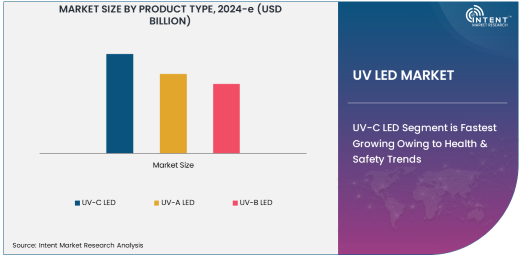
UV-C LED Segment is Fastest Growing Owing to Health & Safety Trends
The UV-C LED segment is experiencing the fastest growth within the UV LED market due to its unmatched potential in disinfection and sterilization applications. UV-C light is known for its ability to deactivate harmful microorganisms such as bacteria, viruses, and molds by breaking down their DNA, making it highly effective in healthcare, water treatment, and air purification systems. In particular, the COVID-19 pandemic has significantly boosted the adoption of UV-C LEDs as companies and industries seek to maintain cleaner environments and reduce the spread of infectious diseases. The growing focus on public health and hygiene, especially in hospitals, clinics, and food processing, is driving the demand for UV-C LEDs. Additionally, the development of more compact and efficient UV-C LEDs has opened up new opportunities in home and commercial air purification systems.
Water Purification Application is Largest Due to Growing Water Scarcity Issues
Among various applications, water purification remains the largest segment driving the demand for UV LEDs. The need for safe drinking water is becoming increasingly critical, particularly in regions facing water scarcity, contamination, or industrial pollution. UV-C LEDs offer an effective, chemical-free method of disinfecting water, ensuring it is free from pathogens. As water treatment plants, municipalities, and residential consumers seek more sustainable and cost-effective methods, UV-C LED technology has gained prominence due to its ability to sterilize water efficiently and with minimal maintenance. With the rising awareness of waterborne diseases and stricter regulations regarding water quality, UV-C LEDs are becoming a preferred choice for both small-scale and large-scale water purification applications.
Healthcare Industry is Largest End-User Owing to Growing Need for Sterilization Solutions
The healthcare industry is the largest end-user sector for UV LED technology. The increasing emphasis on sterilization and disinfection in healthcare settings, especially hospitals, medical clinics, and research laboratories, has propelled the demand for UV LEDs. UV-C LEDs, in particular, are widely used in disinfecting medical devices, sterilizing air, and water, and even in personal protective equipment (PPE) disinfection. With rising concerns about hospital-acquired infections (HAIs) and the ongoing battle against infectious diseases, healthcare providers are investing heavily in advanced disinfection technologies like UV LEDs. Moreover, the medical industry’s move toward more sustainable, chemical-free solutions in sterilization processes is further accelerating the adoption of UV LEDs.
Direct Sales Distribution Channel is Growing Due to Rising Demand for Customized Solutions
Among the distribution channels, direct sales are emerging as the fastest growing segment, particularly for UV LED products that require customized specifications. Direct sales allow manufacturers to offer tailored solutions to industries such as healthcare and industrial applications, where specific UV wavelength requirements and higher efficacy are critical. Customers are increasingly looking for products that cater to their unique needs, whether it’s in water treatment, air sterilization, or medical equipment disinfection. Manufacturers and vendors are increasingly focusing on building direct relationships with their customers to ensure that products meet industry-specific standards and regulations. This growing trend is particularly strong in sectors such as healthcare, where precision and compliance with regulatory standards are paramount.
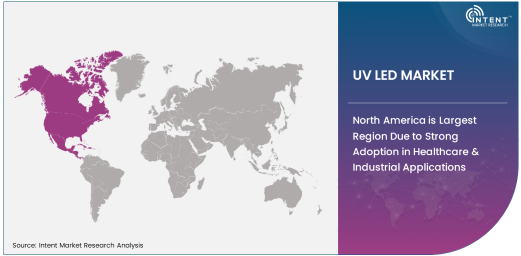
North America is Largest Region Due to Strong Adoption in Healthcare & Industrial Applications
North America is currently the largest region in the UV LED market, driven by the high adoption of UV-C LEDs in healthcare and industrial applications. The region’s strong healthcare infrastructure, combined with increasing awareness of environmental and public health issues, makes it an ideal market for UV-C technology. In particular, the US has seen a surge in demand for UV-C LEDs for air and surface sterilization within healthcare facilities, schools, and commercial spaces. Furthermore, the industrial sector in North America is increasingly adopting UV LED technology for various applications such as water purification and curing processes. The region’s advanced technological capabilities, regulatory frameworks, and high investment in research and development continue to fuel the growth of UV LED adoption.
Competitive Landscape and Leading Companies
The UV LED market is highly competitive with several key players leading the way in product development, technology advancements, and regional market share. Companies such as Philips Lighting, Seoul Semiconductor, Osram Licht AG, and Crystal IS dominate the market, offering a wide range of UV LED products. These companies are investing heavily in R&D to improve the efficiency, lifespan, and effectiveness of UV LEDs, particularly UV-C LEDs. They are also expanding their product portfolios to cater to growing demands across industries like healthcare, water purification, and consumer electronics. The competitive landscape is further intensified by new entrants and technology innovators, such as LG Innotek and Samsung Electronics, who are leveraging their extensive R&D capabilities to develop innovative UV LED solutions. Partnerships, collaborations, and acquisitions are expected to remain key strategies for companies aiming to expand their market presence and gain a competitive edge in this fast-evolving sector
Recent Developments:
- Philips Lighting recently launched an enhanced range of UV-C LED-based disinfection systems aimed at healthcare settings to combat airborne viruses.
- Seoul Semiconductor has secured a major deal to supply UV LED solutions for commercial air purification systems in North America.
- Osram Licht AG has expanded its product portfolio to include high-performance UV-A and UV-C LEDs tailored for consumer electronics and industrial applications.
- Samsung Electronics has developed a new generation of UV LEDs focused on medical sterilization applications, offering enhanced power output and longer lifespans.
- Crystal IS has announced a partnership with a major European water purification company to supply high-output UV-C LEDs for large-scale water treatment projects
List of Leading Companies:
- Philips Lighting
- Osram Licht AG
- Nichia Corporation
- LG Innotek
- Crystal IS (A part of Asahi Kasei Corporation)
- Seoul Semiconductor
- IQE plc
- Nikkiso Co., Ltd.
- Kyocera Corporation
- Samsung Electronics
- Everlight Electronics
- Sensor Electronic Technology, Inc. (SETi)
- Ushio Inc.
- Epistar Corporation
- HexaTech, Inc
Report Scope:
|
Report Features |
Description |
|
Market Size (2024-e) |
USD 5.6 Billion |
|
Forecasted Value (2030) |
USD 20.7 Billion |
|
CAGR (2025 – 2030) |
20.7% |
|
Base Year for Estimation |
2024-e |
|
Historic Year |
2023 |
|
Forecast Period |
2025 – 2030 |
|
Report Coverage |
Market Forecast, Market Dynamics, Competitive Landscape, Recent Developments |
|
Segments Covered |
UV LED Market By Product Type (UV-C LED, UV-A LED, UV-B LED), By Application (Water Purification, Air Purification, Surface Sterilization, Medical & Healthcare, Printing & Curing, Consumer Electronics), By End-User Industry (Healthcare, Industrial, Commercial, Residential, Consumer Electronics), and By Distribution Channel (Online Retail, Offline Retail, Direct Sales, Distributors) |
|
Regional Analysis |
North America (US, Canada, Mexico), Europe (Germany, France, UK, Italy, Spain, and Rest of Europe), Asia-Pacific (China, Japan, South Korea, Australia, India, and Rest of Asia-Pacific), Latin America (Brazil, Argentina, and Rest of Latin America), Middle East & Africa (Saudi Arabia, UAE, Rest of Middle East & Africa) |
|
Major Companies |
Philips Lighting, Osram Licht AG, Nichia Corporation, LG Innotek, Crystal IS (A part of Asahi Kasei Corporation), Seoul Semiconductor, IQE plc, Nikkiso Co., Ltd., Kyocera Corporation, Samsung Electronics, Everlight Electronics, Sensor Electronic Technology, Inc. (SETi), Ushio Inc., Epistar Corporation, HexaTech, Inc |
|
Customization Scope |
Customization for segments, region/country-level will be provided. Moreover, additional customization can be done based on the requirements |
|
1. Introduction |
|
1.1. Market Definition |
|
1.2. Scope of the Study |
|
1.3. Research Assumptions |
|
1.4. Study Limitations |
|
2. Research Methodology |
|
2.1. Research Approach |
|
2.1.1. Top-Down Method |
|
2.1.2. Bottom-Up Method |
|
2.1.3. Factor Impact Analysis |
|
2.2. Insights & Data Collection Process |
|
2.2.1. Secondary Research |
|
2.2.2. Primary Research |
|
2.3. Data Mining Process |
|
2.3.1. Data Analysis |
|
2.3.2. Data Validation and Revalidation |
|
2.3.3. Data Triangulation |
|
3. Executive Summary |
|
3.1. Major Markets & Segments |
|
3.2. Highest Growing Regions and Respective Countries |
|
3.3. Impact of Growth Drivers & Inhibitors |
|
3.4. Regulatory Overview by Country |
|
4. UV Led Market, by Product Type (Market Size & Forecast: USD Million, 2023 – 2030) |
|
4.1. UV-C LED |
|
4.2. UV-A LED |
|
4.3. UV-B LED |
|
5. UV Led Market, by Application (Market Size & Forecast: USD Million, 2023 – 2030) |
|
5.1. Water Purification |
|
5.2. Air Purification |
|
5.3. Surface Sterilization |
|
5.4. Medical & Healthcare |
|
5.5. Printing & Curing |
|
5.6. Consumer Electronics |
|
6. UV Led Market, by End-User Industry (Market Size & Forecast: USD Million, 2023 – 2030) |
|
6.1. Healthcare |
|
6.2. Industrial |
|
6.3. Commercial |
|
6.4. Residential |
|
6.5. Consumer Electronics |
|
7. UV Led Market, by Distribution Channel (Market Size & Forecast: USD Million, 2023 – 2030) |
|
7.1. Online Retail |
|
7.2. Offline Retail |
|
7.3. Direct Sales |
|
7.4. Distributors |
|
8. Regional Analysis (Market Size & Forecast: USD Million, 2023 – 2030) |
|
8.1. Regional Overview |
|
8.2. North America |
|
8.2.1. Regional Trends & Growth Drivers |
|
8.2.2. Barriers & Challenges |
|
8.2.3. Opportunities |
|
8.2.4. Factor Impact Analysis |
|
8.2.5. Technology Trends |
|
8.2.6. North America UV Led Market, by Product Type |
|
8.2.7. North America UV Led Market, by Application |
|
8.2.8. North America UV Led Market, by End-User Industry |
|
8.2.9. North America UV Led Market, by Distribution Channel |
|
8.2.10. By Country |
|
8.2.10.1. US |
|
8.2.10.1.1. US UV Led Market, by Product Type |
|
8.2.10.1.2. US UV Led Market, by Application |
|
8.2.10.1.3. US UV Led Market, by End-User Industry |
|
8.2.10.1.4. US UV Led Market, by Distribution Channel |
|
8.2.10.2. Canada |
|
8.2.10.3. Mexico |
|
*Similar segmentation will be provided for each region and country |
|
8.3. Europe |
|
8.4. Asia-Pacific |
|
8.5. Latin America |
|
8.6. Middle East & Africa |
|
9. Competitive Landscape |
|
9.1. Overview of the Key Players |
|
9.2. Competitive Ecosystem |
|
9.2.1. Level of Fragmentation |
|
9.2.2. Market Consolidation |
|
9.2.3. Product Innovation |
|
9.3. Company Share Analysis |
|
9.4. Company Benchmarking Matrix |
|
9.4.1. Strategic Overview |
|
9.4.2. Product Innovations |
|
9.5. Start-up Ecosystem |
|
9.6. Strategic Competitive Insights/ Customer Imperatives |
|
9.7. ESG Matrix/ Sustainability Matrix |
|
9.8. Manufacturing Network |
|
9.8.1. Locations |
|
9.8.2. Supply Chain and Logistics |
|
9.8.3. Product Flexibility/Customization |
|
9.8.4. Digital Transformation and Connectivity |
|
9.8.5. Environmental and Regulatory Compliance |
|
9.9. Technology Readiness Level Matrix |
|
9.10. Technology Maturity Curve |
|
9.11. Buying Criteria |
|
10. Company Profiles |
|
10.1. Philips Lighting |
|
10.1.1. Company Overview |
|
10.1.2. Company Financials |
|
10.1.3. Product/Service Portfolio |
|
10.1.4. Recent Developments |
|
10.1.5. IMR Analysis |
|
*Similar information will be provided for other companies |
|
10.2. Osram Licht AG |
|
10.3. Nichia Corporation |
|
10.4. LG Innotek |
|
10.5. Crystal IS (A part of Asahi Kasei Corporation) |
|
10.6. Seoul Semiconductor |
|
10.7. IQE plc |
|
10.8. Nikkiso Co., Ltd. |
|
10.9. Kyocera Corporation |
|
10.10. Samsung Electronics |
|
10.11. Everlight Electronics |
|
10.12. Sensor Electronic Technology, Inc. (SETi) |
|
10.13. Ushio Inc. |
|
10.14. Epistar Corporation |
|
10.15. HexaTech, Inc |
|
11. Appendix |
A comprehensive market research approach was employed to gather and analyze data on the UV LED Market. In the process, the analysis was also done to analyze the parent market and relevant adjacencies to measure the impact of them on the UV LED Market. The research methodology encompassed both secondary and primary research techniques, ensuring the accuracy and credibility of the findings.
.jpg)
Secondary Research
Secondary research involved a thorough review of pertinent industry reports, journals, articles, and publications. Additionally, annual reports, press releases, and investor presentations of industry players were scrutinized to gain insights into their market positioning and strategies.
Primary Research
Primary research involved conducting in-depth interviews with industry experts, stakeholders, and market participants across the E-Waste Management ecosystem. The primary research objectives included:
- Validating findings and assumptions derived from secondary research
- Gathering qualitative and quantitative data on market trends, drivers, and challenges
- Understanding the demand-side dynamics, encompassing end-users, component manufacturers, facility providers, and service providers
- Assessing the supply-side landscape, including technological advancements and recent developments
Market Size Assessment
A combination of top-down and bottom-up approaches was utilized to analyze the overall size of the UV LED Market. These methods were also employed to assess the size of various subsegments within the market. The market size assessment methodology encompassed the following steps:
- Identification of key industry players and relevant revenues through extensive secondary research
- Determination of the industry's supply chain and market size, in terms of value, through primary and secondary research processes
- Calculation of percentage shares, splits, and breakdowns using secondary sources and verification through primary sources
.jpg)
Data Triangulation
To ensure the accuracy and reliability of the market size, data triangulation was implemented. This involved cross-referencing data from various sources, including demand and supply side factors, market trends, and expert opinions. Additionally, top-down and bottom-up approaches were employed to validate the market size assessment.
NA