
As per Intent Market Research, the Utility Solar Tracker Market was valued at USD 7.4 Billion in 2024-e and will surpass USD 14.4 Billion by 2030; growing at a CAGR of 11.8% during 2025-2030.
The utility solar tracker market is experiencing significant growth as the demand for renewable energy solutions continues to rise globally. Solar trackers, which adjust the position of solar panels to follow the sun’s path, are key in improving the efficiency and output of solar power systems. These technologies are being increasingly integrated into utility-scale solar power plants, commercial installations, and industrial solar projects. As governments and corporations focus on reducing carbon emissions, the adoption of solar trackers is expected to grow across various regions, driven by advancements in technology and a shift towards cleaner energy.
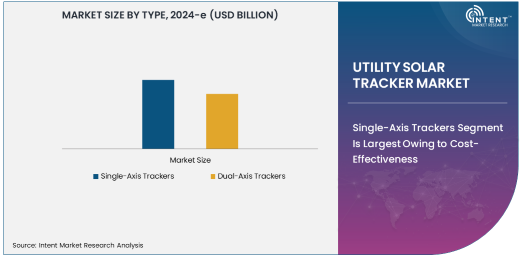
Single-Axis Trackers Segment Is Largest Owing to Cost-Effectiveness
Single-axis trackers dominate the utility solar tracker market due to their cost-effectiveness and the ability to significantly enhance energy generation efficiency. These trackers move along one axis to follow the sun’s movement throughout the day, optimizing the angle of solar panels and improving energy capture compared to fixed systems. As the most widely deployed tracker type, single-axis trackers are popular in large-scale solar farms where cost reduction is a critical factor. Their ability to increase energy yield while maintaining a relatively simple design makes them the go-to solution for many utility-scale solar projects.
The adoption of single-axis trackers continues to grow as their advantages in terms of performance, lower installation costs, and easier maintenance compared to more complex dual-axis systems make them the preferred choice for utilities and large-scale solar projects. As the global solar energy market expands, particularly in regions with high solar irradiance, the demand for single-axis trackers is expected to remain strong, contributing to the overall growth of the utility solar tracker market.
Photovoltaic Solar Trackers Are the Fastest Growing Segment Due to Widespread Use
Photovoltaic (PV) solar trackers have emerged as the fastest growing segment in the utility solar tracker market. PV trackers are integral to solar power plants that harness solar energy through photovoltaic cells, which convert sunlight directly into electricity. These trackers, primarily single-axis, are being deployed in increasing numbers due to their efficiency in optimizing solar panel performance. With the rising demand for solar energy, both in utility-scale power plants and commercial installations, the PV tracker segment is expected to see rapid growth, driven by technological advancements and cost reductions.
The growing popularity of photovoltaic solar trackers is also fueled by the decreasing costs of PV panels and the increasing efficiency of tracking technologies. As countries around the world invest in clean energy infrastructure, PV trackers are becoming a key part of solar power plants, with governments and private sector players looking for the most cost-effective and efficient solutions to meet energy demand. This trend is expected to continue, with PV trackers leading the charge in the growth of the solar tracker market.
Utility-Scale Solar Power Plants Are the Largest Application Segment
Utility-scale solar power plants represent the largest application segment in the utility solar tracker market. These large-scale plants benefit significantly from the use of solar trackers, as they help maximize the amount of solar energy captured throughout the day. By incorporating trackers, utility-scale projects can achieve higher energy outputs, which is crucial for meeting the growing demand for renewable energy. This is particularly beneficial in regions with high sunlight exposure, where solar power generation is a reliable and efficient energy source.
As the demand for clean energy increases globally, utility-scale solar power plants are seeing increased investment, especially in regions with favorable weather conditions and government incentives for renewable energy. The integration of solar trackers into these plants is a key factor driving the growth of this segment, with utility companies looking to optimize energy production and reduce costs in an increasingly competitive energy market.
Independent Power Producers (IPPs) Are the Fastest Growing End-User Segment
Independent Power Producers (IPPs) are the fastest growing end-user segment in the utility solar tracker market, driven by their increasing involvement in the development of utility-scale solar power plants. IPPs are private entities that build, operate, and maintain power plants and sell the generated electricity to the grid or directly to consumers. The rise of IPPs in the renewable energy sector is partially fueled by favorable government policies, renewable energy incentives, and the growing demand for clean energy sources. IPPs are increasingly turning to solar trackers to enhance the efficiency of their solar farms, reduce costs, and improve the economic viability of their projects.
The expansion of IPPs is a key driver for the growth of the utility solar tracker market, particularly in regions such as North America and Asia-Pacific, where many IPPs are focusing on large-scale solar projects to meet rising energy needs. As IPPs continue to dominate the global renewable energy landscape, their adoption of solar trackers will further accelerate market growth and innovation in tracking technology.
Asia-Pacific Is the Fastest Growing Region in the Utility Solar Tracker Market
Asia-Pacific is the fastest growing region in the utility solar tracker market, with countries like China, India, and Japan leading the charge in solar energy adoption. The region’s rapid urbanization, growing energy demands, and commitment to renewable energy goals have made it a hotspot for solar power development. China, in particular, is one of the largest producers of solar energy and has implemented several large-scale solar projects that integrate solar trackers to improve efficiency. India is also expanding its solar capacity, with the government setting ambitious targets for solar power generation.
The combination of strong government support, declining costs of solar panel technology, and an increasing focus on renewable energy sources makes Asia-Pacific a key market for utility solar trackers. As more utility-scale solar projects are developed across the region, the demand for efficient and cost-effective solar tracking systems will continue to grow.

Competitive Landscape and Leading Companies
The utility solar tracker market is competitive, with several prominent players driving innovation and growth. Leading companies in the sector include Array Technologies, NEXTracker, Soltec Energías Renovables, Arctech Solar, and GameChange Solar, among others. These companies are constantly working to enhance the performance and efficiency of solar trackers through technological advancements, strategic partnerships, and expansions into new markets. For instance, Array Technologies has been expanding its portfolio with integrated solar solutions, while NEXTracker continues to innovate with advanced single-axis and dual-axis tracking systems.
The competitive landscape is characterized by a mix of established players and new entrants, all seeking to capture a share of the growing demand for renewable energy solutions. As the market continues to expand, companies are focusing on improving product efficiency, reducing costs, and offering comprehensive solutions to meet the diverse needs of utility-scale solar power plants and commercial installations. Strategic mergers, acquisitions, and partnerships are expected to further shape the market dynamics, with companies striving to enhance their market presence and technological capabilities.
Recent Developments:
- Array Technologies expanded its product portfolio and global presence by acquiring STI Norland, enhancing its position in the solar tracker market.
- NEXTracker introduced an advanced dual-axis tracker to improve energy output for utility-scale solar projects.
- Soltec signed a strategic agreement with a solar energy developer to supply single-axis trackers for a 500 MW project in Europe.
- GameChange Solar increased its production capacity by establishing a new manufacturing facility in Asia, aiming to meet rising global demand.
- Arctech Solar announced a contract to supply trackers for a 300 MW solar power plant in the Middle East, strengthening its regional presence.
List of Leading Companies:
- Array Technologies, Inc.
- NEXTracker Inc.
- Soltec Energías Renovables S.L.
- Arctech Solar Holding Co., Ltd.
- SunPower Corporation
- First Solar, Inc.
- PV Hardware (PVH)
- GameChange Solar
- Ideematec GmbH
- AllEarth Renewables, Inc.
- STI Norland S.L.
- OMCO Solar
- Schletter Group
- Valmont Industries, Inc.
- Solar FlexRack
Report Scope:
|
Report Features |
Description |
|
Market Size (2024-e) |
USD 7.4 Billion |
|
Forecasted Value (2030) |
USD 14.4 Billion |
|
CAGR (2025 – 2030) |
11.8% |
|
Base Year for Estimation |
2024-e |
|
Historic Year |
2023 |
|
Forecast Period |
2025 – 2030 |
|
Report Coverage |
Market Forecast, Market Dynamics, Competitive Landscape, Recent Developments |
|
Segments Covered |
Utility Solar Tracker Market By Type (Single-Axis Trackers, Dual-Axis Trackers), By Technology (Photovoltaic Solar Trackers, Concentrated Solar Power Trackers), By Application (Utility-Scale Solar Power Plants, Commercial & Industrial Solar Installations), By End-User (Independent Power Producers, Utilities, Commercial Enterprises) |
|
Regional Analysis |
North America (US, Canada, Mexico), Europe (Germany, France, UK, Italy, Spain, and Rest of Europe), Asia-Pacific (China, Japan, South Korea, Australia, India, and Rest of Asia-Pacific), Latin America (Brazil, Argentina, and Rest of Latin America), Middle East & Africa (Saudi Arabia, UAE, Rest of Middle East & Africa) |
|
Major Companies |
Array Technologies, Inc., NEXTracker Inc., Soltec Energías Renovables S.L., Arctech Solar Holding Co., Ltd., SunPower Corporation, First Solar, Inc., PV Hardware (PVH), GameChange Solar, Ideematec GmbH, AllEarth Renewables, Inc., STI Norland S.L., OMCO Solar, Schletter Group, Valmont Industries, Inc., Solar FlexRack |
|
Customization Scope |
Customization for segments, region/country-level will be provided. Moreover, additional customization can be done based on the requirements |
|
1. Introduction |
|
1.1. Market Definition |
|
1.2. Scope of the Study |
|
1.3. Research Assumptions |
|
1.4. Study Limitations |
|
2. Research Methodology |
|
2.1. Research Approach |
|
2.1.1. Top-Down Method |
|
2.1.2. Bottom-Up Method |
|
2.1.3. Factor Impact Analysis |
|
2.2. Insights & Data Collection Process |
|
2.2.1. Secondary Research |
|
2.2.2. Primary Research |
|
2.3. Data Mining Process |
|
2.3.1. Data Analysis |
|
2.3.2. Data Validation and Revalidation |
|
2.3.3. Data Triangulation |
|
3. Executive Summary |
|
3.1. Major Markets & Segments |
|
3.2. Highest Growing Regions and Respective Countries |
|
3.3. Impact of Growth Drivers & Inhibitors |
|
3.4. Regulatory Overview by Country |
|
4. Utility Solar Tracker Market, by Type (Market Size & Forecast: USD Million, 2023 – 2030) |
|
4.1. Single-Axis Trackers |
|
4.2. Dual-Axis Trackers |
|
5. Utility Solar Tracker Market, by Technology (Market Size & Forecast: USD Million, 2023 – 2030) |
|
5.1. Photovoltaic (PV) Solar Trackers |
|
5.2. Concentrated Solar Power (CSP) Trackers |
|
6. Utility Solar Tracker Market, by Application (Market Size & Forecast: USD Million, 2023 – 2030) |
|
6.1. Utility-Scale Solar Power Plants |
|
6.2. Commercial & Industrial Solar Installations |
|
7. Utility Solar Tracker Market, by End-User (Market Size & Forecast: USD Million, 2023 – 2030) |
|
7.1. Independent Power Producers (IPPs) |
|
7.2. Utilities |
|
7.3. Commercial Enterprises |
|
8. Regional Analysis (Market Size & Forecast: USD Million, 2023 – 2030) |
|
8.1. Regional Overview |
|
8.2. North America |
|
8.2.1. Regional Trends & Growth Drivers |
|
8.2.2. Barriers & Challenges |
|
8.2.3. Opportunities |
|
8.2.4. Factor Impact Analysis |
|
8.2.5. Technology Trends |
|
8.2.6. North America Utility Solar Tracker Market, by Type |
|
8.2.7. North America Utility Solar Tracker Market, by Technology |
|
8.2.8. North America Utility Solar Tracker Market, by Application |
|
8.2.9. North America Utility Solar Tracker Market, by End-User |
|
8.2.10. By Country |
|
8.2.10.1. US |
|
8.2.10.1.1. US Utility Solar Tracker Market, by Type |
|
8.2.10.1.2. US Utility Solar Tracker Market, by Technology |
|
8.2.10.1.3. US Utility Solar Tracker Market, by Application |
|
8.2.10.1.4. US Utility Solar Tracker Market, by End-User |
|
8.2.10.2. Canada |
|
8.2.10.3. Mexico |
|
*Similar segmentation will be provided for each region and country |
|
8.3. Europe |
|
8.4. Asia-Pacific |
|
8.5. Latin America |
|
8.6. Middle East & Africa |
|
9. Competitive Landscape |
|
9.1. Overview of the Key Players |
|
9.2. Competitive Ecosystem |
|
9.2.1. Level of Fragmentation |
|
9.2.2. Market Consolidation |
|
9.2.3. Product Innovation |
|
9.3. Company Share Analysis |
|
9.4. Company Benchmarking Matrix |
|
9.4.1. Strategic Overview |
|
9.4.2. Product Innovations |
|
9.5. Start-up Ecosystem |
|
9.6. Strategic Competitive Insights/ Customer Imperatives |
|
9.7. ESG Matrix/ Sustainability Matrix |
|
9.8. Manufacturing Network |
|
9.8.1. Locations |
|
9.8.2. Supply Chain and Logistics |
|
9.8.3. Product Flexibility/Customization |
|
9.8.4. Digital Transformation and Connectivity |
|
9.8.5. Environmental and Regulatory Compliance |
|
9.9. Technology Readiness Level Matrix |
|
9.10. Technology Maturity Curve |
|
9.11. Buying Criteria |
|
10. Company Profiles |
|
10.1. Array Technologies, Inc. |
|
10.1.1. Company Overview |
|
10.1.2. Company Financials |
|
10.1.3. Product/Service Portfolio |
|
10.1.4. Recent Developments |
|
10.1.5. IMR Analysis |
|
*Similar information will be provided for other companies |
|
10.2. NEXTracker Inc. |
|
10.3. Soltec Energías Renovables S.L. |
|
10.4. Arctech Solar Holding Co., Ltd. |
|
10.5. SunPower Corporation |
|
10.6. First Solar, Inc. |
|
10.7. PV Hardware (PVH) |
|
10.8. GameChange Solar |
|
10.9. Ideematec GmbH |
|
10.10. AllEarth Renewables, Inc. |
|
10.11. STI Norland S.L. |
|
10.12. OMCO Solar |
|
10.13. Schletter Group |
|
10.14. Valmont Industries, Inc. |
|
10.15. Solar FlexRack |
|
11. Appendix |
A comprehensive market research approach was employed to gather and analyze data on the Utility Solar Tracker Market. In the process, the analysis was also done to analyze the parent market and relevant adjacencies to measure the impact of them on the Utility Solar Tracker Market. The research methodology encompassed both secondary and primary research techniques, ensuring the accuracy and credibility of the findings.
.jpg)
Secondary Research
Secondary research involved a thorough review of pertinent industry reports, journals, articles, and publications. Additionally, annual reports, press releases, and investor presentations of industry players were scrutinized to gain insights into their market positioning and strategies.
Primary Research
Primary research involved conducting in-depth interviews with industry experts, stakeholders, and market participants across the E-Waste Management ecosystem. The primary research objectives included:
- Validating findings and assumptions derived from secondary research
- Gathering qualitative and quantitative data on market trends, drivers, and challenges
- Understanding the demand-side dynamics, encompassing end-users, component manufacturers, facility providers, and service providers
- Assessing the supply-side landscape, including technological advancements and recent developments
Market Size Assessment
A combination of top-down and bottom-up approaches was utilized to analyze the overall size of the Utility Solar Tracker Market. These methods were also employed to assess the size of various subsegments within the market. The market size assessment methodology encompassed the following steps:
- Identification of key industry players and relevant revenues through extensive secondary research
- Determination of the industry's supply chain and market size, in terms of value, through primary and secondary research processes
- Calculation of percentage shares, splits, and breakdowns using secondary sources and verification through primary sources
.jpg)
Data Triangulation
To ensure the accuracy and reliability of the market size, data triangulation was implemented. This involved cross-referencing data from various sources, including demand and supply side factors, market trends, and expert opinions. Additionally, top-down and bottom-up approaches were employed to validate the market size assessment.
NA