
As per Intent Market Research, the Utility Scale Air Insulated Transformer Market was valued at USD 6.6 Billion in 2024-e and will surpass USD 13.6 Billion by 2030; growing at a CAGR of 12.7% during 2025-2030.
The utility-scale air-insulated transformer (AIS) market is witnessing significant growth as utilities and power generation companies seek reliable and efficient solutions for electrical power transmission and distribution. Air-insulated transformers are a critical component in high-voltage substations, playing a key role in stepping up or stepping down voltage levels to ensure the stable and safe delivery of electricity. These transformers are typically used in large-scale energy projects, such as power grids, renewable energy integration, and industrial applications.
The market is driven by the increasing demand for electricity worldwide, the growth of renewable energy sources, and the need for robust infrastructure to support efficient power transmission. Air-insulated transformers are preferred due to their cost-effectiveness, simple design, and low maintenance requirements compared to other types of transformers. The growing need for infrastructure upgrades, especially in emerging markets, further boosts their demand. Additionally, the transition to cleaner energy sources and the rise in utility-scale solar and wind energy projects are expected to fuel the expansion of the utility-scale air-insulated transformer market over the forecast period.
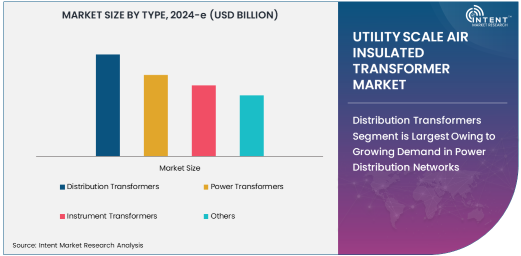
Distribution Transformers Segment is Largest Owing to Growing Demand in Power Distribution Networks
The distribution transformer segment is the largest within the utility-scale transformer market, driven by the increasing demand for electricity, especially in urban and semi-urban areas. Distribution transformers are responsible for stepping down high voltage electricity from power transmission lines to a level suitable for use in homes, businesses, and industries. Their widespread use in power distribution networks across residential, commercial, and industrial sectors makes them a crucial component in the energy supply chain.
As urbanization continues to accelerate, particularly in developing economies, the demand for distribution transformers is expected to remain robust. These transformers are essential for the efficient delivery of power to end-users and are integral to improving the reliability and stability of power systems. Additionally, the rise of smart grids and energy management systems further amplifies the need for high-quality distribution transformers that can support advanced functionalities and automation in power distribution.
High Voltage Segment is Fastest Growing Owing to Expanding Power Transmission Networks
The high voltage transformer segment is witnessing rapid growth due to the expansion of power transmission networks to meet the increasing demand for electricity in both urban and rural areas. High voltage transformers are designed to handle large power flows over long distances, reducing the losses that occur during transmission. This makes them vital for ensuring that electricity generated from power plants reaches urban and industrial centers efficiently.
Increased investments in infrastructure, especially in emerging economies, are driving the growth of high voltage transformers. Additionally, the ongoing development of renewable energy projects, such as wind and solar power plants, is creating a higher demand for high voltage transmission systems to integrate these power sources into the grid. As renewable energy capacity continues to expand, high voltage transformers will be essential to meet the growing electricity demand while maintaining system stability.
Power Transmission Application is Largest Owing to Expanding Grid Infrastructure
The power transmission application is the largest within the utility-scale transformer market, driven by the ever-expanding global power grid infrastructure. Transformers used in power transmission are critical for stepping up or stepping down voltage to ensure that electricity can be transferred efficiently over long distances without significant losses. This application is especially important for maintaining grid reliability and ensuring a steady power supply to industries, businesses, and households.
The increasing investment in power transmission infrastructure, particularly in developing countries, is fueling the demand for these transformers. Additionally, the integration of renewable energy sources into the grid necessitates robust and reliable power transmission systems to accommodate fluctuating energy inputs and ensure grid stability. This has further boosted the adoption of power transmission transformers, which will remain a vital component of the global energy infrastructure.
Power Generation Industry is Largest End-User Owing to the Need for Robust Power Systems
The power generation industry is the largest end-user of utility-scale transformers, as these systems are critical for the efficient and reliable generation of electricity. Power plants, including those based on fossil fuels, nuclear energy, and renewables, require transformers to step up voltage for transmission or step it down for distribution. The increasing global energy demand, coupled with the shift toward cleaner energy sources, ensures that the power generation sector remains a primary driver for transformer market growth.
The demand for power generation transformers is expected to continue to grow as the world transitions to a more sustainable energy mix. Renewable energy projects, such as wind, solar, and hydroelectric plants, require new transformer installations to integrate their power into the grid. As these projects expand globally, particularly in regions with high renewable energy potential, the power generation industry will continue to lead the demand for utility-scale transformers.
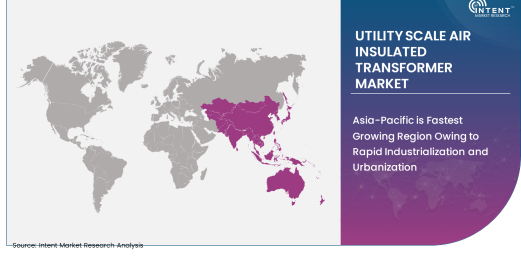
Asia-Pacific is Fastest Growing Region Owing to Rapid Industrialization and Urbanization
Asia-Pacific is the fastest-growing region in the utility-scale transformer market, driven by rapid industrialization, urbanization, and large-scale infrastructure development. Countries like China, India, and Southeast Asian nations are investing heavily in their electricity grid infrastructure to meet the demands of their growing populations and expanding economies. The need for reliable and efficient power systems to support industrial activities and urban growth is driving the demand for transformers across all voltage levels and applications.
In addition, Asia-Pacific is a major hub for renewable energy generation, with significant investments in wind, solar, and hydroelectric power. As these renewable energy projects grow, the demand for transformers to integrate this energy into the grid will also rise. The combination of infrastructure development, industrial growth, and renewable energy integration positions Asia-Pacific as a key region for the utility-scale transformer market in the coming years.
Leading Companies and Competitive Landscape
The utility-scale transformer market is highly competitive, with several key players dominating the global landscape. Companies such as Siemens AG, ABB, Schneider Electric, General Electric, and Mitsubishi Electric lead the market with their extensive product portfolios, advanced technologies, and strong global presence. These companies are focused on innovation, offering transformers with enhanced energy efficiency, smart grid compatibility, and improved environmental performance.
In addition to product innovation, mergers and acquisitions (M&A) are a common strategy employed by these companies to expand their market share and enhance their technological capabilities. Partnerships with utilities, power generation companies, and governments further strengthen their positions in the market. The competitive landscape is characterized by continuous efforts to improve manufacturing processes, reduce costs, and meet the increasing demand for sustainable energy solutions. As the market grows, leading companies will continue to focus on delivering high-performance transformers that support the evolving needs of the global energy infrastructure.
Recent Developments:
- Siemens launched a new series of air-insulated transformers designed for renewable energy integration, focusing on enhancing efficiency and reducing operational costs.
- GE secured a multi-million-dollar contract to supply air-insulated transformers for a new power transmission project in Asia, supporting grid expansion.
- Eaton has completed the acquisition of a leading transformer manufacturer, enhancing its presence in the global utility-scale transformer market.
- Toshiba has developed new high-voltage air-insulated transformers that improve energy efficiency by 10% compared to traditional models.
List of Leading Companies:
- Siemens AG
- ABB Ltd.
- Schneider Electric
- General Electric (GE)
- Mitsubishi Electric Corporation
- Eaton Corporation
- Toshiba Corporation
- Hyundai Electric & Energy Systems Co.
- CG Power and Industrial Solutions
- Bharat Heavy Electricals Ltd. (BHEL)
- Schneider Electric
- TBEA Co., Ltd.
- Alstom SA
- El Sewedy Electric
- Emerson Electric Co.
Report Scope:
|
Report Features |
Description |
|
Market Size (2024-e) |
USD 6.6 Billion |
|
Forecasted Value (2030) |
USD 13.6 Billion |
|
CAGR (2025 – 2030) |
12.7% |
|
Base Year for Estimation |
2024-e |
|
Historic Year |
2023 |
|
Forecast Period |
2025 – 2030 |
|
Report Coverage |
Market Forecast, Market Dynamics, Competitive Landscape, Recent Developments |
|
Segments Covered |
Utility Scale Air Insulated Transformer Market By Product Type (Distribution Transformers, Power Transformers, Instrument Transformers), By Voltage Level (Medium Voltage, High Voltage, Extra High Voltage, Ultra High Voltage), By Application (Power Transmission, Renewable Energy Integration, Industrial Power Distribution, Utilities, Commercial & Industrial Applications), By End-User Industry (Power Generation, Power Transmission & Distribution, Utilities, Industrial Manufacturing, Renewable Energy Producers) |
|
Regional Analysis |
North America (US, Canada, Mexico), Europe (Germany, France, UK, Italy, Spain, and Rest of Europe), Asia-Pacific (China, Japan, South Korea, Australia, India, and Rest of Asia-Pacific), Latin America (Brazil, Argentina, and Rest of Latin America), Middle East & Africa (Saudi Arabia, UAE, Rest of Middle East & Africa) |
|
Major Companies |
Siemens AG, ABB Ltd., Schneider Electric, General Electric (GE), Mitsubishi Electric Corporation, Eaton Corporation, Toshiba Corporation, Hyundai Electric & Energy Systems Co., CG Power and Industrial Solutions, Bharat Heavy Electricals Ltd. (BHEL), Schneider Electric, TBEA Co., Ltd., Alstom SA, El Sewedy Electric, Emerson Electric Co. |
|
Customization Scope |
Customization for segments, region/country-level will be provided. Moreover, additional customization can be done based on the requirements |
|
1. Introduction |
|
1.1. Market Definition |
|
1.2. Scope of the Study |
|
1.3. Research Assumptions |
|
1.4. Study Limitations |
|
2. Research Methodology |
|
2.1. Research Approach |
|
2.1.1. Top-Down Method |
|
2.1.2. Bottom-Up Method |
|
2.1.3. Factor Impact Analysis |
|
2.2. Insights & Data Collection Process |
|
2.2.1. Secondary Research |
|
2.2.2. Primary Research |
|
2.3. Data Mining Process |
|
2.3.1. Data Analysis |
|
2.3.2. Data Validation and Revalidation |
|
2.3.3. Data Triangulation |
|
3. Executive Summary |
|
3.1. Major Markets & Segments |
|
3.2. Highest Growing Regions and Respective Countries |
|
3.3. Impact of Growth Drivers & Inhibitors |
|
3.4. Regulatory Overview by Country |
|
4. Utility Scale Air Insulated Transformer Market, by Type (Market Size & Forecast: USD Million, 2023 – 2030) |
|
4.1. Distribution Transformers |
|
4.2. Power Transformers |
|
4.3. Instrument Transformers |
|
4.4. Others |
|
5. Utility Scale Air Insulated Transformer Market, by Voltage Level (Market Size & Forecast: USD Million, 2023 – 2030) |
|
5.1. Medium Voltage |
|
5.2. High Voltage |
|
5.3. Extra High Voltage |
|
5.4. Ultra High Voltage |
|
6. Utility Scale Air Insulated Transformer Market, by Application (Market Size & Forecast: USD Million, 2023 – 2030) |
|
6.1. Power Transmission |
|
6.2. Renewable Energy Integration |
|
6.3. Industrial Power Distribution |
|
6.4. Utilities |
|
6.5. Commercial & Industrial Applications |
|
7. Regional Analysis (Market Size & Forecast: USD Million, 2023 – 2030) |
|
7.1. Regional Overview |
|
7.2. North America |
|
7.2.1. Regional Trends & Growth Drivers |
|
7.2.2. Barriers & Challenges |
|
7.2.3. Opportunities |
|
7.2.4. Factor Impact Analysis |
|
7.2.5. Technology Trends |
|
7.2.6. North America Utility Scale Air Insulated Transformer Market, by Type |
|
7.2.7. North America Utility Scale Air Insulated Transformer Market, by Voltage Level |
|
7.2.8. North America Utility Scale Air Insulated Transformer Market, by Application |
|
7.2.9. By Country |
|
7.2.9.1. US |
|
7.2.9.1.1. US Utility Scale Air Insulated Transformer Market, by Type |
|
7.2.9.1.2. US Utility Scale Air Insulated Transformer Market, by Voltage Level |
|
7.2.9.1.3. US Utility Scale Air Insulated Transformer Market, by Application |
|
7.2.9.2. Canada |
|
7.2.9.3. Mexico |
|
*Similar segmentation will be provided for each region and country |
|
7.3. Europe |
|
7.4. Asia-Pacific |
|
7.5. Latin America |
|
7.6. Middle East & Africa |
|
8. Competitive Landscape |
|
8.1. Overview of the Key Players |
|
8.2. Competitive Ecosystem |
|
8.2.1. Level of Fragmentation |
|
8.2.2. Market Consolidation |
|
8.2.3. Product Innovation |
|
8.3. Company Share Analysis |
|
8.4. Company Benchmarking Matrix |
|
8.4.1. Strategic Overview |
|
8.4.2. Product Innovations |
|
8.5. Start-up Ecosystem |
|
8.6. Strategic Competitive Insights/ Customer Imperatives |
|
8.7. ESG Matrix/ Sustainability Matrix |
|
8.8. Manufacturing Network |
|
8.8.1. Locations |
|
8.8.2. Supply Chain and Logistics |
|
8.8.3. Product Flexibility/Customization |
|
8.8.4. Digital Transformation and Connectivity |
|
8.8.5. Environmental and Regulatory Compliance |
|
8.9. Technology Readiness Level Matrix |
|
8.10. Technology Maturity Curve |
|
8.11. Buying Criteria |
|
9. Company Profiles |
|
9.1. Siemens AG |
|
9.1.1. Company Overview |
|
9.1.2. Company Financials |
|
9.1.3. Product/Service Portfolio |
|
9.1.4. Recent Developments |
|
9.1.5. IMR Analysis |
|
*Similar information will be provided for other companies |
|
9.2. ABB Ltd. |
|
9.3. Schneider Electric |
|
9.4. General Electric (GE) |
|
9.5. Mitsubishi Electric Corporation |
|
9.6. Eaton Corporation |
|
9.7. Toshiba Corporation |
|
9.8. Hyundai Electric & Energy Systems Co. |
|
9.9. CG Power and Industrial Solutions |
|
9.10. Bharat Heavy Electricals Ltd. (BHEL) |
|
9.11. Schneider Electric |
|
9.12. TBEA Co., Ltd. |
|
9.13. Alstom SA |
|
9.14. El Sewedy Electric |
|
9.15. Emerson Electric Co. |
|
10. Appendix |
A comprehensive market research approach was employed to gather and analyze data on the Utility Scale Air Insulated Transformer Market. In the process, the analysis was also done to analyze the parent market and relevant adjacencies to measure the impact of them on the Utility Scale Air Insulated Transformer Market. The research methodology encompassed both secondary and primary research techniques, ensuring the accuracy and credibility of the findings.
.jpg)
Secondary Research
Secondary research involved a thorough review of pertinent industry reports, journals, articles, and publications. Additionally, annual reports, press releases, and investor presentations of industry players were scrutinized to gain insights into their market positioning and strategies.
Primary Research
Primary research involved conducting in-depth interviews with industry experts, stakeholders, and market participants across the E-Waste Management ecosystem. The primary research objectives included:
- Validating findings and assumptions derived from secondary research
- Gathering qualitative and quantitative data on market trends, drivers, and challenges
- Understanding the demand-side dynamics, encompassing end-users, component manufacturers, facility providers, and service providers
- Assessing the supply-side landscape, including technological advancements and recent developments
Market Size Assessment
A combination of top-down and bottom-up approaches was utilized to analyze the overall size of the Utility Scale Air Insulated Transformer Market. These methods were also employed to assess the size of various subsegments within the market. The market size assessment methodology encompassed the following steps:
- Identification of key industry players and relevant revenues through extensive secondary research
- Determination of the industry's supply chain and market size, in terms of value, through primary and secondary research processes
- Calculation of percentage shares, splits, and breakdowns using secondary sources and verification through primary sources
.jpg)
Data Triangulation
To ensure the accuracy and reliability of the market size, data triangulation was implemented. This involved cross-referencing data from various sources, including demand and supply side factors, market trends, and expert opinions. Additionally, top-down and bottom-up approaches were employed to validate the market size assessment.
NA