
As per Intent Market Research, the Underground High Voltage Cable Market was valued at USD 14.8 Billion in 2024-e and will surpass USD 21.2 Billion by 2030; growing at a CAGR of 6.2% during 2025-2030.
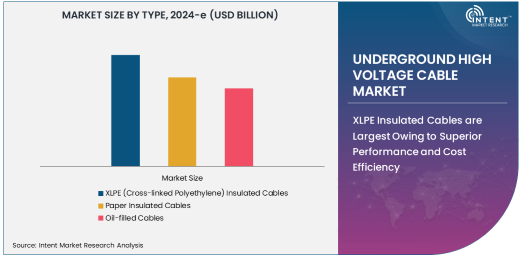
The underground high voltage cable market is seeing substantial growth across various segments, particularly with the increasing demand for reliable and efficient power transmission solutions. Among the different types of cables, XLPE (Cross-linked Polyethylene) Insulated Cables dominate the market due to their superior electrical properties, enhanced mechanical strength, and cost-efficiency. XLPE cables are known for their ability to withstand high temperatures and electrical stress, making them ideal for high voltage applications. This makes them the preferred choice for both new installations and upgrades, particularly in urban environments where space constraints make underground solutions more viable.
XLPE Insulated Cables are Largest Owing to Superior Performance and Cost Efficiency
XLPE cables are growing rapidly due to their versatile applications across multiple sectors, including power transmission, renewable energy, and industrial uses. Their increasing popularity is driven by the global push toward energy efficiency, the need to mitigate environmental risks associated with overhead power lines, and their ability to meet stringent regulatory requirements. The low maintenance costs and extended lifespan also contribute to the growing adoption of XLPE cables, positioning them as the largest sub-segment in the underground high voltage cable market.
220 kV to 400 kV Sub-Segment is Fastest Growing Due to Rising Power Demands
The voltage rating of underground high voltage cables is a critical aspect in determining their suitability for different applications. Among the various voltage ratings, the 220 kV to 400 kV sub-segment is the fastest growing, primarily driven by the expansion of power grids and increasing electricity demand. As nations across the globe invest heavily in infrastructure development, including renewable energy integration and smart grid systems, the demand for higher voltage cables has surged. These cables are crucial in efficiently transmitting electricity over long distances with minimal losses, making them essential for modern power transmission networks.
Power Transmission and Distribution is Largest Due to Infrastructure Modernization
The Power Transmission and Distribution (T&D) sector is the largest end-user industry for underground high voltage cables, driven by the ongoing expansion and modernization of power grids. As countries invest in infrastructure to meet the growing energy demand, the need for efficient and reliable power transmission systems has become critical. T&D networks require advanced solutions to transport electricity from power plants to end-users, and underground cables are increasingly seen as the most reliable and safe option, especially in densely populated urban areas.
With the rising focus on energy efficiency and the shift towards smart grids, underground high voltage cables are becoming a preferred choice in the T&D sector. These cables help in reducing transmission losses, enhancing grid stability, and offering better protection against extreme weather events, which is particularly important in regions prone to natural disasters. Additionally, the integration of renewable energy sources into existing power grids further boosts the demand for underground cables, solidifying the dominance of the T&D sector in the market.
New Installation is Largest Owing to Ongoing Infrastructure Projects
In the underground high voltage cable market, New Installation is the largest sub-segment, reflecting the ongoing global infrastructure investments. Governments and private entities across the world are focusing on upgrading their energy transmission systems, and new installation projects are central to this effort. These projects are driven by the need to expand grid coverage, integrate renewable energy sources, and meet the growing demand for electricity in urban and industrial areas. The expansion of underground cable networks for power transmission and distribution is expected to continue growing in the coming years as new infrastructure projects are initiated worldwide.
New installations account for a significant share of the market as they play a pivotal role in meeting the evolving energy needs of rapidly urbanizing regions. As cities expand and renewable energy projects come online, the demand for underground high voltage cables for new installations will continue to increase, driven by the requirement for more secure, efficient, and environmentally friendly energy transmission solutions. The growing investments in smart cities and modern energy infrastructure further reinforce the dominance of the new installation segment in the market.
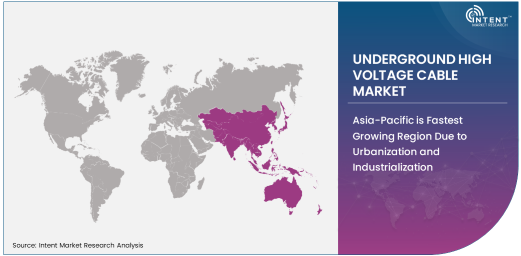
Asia-Pacific is Fastest Growing Region Due to Urbanization and Industrialization
The underground high voltage cable market is experiencing rapid growth across various regions, with Asia-Pacific being the fastest growing region. The region’s robust industrialization, rapid urbanization, and increasing demand for energy are major factors contributing to the growth of the high voltage cable market. Countries like China, India, and Japan are heavily investing in modernizing their power transmission networks to meet the demands of their growing populations and expanding industrial sectors. Additionally, Asia-Pacific's increasing focus on sustainable energy sources and grid modernization is driving the adoption of underground high voltage cables.
In particular, China and India are leading the charge in terms of demand for underground cables, driven by government initiatives to expand and upgrade energy infrastructure. The region's commitment to renewable energy integration and reducing the environmental impact of power transmission is expected to continue boosting the demand for underground high voltage cables. The rapid pace of urbanization and the need for secure and reliable energy transmission in densely populated cities further accelerate the market's growth in Asia-Pacific.
Competitive Landscape: Leading Companies and Strategic Developments
The underground high voltage cable market is highly competitive, with several leading companies vying for market share. Prysmian Group, Nexans, and General Cable (A Southwire Company) are among the prominent players in the market, known for their extensive product portfolios and global reach. These companies have made significant investments in R&D to develop advanced cable technologies that offer improved performance, higher efficiency, and better environmental sustainability. Strategic partnerships, mergers and acquisitions, and product innovations are key strategies employed by these companies to maintain their leadership positions.
The competitive landscape is also influenced by regional players who cater to specific market needs. Companies such as LS Cable & System and Furukawa Electric have strengthened their presence by focusing on the growing demand for underground high voltage cables in emerging markets like Asia-Pacific and Latin America. As the market continues to expand, companies are increasingly focusing on diversifying their product offerings, enhancing manufacturing capabilities, and strengthening their distribution networks to meet the rising demand for underground high voltage cables globally.
Recent Developments:
- Prysmian Group launched its new generation of submarine cables, designed for offshore wind farms, aiming to enhance the efficiency and capacity of renewable energy transmission.
- Nexans announced the acquisition of Cables & Solutions, expanding its offerings in the high-voltage cable and energy infrastructure sectors.
- General Cable (A Southwire Company) signed a strategic partnership with a leading renewable energy firm to provide high voltage cables for offshore wind projects.
- LS Cable & System secured a major contract to supply high voltage underground cables for a large-scale power transmission project in Southeast Asia.
- Furukawa Electric Co., Ltd. introduced an innovative cable system designed to reduce the environmental impact of underground power transmission, particularly in dense urban areas.
List of Leading Companies:
- Prysmian Group
- Nexans
- General Cable (A Southwire Company)
- Sumitomo Electric Industries
- LS Cable & System
- Southwire Company
- Hengtong Group
- Furukawa Electric Co., Ltd.
- Kabelwerk Eupen AG
- NKT Cables
- Helukabel
- ZTT International
- Shandong Luneng
- Jiangnan Group
- Fujikura Ltd.
Report Scope:
|
Report Features |
Description |
|
Market Size (2024-e) |
USD 14.8 Billion |
|
Forecasted Value (2030) |
USD 21.2 Billion |
|
CAGR (2025 – 2030) |
6.2% |
|
Base Year for Estimation |
2024-e |
|
Historic Year |
2023 |
|
Forecast Period |
2025 – 2030 |
|
Report Coverage |
Market Forecast, Market Dynamics, Competitive Landscape, Recent Developments |
|
Segments Covered |
Underground High Voltage Cable Market By Product Type (XLPE Insulated Cables, Paper Insulated Cables, Oil-filled Cables), By Voltage Rating (110 kV to 220 kV, 220 kV to 400 kV, Above 400 kV), By End-User Industry (Power Transmission and Distribution, Renewable Energy, Industrial Applications), By Installation (New Installation, Upgradation and Replacement) |
|
Regional Analysis |
North America (US, Canada, Mexico), Europe (Germany, France, UK, Italy, Spain, and Rest of Europe), Asia-Pacific (China, Japan, South Korea, Australia, India, and Rest of Asia-Pacific), Latin America (Brazil, Argentina, and Rest of Latin America), Middle East & Africa (Saudi Arabia, UAE, Rest of Middle East & Africa) |
|
Major Companies |
Prysmian Group, Nexans, General Cable (A Southwire Company), Sumitomo Electric Industries, LS Cable & System, Southwire Company, Hengtong Group, Furukawa Electric Co., Ltd., Kabelwerk Eupen AG, NKT Cables, Helukabel, ZTT International, Shandong Luneng, Jiangnan Group, Fujikura Ltd. |
|
Customization Scope |
Customization for segments, region/country-level will be provided. Moreover, additional customization can be done based on the requirements |
|
1. Introduction |
|
1.1. Market Definition |
|
1.2. Scope of the Study |
|
1.3. Research Assumptions |
|
1.4. Study Limitations |
|
2. Research Methodology |
|
2.1. Research Approach |
|
2.1.1. Top-Down Method |
|
2.1.2. Bottom-Up Method |
|
2.1.3. Factor Impact Analysis |
|
2.2. Insights & Data Collection Process |
|
2.2.1. Secondary Research |
|
2.2.2. Primary Research |
|
2.3. Data Mining Process |
|
2.3.1. Data Analysis |
|
2.3.2. Data Validation and Revalidation |
|
2.3.3. Data Triangulation |
|
3. Executive Summary |
|
3.1. Major Markets & Segments |
|
3.2. Highest Growing Regions and Respective Countries |
|
3.3. Impact of Growth Drivers & Inhibitors |
|
3.4. Regulatory Overview by Country |
|
4. Underground High Voltage Cable Market, by Type (Market Size & Forecast: USD Million, 2023 – 2030) |
|
4.1. XLPE (Cross-linked Polyethylene) Insulated Cables |
|
4.2. Paper Insulated Cables |
|
4.3. Oil-filled Cables |
|
5. Underground High Voltage Cable Market, by Voltage Rating (Market Size & Forecast: USD Million, 2023 – 2030) |
|
5.1. 110 kV to 220 kV |
|
5.2. 220 kV to 400 kV |
|
5.3. Above 400 kV |
|
6. Underground High Voltage Cable Market, by End-User Industry (Market Size & Forecast: USD Million, 2023 – 2030) |
|
6.1. Power Transmission and Distribution |
|
6.2. Renewable Energy |
|
6.3. Industrial Applications |
|
6.4. Others |
|
7. Underground High Voltage Cable Market, by Installation (Market Size & Forecast: USD Million, 2023 – 2030) |
|
7.1. New Installation |
|
7.2. Upgradation and Replacement |
|
8. Regional Analysis (Market Size & Forecast: USD Million, 2023 – 2030) |
|
8.1. Regional Overview |
|
8.2. North America |
|
8.2.1. Regional Trends & Growth Drivers |
|
8.2.2. Barriers & Challenges |
|
8.2.3. Opportunities |
|
8.2.4. Factor Impact Analysis |
|
8.2.5. Technology Trends |
|
8.2.6. North America Underground High Voltage Cable Market, by Type |
|
8.2.7. North America Underground High Voltage Cable Market, by Voltage Rating |
|
8.2.8. North America Underground High Voltage Cable Market, by End-User Industry |
|
8.2.9. North America Underground High Voltage Cable Market, by Installation |
|
8.2.10. By Country |
|
8.2.10.1. US |
|
8.2.10.1.1. US Underground High Voltage Cable Market, by Type |
|
8.2.10.1.2. US Underground High Voltage Cable Market, by Voltage Rating |
|
8.2.10.1.3. US Underground High Voltage Cable Market, by End-User Industry |
|
8.2.10.1.4. US Underground High Voltage Cable Market, by Installation |
|
8.2.10.2. Canada |
|
8.2.10.3. Mexico |
|
*Similar segmentation will be provided for each region and country |
|
8.3. Europe |
|
8.4. Asia-Pacific |
|
8.5. Latin America |
|
8.6. Middle East & Africa |
|
9. Competitive Landscape |
|
9.1. Overview of the Key Players |
|
9.2. Competitive Ecosystem |
|
9.2.1. Level of Fragmentation |
|
9.2.2. Market Consolidation |
|
9.2.3. Product Innovation |
|
9.3. Company Share Analysis |
|
9.4. Company Benchmarking Matrix |
|
9.4.1. Strategic Overview |
|
9.4.2. Product Innovations |
|
9.5. Start-up Ecosystem |
|
9.6. Strategic Competitive Insights/ Customer Imperatives |
|
9.7. ESG Matrix/ Sustainability Matrix |
|
9.8. Manufacturing Network |
|
9.8.1. Locations |
|
9.8.2. Supply Chain and Logistics |
|
9.8.3. Product Flexibility/Customization |
|
9.8.4. Digital Transformation and Connectivity |
|
9.8.5. Environmental and Regulatory Compliance |
|
9.9. Technology Readiness Level Matrix |
|
9.10. Technology Maturity Curve |
|
9.11. Buying Criteria |
|
10. Company Profiles |
|
10.1. Prysmian Group |
|
10.1.1. Company Overview |
|
10.1.2. Company Financials |
|
10.1.3. Product/Service Portfolio |
|
10.1.4. Recent Developments |
|
10.1.5. IMR Analysis |
|
*Similar information will be provided for other companies |
|
10.2. Nexans |
|
10.3. General Cable (A Southwire Company) |
|
10.4. Sumitomo Electric Industries |
|
10.5. LS Cable & System |
|
10.6. Southwire Company |
|
10.7. Hengtong Group |
|
10.8. Furukawa Electric Co., Ltd. |
|
10.9. Kabelwerk Eupen AG |
|
10.10. NKT Cables |
|
10.11. Helukabel |
|
10.12. ZTT International |
|
10.13. Shandong Luneng |
|
10.14. Jiangnan Group |
|
10.15. Fujikura Ltd. |
|
11. Appendix |
A comprehensive market research approach was employed to gather and analyze data on the Underground High Voltage Cable Market. In the process, the analysis was also done to analyze the parent market and relevant adjacencies to measure the impact of them on the Underground High Voltage Cable Market. The research methodology encompassed both secondary and primary research techniques, ensuring the accuracy and credibility of the findings.
.jpg)
Secondary Research
Secondary research involved a thorough review of pertinent industry reports, journals, articles, and publications. Additionally, annual reports, press releases, and investor presentations of industry players were scrutinized to gain insights into their market positioning and strategies.
Primary Research
Primary research involved conducting in-depth interviews with industry experts, stakeholders, and market participants across the E-Waste Management ecosystem. The primary research objectives included:
- Validating findings and assumptions derived from secondary research
- Gathering qualitative and quantitative data on market trends, drivers, and challenges
- Understanding the demand-side dynamics, encompassing end-users, component manufacturers, facility providers, and service providers
- Assessing the supply-side landscape, including technological advancements and recent developments
Market Size Assessment
A combination of top-down and bottom-up approaches was utilized to analyze the overall size of the Underground High Voltage Cable Market. These methods were also employed to assess the size of various subsegments within the market. The market size assessment methodology encompassed the following steps:
- Identification of key industry players and relevant revenues through extensive secondary research
- Determination of the industry's supply chain and market size, in terms of value, through primary and secondary research processes
- Calculation of percentage shares, splits, and breakdowns using secondary sources and verification through primary sources
.jpg)
Data Triangulation
To ensure the accuracy and reliability of the market size, data triangulation was implemented. This involved cross-referencing data from various sources, including demand and supply side factors, market trends, and expert opinions. Additionally, top-down and bottom-up approaches were employed to validate the market size assessment.
NA