
As per Intent Market Research, the Umbilical Market was valued at USD 1.8 Billion in 2024-e and will surpass USD 2.6 Billion by 2030; growing at a CAGR of 6.4% during 2025-2030.
The Umbilical Market is a critical segment within the subsea and offshore energy industry, supporting various applications such as offshore oil & gas production, subsea power distribution, and renewable energy projects. Umbilicals serve as essential components, providing power, control, and communication signals to subsea systems and equipment. As the demand for offshore energy and renewable resources grows, the umbilical market is poised for significant development. This market is segmented by product type, application, end-user industry, and geography, each with distinct trends and drivers.
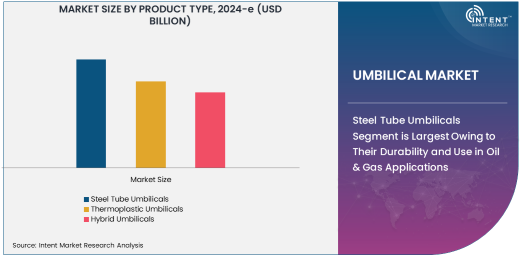
Steel Tube Umbilicals Segment is Largest Owing to Their Durability and Use in Oil & Gas Applications
Among the different product types, Steel Tube Umbilicals (STUs) dominate the market, primarily driven by their durability and reliability in harsh offshore environments. Steel tube umbilicals are robust and capable of withstanding high pressure, making them ideal for deepwater oil and gas exploration. The oil and gas industry, which requires extensive subsea installations, relies heavily on steel tube umbilicals to ensure consistent power and control transmission across long distances. These umbilicals are particularly favored in deepwater oil fields where the infrastructure demands superior strength and protection against environmental factors such as high pressure and extreme temperatures.
As deepwater and ultra-deepwater projects continue to expand, the demand for steel tube umbilicals is expected to remain robust. Additionally, advancements in material technology and manufacturing processes have further enhanced the performance of these umbilicals, improving efficiency and reducing downtime during maintenance. The market for steel tube umbilicals is projected to grow steadily, driven by the increasing number of offshore oil and gas fields that require reliable subsea power and control systems.
Offshore Oil & Gas Application is Largest Owing to High Demand for Subsea Production Systems
The offshore oil & gas application segment is the largest within the umbilical market, driven by the continuous expansion of offshore exploration and production activities. Offshore oil and gas fields, especially deepwater and ultra-deepwater fields, require umbilicals to deliver power, control, and communication to subsea systems, including subsea wells, manifolds, and processing units. As the oil and gas industry increasingly shifts toward deeper and more remote reserves, the need for efficient and reliable umbilicals to support subsea operations has surged. This is particularly true for regions like the North Sea, Gulf of Mexico, and offshore Brazil, where large-scale offshore operations are ongoing.
The future of the offshore oil & gas application segment looks promising, with continued investments in exploration and development activities, especially in deepwater and ultra-deepwater projects. As energy companies seek to unlock new reserves and enhance production capabilities, the demand for advanced umbilical systems will grow, further solidifying the dominance of this segment in the market.
Oil & Gas End-User Industry is Largest Owing to Its Dominant Role in Offshore Energy Production
The oil and gas industry represents the largest end-user segment for umbilicals, as the sector remains the primary driver of demand for subsea infrastructure. The increasing exploration and production activities in both shallow and deepwater offshore oil fields are fueling the growth of the umbilical market. As oil and gas companies continue to explore untapped reserves in more challenging environments, the requirement for high-performance umbilical systems that can operate reliably in deepwater and remote locations is essential. The oil and gas sector's focus on boosting production efficiency and reducing operational costs is leading to higher investments in subsea technologies, including umbilicals, to ensure the safe and continuous operation of offshore facilities.
The oil and gas industry's dominance is expected to continue, driven by the ongoing need for subsea production systems, enhanced oil recovery techniques, and infrastructure upgrades in mature fields. Additionally, the sector's increasing focus on automation and digitalization in offshore operations will further elevate the demand for advanced umbilical systems.
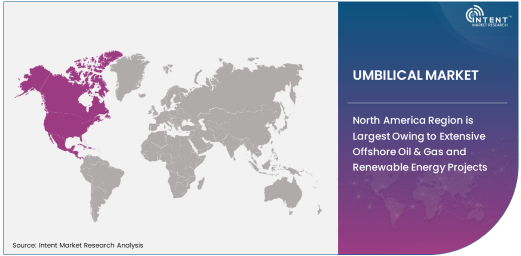
North America Region is Largest Owing to Extensive Offshore Oil & Gas and Renewable Energy Projects
The North American region is the largest market for umbilicals, driven by the substantial offshore oil and gas production activities in the Gulf of Mexico and the rising investments in renewable energy projects, particularly offshore wind farms. The United States remains one of the largest producers of oil and natural gas, with significant offshore reserves that require advanced subsea technologies, including umbilicals. Furthermore, the U.S. and Canada are expanding their renewable energy portfolios, particularly with offshore wind energy, which also requires subsea umbilicals for power distribution and control. As both sectors grow, the demand for reliable umbilical systems in North America is expected to remain strong.
Additionally, North America's robust regulatory environment and ongoing investments in infrastructure maintenance and upgrades are further driving the market for umbilicals. The region's focus on sustainability and energy transition initiatives, including the development of offshore renewable energy infrastructure, presents a significant opportunity for growth in the umbilical market.
Competitive Landscape: Leading Companies and Market Dynamics
The competitive landscape in the umbilical market is characterized by the presence of several global players, each focused on providing advanced subsea solutions for offshore oil and gas, renewable energy, and marine applications. Leading companies such as TechnipFMC, Aker Solutions, Nexans, and Subsea 7 dominate the market, leveraging their technological expertise and extensive project experience to supply high-quality umbilical systems. These companies have established strong relationships with major oil and gas operators, as well as renewable energy developers, positioning themselves as key players in the subsea infrastructure market.
The market is also witnessing increasing consolidation, with companies pursuing strategic mergers and acquisitions to expand their product portfolios and enhance their competitive positioning. Additionally, ongoing innovations in material science, such as the development of hybrid umbilicals and enhanced cable designs, are creating new growth opportunities and driving competition. As the demand for subsea technologies continues to rise, these companies are focusing on expanding their capabilities, enhancing operational efficiency, and delivering tailored solutions to meet the evolving needs of offshore energy projects.
Recent Developments:
- Aker Solutions launched new hybrid umbilical solutions designed to improve the efficiency and reliability of subsea oil and gas production systems.
- TechnipFMC announced the acquisition of a subsea cable manufacturer to expand its umbilical product offerings for offshore energy projects.
- Nexans secured a major contract to supply umbilical cables for a large-scale offshore wind farm development in Europe, strengthening its position in the renewable energy sector.
- Oceaneering International completed a strategic partnership with a leading subsea equipment provider to offer integrated umbilical and control systems for deepwater oil fields.
- Subsea 7 was awarded a significant contract for providing umbilical systems to a new offshore oil platform in the North Sea, reinforcing its market leadership.
List of Leading Companies:
- Aker Solutions
- TechnipFMC
- Nexans
- Oceaneering International, Inc.
- Subsea 7
- Cameron International
- JDR Cable Systems
- McDermott International, Inc.
- DeepOcean
- Prysmian Group
- Trelleborg AB
- Siemens Energy
- Flexlife
- FMC Technologies
- Aquilion
Report Scope:
|
Report Features |
Description |
|
Market Size (2024-e) |
USD 1.8 Billion |
|
Forecasted Value (2030) |
USD 2.6 Billion |
|
CAGR (2025 – 2030) |
6.4% |
|
Base Year for Estimation |
2024-e |
|
Historic Year |
2023 |
|
Forecast Period |
2025 – 2030 |
|
Report Coverage |
Market Forecast, Market Dynamics, Competitive Landscape, Recent Developments |
|
Segments Covered |
Umbilical Market By Product Type (Steel Tube Umbilicals, Thermoplastic Umbilicals, Hybrid Umbilicals), By Application (Offshore Oil & Gas, Subsea Power Distribution, Renewable Energy), By End-User Industry (Oil & Gas, Renewable Energy, Marine) |
|
Regional Analysis |
North America (US, Canada, Mexico), Europe (Germany, France, UK, Italy, Spain, and Rest of Europe), Asia-Pacific (China, Japan, South Korea, Australia, India, and Rest of Asia-Pacific), Latin America (Brazil, Argentina, and Rest of Latin America), Middle East & Africa (Saudi Arabia, UAE, Rest of Middle East & Africa) |
|
Major Companies |
Aker Solutions, TechnipFMC, Nexans, Oceaneering International, Inc., Subsea 7, Cameron International, JDR Cable Systems, McDermott International, Inc., DeepOcean, Prysmian Group, Trelleborg AB, Siemens Energy, Flexlife, FMC Technologies, Aquilion |
|
Customization Scope |
Customization for segments, region/country-level will be provided. Moreover, additional customization can be done based on the requirements |
|
1. Introduction |
|
1.1. Market Definition |
|
1.2. Scope of the Study |
|
1.3. Research Assumptions |
|
1.4. Study Limitations |
|
2. Research Methodology |
|
2.1. Research Approach |
|
2.1.1. Top-Down Method |
|
2.1.2. Bottom-Up Method |
|
2.1.3. Factor Impact Analysis |
|
2.2. Insights & Data Collection Process |
|
2.2.1. Secondary Research |
|
2.2.2. Primary Research |
|
2.3. Data Mining Process |
|
2.3.1. Data Analysis |
|
2.3.2. Data Validation and Revalidation |
|
2.3.3. Data Triangulation |
|
3. Executive Summary |
|
3.1. Major Markets & Segments |
|
3.2. Highest Growing Regions and Respective Countries |
|
3.3. Impact of Growth Drivers & Inhibitors |
|
3.4. Regulatory Overview by Country |
|
4. Umbilical Market, by Product Type (Market Size & Forecast: USD Million, 2023 – 2030) |
|
4.1. Steel Tube Umbilicals |
|
4.2. Thermoplastic Umbilicals |
|
4.3. Hybrid Umbilicals |
|
5. Umbilical Market, by Application (Market Size & Forecast: USD Million, 2023 – 2030) |
|
5.1. Offshore Oil & Gas |
|
5.2. Subsea Power Distribution |
|
5.3. Renewable Energy |
|
5.4. Others |
|
6. Umbilical Market, by End-User Industry (Market Size & Forecast: USD Million, 2023 – 2030) |
|
6.1. Oil & Gas |
|
6.2. Renewable Energy |
|
6.3. Marine |
|
6.4. Others |
|
7. Regional Analysis (Market Size & Forecast: USD Million, 2023 – 2030) |
|
7.1. Regional Overview |
|
7.2. North America |
|
7.2.1. Regional Trends & Growth Drivers |
|
7.2.2. Barriers & Challenges |
|
7.2.3. Opportunities |
|
7.2.4. Factor Impact Analysis |
|
7.2.5. Technology Trends |
|
7.2.6. North America Umbilical Market, by Product Type |
|
7.2.7. North America Umbilical Market, by Application |
|
7.2.8. North America Umbilical Market, by End-User Industry |
|
7.2.9. By Country |
|
7.2.9.1. US |
|
7.2.9.1.1. US Umbilical Market, by Product Type |
|
7.2.9.1.2. US Umbilical Market, by Application |
|
7.2.9.1.3. US Umbilical Market, by End-User Industry |
|
7.2.9.2. Canada |
|
7.2.9.3. Mexico |
|
*Similar segmentation will be provided for each region and country |
|
7.3. Europe |
|
7.4. Asia-Pacific |
|
7.5. Latin America |
|
7.6. Middle East & Africa |
|
8. Competitive Landscape |
|
8.1. Overview of the Key Players |
|
8.2. Competitive Ecosystem |
|
8.2.1. Level of Fragmentation |
|
8.2.2. Market Consolidation |
|
8.2.3. Product Innovation |
|
8.3. Company Share Analysis |
|
8.4. Company Benchmarking Matrix |
|
8.4.1. Strategic Overview |
|
8.4.2. Product Innovations |
|
8.5. Start-up Ecosystem |
|
8.6. Strategic Competitive Insights/ Customer Imperatives |
|
8.7. ESG Matrix/ Sustainability Matrix |
|
8.8. Manufacturing Network |
|
8.8.1. Locations |
|
8.8.2. Supply Chain and Logistics |
|
8.8.3. Product Flexibility/Customization |
|
8.8.4. Digital Transformation and Connectivity |
|
8.8.5. Environmental and Regulatory Compliance |
|
8.9. Technology Readiness Level Matrix |
|
8.10. Technology Maturity Curve |
|
8.11. Buying Criteria |
|
9. Company Profiles |
|
9.1. Aker Solutions |
|
9.1.1. Company Overview |
|
9.1.2. Company Financials |
|
9.1.3. Product/Service Portfolio |
|
9.1.4. Recent Developments |
|
9.1.5. IMR Analysis |
|
*Similar information will be provided for other companies |
|
9.2. TechnipFMC |
|
9.3. Nexans |
|
9.4. Oceaneering International, Inc. |
|
9.5. Subsea 7 |
|
9.6. Cameron International |
|
9.7. JDR Cable Systems |
|
9.8. McDermott International, Inc. |
|
9.9. DeepOcean |
|
9.10. Prysmian Group |
|
9.11. Trelleborg AB |
|
9.12. Siemens Energy |
|
9.13. Flexlife |
|
9.14. FMC Technologies |
|
9.15. Aquilion |
|
10. Appendix |
A comprehensive market research approach was employed to gather and analyze data on the Umbilical Market. In the process, the analysis was also done to analyze the parent market and relevant adjacencies to measure the impact of them on the Umbilical Market. The research methodology encompassed both secondary and primary research techniques, ensuring the accuracy and credibility of the findings.
.jpg)
Secondary Research
Secondary research involved a thorough review of pertinent industry reports, journals, articles, and publications. Additionally, annual reports, press releases, and investor presentations of industry players were scrutinized to gain insights into their market positioning and strategies.
Primary Research
Primary research involved conducting in-depth interviews with industry experts, stakeholders, and market participants across the E-Waste Management ecosystem. The primary research objectives included:
- Validating findings and assumptions derived from secondary research
- Gathering qualitative and quantitative data on market trends, drivers, and challenges
- Understanding the demand-side dynamics, encompassing end-users, component manufacturers, facility providers, and service providers
- Assessing the supply-side landscape, including technological advancements and recent developments
Market Size Assessment
A combination of top-down and bottom-up approaches was utilized to analyze the overall size of the Umbilical Market. These methods were also employed to assess the size of various subsegments within the market. The market size assessment methodology encompassed the following steps:
- Identification of key industry players and relevant revenues through extensive secondary research
- Determination of the industry's supply chain and market size, in terms of value, through primary and secondary research processes
- Calculation of percentage shares, splits, and breakdowns using secondary sources and verification through primary sources
.jpg)
Data Triangulation
To ensure the accuracy and reliability of the market size, data triangulation was implemented. This involved cross-referencing data from various sources, including demand and supply side factors, market trends, and expert opinions. Additionally, top-down and bottom-up approaches were employed to validate the market size assessment.
NA