
As per Intent Market Research, the Post Acute Care Market was valued at USD 730.6 billion in 2024-e and will surpass USD 1,143.5 billion by 2030; growing at a CAGR of 7.8% during 2025 - 2030.
The post-acute care (PAC) market is experiencing significant growth due to the increasing demand for care services after hospital discharge. This market encompasses a range of medical and rehabilitation services designed to support patients recovering from surgery, managing chronic diseases, or requiring long-term care. The rise in elderly populations, the growing prevalence of chronic illnesses, and advancements in healthcare technology are all driving the growth of this market. Post-acute care services are essential in reducing hospital readmissions and ensuring better patient outcomes through continuous support and specialized care. With the shift toward home-based care and integrated care models, the post-acute care landscape is evolving rapidly.
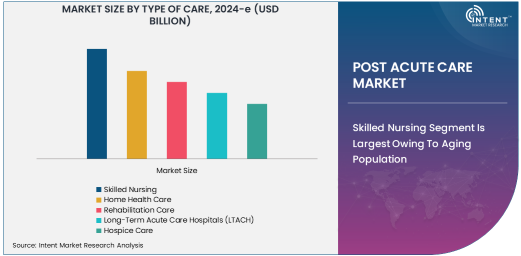
Skilled Nursing Segment Is Largest Owing To Aging Population
Among the various types of care, skilled nursing remains the largest segment in the post-acute care market. Skilled nursing services involve comprehensive medical care for patients who require ongoing monitoring and assistance after they are discharged from the hospital. This service is particularly important for elderly patients, who often face complex health issues requiring continuous attention and care. Skilled nursing facilities (SNFs) offer services such as wound care, physical therapy, medication management, and more. The aging global population, especially in developed regions, has driven the demand for skilled nursing care as a critical part of post-acute recovery.
As the need for skilled nursing services rises, many healthcare providers are focusing on improving the quality of care and expanding their skilled nursing facilities. These facilities provide a level of care and attention that ensures patients recover more effectively after acute medical events such as surgery or illness. The significant growth in the elderly population worldwide, particularly in North America and Europe, is a key factor in the continued dominance of this segment in the post-acute care market.
In-Home Care Segment Is Fastest Growing Owing To Technological Advancements
In-home care is the fastest-growing segment within post-acute care, driven by the increasing preference for receiving care at home instead of in institutional settings. Technological advancements, such as telemedicine, remote monitoring, and wearable health devices, are making it easier to deliver high-quality care outside of traditional healthcare settings. Home health care services provide patients with personalized care in the comfort of their own homes, reducing the need for hospital visits and enhancing recovery outcomes. These services are particularly beneficial for elderly individuals and patients managing chronic conditions who prefer a more familiar, comfortable environment for their recovery.
The growth of in-home care is also influenced by the rising healthcare costs associated with hospital stays, leading many patients to seek alternatives that are more affordable and equally effective. In addition, the COVID-19 pandemic accelerated the adoption of home healthcare services, as patients and providers sought ways to minimize exposure to the virus. The convenience, cost-effectiveness, and personalized care provided by in-home care services have made this segment the fastest-growing in the post-acute care market.
Post-Acute Rehabilitation Services Lead the Market By Service Type
Post-acute rehabilitation services are the leading services in the post-acute care market. Rehabilitation helps patients regain their physical and mental functionality after surgery, injury, or illness. These services include physical therapy, occupational therapy, and speech therapy, which are designed to help patients recover mobility, strength, and independence. As medical advancements have led to an increase in the number of surgeries and treatments, the demand for rehabilitation services has surged. Patients with conditions such as strokes, fractures, or neurological disorders benefit immensely from rehabilitation, making it a cornerstone of post-acute care.
The popularity of rehabilitation services is expected to continue growing due to the increased focus on improving patient mobility and quality of life after hospital discharge. Rehabilitation also plays a pivotal role in preventing hospital readmissions and providing long-term benefits for patients. The expansion of rehabilitation services within both home care and skilled nursing settings ensures that patients receive the comprehensive support they need throughout their recovery process.
Elderly Population Is the Primary End-User in Post-Acute Care
The elderly population is the primary end-user driving demand within the post-acute care market. As people age, they are more likely to experience chronic health conditions, disabilities, or other medical issues that require ongoing care and rehabilitation after hospitalization. The global increase in the aging population, especially in countries with a high proportion of elderly individuals, such as Japan, the United States, and Europe, is one of the major contributors to the demand for post-acute care services. Elderly patients often require specialized care, including skilled nursing, physical therapy, and rehabilitation services, as they recover from surgery, injury, or illness.
The growing elderly population is expected to fuel the market's expansion in the coming years. With an increase in life expectancy and advancements in medical care, more elderly people are living with chronic conditions, which necessitate long-term care. Healthcare providers are responding to this demand by expanding their post-acute care offerings, with a focus on personalized, high-quality care tailored to the unique needs of elderly patients.
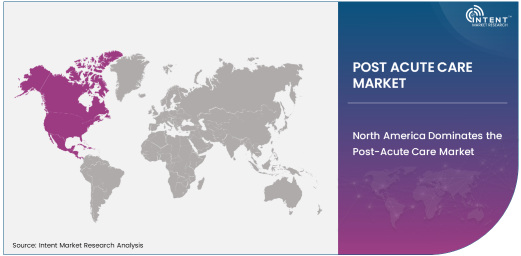
North America Dominates the Post-Acute Care Market
North America holds the largest market share in the post-acute care industry. The United States, in particular, is home to a large elderly population, and the demand for post-acute services is driven by both the aging demographic and the increasing prevalence of chronic diseases such as diabetes and heart disease. Additionally, the U.S. healthcare system is highly developed, with widespread access to skilled nursing facilities, home health care, and rehabilitation services. The increasing focus on reducing hospital readmissions and lowering healthcare costs has further fueled the adoption of post-acute care services in the region.
The region's dominance in the post-acute care market can also be attributed to its advanced healthcare infrastructure, widespread insurance coverage, and the presence of major healthcare providers. The implementation of value-based care models, which incentivize providers to improve patient outcomes, has also encouraged the growth of post-acute care services. As the elderly population in North America continues to grow, the demand for post-acute care will likely remain robust, ensuring that the region retains its leadership in the market.
Leading Companies and Competitive Landscape
The post-acute care market is highly competitive, with several leading companies offering a wide array of services across different care settings. Key players in the market include Amedisys Inc., LHC Group Inc., Kindred Healthcare, Brookdale Senior Living, and Genesis HealthCare. These companies are expanding their offerings through strategic acquisitions, partnerships, and technological advancements to cater to the growing demand for post-acute care services.
The market is characterized by a mix of large, established players and smaller, specialized providers. Major players are focusing on enhancing patient care through the integration of technology, including telemedicine, remote monitoring, and electronic health records (EHR). Smaller, niche companies are focusing on specific services, such as home health care or rehabilitation, offering personalized care to meet the evolving needs of patients. With an increasing emphasis on improving patient outcomes and reducing healthcare costs, the competitive landscape in the post-acute care market is expected to continue evolving.
Recent Developments:
- In 2024, Amedisys Inc. completed the acquisition of Visiting Angels to expand its home health services and address the growing demand for post-acute care.
- LHC Group introduced a new platform in 2023 for enhanced rehabilitation services that integrates with home health care to improve patient outcomes in post-acute care.
- Brookdale Senior Living expanded its hospice care offerings by opening new units across several states to meet rising demand for end-of-life care in 2023.
- Encompass Health entered a partnership with a health-tech company in 2024 to offer remote monitoring solutions for patients receiving post-acute care at home.
- Genesis HealthCare announced the opening of a new skilled nursing facility in late 2023 after receiving regulatory approval, expanding its footprint in the post-acute care sector.
List of Leading Companies:
- Amedisys Inc.
- LHC Group, Inc.
- Kindred Healthcare
- Amedisys Inc.
- Brookdale Senior Living Inc.
- Genesis HealthCare
- Encompass Health
- Addus HomeCare Corporation
- LifePoint Health
- Genesis Healthcare
- Comfort Keepers
- Visiting Angels
- Gentiva Health Services
- VITAS Healthcare
- Rotech Healthcare
Report Scope:
|
Report Features |
Description |
|
Market Size (2024-e) |
USD 730.6 billion |
|
Forecasted Value (2030) |
USD 1,143.5 billion |
|
CAGR (2025 – 2030) |
7.8% |
|
Base Year for Estimation |
2024-e |
|
Historic Year |
2023 |
|
Forecast Period |
2025 – 2030 |
|
Report Coverage |
Market Forecast, Market Dynamics, Competitive Landscape, Recent Developments |
|
Segments Covered |
Post Acute Care Market By Type of Care (Skilled Nursing, Home Health Care, Rehabilitation Care, Long-Term Acute Care Hospitals, Hospice Care), By Care Setting (In-Home Care, In-Hospital Care, Outpatient Care, Residential Care Facilities), By Services (Post-Acute Rehabilitation, Pain Management, Respiratory Therapy, Wound Care, Hospice & Palliative Care, Physical Therapy), By End-User (Elderly Population, Post-Surgery Patients, Chronic Disease Patients, Traumatic Injury Patients) |
|
Regional Analysis |
North America (US, Canada, Mexico), Europe (Germany, France, UK, Italy, Spain, and Rest of Europe), Asia-Pacific (China, Japan, South Korea, Australia, India, and Rest of Asia-Pacific), Latin America (Brazil, Argentina, and Rest of Latin America), Middle East & Africa (Saudi Arabia, UAE, Rest of Middle East & Africa) |
|
Major Companies |
Amedisys Inc., LHC Group, Inc., Kindred Healthcare, Amedisys Inc., Brookdale Senior Living Inc., Genesis HealthCare, Encompass Health, Addus HomeCare Corporation, LifePoint Health, Genesis Healthcare, Comfort Keepers, Visiting Angels, Gentiva Health Services, VITAS Healthcare, Rotech Healthcare |
|
Customization Scope |
Customization for segments, region/country-level will be provided. Moreover, additional customization can be done based on the requirements |
|
1. Introduction |
|
1.1. Market Definition |
|
1.2. Scope of the Study |
|
1.3. Research Assumptions |
|
1.4. Study Limitations |
|
2. Research Methodology |
|
2.1. Research Approach |
|
2.1.1. Top-Down Method |
|
2.1.2. Bottom-Up Method |
|
2.1.3. Factor Impact Analysis |
|
2.2. Insights & Data Collection Process |
|
2.2.1. Secondary Research |
|
2.2.2. Primary Research |
|
2.3. Data Mining Process |
|
2.3.1. Data Analysis |
|
2.3.2. Data Validation and Revalidation |
|
2.3.3. Data Triangulation |
|
3. Executive Summary |
|
3.1. Major Markets & Segments |
|
3.2. Highest Growing Regions and Respective Countries |
|
3.3. Impact of Growth Drivers & Inhibitors |
|
3.4. Regulatory Overview by Country |
|
4. Post Acute Care Market, by Type of Care (Market Size & Forecast: USD Million, 2022 – 2030) |
|
4.1. Skilled Nursing |
|
4.2. Home Health Care |
|
4.3. Rehabilitation Care |
|
4.4. Long-Term Acute Care Hospitals (LTACH) |
|
4.5. Hospice Care |
|
5. Post Acute Care Market, by Care Setting (Market Size & Forecast: USD Million, 2022 – 2030) |
|
5.1. In-Home Care |
|
5.2. In-Hospital Care |
|
5.3. Outpatient Care |
|
5.4. Residential Care Facilities |
|
6. Post Acute Care Market, by Services (Market Size & Forecast: USD Million, 2022 – 2030) |
|
6.1. Post-Acute Rehabilitation |
|
6.2. Pain Management |
|
6.3. Respiratory Therapy |
|
6.4. Wound Care |
|
6.5. Hospice & Palliative Care |
|
6.6. Physical Therapy |
|
7. Post Acute Care Market, by End-User (Market Size & Forecast: USD Million, 2022 – 2030) |
|
7.1. Elderly Population |
|
7.2. Post-Surgery Patients |
|
7.3. Chronic Disease Patients |
|
7.4. Traumatic Injury Patients |
|
7.5. Others |
|
8. Regional Analysis (Market Size & Forecast: USD Million, 2022 – 2030) |
|
8.1. Regional Overview |
|
8.2. North America |
|
8.2.1. Regional Trends & Growth Drivers |
|
8.2.2. Barriers & Challenges |
|
8.2.3. Opportunities |
|
8.2.4. Factor Impact Analysis |
|
8.2.5. Technology Trends |
|
8.2.6. North America Post Acute Care Market, by Type of Care |
|
8.2.7. North America Post Acute Care Market, by Care Setting |
|
8.2.8. North America Post Acute Care Market, by Services |
|
8.2.9. North America Post Acute Care Market, by End-User |
|
8.2.10. By Country |
|
8.2.10.1. US |
|
8.2.10.1.1. US Post Acute Care Market, by Type of Care |
|
8.2.10.1.2. US Post Acute Care Market, by Care Setting |
|
8.2.10.1.3. US Post Acute Care Market, by Services |
|
8.2.10.1.4. US Post Acute Care Market, by End-User |
|
8.2.10.2. Canada |
|
8.2.10.3. Mexico |
|
*Similar segmentation will be provided for each region and country |
|
8.3. Europe |
|
8.4. Asia-Pacific |
|
8.5. Latin America |
|
8.6. Middle East & Africa |
|
9. Competitive Landscape |
|
9.1. Overview of the Key Players |
|
9.2. Competitive Ecosystem |
|
9.2.1. Level of Fragmentation |
|
9.2.2. Market Consolidation |
|
9.2.3. Product Innovation |
|
9.3. Company Share Analysis |
|
9.4. Company Benchmarking Matrix |
|
9.4.1. Strategic Overview |
|
9.4.2. Product Innovations |
|
9.5. Start-up Ecosystem |
|
9.6. Strategic Competitive Insights/ Customer Imperatives |
|
9.7. ESG Matrix/ Sustainability Matrix |
|
9.8. Manufacturing Network |
|
9.8.1. Locations |
|
9.8.2. Supply Chain and Logistics |
|
9.8.3. Product Flexibility/Customization |
|
9.8.4. Digital Transformation and Connectivity |
|
9.8.5. Environmental and Regulatory Compliance |
|
9.9. Technology Readiness Level Matrix |
|
9.10. Technology Maturity Curve |
|
9.11. Buying Criteria |
|
10. Company Profiles |
|
10.1. Amedisys Inc. |
|
10.1.1. Company Overview |
|
10.1.2. Company Financials |
|
10.1.3. Product/Service Portfolio |
|
10.1.4. Recent Developments |
|
10.1.5. IMR Analysis |
|
*Similar information will be provided for other companies |
|
10.2. LHC Group, Inc. |
|
10.3. Kindred Healthcare |
|
10.4. Amedisys Inc. |
|
10.5. Brookdale Senior Living Inc. |
|
10.6. Genesis HealthCare |
|
10.7. Encompass Health |
|
10.8. Addus HomeCare Corporation |
|
10.9. LifePoint Health |
|
10.10. Genesis Healthcare |
|
10.11. Comfort Keepers |
|
10.12. Visiting Angels |
|
10.13. Gentiva Health Services |
|
10.14. VITAS Healthcare |
|
10.15. Rotech Healthcare |
|
11. Appendix |
A comprehensive market research approach was employed to gather and analyze data on the Post Acute Care Market. In the process, the analysis was also done to analyze the parent market and relevant adjacencies to measure the impact of them on the Post Acute Care Market. The research methodology encompassed both secondary and primary research techniques, ensuring the accuracy and credibility of the findings.
.jpg)
Secondary Research
Secondary research involved a thorough review of pertinent industry reports, journals, articles, and publications. Additionally, annual reports, press releases, and investor presentations of industry players were scrutinized to gain insights into their market positioning and strategies.
Primary Research
Primary research involved conducting in-depth interviews with industry experts, stakeholders, and market participants across the E-Waste Management ecosystem. The primary research objectives included:
- Validating findings and assumptions derived from secondary research
- Gathering qualitative and quantitative data on market trends, drivers, and challenges
- Understanding the demand-side dynamics, encompassing end-users, component manufacturers, facility providers, and service providers
- Assessing the supply-side landscape, including technological advancements and recent developments
Market Size Assessment
A combination of top-down and bottom-up approaches was utilized to analyze the overall size of the Post Acute Care Market. These methods were also employed to assess the size of various subsegments within the market. The market size assessment methodology encompassed the following steps:
- Identification of key industry players and relevant revenues through extensive secondary research
- Determination of the industry's supply chain and market size, in terms of value, through primary and secondary research processes
- Calculation of percentage shares, splits, and breakdowns using secondary sources and verification through primary sources
.jpg)
Data Triangulation
To ensure the accuracy and reliability of the market size, data triangulation was implemented. This involved cross-referencing data from various sources, including demand and supply side factors, market trends, and expert opinions. Additionally, top-down and bottom-up approaches were employed to validate the market size assessment.
NA