
As per Intent Market Research, the Phosphor Screen Scanner Market was valued at USD 2.3 Billion in 2024-e and will surpass USD 3.6 Billion by 2030; growing at a CAGR of 7.8% during 2025-2030.
The phosphor screen scanner market is gaining traction, driven by increasing demand across healthcare, industrial applications, and security sectors. Phosphor screen scanners, used primarily in radiography and imaging applications, play a crucial role in capturing and converting images from X-ray scans onto phosphor plates for further processing. The healthcare industry, particularly medical imaging, is the largest contributor to the market, as these scanners are integral in diagnostic imaging systems. The market is poised for growth due to advancements in radiographic technologies and increasing applications in non-medical fields.
The rise of industrial applications, such as non-destructive testing (NDT), and the growing need for security and surveillance systems are further propelling the adoption of phosphor screen scanners. As industries focus on improving safety protocols and diagnostic capabilities, the need for high-quality imaging solutions like phosphor screen scanners is set to increase. The technology segment, particularly with the shift from traditional radiography to more advanced methods, is expected to play a significant role in shaping the market landscape.
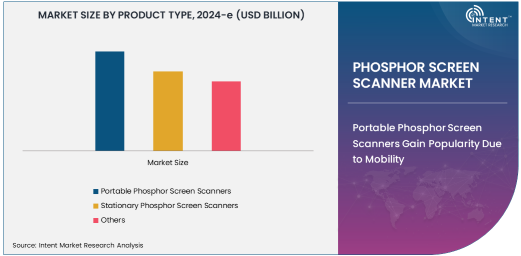
Portable Phosphor Screen Scanners Gain Popularity Due to Mobility
Portable phosphor screen scanners are the fastest-growing product type segment in the market, driven by the increasing need for mobility in medical imaging and industrial applications. These portable units offer flexibility and ease of use, allowing healthcare professionals and industrial technicians to perform imaging procedures outside of conventional settings. In medical applications, portable scanners enable remote diagnostics in emergency and rural healthcare environments, making them indispensable for healthcare providers who require on-the-go imaging capabilities.
The advantages of portability in terms of ease of transport, user-friendly design, and efficient workflow are contributing to the growth of this segment. As portable technology becomes more advanced, with features such as wireless connectivity and integration with cloud-based platforms, the demand for portable phosphor screen scanners is expected to continue rising, particularly in the medical imaging and field inspection markets. Their increasing adoption in remote areas and the need for rapid diagnostic results are key drivers of this growth.
Healthcare Industry Dominates End-User Demand for Phosphor Screen Scanners
The healthcare industry is the largest end-user of phosphor screen scanners, owing to the widespread application of these devices in medical imaging. In medical settings, phosphor screen scanners are commonly used in computed radiography (CR) systems to capture high-quality radiographic images. They serve as a vital tool in diagnostics, especially in detecting fractures, tumors, and other abnormalities within the body. As healthcare providers aim to enhance diagnostic accuracy and improve patient outcomes, the demand for phosphor screen scanners is expected to remain strong.
In addition to conventional hospitals and imaging centers, the increasing adoption of phosphor screen scanners in specialized diagnostic units, such as dental and veterinary imaging, is expanding the scope of this market. As advancements in medical imaging technologies improve the efficiency and precision of healthcare diagnoses, the healthcare industry’s demand for phosphor screen scanners will continue to drive the market’s expansion. The ongoing trend toward digitalization and the shift towards more accessible and advanced imaging solutions further reinforce the growth of this segment.
Computed Radiography (CR) Technology Drives Market Growth
Computed Radiography (CR) is the largest technology segment in the phosphor screen scanner market due to its widespread adoption in medical imaging and industrial testing. CR systems use phosphor screens to capture X-ray images and convert them into digital formats for further analysis, providing a highly efficient and cost-effective solution for image capturing. This technology has revolutionized the way radiographs are captured and processed, offering significant improvements over traditional film-based methods. The transition to digital imaging, which is more efficient and environmentally friendly, is fueling the growth of CR systems in both healthcare and industrial applications.
In healthcare, CR technology is particularly prevalent in smaller clinics and outpatient settings due to its lower initial cost and flexibility compared to newer digital radiography (DR) systems. The ability to easily store and share images digitally also aligns with the growing emphasis on electronic health records (EHR) in the healthcare sector. As the healthcare industry continues to embrace digital transformation and seek more cost-effective diagnostic tools, CR systems' ability to meet these needs ensures its dominance in the phosphor screen scanner market.
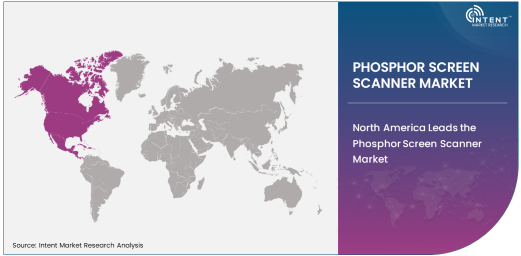
North America Leads the Phosphor Screen Scanner Market
North America is the largest market for phosphor screen scanners, with the healthcare industry in the region being a major driver of demand. The United States, in particular, is home to some of the world’s leading healthcare facilities, including hospitals, diagnostic imaging centers, and research institutions, all of which heavily rely on phosphor screen scanners for radiographic imaging. Additionally, advancements in healthcare technology, including the adoption of digital imaging solutions, continue to fuel the demand for these scanners in North America.
The region also benefits from the robust infrastructure in industries such as security and non-destructive testing (NDT), where phosphor screen scanners are used for inspection and surveillance purposes. As North America continues to invest in healthcare and industrial innovations, the demand for advanced imaging solutions, including phosphor screen scanners, will continue to grow. The region’s focus on improving healthcare accessibility, along with increasing investments in technology-driven solutions, positions it as the leading market for phosphor screen scanners.
Competitive Landscape: Innovation and Technology Integration Drive Growth
The phosphor screen scanner market is highly competitive, with several key players leading the way in terms of innovation and market share. Companies like Fujifilm, Agfa-Gevaert, and Carestream Health are prominent in the development of advanced imaging systems, including phosphor screen scanners, with a focus on integrating new technologies such as wireless connectivity and cloud-based platforms. These advancements are designed to enhance the efficiency, ease of use, and accessibility of imaging systems.
To maintain their competitive edge, industry leaders are also investing in product diversification and partnerships with healthcare providers, industrial companies, and security firms. As demand for these scanners continues to rise, particularly in emerging markets, companies are focusing on offering solutions that are not only cost-effective but also provide high-quality imaging with faster processing times. The competitive landscape is also shaped by a growing emphasis on sustainability, as more companies work to develop energy-efficient products and solutions that meet the evolving needs of various end-user industries.
Recent Developments:
- Fujifilm Holdings Corporation launched an advanced phosphor screen scanner, enhancing image clarity and diagnostic capabilities for healthcare providers.
- Agfa-Gevaert Group introduced a new series of digital phosphor screen scanners with improved imaging speed and resolution.
- Siemens Healthineers expanded its portfolio of phosphor screen scanners with upgraded features for both medical and industrial applications.
- Canon Medical Systems Corporation unveiled a next-generation portable phosphor screen scanner, designed for field use in healthcare diagnostics.
- GE Healthcare enhanced its phosphor screen scanner systems with AI-based image processing capabilities for faster and more accurate diagnostics.
List of Leading Companies:
- Fujifilm Holdings Corporation
- Carestream Health
- Agfa-Gevaert Group
- Siemens Healthineers
- Philips Healthcare
- GE Healthcare
- Canon Medical Systems Corporation
- Konica Minolta, Inc.
- Hitachi Healthcare
- Shimadzu Corporation
- Samsung Medison
- Analogic Corporation
- Hologic, Inc.
- Varex Imaging Corporation
- Radlink
Report Scope:
|
Report Features |
Description |
|
Market Size (2024-e) |
USD 2.3 Billion |
|
Forecasted Value (2030) |
USD 3.6 Billion |
|
CAGR (2025 – 2030) |
7.8% |
|
Base Year for Estimation |
2024-e |
|
Historic Year |
2023 |
|
Forecast Period |
2025 – 2030 |
|
Report Coverage |
Market Forecast, Market Dynamics, Competitive Landscape, Recent Developments |
|
Segments Covered |
Phosphor Screen Scanner Market By Product Type (Portable Phosphor Screen Scanners, Stationary Phosphor Screen Scanners), By End-User Industry (Healthcare - Medical Imaging, Industrial Applications, Security and Surveillance), By Technology (Computed Radiography - CR, Direct Radiography - DR) |
|
Regional Analysis |
North America (US, Canada, Mexico), Europe (Germany, France, UK, Italy, Spain, and Rest of Europe), Asia-Pacific (China, Japan, South Korea, Australia, India, and Rest of Asia-Pacific), Latin America (Brazil, Argentina, and Rest of Latin America), Middle East & Africa (Saudi Arabia, UAE, Rest of Middle East & Africa) |
|
Major Companies |
Fujifilm Holdings Corporation, Carestream Health, Agfa-Gevaert Group, Siemens Healthineers, Philips Healthcare, GE Healthcare, Canon Medical Systems Corporation, Konica Minolta, Inc., Hitachi Healthcare, Shimadzu Corporation, Samsung Medison, Analogic Corporation, Hologic, Inc., Varex Imaging Corporation, Radlink |
|
Customization Scope |
Customization for segments, region/country-level will be provided. Moreover, additional customization can be done based on the requirements |
|
1. Introduction |
|
1.1. Market Definition |
|
1.2. Scope of the Study |
|
1.3. Research Assumptions |
|
1.4. Study Limitations |
|
2. Research Methodology |
|
2.1. Research Approach |
|
2.1.1. Top-Down Method |
|
2.1.2. Bottom-Up Method |
|
2.1.3. Factor Impact Analysis |
|
2.2. Insights & Data Collection Process |
|
2.2.1. Secondary Research |
|
2.2.2. Primary Research |
|
2.3. Data Mining Process |
|
2.3.1. Data Analysis |
|
2.3.2. Data Validation and Revalidation |
|
2.3.3. Data Triangulation |
|
3. Executive Summary |
|
3.1. Major Markets & Segments |
|
3.2. Highest Growing Regions and Respective Countries |
|
3.3. Impact of Growth Drivers & Inhibitors |
|
3.4. Regulatory Overview by Country |
|
4. Phosphor Screen Scanner Market, by Product Type (Market Size & Forecast: USD Million, 2023 – 2030) |
|
4.1. Portable Phosphor Screen Scanners |
|
4.2. Stationary Phosphor Screen Scanners |
|
4.3. Others |
|
5. Phosphor Screen Scanner Market, by End-User Industry (Market Size & Forecast: USD Million, 2023 – 2030) |
|
5.1. Healthcare (Medical Imaging) |
|
5.2. Industrial Applications |
|
5.3. Security and Surveillance |
|
5.4. Others |
|
6. Phosphor Screen Scanner Market, by Technology (Market Size & Forecast: USD Million, 2023 – 2030) |
|
6.1. Computed Radiography (CR) |
|
6.2. Direct Radiography (DR) |
|
6.3. Others |
|
7. Regional Analysis (Market Size & Forecast: USD Million, 2023 – 2030) |
|
7.1. Regional Overview |
|
7.2. North America |
|
7.2.1. Regional Trends & Growth Drivers |
|
7.2.2. Barriers & Challenges |
|
7.2.3. Opportunities |
|
7.2.4. Factor Impact Analysis |
|
7.2.5. Technology Trends |
|
7.2.6. North America Phosphor Screen Scanner Market, by Product Type |
|
7.2.7. North America Phosphor Screen Scanner Market, by End-User Industry |
|
7.2.8. North America Phosphor Screen Scanner Market, by Technology |
|
7.2.9. By Country |
|
7.2.9.1. US |
|
7.2.9.1.1. US Phosphor Screen Scanner Market, by Product Type |
|
7.2.9.1.2. US Phosphor Screen Scanner Market, by End-User Industry |
|
7.2.9.1.3. US Phosphor Screen Scanner Market, by Technology |
|
7.2.9.2. Canada |
|
7.2.9.3. Mexico |
|
*Similar segmentation will be provided for each region and country |
|
7.3. Europe |
|
7.4. Asia-Pacific |
|
7.5. Latin America |
|
7.6. Middle East & Africa |
|
8. Competitive Landscape |
|
8.1. Overview of the Key Players |
|
8.2. Competitive Ecosystem |
|
8.2.1. Level of Fragmentation |
|
8.2.2. Market Consolidation |
|
8.2.3. Product Innovation |
|
8.3. Company Share Analysis |
|
8.4. Company Benchmarking Matrix |
|
8.4.1. Strategic Overview |
|
8.4.2. Product Innovations |
|
8.5. Start-up Ecosystem |
|
8.6. Strategic Competitive Insights/ Customer Imperatives |
|
8.7. ESG Matrix/ Sustainability Matrix |
|
8.8. Manufacturing Network |
|
8.8.1. Locations |
|
8.8.2. Supply Chain and Logistics |
|
8.8.3. Product Flexibility/Customization |
|
8.8.4. Digital Transformation and Connectivity |
|
8.8.5. Environmental and Regulatory Compliance |
|
8.9. Technology Readiness Level Matrix |
|
8.10. Technology Maturity Curve |
|
8.11. Buying Criteria |
|
9. Company Profiles |
|
9.1. Fujifilm Holdings Corporation |
|
9.1.1. Company Overview |
|
9.1.2. Company Financials |
|
9.1.3. Product/Service Portfolio |
|
9.1.4. Recent Developments |
|
9.1.5. IMR Analysis |
|
*Similar information will be provided for other companies |
|
9.2. Carestream Health |
|
9.3. Agfa-Gevaert Group |
|
9.4. Siemens Healthineers |
|
9.5. Philips Healthcare |
|
9.6. GE Healthcare |
|
9.7. Canon Medical Systems Corporation |
|
9.8. Konica Minolta, Inc. |
|
9.9. Hitachi Healthcare |
|
9.10. Shimadzu Corporation |
|
9.11. Samsung Medison |
|
9.12. Analogic Corporation |
|
9.13. Hologic, Inc. |
|
9.14. Varex Imaging Corporation |
|
9.15. Radlink |
|
10. Appendix |
A comprehensive market research approach was employed to gather and analyze data on the Phosphor Screen Scanner Market. In the process, the analysis was also done to analyze the parent market and relevant adjacencies to measure the impact of them on the Phosphor Screen Scanner Market. The research methodology encompassed both secondary and primary research techniques, ensuring the accuracy and credibility of the findings.
.jpg)
Secondary Research
Secondary research involved a thorough review of pertinent industry reports, journals, articles, and publications. Additionally, annual reports, press releases, and investor presentations of industry players were scrutinized to gain insights into their market positioning and strategies.
Primary Research
Primary research involved conducting in-depth interviews with industry experts, stakeholders, and market participants across the E-Waste Management ecosystem. The primary research objectives included:
- Validating findings and assumptions derived from secondary research
- Gathering qualitative and quantitative data on market trends, drivers, and challenges
- Understanding the demand-side dynamics, encompassing end-users, component manufacturers, facility providers, and service providers
- Assessing the supply-side landscape, including technological advancements and recent developments
Market Size Assessment
A combination of top-down and bottom-up approaches was utilized to analyze the overall size of the Phosphor Screen Scanner Market. These methods were also employed to assess the size of various subsegments within the market. The market size assessment methodology encompassed the following steps:
- Identification of key industry players and relevant revenues through extensive secondary research
- Determination of the industry's supply chain and market size, in terms of value, through primary and secondary research processes
- Calculation of percentage shares, splits, and breakdowns using secondary sources and verification through primary sources
.jpg)
Data Triangulation
To ensure the accuracy and reliability of the market size, data triangulation was implemented. This involved cross-referencing data from various sources, including demand and supply side factors, market trends, and expert opinions. Additionally, top-down and bottom-up approaches were employed to validate the market size assessment.
NA