
As per Intent Market Research, the Pharmaceutical Stability and Storage Services Market was valued at USD 6.9 Billion in 2024-e and will surpass USD 11.6 Billion by 2030; growing at a CAGR of 8.9% during 2025 - 2030.
The pharmaceutical stability and storage services market is critical in ensuring the safety, efficacy, and quality of pharmaceutical products. These services encompass stability testing, controlled storage, and logistics solutions, which are vital for maintaining product integrity throughout the supply chain. With the growth of global pharmaceutical manufacturing and the increasing complexity of drug formulations, the demand for robust stability and storage services has surged. Regulatory requirements mandating strict adherence to stability testing protocols and cold chain management further propel the market.
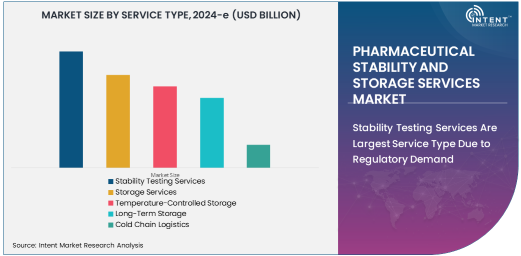
Stability Testing Services Are Largest Service Type Due to Regulatory Demand
Stability testing services represent the largest segment in the pharmaceutical stability and storage services market. These services are essential for assessing the shelf life and stability of pharmaceutical products under various environmental conditions such as temperature, humidity, and light. Regulatory agencies like the FDA and EMA mandate rigorous stability testing before drugs can be approved for market entry.
The rising number of biologics, complex drugs, and personalized medicine formulations has increased the need for specialized stability testing protocols. Pharmaceutical companies rely on third-party providers for these services to ensure compliance, reduce operational burdens, and focus on core competencies. The growing pipeline of new drug developments further reinforces the demand for stability testing services, solidifying their dominant position in the market.
Temperature-Controlled Storage Is Fastest-Growing Service Type Driven by Biologics
Temperature-controlled storage is the fastest-growing service type in the market, driven by the increasing prevalence of temperature-sensitive biologics, vaccines, and specialty drugs. Maintaining precise temperature conditions is critical to preserving the efficacy of these products, particularly in the case of biologics, which are highly sensitive to temperature fluctuations.
Cold chain logistics and storage solutions have become indispensable for pharmaceutical companies managing temperature-sensitive products. Advanced technologies such as real-time monitoring, automated temperature control systems, and data loggers ensure compliance with regulatory standards and enhance product safety. The ongoing demand for vaccines, including those for pandemics and infectious diseases, has also contributed to the rapid growth of temperature-controlled storage services.
Pharmaceutical Companies Are Largest End-Use Industry Due to High Dependence on Outsourcing
Pharmaceutical companies represent the largest end-use industry for stability and storage services, as they require reliable solutions to maintain compliance and ensure product quality. The complexity of modern pharmaceutical products, coupled with stringent regulatory requirements, has driven these companies to outsource stability and storage services to specialized providers.
Outsourcing allows pharmaceutical companies to focus on their core functions, such as research, development, and manufacturing, while leveraging the expertise of service providers for stability testing, storage, and cold chain logistics. The increasing development of biologics, biosimilars, and specialty drugs further emphasizes the need for robust storage solutions tailored to specific product requirements.
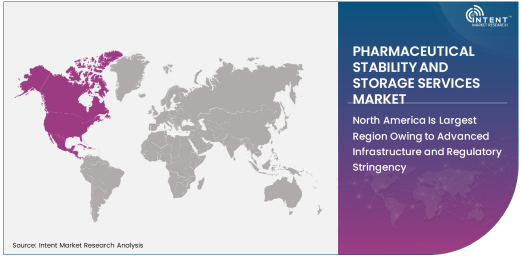
North America Is Largest Region Owing to Advanced Infrastructure and Regulatory Stringency
North America holds the largest share in the pharmaceutical stability and storage services market, primarily due to its advanced infrastructure and strict regulatory environment. The presence of a well-established pharmaceutical and biotechnology industry, coupled with strong investment in research and development, drives the demand for stability and storage services in the region.
The U.S., being home to numerous pharmaceutical and biotech companies, contributes significantly to the market. Regulatory agencies like the FDA enforce stringent stability testing and storage protocols, further boosting the demand for high-quality services. Additionally, the increasing adoption of temperature-sensitive biologics and vaccines in the region amplifies the need for cold chain logistics and temperature-controlled storage solutions.
Competitive Landscape and Key Players
The pharmaceutical stability and storage services market is highly competitive, with key players including Catalent, Eurofins Scientific, Lonza, and Charles River Laboratories. These companies offer comprehensive solutions encompassing stability testing, temperature-controlled storage, and cold chain logistics.
Strategic partnerships, technological advancements, and geographic expansion are common strategies employed by market leaders to strengthen their positions. Service providers are increasingly focusing on automation, real-time monitoring, and eco-friendly storage solutions to cater to the evolving needs of pharmaceutical and biotech companies. With the rising complexity of drug formulations and stringent regulatory requirements, the market is expected to witness sustained growth and innovation in the coming years.
Recent Developments:
- Eurofins Scientific expanded its stability testing services in Asia-Pacific to meet the growing demand for pharmaceutical stability and storage solutions in the region.
- Lonza Group partnered with a global pharmaceutical company to provide temperature-controlled storage for high-value biologic drugs, ensuring product integrity during transportation.
- Thermo Fisher Scientific launched a new cold chain logistics solution for temperature-sensitive pharmaceutical products, enhancing its offering in global distribution.
- Piramal Enterprises expanded its pharmaceutical storage services with new facilities designed to handle biologics and other temperature-sensitive medicines.
- DHL Supply Chain introduced a smart storage system for pharmaceuticals, improving efficiency and temperature control through advanced monitoring technology.
List of Leading Companies:
- Eurofins Scientific
- Lonza Group
- Piramal Enterprises
- Cold Chain Technologies
- DB Schenker
- DHL Supply Chain
- Kuehne + Nagel
- Mainfreight Ltd
- Norco Inc.
- Thermo Fisher Scientific
- Catalent, Inc.
- Cognizant Technology Solutions
- WuXi AppTec
- Marken
- Agility Logistics
Report Scope:
|
Report Features |
Description |
|
Market Size (2024-e) |
USD 6.9 Billion |
|
Forecasted Value (2030) |
USD 11.6 Billion |
|
CAGR (2025 – 2030) |
8.9% |
|
Base Year for Estimation |
2024-e |
|
Historic Year |
2023 |
|
Forecast Period |
2025 – 2030 |
|
Report Coverage |
Market Forecast, Market Dynamics, Competitive Landscape, Recent Developments |
|
Segments Covered |
Global Pharmaceutical Stability and Storage Services Market by Service Type (Stability Testing Services, Storage Services, Temperature-Controlled Storage, Long-Term Storage, Cold Chain Logistics), by End-Use Industry (Pharmaceutical Companies, Biotech Companies, Contract Research Organizations (CROs)); Insights & Forecast (2024 – 2030) |
|
Regional Analysis |
North America (US, Canada, Mexico), Europe (Germany, France, UK, Italy, Spain, and Rest of Europe), Asia-Pacific (China, Japan, South Korea, Australia, India, and Rest of Asia-Pacific), Latin America (Brazil, Argentina, and Rest of Latin America), Middle East & Africa (Saudi Arabia, UAE, Rest of Middle East & Africa) |
|
Major Companies |
Eurofins Scientific, Lonza Group, Piramal Enterprises, Cold Chain Technologies, DB Schenker, DHL Supply Chain, Mainfreight Ltd, Norco Inc., Thermo Fisher Scientific, Catalent, Inc., Cognizant Technology Solutions, WuXi AppTec, Agility Logistics |
|
Customization Scope |
Customization for segments, region/country-level will be provided. Moreover, additional customization can be done based on the requirements |
|
1. Introduction |
|
1.1. Market Definition |
|
1.2. Scope of the Study |
|
1.3. Research Assumptions |
|
1.4. Study Limitations |
|
2. Research Methodology |
|
2.1. Research Approach |
|
2.1.1. Top-Down Method |
|
2.1.2. Bottom-Up Method |
|
2.1.3. Factor Impact Analysis |
|
2.2. Insights & Data Collection Process |
|
2.2.1. Secondary Research |
|
2.2.2. Primary Research |
|
2.3. Data Mining Process |
|
2.3.1. Data Analysis |
|
2.3.2. Data Validation and Revalidation |
|
2.3.3. Data Triangulation |
|
3. Executive Summary |
|
3.1. Major Markets & Segments |
|
3.2. Highest Growing Regions and Respective Countries |
|
3.3. Impact of Growth Drivers & Inhibitors |
|
3.4. Regulatory Overview by Country |
|
4. Pharmaceutical Stability and Storage Services Market, by Service Type (Market Size & Forecast: USD Million, 2023 – 2030) |
|
4.1. Stability Testing Services |
|
4.2. Storage Services |
|
4.3. Temperature-Controlled Storage |
|
4.4. Long-Term Storage |
|
4.5. Cold Chain Logistics |
|
5. Pharmaceutical Stability and Storage Services Market, by End-Use Industry (Market Size & Forecast: USD Million, 2023 – 2030) |
|
5.1. Pharmaceutical Companies |
|
5.2. Biotech Companies |
|
5.3. Contract Research Organizations (CROs) |
|
6. Regional Analysis (Market Size & Forecast: USD Million, 2023 – 2030) |
|
6.1. Regional Overview |
|
6.2. North America |
|
6.2.1. Regional Trends & Growth Drivers |
|
6.2.2. Barriers & Challenges |
|
6.2.3. Opportunities |
|
6.2.4. Factor Impact Analysis |
|
6.2.5. Technology Trends |
|
6.2.6. North America Pharmaceutical Stability and Storage Services Market, by Service Type |
|
6.2.7. North America Pharmaceutical Stability and Storage Services Market, by End-Use Industry |
|
6.2.8. By Country |
|
6.2.8.1. US |
|
6.2.8.1.1. US Pharmaceutical Stability and Storage Services Market, by Service Type |
|
6.2.8.1.2. US Pharmaceutical Stability and Storage Services Market, by End-Use Industry |
|
6.2.8.2. Canada |
|
6.2.8.3. Mexico |
|
*Similar segmentation will be provided for each region and country |
|
6.3. Europe |
|
6.4. Asia-Pacific |
|
6.5. Latin America |
|
6.6. Middle East & Africa |
|
7. Competitive Landscape |
|
7.1. Overview of the Key Players |
|
7.2. Competitive Ecosystem |
|
7.2.1. Level of Fragmentation |
|
7.2.2. Market Consolidation |
|
7.2.3. Product Innovation |
|
7.3. Company Share Analysis |
|
7.4. Company Benchmarking Matrix |
|
7.4.1. Strategic Overview |
|
7.4.2. Product Innovations |
|
7.5. Start-up Ecosystem |
|
7.6. Strategic Competitive Insights/ Customer Imperatives |
|
7.7. ESG Matrix/ Sustainability Matrix |
|
7.8. Manufacturing Network |
|
7.8.1. Locations |
|
7.8.2. Supply Chain and Logistics |
|
7.8.3. Product Flexibility/Customization |
|
7.8.4. Digital Transformation and Connectivity |
|
7.8.5. Environmental and Regulatory Compliance |
|
7.9. Technology Readiness Level Matrix |
|
7.10. Technology Maturity Curve |
|
7.11. Buying Criteria |
|
8. Company Profiles |
|
8.1. Eurofins Scientific |
|
8.1.1. Company Overview |
|
8.1.2. Company Financials |
|
8.1.3. Product/Service Portfolio |
|
8.1.4. Recent Developments |
|
8.1.5. IMR Analysis |
|
*Similar information will be provided for other companies |
|
8.2. Lonza Group |
|
8.3. Piramal Enterprises |
|
8.4. Cold Chain Technologies |
|
8.5. DB Schenker |
|
8.6. DHL Supply Chain |
|
8.7. Kuehne + Nagel |
|
8.8. Mainfreight Ltd |
|
8.9. Norco Inc. |
|
8.10. Thermo Fisher Scientific |
|
8.11. Catalent, Inc. |
|
8.12. Cognizant Technology Solutions |
|
8.13. WuXi AppTec |
|
8.14. Marken |
|
8.15. Agility Logistics |
|
9. Appendix |
A comprehensive market research approach was employed to gather and analyze data on the Pharmaceutical Stability and Storage Services Market. In the process, the analysis was also done to analyze the parent market and relevant adjacencies to measure the impact of them on the Pharmaceutical Stability and Storage Services Market. The research methodology encompassed both secondary and primary research techniques, ensuring the accuracy and credibility of the findings.
.jpg)
Secondary Research
Secondary research involved a thorough review of pertinent industry reports, journals, articles, and publications. Additionally, annual reports, press releases, and investor presentations of industry players were scrutinized to gain insights into their market positioning and strategies.
Primary Research
Primary research involved conducting in-depth interviews with industry experts, stakeholders, and market participants across the E-Waste Management ecosystem. The primary research objectives included:
- Validating findings and assumptions derived from secondary research
- Gathering qualitative and quantitative data on market trends, drivers, and challenges
- Understanding the demand-side dynamics, encompassing end-users, component manufacturers, facility providers, and service providers
- Assessing the supply-side landscape, including technological advancements and recent developments
Market Size Assessment
A combination of top-down and bottom-up approaches was utilized to analyze the overall size of the Pharmaceutical Stability and Storage Services Market. These methods were also employed to assess the size of various subsegments within the market. The market size assessment methodology encompassed the following steps:
- Identification of key industry players and relevant revenues through extensive secondary research
- Determination of the industry's supply chain and market size, in terms of value, through primary and secondary research processes
- Calculation of percentage shares, splits, and breakdowns using secondary sources and verification through primary sources
.jpg)
Data Triangulation
To ensure the accuracy and reliability of the market size, data triangulation was implemented. This involved cross-referencing data from various sources, including demand and supply side factors, market trends, and expert opinions. Additionally, top-down and bottom-up approaches were employed to validate the market size assessment.
NA