
As per Intent Market Research, the Pharmaceutical Logistics Market was valued at USD 76.3 Billion in 2024-e and will surpass USD 145.4 Billion by 2030; growing at a CAGR of 11.3% during 2025 - 2030.
The pharmaceutical logistics market plays a critical role in the global healthcare supply chain, ensuring the safe and timely delivery of pharmaceutical products from manufacturers to end-users. This market is pivotal for maintaining the integrity, quality, and efficacy of pharmaceutical products, particularly those sensitive to temperature fluctuations. With the rise of biologics, vaccines, and temperature-sensitive drugs, the demand for advanced logistics solutions that ensure product safety, regulatory compliance, and efficiency has grown. As global pharmaceutical distribution networks expand, the need for sophisticated logistics and transportation solutions will continue to rise, making pharmaceutical logistics an essential part of the healthcare infrastructure.
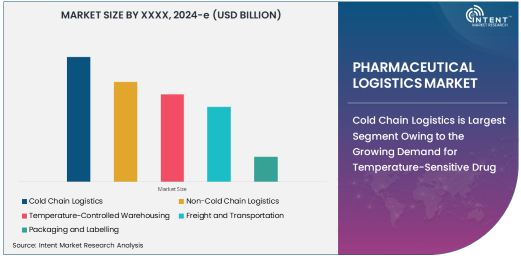
Cold Chain Logistics is Largest Segment Owing to the Growing Demand for Temperature-Sensitive Drugs
Cold chain logistics is the largest segment in the pharmaceutical logistics market, driven by the growing demand for temperature-sensitive pharmaceuticals such as biologics, vaccines, and certain types of insulin. These products require a controlled environment throughout the entire supply chain to maintain their stability, safety, and efficacy. Cold chain logistics ensures that these products are transported and stored at specific temperatures, typically ranging from 2°C to 8°C, and even lower in some cases, to prevent degradation.
The increasing adoption of biologics and vaccines, particularly in oncology, immunology, and the COVID-19 vaccine rollout, has significantly increased the need for cold chain logistics. With the expansion of personalized medicine and gene therapies, which often require ultra-low temperature storage, the demand for highly specialized cold chain logistics solutions has surged. Moreover, as regulatory requirements for drug transportation and storage become more stringent, pharmaceutical companies are investing heavily in advanced cold chain solutions to meet compliance standards and ensure product quality during transport and storage.
Road Transportation is Largest Mode of Transportation Due to its Versatility and Cost-Effectiveness
Road transportation is the largest mode of transportation in the pharmaceutical logistics market, owing to its versatility, cost-effectiveness, and wide availability. Road transport offers flexible and direct delivery to a wide range of destinations, including hospitals, pharmacies, wholesalers, and retail outlets. It is the preferred mode for the distribution of pharmaceutical products within a country or region, providing the advantage of door-to-door delivery and allowing for better control over delivery schedules and conditions.
Additionally, road transportation is well-suited for both cold chain and non-cold chain logistics, with the availability of refrigerated trucks ensuring the safe transport of temperature-sensitive products. The ability to provide timely deliveries, especially for urgent or critical medications, is a major factor driving the preference for road transport in the pharmaceutical logistics industry. With the growing demand for faster delivery times and more efficient distribution networks, the road transportation segment will continue to dominate the market.
Pharmaceutical Manufacturers Are Largest End-Use Industry Due to Ongoing Need for Distribution of Drugs
Pharmaceutical manufacturers are the largest end-use industry in the pharmaceutical logistics market, as they are the primary source of demand for logistics services to distribute drugs to various stakeholders in the healthcare system. These manufacturers require reliable logistics solutions to ensure that their products reach wholesalers, distributors, healthcare providers, and retail pharmacies in a timely and efficient manner. The increasing complexity of the drug manufacturing process, particularly in the production of biologics and specialty drugs, has further emphasized the need for specialized logistics services.
As pharmaceutical manufacturers continue to expand their product portfolios, including the development of personalized medicines, vaccines, and other complex biologics, the need for efficient and secure logistics solutions will remain paramount. Pharmaceutical companies are increasingly outsourcing their logistics requirements to third-party providers who can offer comprehensive services such as cold chain logistics, temperature-controlled warehousing, and advanced tracking systems. This trend, combined with the growing demand for global distribution, reinforces the importance of pharmaceutical logistics in the industry's supply chain.
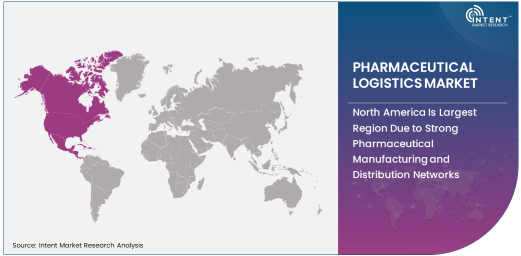
North America Is Largest Region Due to Strong Pharmaceutical Manufacturing and Distribution Networks
North America holds the largest share of the pharmaceutical logistics market, driven by its well-established pharmaceutical manufacturing base and robust distribution networks. The U.S., in particular, is home to numerous pharmaceutical companies and contract research organizations (CROs), making it a major hub for pharmaceutical logistics activities. The region also benefits from a highly developed healthcare infrastructure and stringent regulatory requirements, which ensure the safe and timely delivery of pharmaceutical products.
North America’s dominance in the pharmaceutical logistics market is further supported by the increasing demand for temperature-sensitive drugs, including biologics and vaccines, which require specialized logistics solutions. The region also has a significant presence of logistics companies that provide advanced cold chain services, contributing to its strong market position. As the pharmaceutical industry continues to grow, particularly in areas such as personalized medicine, North America's pharmaceutical logistics market is expected to maintain its leadership.
Competitive Landscape and Key Players
The pharmaceutical logistics market is highly competitive, with several key players providing specialized logistics services tailored to the needs of the pharmaceutical and healthcare industries. Leading companies in this market include DHL Supply Chain, UPS Healthcare, Kuehne + Nagel, DB Schenker, and XPO Logistics, among others. These companies offer a wide range of logistics solutions, including cold chain logistics, temperature-controlled warehousing, freight forwarding, and packaging services.
The market is characterized by continuous innovation, as logistics providers seek to enhance operational efficiency and ensure compliance with stringent regulatory standards. Companies are increasingly investing in technologies such as IoT-based tracking systems, temperature monitoring devices, and blockchain for supply chain transparency and real-time visibility. Strategic partnerships, acquisitions, and the expansion of cold chain capabilities are common strategies employed by market players to stay competitive. With the growing demand for temperature-sensitive pharmaceuticals and the increasing complexity of drug distribution networks, the competitive landscape is expected to remain dynamic in the coming years.
Recent Developments:
- DHL Supply Chain launched a new temperature-controlled logistics network aimed at enhancing cold chain capabilities for pharmaceutical products.
- Kuehne + Nagel International AG expanded its pharmaceutical logistics services by opening a new temperature-sensitive warehouse in Europe.
- UPS Supply Chain Solutions introduced an advanced tracking system for pharmaceutical shipments, improving real-time monitoring and ensuring compliance with global regulations.
- C.H. Robinson Worldwide, Inc. formed a strategic partnership with a global pharmaceutical company to enhance supply chain efficiency and reduce costs.
- Agility Logistics invested in automated packaging systems to optimize the pharmaceutical logistics process, aiming to improve delivery speed and reduce errors.
List of Leading Companies:
DHL Supply Chain
Kuehne + Nagel International AG
XPO Logistics, Inc.
DB Schenker
UPS Supply Chain Solutions
C.H. Robinson Worldwide, Inc.
Kerry Logistics Network Limited
Ceva Logistics
Toll Group
Geodis
Sinotrans Limited
Agility Logistics
Panther Westwinds
Panalpina World Transport (Holding) Ltd.
Sims Group Ltd. Report Scope:
|
Report Features |
Description |
|
Market Size (2024-e) |
USD 76.3 Billion |
|
Forecasted Value (2030) |
USD 145.4 Billion |
|
CAGR (2025 – 2030) |
11.3% |
|
Base Year for Estimation |
2024-e |
|
Historic Year |
2023 |
|
Forecast Period |
2025 – 2030 |
|
Report Coverage |
Market Forecast, Market Dynamics, Competitive Landscape, Recent Developments |
|
Segments Covered |
Global Pharmaceutical Logistics Market by Type (Cold Chain Logistics, Non-Cold Chain Logistics, Temperature-Controlled Warehousing, Freight and Transportation, Packaging and Labelling), by Mode of Transportation (Road Transportation, Rail Transportation, Air Transportation, Sea Transportation), by End-Use Industry (Pharmaceutical Manufacturers, Contract Research Organizations (CROs), Distributors and Wholesalers, Retail Pharmacies); Insights & Forecast (2024 – 2030) |
|
Regional Analysis |
North America (US, Canada, Mexico), Europe (Germany, France, UK, Italy, Spain, and Rest of Europe), Asia-Pacific (China, Japan, South Korea, Australia, India, and Rest of Asia-Pacific), Latin America (Brazil, Argentina, and Rest of Latin America), Middle East & Africa (Saudi Arabia, UAE, Rest of Middle East & Africa) |
|
Major Companies |
DHL Supply Chain, Kuehne + Nagel International AG, XPO Logistics, Inc., DB Schenker, UPS Supply Chain Solutions, C.H. Robinson Worldwide, Inc., Ceva Logistics, Toll Group, Geodis, Sinotrans Limited, Agility Logistics, Panther Westwinds, Sims Group Ltd. |
|
Customization Scope |
Customization for segments, region/country-level will be provided. Moreover, additional customization can be done based on the requirements |
|
1. Introduction |
|
1.1. Market Definition |
|
1.2. Scope of the Study |
|
1.3. Research Assumptions |
|
1.4. Study Limitations |
|
2. Research Methodology |
|
2.1. Research Approach |
|
2.1.1. Top-Down Method |
|
2.1.2. Bottom-Up Method |
|
2.1.3. Factor Impact Analysis |
|
2.2. Insights & Data Collection Process |
|
2.2.1. Secondary Research |
|
2.2.2. Primary Research |
|
2.3. Data Mining Process |
|
2.3.1. Data Analysis |
|
2.3.2. Data Validation and Revalidation |
|
2.3.3. Data Triangulation |
|
3. Executive Summary |
|
3.1. Major Markets & Segments |
|
3.2. Highest Growing Regions and Respective Countries |
|
3.3. Impact of Growth Drivers & Inhibitors |
|
3.4. Regulatory Overview by Country |
|
4. Pharmaceutical Logistics Market, by Type (Market Size & Forecast: USD Million, 2023 – 2030) |
|
4.1. Cold Chain Logistics |
|
4.2. Non-Cold Chain Logistics |
|
4.3. Temperature-Controlled Warehousing |
|
4.4. Freight and Transportation |
|
4.5. Packaging and Labelling |
|
5. Pharmaceutical Logistics Market, by Mode of Transportation (Market Size & Forecast: USD Million, 2023 – 2030) |
|
5.1. Road Transportation |
|
5.2. Rail Transportation |
|
5.3. Air Transportation |
|
5.4. Sea Transportation |
|
6. Pharmaceutical Logistics Market, by End-Use Industry (Market Size & Forecast: USD Million, 2023 – 2030) |
|
6.1. Pharmaceutical Manufacturers |
|
6.2. Contract Research Organizations (CROs) |
|
6.3. Distributors and Wholesalers |
|
6.4. Retail Pharmacies |
|
7. Regional Analysis (Market Size & Forecast: USD Million, 2023 – 2030) |
|
7.1. Regional Overview |
|
7.2. North America |
|
7.2.1. Regional Trends & Growth Drivers |
|
7.2.2. Barriers & Challenges |
|
7.2.3. Opportunities |
|
7.2.4. Factor Impact Analysis |
|
7.2.5. Technology Trends |
|
7.2.6. North America Pharmaceutical Logistics Market, by Type |
|
7.2.7. North America Pharmaceutical Logistics Market, by Mode of Transportation |
|
7.2.8. North America Pharmaceutical Logistics Market, by End-Use Industry |
|
7.2.9. By Country |
|
7.2.9.1. US |
|
7.2.9.1.1. US Pharmaceutical Logistics Market, by Type |
|
7.2.9.1.2. US Pharmaceutical Logistics Market, by Mode of Transportation |
|
7.2.9.1.3. US Pharmaceutical Logistics Market, by End-Use Industry |
|
7.2.9.2. Canada |
|
7.2.9.3. Mexico |
|
*Similar segmentation will be provided for each region and country |
|
7.3. Europe |
|
7.4. Asia-Pacific |
|
7.5. Latin America |
|
7.6. Middle East & Africa |
|
8. Competitive Landscape |
|
8.1. Overview of the Key Players |
|
8.2. Competitive Ecosystem |
|
8.2.1. Level of Fragmentation |
|
8.2.2. Market Consolidation |
|
8.2.3. Product Innovation |
|
8.3. Company Share Analysis |
|
8.4. Company Benchmarking Matrix |
|
8.4.1. Strategic Overview |
|
8.4.2. Product Innovations |
|
8.5. Start-up Ecosystem |
|
8.6. Strategic Competitive Insights/ Customer Imperatives |
|
8.7. ESG Matrix/ Sustainability Matrix |
|
8.8. Manufacturing Network |
|
8.8.1. Locations |
|
8.8.2. Supply Chain and Logistics |
|
8.8.3. Product Flexibility/Customization |
|
8.8.4. Digital Transformation and Connectivity |
|
8.8.5. Environmental and Regulatory Compliance |
|
8.9. Technology Readiness Level Matrix |
|
8.10. Technology Maturity Curve |
|
8.11. Buying Criteria |
|
9. Company Profiles |
|
9.1. DHL Supply Chain |
|
9.1.1. Company Overview |
|
9.1.2. Company Financials |
|
9.1.3. Product/Service Portfolio |
|
9.1.4. Recent Developments |
|
9.1.5. IMR Analysis |
|
*Similar information will be provided for other companies |
|
9.2. Kuehne + Nagel International AG |
|
9.3. XPO Logistics, Inc. |
|
9.4. DB Schenker |
|
9.5. UPS Supply Chain Solutions |
|
9.6. C.H. Robinson Worldwide, Inc. |
|
9.7. Kerry Logistics Network Limited |
|
9.8. Ceva Logistics |
|
9.9. Toll Group |
|
9.10. Geodis |
|
9.11. Sinotrans Limited |
|
9.12. Agility Logistics |
|
9.13. Panther Westwinds |
|
9.14. Panalpina World Transport (Holding) Ltd. |
|
9.15. Sims Group Ltd. |
|
10. Appendix |
A comprehensive market research approach was employed to gather and analyze data on the Pharmaceutical Logistics Market. In the process, the analysis was also done to analyze the parent market and relevant adjacencies to measure the impact of them on the Pharmaceutical Logistics Market. The research methodology encompassed both secondary and primary research techniques, ensuring the accuracy and credibility of the findings.
.jpg)
Secondary Research
Secondary research involved a thorough review of pertinent industry reports, journals, articles, and publications. Additionally, annual reports, press releases, and investor presentations of industry players were scrutinized to gain insights into their market positioning and strategies.
Primary Research
Primary research involved conducting in-depth interviews with industry experts, stakeholders, and market participants across the E-Waste Management ecosystem. The primary research objectives included:
- Validating findings and assumptions derived from secondary research
- Gathering qualitative and quantitative data on market trends, drivers, and challenges
- Understanding the demand-side dynamics, encompassing end-users, component manufacturers, facility providers, and service providers
- Assessing the supply-side landscape, including technological advancements and recent developments
Market Size Assessment
A combination of top-down and bottom-up approaches was utilized to analyze the overall size of the Pharmaceutical Logistics Market. These methods were also employed to assess the size of various subsegments within the market. The market size assessment methodology encompassed the following steps:
- Identification of key industry players and relevant revenues through extensive secondary research
- Determination of the industry's supply chain and market size, in terms of value, through primary and secondary research processes
- Calculation of percentage shares, splits, and breakdowns using secondary sources and verification through primary sources
.jpg)
Data Triangulation
To ensure the accuracy and reliability of the market size, data triangulation was implemented. This involved cross-referencing data from various sources, including demand and supply side factors, market trends, and expert opinions. Additionally, top-down and bottom-up approaches were employed to validate the market size assessment.
NA