
As per Intent Market Research, the Pharmaceutical Fine Chemicals Market was valued at USD 171.3 Billion in 2024-e and will surpass USD 238.0 Billion by 2030; growing at a CAGR of 5.6% during 2025 - 2030.
The pharmaceutical fine chemicals market is a critical segment within the global pharmaceutical industry, providing the essential raw materials for drug production. These fine chemicals, which include active pharmaceutical ingredients (APIs), excipients, intermediates, and biopharmaceuticals, play a significant role in the formulation, manufacturing, and production of pharmaceutical products. As the pharmaceutical industry grows, the demand for these fine chemicals is also rising, driven by the increasing need for new drug formulations, generic drug production, and the expansion of biopharmaceuticals. Stringent regulatory standards and the constant innovation in drug development are further propelling the growth of this market.
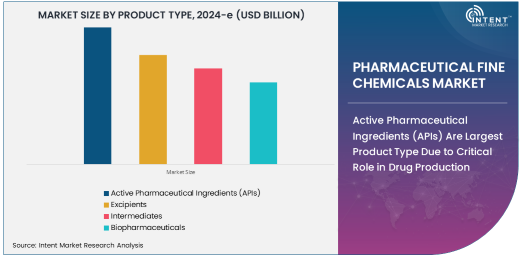
Active Pharmaceutical Ingredients (APIs) Are Largest Product Type Due to Critical Role in Drug Production
Active pharmaceutical ingredients (APIs) are the largest product type in the pharmaceutical fine chemicals market due to their indispensable role in drug production. APIs are the main ingredients responsible for the therapeutic effect of a drug and are used in nearly all pharmaceutical products. As the core component of pharmaceutical formulations, APIs are central to both branded and generic drug manufacturing.
The increasing global demand for both branded and generic drugs has amplified the need for APIs. With the growing prevalence of chronic diseases, aging populations, and expanding healthcare needs, the demand for APIs has seen substantial growth. Pharmaceutical companies and contract manufacturing organizations (CMOs) are continually seeking high-quality, cost-effective APIs to ensure the efficacy and safety of their drug products. Additionally, the advancement of biopharmaceuticals has further heightened the reliance on APIs in modern medicine.
Drug Manufacturing Is Largest Application Due to High Demand for Pharmaceutical Production
Drug manufacturing represents the largest application segment in the pharmaceutical fine chemicals market, driven by the ever-expanding demand for new drugs and therapeutic formulations. The global increase in healthcare spending, along with a rising prevalence of chronic and lifestyle diseases, is fueling the growth of drug manufacturing. Pharmaceutical companies require a wide variety of fine chemicals, such as APIs and excipients, to produce drugs that meet regulatory standards and ensure patient safety.
The increasing shift towards personalized medicine and the growing focus on biologics and complex therapies are also contributing to the expansion of the drug manufacturing segment. As drug manufacturing processes become more intricate and diverse, the need for specialized fine chemicals continues to rise, further solidifying the dominance of this application in the market.
Pharmaceuticals Are Largest End-Use Industry Due to Dominance in Drug Production
The pharmaceutical industry is the largest end-use sector for pharmaceutical fine chemicals, as these chemicals are integral to the production of both prescription and over-the-counter drugs. Pharmaceutical manufacturers rely heavily on high-quality APIs, excipients, and intermediates to ensure the safety, efficacy, and stability of their drug products. As the pharmaceutical industry continues to expand, driven by innovations in drug discovery and development, the demand for fine chemicals remains robust.
Additionally, the shift toward biologics, precision medicine, and generics has further driven the pharmaceutical industry's reliance on pharmaceutical fine chemicals. The need for continuous innovation, along with strict regulatory frameworks, ensures that pharmaceutical companies are constantly sourcing the most effective and compliant chemicals for their formulations. This continued growth in the pharmaceutical sector positions it as the largest end-use industry for pharmaceutical fine chemicals.
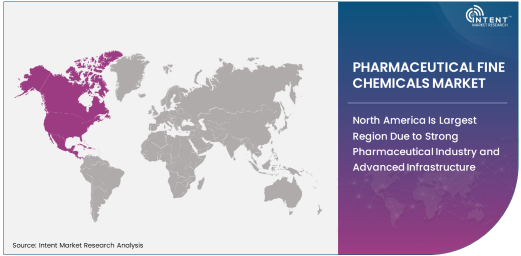
North America Is Largest Region Due to Strong Pharmaceutical Industry and Advanced Infrastructure
North America is the largest region in the pharmaceutical fine chemicals market, driven by the presence of a well-established pharmaceutical industry and advanced healthcare infrastructure. The region is home to some of the world’s largest pharmaceutical companies, which are major consumers of fine chemicals, particularly APIs and excipients. Furthermore, North America’s stringent regulatory environment ensures that only the highest-quality chemicals are used in drug manufacturing, contributing to the region's dominance in the market.
The increasing adoption of biopharmaceuticals, as well as the rising demand for generic drugs and over-the-counter products, further fuels the need for pharmaceutical fine chemicals in North America. The region’s strong research and development capabilities, combined with its advanced manufacturing infrastructure, solidify its position as the largest market for pharmaceutical fine chemicals.
Competitive Landscape and Key Players
The pharmaceutical fine chemicals market is highly competitive, with key players including Lonza Group, BASF SE, and DSM Nutritional Products. These companies offer a range of pharmaceutical fine chemicals, including APIs, excipients, and intermediates, to meet the diverse needs of pharmaceutical manufacturers. The competition in this market is driven by the continuous innovation in drug development, the need for regulatory compliance, and the increasing demand for high-quality chemicals across various pharmaceutical applications.
Leading players in the market focus on expanding their product portfolios, optimizing manufacturing processes, and forging strategic partnerships with pharmaceutical companies and contract manufacturing organizations. Additionally, some companies are investing heavily in the production of biologics and high-end pharmaceutical ingredients to cater to the growing demand for complex therapies and personalized medicine. With ongoing advancements in technology and stringent regulatory frameworks, these key players are well-positioned to lead the pharmaceutical fine chemicals market in the coming years.
Recent Developments:
- Lonza Group Ltd. entered into a partnership with a leading pharmaceutical company to expand its biologics manufacturing capabilities, leveraging advanced fine chemical production techniques.
- Evonik Industries AG unveiled a new biotechnology-based process for producing high-purity APIs, aimed at enhancing efficiency in the pharmaceutical fine chemicals sector.
- DSM Nutritional Products announced the expansion of its manufacturing facility for pharmaceutical excipients, catering to the growing demand for high-quality, safe drug components.
- Teva Pharmaceutical Industries Ltd. completed a strategic acquisition of a fine chemicals production unit, strengthening its API manufacturing capacity.
- BASF SE launched an innovative biotechnological platform to produce complex pharmaceutical intermediates, helping meet increasing global demand for high-quality APIs.
List of Leading Companies:
- BASF SE
- Lonza Group Ltd.
- DSM Nutritional Products
- Evonik Industries AG
- Hubei Widu Pharmaceutical Co. Ltd.
- Cipla Limited
- Azelis Group
- Albemarle Corporation
- Wuhan Grand Hoyo Co. Ltd.
- Hangzhou Jinlin Pharmaceutical Co. Ltd.
- Boehringer Ingelheim GmbH
- Syngenta AG
- Samsung Biologics
- Shandong Xinhua Pharmaceutical Co. Ltd.
- Teva Pharmaceutical Industries Ltd.
Report Scope:
|
Report Features |
Description |
|
Market Size (2024-e) |
USD 171.3 Billion |
|
Forecasted Value (2030) |
USD 238.0 Billion |
|
CAGR (2025 – 2030) |
5.6% |
|
Base Year for Estimation |
2024-e |
|
Historic Year |
2023 |
|
Forecast Period |
2025 – 2030 |
|
Report Coverage |
Market Forecast, Market Dynamics, Competitive Landscape, Recent Developments |
|
Segments Covered |
Global Pharmaceutical Fine Chemicals Market by Product Type (Active Pharmaceutical Ingredients (APIs), Excipients, Intermediates, Biopharmaceuticals), by Application (Drug Manufacturing, Generic Drug Production, Contract Manufacturing Organizations, Over-the-Counter Drugs), by End-Use Industry (Pharmaceuticals, Biopharmaceuticals, Contract Manufacturing Organizations, Chemical Industry); Insights & Forecast (2024 – 2030) |
|
Regional Analysis |
North America (US, Canada, Mexico), Europe (Germany, France, UK, Italy, Spain, and Rest of Europe), Asia-Pacific (China, Japan, South Korea, Australia, India, and Rest of Asia-Pacific), Latin America (Brazil, Argentina, and Rest of Latin America), Middle East & Africa (Saudi Arabia, UAE, Rest of Middle East & Africa) |
|
Major Companies |
BASF SE, Lonza Group Ltd., DSM Nutritional Products, Evonik Industries AG, Hubei Widu Pharmaceutical Co. Ltd., Cipla Limited, Albemarle Corporation, Wuhan Grand Hoyo Co. Ltd., Hangzhou Jinlin Pharmaceutical Co. Ltd., Boehringer Ingelheim GmbH, Syngenta AG, Samsung Biologics, Teva Pharmaceutical Industries Ltd. |
|
Customization Scope |
Customization for segments, region/country-level will be provided. Moreover, additional customization can be done based on the requirements |
|
1. Introduction |
|
1.1. Market Definition |
|
1.2. Scope of the Study |
|
1.3. Research Assumptions |
|
1.4. Study Limitations |
|
2. Research Methodology |
|
2.1. Research Approach |
|
2.1.1. Top-Down Method |
|
2.1.2. Bottom-Up Method |
|
2.1.3. Factor Impact Analysis |
|
2.2. Insights & Data Collection Process |
|
2.2.1. Secondary Research |
|
2.2.2. Primary Research |
|
2.3. Data Mining Process |
|
2.3.1. Data Analysis |
|
2.3.2. Data Validation and Revalidation |
|
2.3.3. Data Triangulation |
|
3. Executive Summary |
|
3.1. Major Markets & Segments |
|
3.2. Highest Growing Regions and Respective Countries |
|
3.3. Impact of Growth Drivers & Inhibitors |
|
3.4. Regulatory Overview by Country |
|
4. Pharmaceutical Fine Chemicals Market, by Product Type (Market Size & Forecast: USD Million, 2023 – 2030) |
|
4.1. Active Pharmaceutical Ingredients (APIs) |
|
4.2. Excipients |
|
4.3. Intermediates |
|
4.4. Biopharmaceuticals |
|
5. Pharmaceutical Fine Chemicals Market, by Application (Market Size & Forecast: USD Million, 2023 – 2030) |
|
5.1. Drug Manufacturing |
|
5.2. Generic Drug Production |
|
5.3. Contract Manufacturing Organizations |
|
5.4. Over-the-Counter Drugs |
|
6. Pharmaceutical Fine Chemicals Market, by End-Use Industry (Market Size & Forecast: USD Million, 2023 – 2030) |
|
6.1. Pharmaceuticals |
|
6.2. Biopharmaceuticals |
|
6.3. Contract Manufacturing Organizations |
|
6.4. Chemical Industry |
|
7. Regional Analysis (Market Size & Forecast: USD Million, 2023 – 2030) |
|
7.1. Regional Overview |
|
7.2. North America |
|
7.2.1. Regional Trends & Growth Drivers |
|
7.2.2. Barriers & Challenges |
|
7.2.3. Opportunities |
|
7.2.4. Factor Impact Analysis |
|
7.2.5. Technology Trends |
|
7.2.6. North America Pharmaceutical Fine Chemicals Market, by Product Type |
|
7.2.7. North America Pharmaceutical Fine Chemicals Market, by Application |
|
7.2.8. North America Pharmaceutical Fine Chemicals Market, by End-Use Industry |
|
7.2.9. By Country |
|
7.2.9.1. US |
|
7.2.9.1.1. US Pharmaceutical Fine Chemicals Market, by Product Type |
|
7.2.9.1.2. US Pharmaceutical Fine Chemicals Market, by Application |
|
7.2.9.1.3. US Pharmaceutical Fine Chemicals Market, by End-Use Industry |
|
7.2.9.2. Canada |
|
7.2.9.3. Mexico |
|
*Similar segmentation will be provided for each region and country |
|
7.3. Europe |
|
7.4. Asia-Pacific |
|
7.5. Latin America |
|
7.6. Middle East & Africa |
|
8. Competitive Landscape |
|
8.1. Overview of the Key Players |
|
8.2. Competitive Ecosystem |
|
8.2.1. Level of Fragmentation |
|
8.2.2. Market Consolidation |
|
8.2.3. Product Innovation |
|
8.3. Company Share Analysis |
|
8.4. Company Benchmarking Matrix |
|
8.4.1. Strategic Overview |
|
8.4.2. Product Innovations |
|
8.5. Start-up Ecosystem |
|
8.6. Strategic Competitive Insights/ Customer Imperatives |
|
8.7. ESG Matrix/ Sustainability Matrix |
|
8.8. Manufacturing Network |
|
8.8.1. Locations |
|
8.8.2. Supply Chain and Logistics |
|
8.8.3. Product Flexibility/Customization |
|
8.8.4. Digital Transformation and Connectivity |
|
8.8.5. Environmental and Regulatory Compliance |
|
8.9. Technology Readiness Level Matrix |
|
8.10. Technology Maturity Curve |
|
8.11. Buying Criteria |
|
9. Company Profiles |
|
9.1. BASF SE |
|
9.1.1. Company Overview |
|
9.1.2. Company Financials |
|
9.1.3. Product/Service Portfolio |
|
9.1.4. Recent Developments |
|
9.1.5. IMR Analysis |
|
*Similar information will be provided for other companies |
|
9.2. Lonza Group Ltd. |
|
9.3. DSM Nutritional Products |
|
9.4. Evonik Industries AG |
|
9.5. Hubei Widu Pharmaceutical Co. Ltd. |
|
9.6. Cipla Limited |
|
9.7. Azelis Group |
|
9.8. Albemarle Corporation |
|
9.9. Wuhan Grand Hoyo Co. Ltd. |
|
9.10. Hangzhou Jinlin Pharmaceutical Co. Ltd. |
|
9.11. Boehringer Ingelheim GmbH |
|
9.12. Syngenta AG |
|
9.13. Samsung Biologics |
|
9.14. Shandong Xinhua Pharmaceutical Co. Ltd. |
|
9.15. Teva Pharmaceutical Industries Ltd. |
|
10. Appendix |
A comprehensive market research approach was employed to gather and analyze data on the Pharmaceutical Fine Chemicals Market. In the process, the analysis was also done to analyze the parent market and relevant adjacencies to measure the impact of them on the Pharmaceutical Fine Chemicals Market. The research methodology encompassed both secondary and primary research techniques, ensuring the accuracy and credibility of the findings.
.jpg)
Secondary Research
Secondary research involved a thorough review of pertinent industry reports, journals, articles, and publications. Additionally, annual reports, press releases, and investor presentations of industry players were scrutinized to gain insights into their market positioning and strategies.
Primary Research
Primary research involved conducting in-depth interviews with industry experts, stakeholders, and market participants across the E-Waste Management ecosystem. The primary research objectives included:
- Validating findings and assumptions derived from secondary research
- Gathering qualitative and quantitative data on market trends, drivers, and challenges
- Understanding the demand-side dynamics, encompassing end-users, component manufacturers, facility providers, and service providers
- Assessing the supply-side landscape, including technological advancements and recent developments
Market Size Assessment
A combination of top-down and bottom-up approaches was utilized to analyze the overall size of the Pharmaceutical Fine Chemicals Market. These methods were also employed to assess the size of various subsegments within the market. The market size assessment methodology encompassed the following steps:
- Identification of key industry players and relevant revenues through extensive secondary research
- Determination of the industry's supply chain and market size, in terms of value, through primary and secondary research processes
- Calculation of percentage shares, splits, and breakdowns using secondary sources and verification through primary sources
.jpg)
Data Triangulation
To ensure the accuracy and reliability of the market size, data triangulation was implemented. This involved cross-referencing data from various sources, including demand and supply side factors, market trends, and expert opinions. Additionally, top-down and bottom-up approaches were employed to validate the market size assessment.
NA