
As per Intent Market Research, the Pharmaceutical Contract Manufacturing and Research Services Market was valued at USD 247.7 Billion in 2024-e and will surpass USD 378.1 Billion by 2030; growing at a CAGR of 7.3% during 2025-2030.
The pharmaceutical contract manufacturing and research services market is integral to the pharmaceutical and biotechnology industries, providing a range of outsourcing solutions for drug development, production, and commercialization. Companies in this market offer services such as contract manufacturing, contract research, and contract development and manufacturing services (CDMO), allowing pharmaceutical companies to focus on core competencies while outsourcing specialized processes. These services also cater to the growing demand for biologics, biosimilars, and generics, providing cost-effective and efficient solutions for drug production and research.
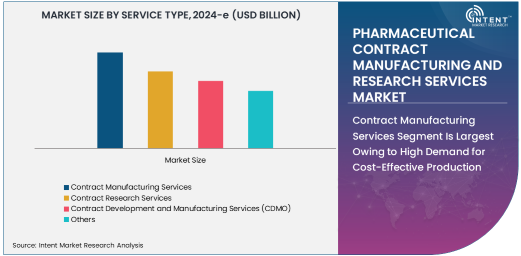
Contract Manufacturing Services Segment Is Largest Owing to High Demand for Cost-Effective Production
The contract manufacturing services segment is the largest in the pharmaceutical contract manufacturing and research services market, driven by the increasing demand for outsourced production. Pharmaceutical companies are increasingly outsourcing their manufacturing needs to reduce costs, enhance operational efficiency, and meet stringent regulatory requirements. Contract manufacturers provide specialized expertise in the large-scale production of drugs, including small molecules and biologics, ensuring compliance with international standards. The growing global demand for drugs, especially generics, has further fueled the need for these services.
As pharmaceutical companies focus on core activities such as research and development, contract manufacturing services allow them to expand their production capacity without significant capital investments in facilities. This is particularly true for generic drug manufacturers who rely heavily on outsourced production to meet global demand. By leveraging contract manufacturers' specialized facilities and capabilities, pharmaceutical companies can achieve greater flexibility, speed, and cost efficiency in production.
Biologics Application Is Fastest Growing Due to Rising Demand for Targeted Therapies
The biologics application segment is the fastest-growing subsegment within the pharmaceutical contract manufacturing and research services market. Biologics, which include therapeutic proteins, monoclonal antibodies, and vaccines, are increasingly being developed to target specific diseases, making them essential in the treatment of conditions such as cancer, autoimmune diseases, and genetic disorders. The rise in chronic diseases and the shift towards personalized medicine are key drivers of the biologics market.
The demand for biologics has prompted pharmaceutical companies to seek out contract development and manufacturing organizations (CDMOs) with specialized capabilities in biologics production. This has led to an increase in strategic partnerships between biopharma companies and contract manufacturers, providing the latter with the necessary expertise and infrastructure to handle the complex production processes involved in biologics manufacturing. As biologics continue to dominate the pharmaceutical pipeline, the demand for contract services in this area is expected to grow rapidly.
Pharmaceutical Manufacturers End-User Industry Leads Owing to Outsourcing Trends
The pharmaceutical manufacturers end-user industry leads the market, as pharmaceutical companies increasingly rely on contract manufacturing and research services to meet the demands of drug production and development. Outsourcing allows pharmaceutical manufacturers to focus on drug discovery, regulatory affairs, and marketing, while leveraging specialized contract research organizations (CROs) and CDMOs to handle production and clinical trials.
Pharmaceutical manufacturers are seeking cost-effective ways to scale up production, particularly for generics and biosimilars. By outsourcing to contract manufacturers, companies can avoid the capital expenditures associated with maintaining large-scale production facilities. This also enables them to meet stringent global regulatory standards and reduce time-to-market for new drugs, especially in a competitive landscape where speed and cost efficiency are crucial for success.
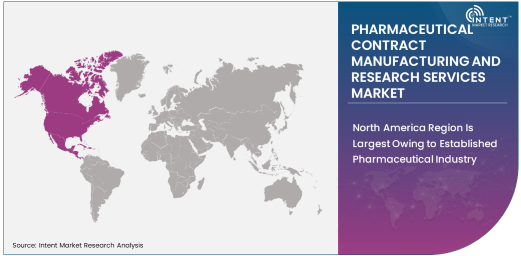
North America Region Is Largest Owing to Established Pharmaceutical Industry
North America is the largest region in the pharmaceutical contract manufacturing and research services market, largely due to the well-established pharmaceutical industry in the United States and Canada. The region is home to some of the world’s largest pharmaceutical companies, many of which rely heavily on outsourcing to CDMOs and contract research organizations (CROs) for drug development and production. North America’s robust healthcare infrastructure, advanced technology, and regulatory frameworks provide an ideal environment for the growth of the pharmaceutical contract manufacturing market.
The demand for outsourced services in North America is driven by the increasing complexity of drug manufacturing, particularly in biologics and biosimilars, and the need for cost-effective production solutions. Additionally, North American pharmaceutical companies are expanding their global reach and outsourcing production to meet growing international demand. The region’s dominance is expected to continue as pharmaceutical companies continue to embrace outsourcing as a strategic approach to improve efficiency and reduce costs.
Leading Companies and Competitive Landscape
The pharmaceutical contract manufacturing and research services market is highly competitive, with several global players providing a wide range of services across different drug types and stages of development. Leading companies in the market include Lonza Group, Catalent, Inc., WuXi AppTec, Patheon (Thermo Fisher Scientific), and Boehringer Ingelheim. These companies are well-positioned to capitalize on the growing demand for biologics, biosimilars, and generics, with strong capabilities in drug development, manufacturing, and commercialization.
The competitive landscape is characterized by strategic partnerships, acquisitions, and investments in advanced manufacturing technologies. Companies are focusing on expanding their service offerings to include biologics and biosimilars production, as well as enhancing their global manufacturing capabilities to cater to the increasing demand for outsourced services. The market is also witnessing the emergence of new players, particularly in emerging markets, as pharmaceutical companies seek to diversify their outsourcing partners and minimize production costs.
Recent Developments:
- Lonza Group and Moderna have extended their partnership for mRNA vaccine production, increasing capacity to meet global demands.
- WuXi AppTec acquired XenoBiotic Laboratories to expand its global footprint and improve its offering of comprehensive preclinical and clinical services to the pharmaceutical industry.
- Thermo Fisher Scientific announced the opening of a state-of-the-art drug manufacturing facility in the United States to support the growing demand for biologics and small molecule production.
- Boehringer Ingelheim has invested $200 million to expand its biologics manufacturing facility in Germany, enhancing production capacity for therapeutic protein production.
- Piramal Pharma Solutions announced a partnership with several biotech companies to provide end-to-end services from drug development to commercialization for biosimilars.
List of Leading Companies:
- Lonza Group
- Catalent, Inc.
- WuXi AppTec
- Samsung Biologics
- Boehringer Ingelheim
- Recipharm AB
- Evonik Industries
- Charles River Laboratories
- Siegfried Holding AG
- Piramal Pharma Solutions
- Jubilant Life Sciences
- Aenova Group
- CordenPharma
- Patheon (Thermo Fisher Scientific)
- Kindeva Drug Delivery
Report Scope:
|
Report Features |
Description |
|
Market Size (2024-e) |
USD 247.7 Billion |
|
Forecasted Value (2030) |
USD 378.1 Billion |
|
CAGR (2025 – 2030) |
7.3% |
|
Base Year for Estimation |
2024-e |
|
Historic Year |
2023 |
|
Forecast Period |
2025 – 2030 |
|
Report Coverage |
Market Forecast, Market Dynamics, Competitive Landscape, Recent Developments |
|
Segments Covered |
Pharmaceutical Contract Manufacturing and Research Services Market By Service Type (Contract Manufacturing Services, Contract Research Services, Contract Development and Manufacturing Services, Contract Packaging), By Application (Small Molecule, Biologics, Biosimilars, Generics, Over-the-Counter Products), By End-User Industry (Pharmaceutical Manufacturers, Biotechnology Companies, Generic Drug Manufacturers, Contract Research Organizations) |
|
Regional Analysis |
North America (US, Canada, Mexico), Europe (Germany, France, UK, Italy, Spain, and Rest of Europe), Asia-Pacific (China, Japan, South Korea, Australia, India, and Rest of Asia-Pacific), Latin America (Brazil, Argentina, and Rest of Latin America), Middle East & Africa (Saudi Arabia, UAE, Rest of Middle East & Africa) |
|
Major Companies |
Lonza Group, Catalent, Inc., WuXi AppTec, Samsung Biologics, Boehringer Ingelheim, Recipharm AB, Evonik Industries, Charles River Laboratories, Siegfried Holding AG, Piramal Pharma Solutions, Jubilant Life Sciences, Aenova Group, CordenPharma, Patheon (Thermo Fisher Scientific), Kindeva Drug Delivery |
|
Customization Scope |
Customization for segments, region/country-level will be provided. Moreover, additional customization can be done based on the requirements |
|
1. Introduction |
|
1.1. Market Definition |
|
1.2. Scope of the Study |
|
1.3. Research Assumptions |
|
1.4. Study Limitations |
|
2. Research Methodology |
|
2.1. Research Approach |
|
2.1.1. Top-Down Method |
|
2.1.2. Bottom-Up Method |
|
2.1.3. Factor Impact Analysis |
|
2.2. Insights & Data Collection Process |
|
2.2.1. Secondary Research |
|
2.2.2. Primary Research |
|
2.3. Data Mining Process |
|
2.3.1. Data Analysis |
|
2.3.2. Data Validation and Revalidation |
|
2.3.3. Data Triangulation |
|
3. Executive Summary |
|
3.1. Major Markets & Segments |
|
3.2. Highest Growing Regions and Respective Countries |
|
3.3. Impact of Growth Drivers & Inhibitors |
|
3.4. Regulatory Overview by Country |
|
4. Pharmaceutical Contract Manufacturing and Research Services Market, by Service Type (Market Size & Forecast: USD Million, 2023 – 2030) |
|
4.1. Contract Manufacturing Services |
|
4.2. Contract Research Services |
|
4.3. Contract Development and Manufacturing Services (CDMO) |
|
4.4. Others |
|
5. Pharmaceutical Contract Manufacturing and Research Services Market, by Application (Market Size & Forecast: USD Million, 2023 – 2030) |
|
5.1. Small Molecule |
|
5.2. Biologics |
|
5.3. Biosimilars |
|
5.4. Generics |
|
5.5. Over-the-Counter (OTC) Products |
|
6. Pharmaceutical Contract Manufacturing and Research Services Market, by End-User Industry (Market Size & Forecast: USD Million, 2023 – 2030) |
|
6.1. Pharmaceutical Manufacturers |
|
6.2. Biotechnology Companies |
|
6.3. Generic Drug Manufacturers |
|
6.4. Contract Research Organizations (CROs) |
|
6.5. Other Healthcare Providers |
|
7. Regional Analysis (Market Size & Forecast: USD Million, 2023 – 2030) |
|
7.1. Regional Overview |
|
7.2. North America |
|
7.2.1. Regional Trends & Growth Drivers |
|
7.2.2. Barriers & Challenges |
|
7.2.3. Opportunities |
|
7.2.4. Factor Impact Analysis |
|
7.2.5. Technology Trends |
|
7.2.6. North America Pharmaceutical Contract Manufacturing and Research Services Market, by Service Type |
|
7.2.7. North America Pharmaceutical Contract Manufacturing and Research Services Market, by Application |
|
7.2.8. North America Pharmaceutical Contract Manufacturing and Research Services Market, by End-User Industry |
|
7.2.9. By Country |
|
7.2.9.1. US |
|
7.2.9.1.1. US Pharmaceutical Contract Manufacturing and Research Services Market, by Service Type |
|
7.2.9.1.2. US Pharmaceutical Contract Manufacturing and Research Services Market, by Application |
|
7.2.9.1.3. US Pharmaceutical Contract Manufacturing and Research Services Market, by End-User Industry |
|
7.2.9.2. Canada |
|
7.2.9.3. Mexico |
|
*Similar segmentation will be provided for each region and country |
|
7.3. Europe |
|
7.4. Asia-Pacific |
|
7.5. Latin America |
|
7.6. Middle East & Africa |
|
8. Competitive Landscape |
|
8.1. Overview of the Key Players |
|
8.2. Competitive Ecosystem |
|
8.2.1. Level of Fragmentation |
|
8.2.2. Market Consolidation |
|
8.2.3. Product Innovation |
|
8.3. Company Share Analysis |
|
8.4. Company Benchmarking Matrix |
|
8.4.1. Strategic Overview |
|
8.4.2. Product Innovations |
|
8.5. Start-up Ecosystem |
|
8.6. Strategic Competitive Insights/ Customer Imperatives |
|
8.7. ESG Matrix/ Sustainability Matrix |
|
8.8. Manufacturing Network |
|
8.8.1. Locations |
|
8.8.2. Supply Chain and Logistics |
|
8.8.3. Product Flexibility/Customization |
|
8.8.4. Digital Transformation and Connectivity |
|
8.8.5. Environmental and Regulatory Compliance |
|
8.9. Technology Readiness Level Matrix |
|
8.10. Technology Maturity Curve |
|
8.11. Buying Criteria |
|
9. Company Profiles |
|
9.1. Lonza Group |
|
9.1.1. Company Overview |
|
9.1.2. Company Financials |
|
9.1.3. Product/Service Portfolio |
|
9.1.4. Recent Developments |
|
9.1.5. IMR Analysis |
|
*Similar information will be provided for other companies |
|
9.2. Catalent, Inc. |
|
9.3. WuXi AppTec |
|
9.4. Samsung Biologics |
|
9.5. Boehringer Ingelheim |
|
9.6. Recipharm AB |
|
9.7. Evonik Industries |
|
9.8. Charles River Laboratories |
|
9.9. Siegfried Holding AG |
|
9.10. Piramal Pharma Solutions |
|
9.11. Jubilant Life Sciences |
|
9.12. Aenova Group |
|
9.13. CordenPharma |
|
9.14. Patheon (Thermo Fisher Scientific) |
|
9.15. Kindeva Drug Delivery |
|
10. Appendix |
A comprehensive market research approach was employed to gather and analyze data on the Pharmaceutical Contract Manufacturing and Research Services Market. In the process, the analysis was also done to analyze the parent market and relevant adjacencies to measure the impact of them on the Pharmaceutical Contract Manufacturing and Research Services Market. The research methodology encompassed both secondary and primary research techniques, ensuring the accuracy and credibility of the findings.
.jpg)
Secondary Research
Secondary research involved a thorough review of pertinent industry reports, journals, articles, and publications. Additionally, annual reports, press releases, and investor presentations of industry players were scrutinized to gain insights into their market positioning and strategies.
Primary Research
Primary research involved conducting in-depth interviews with industry experts, stakeholders, and market participants across the E-Waste Management ecosystem. The primary research objectives included:
- Validating findings and assumptions derived from secondary research
- Gathering qualitative and quantitative data on market trends, drivers, and challenges
- Understanding the demand-side dynamics, encompassing end-users, component manufacturers, facility providers, and service providers
- Assessing the supply-side landscape, including technological advancements and recent developments
Market Size Assessment
A combination of top-down and bottom-up approaches was utilized to analyze the overall size of the Pharmaceutical Contract Manufacturing and Research Services Market. These methods were also employed to assess the size of various subsegments within the market. The market size assessment methodology encompassed the following steps:
- Identification of key industry players and relevant revenues through extensive secondary research
- Determination of the industry's supply chain and market size, in terms of value, through primary and secondary research processes
- Calculation of percentage shares, splits, and breakdowns using secondary sources and verification through primary sources
.jpg)
Data Triangulation
To ensure the accuracy and reliability of the market size, data triangulation was implemented. This involved cross-referencing data from various sources, including demand and supply side factors, market trends, and expert opinions. Additionally, top-down and bottom-up approaches were employed to validate the market size assessment.
NA