
As per Intent Market Research, the Pharma Grade Magnesium Trisilicate Market was valued at USD 1.4 Billion in 2024-e and will surpass USD 2.2 Billion by 2030; growing at a CAGR of 7.8% during 2025-2030.
The Pharma Grade Magnesium Trisilicate market is a critical sector in the pharmaceutical and nutraceutical industries, driven by its wide-ranging applications. This compound is primarily used as an antacid to treat heartburn, indigestion, and other gastrointestinal conditions. Additionally, it serves as a key ingredient in multiple products across various sectors, including food and beverages, cosmetics, and nutraceuticals. The market is poised for growth, influenced by an increasing demand for antacid treatments and the rising importance of magnesium in nutritional supplements. As health-conscious consumers and the pharmaceutical sector continue to focus on safer, more natural alternatives, the demand for high-quality magnesium-based products is expected to rise.
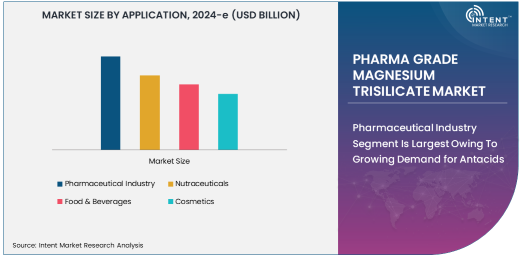
Pharmaceutical Industry Segment Is Largest Owing To Growing Demand for Antacids
The pharmaceutical industry remains the largest application segment for Pharma Grade Magnesium Trisilicate. Its primary use in antacid formulations, especially for treating acid reflux, indigestion, and heartburn, has driven its dominance in the market. Pharmaceutical companies increasingly prefer magnesium trisilicate because of its effectiveness and safety profile, offering a reliable solution for gastrointestinal disorders. Additionally, the compound’s role as a pharmaceutical excipient in drug formulations further boosts its significance in the industry.
In addition to its role in over-the-counter medications, Pharma Grade Magnesium Trisilicate is essential in various prescription medications. It is highly valued for its ability to neutralize stomach acid and act as a buffer, making it a staple in the preparation of antacid tablets and liquid formulations. As the global population continues to age and the prevalence of gastrointestinal diseases rises, the demand for magnesium-based antacids in the pharmaceutical sector is expected to remain strong.
Powder Form Segment Is Fastest Growing Due To Ease of Integration in Drug Formulations
Among the various forms of Pharma Grade Magnesium Trisilicate, the powder segment is experiencing the fastest growth. The powder form is highly preferred for its versatility in drug formulation, as it can easily be incorporated into tablets, capsules, and other pharmaceutical products. It allows for better control over dosage and ensures consistent quality in each unit. The ability to mix powder with other excipients or active ingredients without compromising on efficacy or texture has made it a popular choice among pharmaceutical manufacturers.
The growing trend of patient-centered drug formulations and customized medications has also contributed to the increased use of powder-based magnesium trisilicate. Furthermore, the powder form is more cost-effective compared to other forms, which encourages its adoption in the mass production of antacid products. As the global pharmaceutical market embraces more complex and personalized treatments, the powder form’s role in both over-the-counter and prescription drugs is expected to expand further.
Pharmaceutical Manufacturers Segment Is Largest End-User Due to High Production Demand
Pharmaceutical manufacturers constitute the largest end-user segment for Pharma Grade Magnesium Trisilicate. These manufacturers rely heavily on magnesium trisilicate as a key ingredient in the production of antacids and other gastrointestinal drugs. The consistent demand for effective acid neutralizing agents in both branded and generic drug markets ensures that pharmaceutical manufacturers remain the primary consumers of this compound. The increasing focus on gastrointestinal health and the growing prevalence of digestive disorders further support the dominance of pharmaceutical manufacturers in the market.
Pharmaceutical manufacturers also contribute to the growth of the market by driving innovation in drug formulations, creating a variety of products ranging from chewable antacid tablets to liquid suspensions. Their continuous demand for high-quality, standardized excipients like magnesium trisilicate ensures that this segment remains a cornerstone of the market.
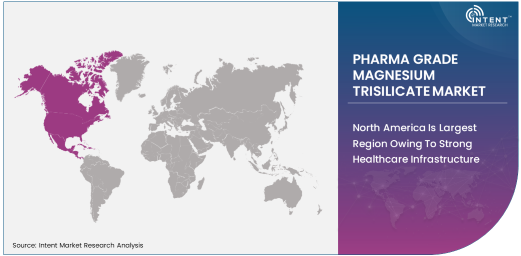
North America Is Largest Region Owing To Strong Healthcare Infrastructure
North America is the largest region in the Pharma Grade Magnesium Trisilicate market, driven by its well-established healthcare infrastructure, high healthcare spending, and a large base of pharmaceutical manufacturers. The region’s robust regulatory frameworks also ensure the consistent quality of pharmaceutical products, which includes the utilization of magnesium trisilicate as a key ingredient in antacid formulations. The significant presence of major pharmaceutical companies in the U.S. and Canada further fuels the demand for high-quality excipients.
The rising incidence of gastrointestinal diseases and the growing awareness among consumers about digestive health are additional factors contributing to North America’s dominance in the market. Furthermore, the region’s advanced research and development (R&D) capabilities in the pharmaceutical sector support the continuous innovation of new formulations that incorporate magnesium trisilicate. As a result, North America is expected to maintain its leadership in the Pharma Grade Magnesium Trisilicate market for the foreseeable future.
Competitive Landscape and Leading Companies
The competitive landscape of the Pharma Grade Magnesium Trisilicate market is highly fragmented, with several key players dominating the space. Leading companies in this market include Albemarle Corporation, Hawkins Inc., Omya International AG, Magnesium Elektron, and Solvay, among others. These companies are actively involved in the production and supply of high-quality magnesium-based products, with a strong focus on meeting the stringent regulatory requirements of the pharmaceutical industry.
The competition is driven by factors such as product innovation, cost-effectiveness, and the ability to meet the growing demands of the pharmaceutical and nutraceutical industries. With an increasing focus on research and development, many companies are looking to differentiate themselves by offering specialized formulations of magnesium trisilicate that cater to specific consumer needs. Strategic partnerships, mergers, and acquisitions are also common in this market, as companies aim to expand their product portfolios and increase their global reach. As the market grows, companies are likely to face heightened competition, necessitating continuous innovation and efficient production techniques to maintain their market position.
Recent Developments:
- Albemarle Corporation recently launched a new line of magnesium-based products for the pharmaceutical industry to enhance the quality of excipients used in formulations.
- Solvay expanded its product portfolio with a new Pharma Grade Magnesium Trisilicate powder to meet the growing demand for high-quality antacid treatments.
- BASF SE entered into a joint venture with a leading pharmaceutical company to produce magnesium silicate excipients for pharmaceutical applications, strengthening its position in the market.
- Omya International AG announced regulatory approval for its new Magnesium Trisilicate formulation, aimed at improving the efficacy of over-the-counter antacid products.
- Magnesium Elektron has made significant investments in expanding its production capacity to meet the growing global demand for magnesium silicate in pharmaceutical applications.
List of Leading Companies:
- Albemarle Corporation
- Hawkins Inc.
- Magnesium Elektron
- Omya International AG
- Solvay
- Imerys
- LyondellBasell Industries
- BASF SE
- Merck Group
- J.M. Huber Corporation
- Magneisium Oxide Limited
- Hindalco Industries
- Kaiser Aluminum
- Rus Chemical
- Magneisium Corporation of America
Report Scope:
|
Report Features |
Description |
|
Market Size (2024-e) |
USD 1.4 Billion |
|
Forecasted Value (2030) |
USD 2.2 Billion |
|
CAGR (2025 – 2030) |
7.8% |
|
Base Year for Estimation |
2024-e |
|
Historic Year |
2023 |
|
Forecast Period |
2025 – 2030 |
|
Report Coverage |
Market Forecast, Market Dynamics, Competitive Landscape, Recent Developments |
|
Segments Covered |
Pharma Grade Magnesium Trisilicate Market By Form (Powder, Granules, Tablets, Capsules), By Application (Pharmaceutical Industry, Nutraceuticals, Food & Beverages, Cosmetics), By End-User (Hospitals & Clinics, Pharmaceutical Manufacturers, Contract Manufacturing Organizations, Retail Pharmacies) |
|
Regional Analysis |
North America (US, Canada, Mexico), Europe (Germany, France, UK, Italy, Spain, and Rest of Europe), Asia-Pacific (China, Japan, South Korea, Australia, India, and Rest of Asia-Pacific), Latin America (Brazil, Argentina, and Rest of Latin America), Middle East & Africa (Saudi Arabia, UAE, Rest of Middle East & Africa) |
|
Major Companies |
Albemarle Corporation, Hawkins Inc., Magnesium Elektron, Omya International AG, Solvay, Imerys, LyondellBasell Industries, BASF SE, Merck Group, J.M. Huber Corporation, Magneisium Oxide Limited, Hindalco Industries, Kaiser Aluminum, Rus Chemical, Magneisium Corporation of America |
|
Customization Scope |
Customization for segments, region/country-level will be provided. Moreover, additional customization can be done based on the requirements |
|
1. Introduction |
|
1.1. Market Definition |
|
1.2. Scope of the Study |
|
1.3. Research Assumptions |
|
1.4. Study Limitations |
|
2. Research Methodology |
|
2.1. Research Approach |
|
2.1.1. Top-Down Method |
|
2.1.2. Bottom-Up Method |
|
2.1.3. Factor Impact Analysis |
|
2.2. Insights & Data Collection Process |
|
2.2.1. Secondary Research |
|
2.2.2. Primary Research |
|
2.3. Data Mining Process |
|
2.3.1. Data Analysis |
|
2.3.2. Data Validation and Revalidation |
|
2.3.3. Data Triangulation |
|
3. Executive Summary |
|
3.1. Major Markets & Segments |
|
3.2. Highest Growing Regions and Respective Countries |
|
3.3. Impact of Growth Drivers & Inhibitors |
|
3.4. Regulatory Overview by Country |
|
4. Pharma Grade Magnesium Trisilicate Market, by Application (Market Size & Forecast: USD Million, 2023 – 2030) |
|
4.1. Pharmaceutical Industry |
|
4.2. Nutraceuticals |
|
4.3. Food & Beverages |
|
4.4. Cosmetics |
|
5. Pharma Grade Magnesium Trisilicate Market, by Form (Market Size & Forecast: USD Million, 2023 – 2030) |
|
5.1. Powder |
|
5.2. Granules |
|
5.3. Tablets |
|
5.4. Capsules |
|
6. Pharma Grade Magnesium Trisilicate Market, by End-User (Market Size & Forecast: USD Million, 2023 – 2030) |
|
6.1. Hospitals & Clinics |
|
6.2. Pharmaceutical Manufacturers |
|
6.3. Contract Manufacturing Organizations (CMOs) |
|
6.4. Retail Pharmacies |
|
7. Regional Analysis (Market Size & Forecast: USD Million, 2023 – 2030) |
|
7.1. Regional Overview |
|
7.2. North America |
|
7.2.1. Regional Trends & Growth Drivers |
|
7.2.2. Barriers & Challenges |
|
7.2.3. Opportunities |
|
7.2.4. Factor Impact Analysis |
|
7.2.5. Technology Trends |
|
7.2.6. North America Pharma Grade Magnesium Trisilicate Market, by Application |
|
7.2.7. North America Pharma Grade Magnesium Trisilicate Market, by Form |
|
7.2.8. North America Pharma Grade Magnesium Trisilicate Market, by End-User |
|
7.2.9. By Country |
|
7.2.9.1. US |
|
7.2.9.1.1. US Pharma Grade Magnesium Trisilicate Market, by Application |
|
7.2.9.1.2. US Pharma Grade Magnesium Trisilicate Market, by Form |
|
7.2.9.1.3. US Pharma Grade Magnesium Trisilicate Market, by End-User |
|
7.2.9.2. Canada |
|
7.2.9.3. Mexico |
|
*Similar segmentation will be provided for each region and country |
|
7.3. Europe |
|
7.4. Asia-Pacific |
|
7.5. Latin America |
|
7.6. Middle East & Africa |
|
8. Competitive Landscape |
|
8.1. Overview of the Key Players |
|
8.2. Competitive Ecosystem |
|
8.2.1. Level of Fragmentation |
|
8.2.2. Market Consolidation |
|
8.2.3. Product Innovation |
|
8.3. Company Share Analysis |
|
8.4. Company Benchmarking Matrix |
|
8.4.1. Strategic Overview |
|
8.4.2. Product Innovations |
|
8.5. Start-up Ecosystem |
|
8.6. Strategic Competitive Insights/ Customer Imperatives |
|
8.7. ESG Matrix/ Sustainability Matrix |
|
8.8. Manufacturing Network |
|
8.8.1. Locations |
|
8.8.2. Supply Chain and Logistics |
|
8.8.3. Product Flexibility/Customization |
|
8.8.4. Digital Transformation and Connectivity |
|
8.8.5. Environmental and Regulatory Compliance |
|
8.9. Technology Readiness Level Matrix |
|
8.10. Technology Maturity Curve |
|
8.11. Buying Criteria |
|
9. Company Profiles |
|
9.1. Albemarle Corporation |
|
9.1.1. Company Overview |
|
9.1.2. Company Financials |
|
9.1.3. Product/Service Portfolio |
|
9.1.4. Recent Developments |
|
9.1.5. IMR Analysis |
|
*Similar information will be provided for other companies |
|
9.2. Hawkins Inc. |
|
9.3. Magnesium Elektron |
|
9.4. Omya International AG |
|
9.5. Solvay |
|
9.6. Imerys |
|
9.7. LyondellBasell Industries |
|
9.8. BASF SE |
|
9.9. Merck Group |
|
9.10. J.M. Huber Corporation |
|
9.11. Magneisium Oxide Limited |
|
9.12. Hindalco Industries |
|
9.13. Kaiser Aluminum |
|
9.14. Rus Chemical |
|
9.15. Magneisium Corporation of America |
|
10. Appendix |
A comprehensive market research approach was employed to gather and analyze data on the Pharma Grade Magnesium Trisilicate Market. In the process, the analysis was also done to analyze the parent market and relevant adjacencies to measure the impact of them on the Pharma Grade Magnesium Trisilicate Market. The research methodology encompassed both secondary and primary research techniques, ensuring the accuracy and credibility of the findings.
.jpg)
Secondary Research
Secondary research involved a thorough review of pertinent industry reports, journals, articles, and publications. Additionally, annual reports, press releases, and investor presentations of industry players were scrutinized to gain insights into their market positioning and strategies.
Primary Research
Primary research involved conducting in-depth interviews with industry experts, stakeholders, and market participants across the E-Waste Management ecosystem. The primary research objectives included:
- Validating findings and assumptions derived from secondary research
- Gathering qualitative and quantitative data on market trends, drivers, and challenges
- Understanding the demand-side dynamics, encompassing end-users, component manufacturers, facility providers, and service providers
- Assessing the supply-side landscape, including technological advancements and recent developments
Market Size Assessment
A combination of top-down and bottom-up approaches was utilized to analyze the overall size of the Pharma Grade Magnesium Trisilicate Market. These methods were also employed to assess the size of various subsegments within the market. The market size assessment methodology encompassed the following steps:
- Identification of key industry players and relevant revenues through extensive secondary research
- Determination of the industry's supply chain and market size, in terms of value, through primary and secondary research processes
- Calculation of percentage shares, splits, and breakdowns using secondary sources and verification through primary sources
.jpg)
Data Triangulation
To ensure the accuracy and reliability of the market size, data triangulation was implemented. This involved cross-referencing data from various sources, including demand and supply side factors, market trends, and expert opinions. Additionally, top-down and bottom-up approaches were employed to validate the market size assessment.
NA