
As per Intent Market Research, the Petroleum Waxes Market was valued at USD 7.9 Billion in 2024-e and will surpass USD 10.6 Billion by 2030; growing at a CAGR of 5.1% during 2025-2030.
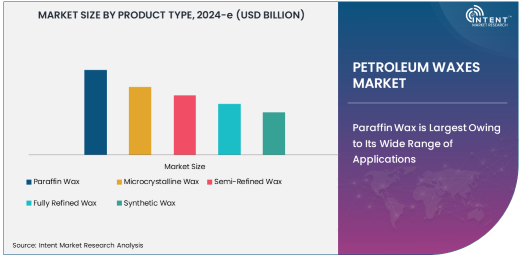
The petroleum waxes market is vital to various industries due to its wide range of applications and versatile characteristics. Petroleum waxes, derived from crude oil refining, are used in everything from packaging and coatings to food safety and industrial products. With increasing demand for these waxes across different sectors, the market is witnessing steady growth. Among the different types of petroleum waxes available, paraffin wax holds the largest market share, owing to its widespread use in industries such as candles, packaging, and coatings.
Paraffin Wax is Largest Owing to Its Wide Range of Applications
Paraffin wax is the most commonly used type of petroleum wax, accounting for a significant share of the market. Its low cost, ease of processing, and versatile physical properties make it ideal for a variety of applications, including the production of candles, packaging materials, and coatings. The demand for paraffin wax is driven by the growing candle industry, which is particularly popular in North America and Europe, as well as the expanding packaging sector. Additionally, paraffin wax is used extensively in the production of cosmetics, food packaging, and pharmaceuticals, further contributing to its dominance in the market.
Candles Application is Fastest Growing Owing to Rising Consumer Demand
The candle market is the fastest-growing application segment for petroleum waxes, primarily driven by shifting consumer preferences towards home decor and wellness products. With the increasing trend of using candles for relaxation, aromatherapy, and aesthetic purposes, the demand for candle wax has surged. The use of petroleum-based paraffin wax remains dominant in candle production due to its affordability, availability, and ability to burn cleanly. In addition, the rising interest in luxury and scented candles has further contributed to the growth of this segment. The expansion of retail and online platforms has also played a critical role in driving consumer demand for candles globally.
Consumer Goods Industry Leads Demand for Petroleum Waxes
Among the various end-user industries, the consumer goods sector remains the largest contributor to the petroleum wax market. The extensive use of petroleum waxes in cosmetics, personal care products, and packaging materials is a key factor driving this demand. Additionally, the growing trend of eco-friendly and organic products has prompted the use of waxes that offer properties such as biodegradability and non-toxicity, which further boosts the market for petroleum waxes in consumer goods. As the global population continues to grow and consumer purchasing power increases, the demand for petroleum waxes in this industry is expected to remain strong.
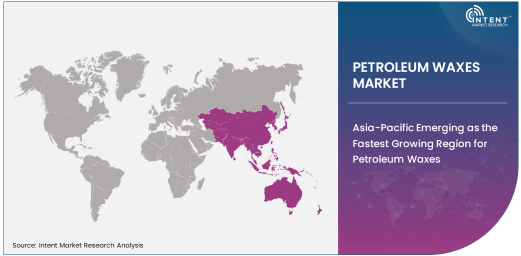
Asia-Pacific Emerging as the Fastest Growing Region for Petroleum Waxes
The petroleum waxes market is global in nature, with demand spread across various regions. Asia-Pacific is currently the fastest-growing region, driven by the expansion of industries such as packaging, automotive, and consumer goods. The region has seen a sharp rise in the production and consumption of petroleum waxes, with countries like China and India leading the charge. The growing industrialization, increasing disposable income, and expanding manufacturing base in these countries are key factors fueling the growth of the petroleum wax market.
Leading Companies and Competitive Landscape in the Petroleum Waxes Market
The petroleum waxes market is highly competitive, with numerous players vying for market share across product types, applications, and regions. Leading companies such as ExxonMobil Corporation, Shell Plc, Sinopec Corporation, and Sasol Limited dominate the global market due to their extensive product portfolios, robust production capabilities, and global distribution networks. These companies maintain a strong presence in key markets, including North America, Europe, and Asia-Pacific.
Competitive Landscape and Strategies
The competitive landscape in the petroleum waxes market is characterized by a mix of large multinational corporations and specialized regional players. Companies are increasingly focusing on product innovation, supply chain optimization, and strategic partnerships to maintain a competitive edge. Moreover, there is a growing emphasis on sustainable production methods, with companies investing in eco-friendly wax alternatives to cater to the rising consumer demand for more environmentally responsible products. Mergers, acquisitions, and joint ventures are also common strategies employed by companies to expand their market reach and product offerings, ensuring they stay ahead in an increasingly competitive market.
Recent Developments:
- Sasol has completed its facility expansion to meet the growing global demand for wax applications.
- Shell announced the acquisition of a regional wax manufacturer to strengthen its specialty wax product portfolio.
- The new product is certified for direct and indirect food contact, targeting the food packaging sector.
- Sinopec has launched a fully refined wax product that adheres to stringent pharmaceutical industry standards.
List of Leading Companies:
- ExxonMobil Corporation
- Shell Plc
- Sinopec Corporation
- Lukoil
- Sasol Limited
- PetroChina Company Limited
- H&R Group
- Cepsa
- Nippon Seiro Co., Ltd.
- The International Group, Inc.
- Blended Waxes, Inc.
- BASF SE
- Sonneborn LLC
- HollyFrontier Refining & Marketing LLC
- Calumet Specialty Products Partners, L.P.
Report Scope:
|
Report Features |
Description |
|
Market Size (2024-e) |
USD 7.9 Billion |
|
Forecasted Value (2030) |
USD 10.6 Billion |
|
CAGR (2025 – 2030) |
5.1% |
|
Base Year for Estimation |
2024-e |
|
Historic Year |
2023 |
|
Forecast Period |
2025 – 2030 |
|
Report Coverage |
Market Forecast, Market Dynamics, Competitive Landscape, Recent Developments |
|
Segments Covered |
Petroleum Waxes Market By Product Type (Paraffin Wax, Microcrystalline Wax, Semi-Refined Wax, Fully Refined Wax, Synthetic Wax), By Application (Candles, Packaging, Coatings & Polishes, Rubber Processing, Hot Melt Adhesives), By End-User Industry (Consumer Goods, Food & Beverage, Pharmaceuticals, Automotive, Chemicals) |
|
Regional Analysis |
North America (US, Canada, Mexico), Europe (Germany, France, UK, Italy, Spain, and Rest of Europe), Asia-Pacific (China, Japan, South Korea, Australia, India, and Rest of Asia-Pacific), Latin America (Brazil, Argentina, and Rest of Latin America), Middle East & Africa (Saudi Arabia, UAE, Rest of Middle East & Africa) |
|
Major Companies |
ExxonMobil Corporation, Shell Plc, Sinopec Corporation, Lukoil, Sasol Limited, PetroChina Company Limited, H&R Group, Cepsa, Nippon Seiro Co., Ltd., The International Group, Inc., Blended Waxes, Inc., BASF SE, Sonneborn LLC, HollyFrontier Refining & Marketing LLC, Calumet Specialty Products Partners, L.P. |
|
Customization Scope |
Customization for segments, region/country-level will be provided. Moreover, additional customization can be done based on the requirements |
|
1. Introduction |
|
1.1. Market Definition |
|
1.2. Scope of the Study |
|
1.3. Research Assumptions |
|
1.4. Study Limitations |
|
2. Research Methodology |
|
2.1. Research Approach |
|
2.1.1. Top-Down Method |
|
2.1.2. Bottom-Up Method |
|
2.1.3. Factor Impact Analysis |
|
2.2. Insights & Data Collection Process |
|
2.2.1. Secondary Research |
|
2.2.2. Primary Research |
|
2.3. Data Mining Process |
|
2.3.1. Data Analysis |
|
2.3.2. Data Validation and Revalidation |
|
2.3.3. Data Triangulation |
|
3. Executive Summary |
|
3.1. Major Markets & Segments |
|
3.2. Highest Growing Regions and Respective Countries |
|
3.3. Impact of Growth Drivers & Inhibitors |
|
3.4. Regulatory Overview by Country |
|
4. Petroleum Waxes Market, by Product Type (Market Size & Forecast: USD Million, 2023 – 2030) |
|
4.1. Paraffin Wax |
|
4.2. Microcrystalline Wax |
|
4.3. Semi-Refined Wax |
|
4.4. Fully Refined Wax |
|
4.5. Synthetic Wax |
|
5. Petroleum Waxes Market, by Application (Market Size & Forecast: USD Million, 2023 – 2030) |
|
5.1. Candles |
|
5.2. Packaging |
|
5.3. Coatings & Polishes |
|
5.4. Rubber Processing |
|
5.5. Hot Melt Adhesives |
|
6. Petroleum Waxes Market, by End-User Industry (Market Size & Forecast: USD Million, 2023 – 2030) |
|
6.1. Consumer Goods |
|
6.2. Food & Beverage |
|
6.3. Pharmaceuticals |
|
6.4. Automotive |
|
6.5. Chemicals |
|
7. Regional Analysis (Market Size & Forecast: USD Million, 2023 – 2030) |
|
7.1. Regional Overview |
|
7.2. North America |
|
7.2.1. Regional Trends & Growth Drivers |
|
7.2.2. Barriers & Challenges |
|
7.2.3. Opportunities |
|
7.2.4. Factor Impact Analysis |
|
7.2.5. Technology Trends |
|
7.2.6. North America Petroleum Waxes Market, by Product Type |
|
7.2.7. North America Petroleum Waxes Market, by Application |
|
7.2.8. North America Petroleum Waxes Market, by End-User Industry |
|
7.2.9. By Country |
|
7.2.9.1. US |
|
7.2.9.1.1. US Petroleum Waxes Market, by Product Type |
|
7.2.9.1.2. US Petroleum Waxes Market, by Application |
|
7.2.9.1.3. US Petroleum Waxes Market, by End-User Industry |
|
7.2.9.2. Canada |
|
7.2.9.3. Mexico |
|
*Similar segmentation will be provided for each region and country |
|
7.3. Europe |
|
7.4. Asia-Pacific |
|
7.5. Latin America |
|
7.6. Middle East & Africa |
|
8. Competitive Landscape |
|
8.1. Overview of the Key Players |
|
8.2. Competitive Ecosystem |
|
8.2.1. Level of Fragmentation |
|
8.2.2. Market Consolidation |
|
8.2.3. Product Innovation |
|
8.3. Company Share Analysis |
|
8.4. Company Benchmarking Matrix |
|
8.4.1. Strategic Overview |
|
8.4.2. Product Innovations |
|
8.5. Start-up Ecosystem |
|
8.6. Strategic Competitive Insights/ Customer Imperatives |
|
8.7. ESG Matrix/ Sustainability Matrix |
|
8.8. Manufacturing Network |
|
8.8.1. Locations |
|
8.8.2. Supply Chain and Logistics |
|
8.8.3. Product Flexibility/Customization |
|
8.8.4. Digital Transformation and Connectivity |
|
8.8.5. Environmental and Regulatory Compliance |
|
8.9. Technology Readiness Level Matrix |
|
8.10. Technology Maturity Curve |
|
8.11. Buying Criteria |
|
9. Company Profiles |
|
9.1. ExxonMobil Corporation |
|
9.1.1. Company Overview |
|
9.1.2. Company Financials |
|
9.1.3. Product/Service Portfolio |
|
9.1.4. Recent Developments |
|
9.1.5. IMR Analysis |
|
*Similar information will be provided for other companies |
|
9.2. Shell Plc |
|
9.3. Sinopec Corporation |
|
9.4. Lukoil |
|
9.5. Sasol Limited |
|
9.6. PetroChina Company Limited |
|
9.7. H&R Group |
|
9.8. Cepsa |
|
9.9. Nippon Seiro Co., Ltd. |
|
9.10. The International Group, Inc. |
|
9.11. Blended Waxes, Inc. |
|
9.12. BASF SE |
|
9.13. Sonneborn LLC |
|
9.14. HollyFrontier Refining & Marketing LLC |
|
9.15. Calumet Specialty Products Partners, L.P. |
|
10. Appendix |
A comprehensive market research approach was employed to gather and analyze data on the Petroleum Waxes Market. In the process, the analysis was also done to analyze the parent market and relevant adjacencies to measure the impact of them on the Petroleum Waxes Market. The research methodology encompassed both secondary and primary research techniques, ensuring the accuracy and credibility of the findings.
.jpg)
Secondary Research
Secondary research involved a thorough review of pertinent industry reports, journals, articles, and publications. Additionally, annual reports, press releases, and investor presentations of industry players were scrutinized to gain insights into their market positioning and strategies.
Primary Research
Primary research involved conducting in-depth interviews with industry experts, stakeholders, and market participants across the E-Waste Management ecosystem. The primary research objectives included:
- Validating findings and assumptions derived from secondary research
- Gathering qualitative and quantitative data on market trends, drivers, and challenges
- Understanding the demand-side dynamics, encompassing end-users, component manufacturers, facility providers, and service providers
- Assessing the supply-side landscape, including technological advancements and recent developments
Market Size Assessment
A combination of top-down and bottom-up approaches was utilized to analyze the overall size of the Petroleum Waxes Market. These methods were also employed to assess the size of various subsegments within the market. The market size assessment methodology encompassed the following steps:
- Identification of key industry players and relevant revenues through extensive secondary research
- Determination of the industry's supply chain and market size, in terms of value, through primary and secondary research processes
- Calculation of percentage shares, splits, and breakdowns using secondary sources and verification through primary sources
.jpg)
Data Triangulation
To ensure the accuracy and reliability of the market size, data triangulation was implemented. This involved cross-referencing data from various sources, including demand and supply side factors, market trends, and expert opinions. Additionally, top-down and bottom-up approaches were employed to validate the market size assessment.
NA