
As per Intent Market Research, the Petroleum Refining Blue Hydrogen Market was valued at USD 1.3 Billion in 2024-e and will surpass USD 2.1 Billion by 2030; growing at a CAGR of 8.6% during 2025-2030.
The petroleum refining blue hydrogen market is a cornerstone of the global energy transition, leveraging advanced carbon capture technologies to reduce greenhouse gas emissions while meeting growing demand for cleaner energy solutions. With industries and governments emphasizing sustainability, blue hydrogen production in refineries is becoming integral to decarbonizing traditional energy systems. This market is poised for substantial growth, supported by technological advancements, regulatory frameworks, and expanding applications across diverse industries.
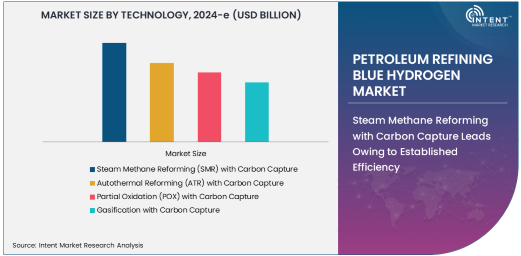
Steam Methane Reforming with Carbon Capture Leads Owing to Established Efficiency
Steam Methane Reforming (SMR) with carbon capture is the largest segment in the market due to its established efficiency and widespread adoption. SMR enables large-scale hydrogen production by reforming natural gas, and when coupled with carbon capture and storage (CCS) technology, it significantly reduces emissions.
The dominance of SMR is attributed to its scalability, cost-effectiveness, and compatibility with existing refinery infrastructure. Companies are increasingly integrating CCS into SMR processes to align with stringent emission regulations, making it the backbone of blue hydrogen production in refineries.
Desulfurization Segment is Fastest Growing Due to Environmental Regulations
Desulfurization is the fastest-growing application segment, driven by stringent global regulations to reduce sulfur content in fuels. Blue hydrogen plays a critical role in the hydrodesulfurization process, enabling refineries to produce cleaner fuels that comply with emission standards.
The increasing adoption of desulfurization technologies is supported by the growing demand for ultra-low sulfur diesel (ULSD) and gasoline. As governments push for cleaner transportation fuels, the need for blue hydrogen in desulfurization processes is accelerating rapidly.
Transportation Fuel Segment Leads Owing to Decarbonization Efforts
The transportation fuel segment is the largest end-user industry due to the rising demand for low-emission fuels. Blue hydrogen is a vital component in producing cleaner fuels for vehicles, supporting the decarbonization of the transportation sector.
Government incentives and consumer demand for sustainable fuel alternatives are driving the growth of blue hydrogen in this segment. Moreover, advancements in hydrogen fuel cell technology for vehicles are contributing to the segment's prominence in the market.
Gas Pipelines Segment is Fastest Growing with Infrastructure Expansion
Gas pipelines are the fastest-growing distribution channel as they offer an efficient and scalable means of transporting blue hydrogen. Pipeline networks are being expanded and upgraded to accommodate the growing demand for hydrogen across various industries.
The development of dedicated hydrogen pipelines and blending hydrogen with natural gas are key drivers for this segment. As infrastructure investments continue, gas pipelines are expected to play a pivotal role in distributing blue hydrogen globally.
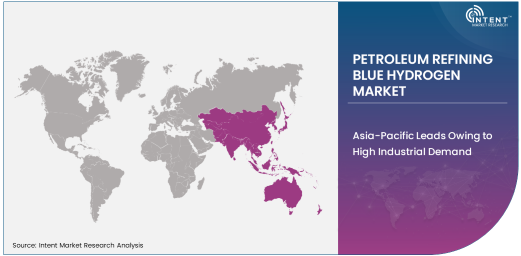
Asia-Pacific Leads Owing to High Industrial Demand
Asia-Pacific is the largest region in the petroleum refining blue hydrogen market, driven by rapid industrialization, significant refinery capacity, and strong government support for cleaner energy solutions. Countries like China, India, and Japan are investing heavily in blue hydrogen technologies to meet their energy transition goals.
The region's dominance is further supported by growing demand for hydrogen in refining, petrochemicals, and transportation. Strategic collaborations and investments in CCS facilities are enabling Asia-Pacific to maintain its leadership in the market.
Competitive Landscape: Leaders Focus on Innovation and Expansion
Leading companies such as Air Products, Linde, Shell, and ExxonMobil are driving the competitive landscape with investments in advanced carbon capture technologies and large-scale blue hydrogen projects. Collaborations between oil majors and technology providers are accelerating innovation and deployment.
The market is characterized by strategic partnerships, mergers, and acquisitions aimed at expanding capabilities and market presence. With rising demand for sustainable hydrogen solutions, competition among key players is expected to intensify, fostering innovation and technological advancements.
Recent Developments:
- In December 2024, Shell announced a collaboration with RWE to construct a large-scale blue hydrogen plant in Germany, supporting the country’s net-zero goals.
- ExxonMobil unveiled plans in November 2024 to expand its CCS facilities, aiming to scale its blue hydrogen production globally.
- Air Products began operations at its new Texas-based hydrogen facility in October 2024, incorporating advanced CCS technology.
- In September 2024, Linde announced a strategic investment in a start-up specializing in innovative blue hydrogen solutions.
List of Leading Companies:
- Air Products and Chemicals, Inc.
- Linde plc
- Air Liquide S.A.
- Shell Global Solutions
- BP p.l.c.
- ExxonMobil Corporation
- Chevron Corporation
- Sinopec Limited
- TotalEnergies SE
- Mitsubishi Heavy Industries, Ltd.
- Iwatani Corporation
- Uniper SE
- HyGear B.V.
- Chart Industries, Inc.
- Cummins Inc.
Report Scope:
|
Report Features |
Description |
|
Market Size (2024-e) |
USD 1.3 Billion |
|
Forecasted Value (2030) |
USD 2.1 Billion |
|
CAGR (2025 – 2030) |
8.6% |
|
Base Year for Estimation |
2024-e |
|
Historic Year |
2023 |
|
Forecast Period |
2025 – 2030 |
|
Report Coverage |
Market Forecast, Market Dynamics, Competitive Landscape, Recent Developments |
|
Segments Covered |
Petroleum Refining Blue Hydrogen Market By Technology (Steam Methane Reforming with Carbon Capture, Autothermal Reforming with Carbon Capture, Partial Oxidation with Carbon Capture, Gasification with Carbon Capture), By Application (Hydrogenation, Desulfurization, Hydrocracking, Refinery Heating, Fuel Production), By End-User Industry (Oil & Gas, Petrochemical Manufacturing, Power Generation, Transportation Fuel, Chemicals), By Distribution Channel (Direct Supply, Gas Pipelines, Tanker Delivery, Onsite Generation) |
|
Regional Analysis |
North America (US, Canada, Mexico), Europe (Germany, France, UK, Italy, Spain, and Rest of Europe), Asia-Pacific (China, Japan, South Korea, Australia, India, and Rest of Asia-Pacific), Latin America (Brazil, Argentina, and Rest of Latin America), Middle East & Africa (Saudi Arabia, UAE, Rest of Middle East & Africa) |
|
Major Companies |
Air Products and Chemicals, Inc., Linde plc, Air Liquide S.A., Shell Global Solutions, BP p.l.c., ExxonMobil Corporation, Chevron Corporation, Sinopec Limited, TotalEnergies SE, Mitsubishi Heavy Industries, Ltd., Iwatani Corporation, Uniper SE, HyGear B.V., Chart Industries, Inc., Cummins Inc. |
|
Customization Scope |
Customization for segments, region/country-level will be provided. Moreover, additional customization can be done based on the requirements |
|
1. Introduction |
|
1.1. Market Definition |
|
1.2. Scope of the Study |
|
1.3. Research Assumptions |
|
1.4. Study Limitations |
|
2. Research Methodology |
|
2.1. Research Approach |
|
2.1.1. Top-Down Method |
|
2.1.2. Bottom-Up Method |
|
2.1.3. Factor Impact Analysis |
|
2.2. Insights & Data Collection Process |
|
2.2.1. Secondary Research |
|
2.2.2. Primary Research |
|
2.3. Data Mining Process |
|
2.3.1. Data Analysis |
|
2.3.2. Data Validation and Revalidation |
|
2.3.3. Data Triangulation |
|
3. Executive Summary |
|
3.1. Major Markets & Segments |
|
3.2. Highest Growing Regions and Respective Countries |
|
3.3. Impact of Growth Drivers & Inhibitors |
|
3.4. Regulatory Overview by Country |
|
4. Petroleum Refining Blue Hydrogen Market, by Technology (Market Size & Forecast: USD Million, 2023 – 2030) |
|
4.1. Steam Methane Reforming (SMR) with Carbon Capture |
|
4.2. Autothermal Reforming (ATR) with Carbon Capture |
|
4.3. Partial Oxidation (POX) with Carbon Capture |
|
4.4. Gasification with Carbon Capture |
|
5. Petroleum Refining Blue Hydrogen Market, by Application (Market Size & Forecast: USD Million, 2023 – 2030) |
|
5.1. Hydrogenation |
|
5.2. Desulfurization |
|
5.3. Hydrocracking |
|
5.4. Refinery Heating |
|
5.5. Fuel Production |
|
6. Petroleum Refining Blue Hydrogen Market, by End-User Industry (Market Size & Forecast: USD Million, 2023 – 2030) |
|
6.1. Oil & Gas |
|
6.2. Petrochemical Manufacturing |
|
6.3. Power Generation |
|
6.4. Transportation Fuel |
|
6.5. Chemicals |
|
7. Petroleum Refining Blue Hydrogen Market, by Distribution Channel (Market Size & Forecast: USD Million, 2023 – 2030) |
|
7.1. Direct Supply |
|
7.2. Gas Pipelines |
|
7.3. Tanker Delivery |
|
7.4. Onsite Generation |
|
8. Regional Analysis (Market Size & Forecast: USD Million, 2023 – 2030) |
|
8.1. Regional Overview |
|
8.2. North America |
|
8.2.1. Regional Trends & Growth Drivers |
|
8.2.2. Barriers & Challenges |
|
8.2.3. Opportunities |
|
8.2.4. Factor Impact Analysis |
|
8.2.5. Technology Trends |
|
8.2.6. North America Petroleum Refining Blue Hydrogen Market, by Technology |
|
8.2.7. North America Petroleum Refining Blue Hydrogen Market, by Application |
|
8.2.8. North America Petroleum Refining Blue Hydrogen Market, by End-User Industry |
|
8.2.9. North America Petroleum Refining Blue Hydrogen Market, by Distribution Channel |
|
8.2.10. By Country |
|
8.2.10.1. US |
|
8.2.10.1.1. US Petroleum Refining Blue Hydrogen Market, by Technology |
|
8.2.10.1.2. US Petroleum Refining Blue Hydrogen Market, by Application |
|
8.2.10.1.3. US Petroleum Refining Blue Hydrogen Market, by End-User Industry |
|
8.2.10.1.4. US Petroleum Refining Blue Hydrogen Market, by Distribution Channel |
|
8.2.10.2. Canada |
|
8.2.10.3. Mexico |
|
*Similar segmentation will be provided for each region and country |
|
8.3. Europe |
|
8.4. Asia-Pacific |
|
8.5. Latin America |
|
8.6. Middle East & Africa |
|
9. Competitive Landscape |
|
9.1. Overview of the Key Players |
|
9.2. Competitive Ecosystem |
|
9.2.1. Level of Fragmentation |
|
9.2.2. Market Consolidation |
|
9.2.3. Product Innovation |
|
9.3. Company Share Analysis |
|
9.4. Company Benchmarking Matrix |
|
9.4.1. Strategic Overview |
|
9.4.2. Product Innovations |
|
9.5. Start-up Ecosystem |
|
9.6. Strategic Competitive Insights/ Customer Imperatives |
|
9.7. ESG Matrix/ Sustainability Matrix |
|
9.8. Manufacturing Network |
|
9.8.1. Locations |
|
9.8.2. Supply Chain and Logistics |
|
9.8.3. Product Flexibility/Customization |
|
9.8.4. Digital Transformation and Connectivity |
|
9.8.5. Environmental and Regulatory Compliance |
|
9.9. Technology Readiness Level Matrix |
|
9.10. Technology Maturity Curve |
|
9.11. Buying Criteria |
|
10. Company Profiles |
|
10.1. Air Products and Chemicals, Inc. |
|
10.1.1. Company Overview |
|
10.1.2. Company Financials |
|
10.1.3. Product/Service Portfolio |
|
10.1.4. Recent Developments |
|
10.1.5. IMR Analysis |
|
*Similar information will be provided for other companies |
|
10.2. Linde plc |
|
10.3. Air Liquide |
|
10.4. Praxair, Inc. |
|
10.5. Shell Hydrogen |
|
10.6. ExxonMobil Corporation |
|
10.7. BP PLC |
|
10.8. Chevron Corporation |
|
10.9. Sinopec Limited |
|
10.10. TotalEnergies SE |
|
10.11. Mitsubishi Chemical Corporation |
|
10.12. Iwatani Corporation |
|
10.13. Messer Group GmbH |
|
10.14. Uniper SE |
|
10.15. Chiyoda Corporation |
|
11. Appendix |
A comprehensive market research approach was employed to gather and analyze data on the Petroleum Refining Blue Hydrogen Market. In the process, the analysis was also done to analyze the parent market and relevant adjacencies to measure the impact of them on the Petroleum Refining Blue Hydrogen Market. The research methodology encompassed both secondary and primary research techniques, ensuring the accuracy and credibility of the findings.
.jpg)
Secondary Research
Secondary research involved a thorough review of pertinent industry reports, journals, articles, and publications. Additionally, annual reports, press releases, and investor presentations of industry players were scrutinized to gain insights into their market positioning and strategies.
Primary Research
Primary research involved conducting in-depth interviews with industry experts, stakeholders, and market participants across the E-Waste Management ecosystem. The primary research objectives included:
- Validating findings and assumptions derived from secondary research
- Gathering qualitative and quantitative data on market trends, drivers, and challenges
- Understanding the demand-side dynamics, encompassing end-users, component manufacturers, facility providers, and service providers
- Assessing the supply-side landscape, including technological advancements and recent developments
Market Size Assessment
A combination of top-down and bottom-up approaches was utilized to analyze the overall size of the Petroleum Refining Blue Hydrogen Market. These methods were also employed to assess the size of various subsegments within the market. The market size assessment methodology encompassed the following steps:
- Identification of key industry players and relevant revenues through extensive secondary research
- Determination of the industry's supply chain and market size, in terms of value, through primary and secondary research processes
- Calculation of percentage shares, splits, and breakdowns using secondary sources and verification through primary sources
.jpg)
Data Triangulation
To ensure the accuracy and reliability of the market size, data triangulation was implemented. This involved cross-referencing data from various sources, including demand and supply side factors, market trends, and expert opinions. Additionally, top-down and bottom-up approaches were employed to validate the market size assessment.
NA