
As per Intent Market Research, the Petri Dish Market was valued at USD 0.4 Billion in 2024-e and will surpass USD 0.5 Billion by 2030; growing at a CAGR of 4.1% during 2025-2030.
The global Petri dish market is experiencing steady growth, driven by increasing research and development activities across various sectors such as microbiology, pharmaceuticals, and biotechnology. Petri dishes, essential for microbial culturing and tissue culture processes, are widely used in laboratories worldwide. Their application spans numerous industries including healthcare, education, and research institutes, where they serve as a fundamental tool for studying microorganisms, cells, and conducting various laboratory experiments. As demand for laboratory research tools rises, the Petri dish market is poised for expansion, supported by ongoing advancements in scientific research and development.
Glass Petri Dishes Are Largest Owing to Their Durability and Reusability
Glass Petri dishes hold the largest share in the material type segment, largely due to their durability, non-reactivity, and reusability. These dishes are ideal for applications in microbiology and tissue culture, where maintaining a sterile environment and accurate observation is crucial. Glass Petri dishes have long been a preferred choice for laboratory researchers because they can be sterilized through autoclaving and used multiple times without degradation, making them cost-effective in the long run. Additionally, their transparent nature allows for easy monitoring of cultures, further enhancing their value in scientific research.
The durability and ease of cleaning make glass Petri dishes essential for high-precision work, particularly in microbiological research. As laboratories continue to prioritize sustainable and long-lasting solutions, the demand for glass-based Petri dishes remains strong. The global shift towards more sustainable practices in laboratory environments further supports the enduring popularity of glass Petri dishes, ensuring their position as the largest subsegment in the market.

Medium-Sized Petri Dishes Are Growing Fast Due to Versatility
In the size category, medium-sized Petri dishes (60 mm to 100 mm) represent the fastest-growing subsegment, driven by their versatile use in various laboratory applications. Medium-sized dishes offer the perfect balance between capacity and ease of handling, making them ideal for a wide range of microbiological and research-based applications. Their size is particularly suitable for bacterial and fungal cultures, as well as tissue culture experiments, which require a moderate surface area to facilitate growth without being overly large or cumbersome to handle.
As laboratories and research facilities increasingly focus on optimizing space and efficiency, medium-sized Petri dishes provide the flexibility needed to handle diverse research needs. Their growing popularity is also fueled by advancements in automation and high-throughput screening, where the size of the Petri dish plays a critical role in enabling faster and more effective experimentation. As research becomes more specialized and scalable, medium-sized Petri dishes will continue to see strong demand, driving their rapid growth in the market.
Microbiology Segment Is Largest Owing to Demand in Healthcare and Research
The microbiology segment is the largest in the Petri dish market, driven by the growing demand for microbial culture and diagnostics in healthcare and research institutions. Microbiological studies are fundamental to various industries, including healthcare, agriculture, and environmental sciences, where Petri dishes are used for isolating, cultivating, and analyzing microorganisms such as bacteria, fungi, and viruses. The rise in infectious diseases, along with the increasing need for antimicrobial resistance (AMR) research, has further fueled the demand for microbiological research tools like Petri dishes.
In healthcare, Petri dishes are crucial for diagnostic purposes, where rapid culturing of microorganisms helps in identifying pathogens and determining appropriate treatments. In addition, the biotechnology and pharmaceutical sectors rely heavily on Petri dishes for genetic research and drug development. With the growing focus on microbial testing, diagnostics, and drug discovery, the microbiology segment is expected to continue dominating the Petri dish market for the foreseeable future.
Research Institutes Are the Largest End-User Segment Due to Expanding Research Activities
Research institutes represent the largest end-user segment in the Petri dish market, largely driven by the increasing global emphasis on scientific research and innovation. These institutes are the primary users of Petri dishes for microbiological studies, tissue cultures, and laboratory experiments. With the rising importance of genomics, biotechnology, and medical research, the demand for Petri dishes in research institutions has surged. Research institutes are at the forefront of academic and clinical studies, where Petri dishes are indispensable tools for studying cellular behavior, drug testing, and microorganisms.
In addition to academic research, these institutions play a key role in advancing medical and agricultural sciences. As funding for research and development continues to grow globally, particularly in emerging markets, the demand for laboratory consumables like Petri dishes is expected to increase, reinforcing the dominance of research institutes as the largest end-user segment in the market.
Online Retailers Are the Fastest Growing Distribution Channel
Online retailers represent the fastest-growing distribution channel in the Petri dish market, driven by the increasing trend of e-commerce in laboratory supply sales. The convenience and accessibility of purchasing laboratory consumables online have significantly contributed to this growth. Online platforms offer a wide variety of Petri dishes, ranging from different materials to various sizes, which allows researchers to easily find and order products that meet their specific needs. This channel is especially appealing to small laboratories, educational institutions, and individual researchers who may not have easy access to specialized laboratory stores or distributors.
The rapid adoption of e-commerce is further fueled by the global shift towards digitalization in research procurement processes. Many suppliers have strengthened their online presence, providing efficient delivery services and better customer support, thus enhancing the attractiveness of online purchasing options. As a result, online retailers are expected to see continued growth, positioning them as the fastest-growing distribution channel in the Petri dish market.
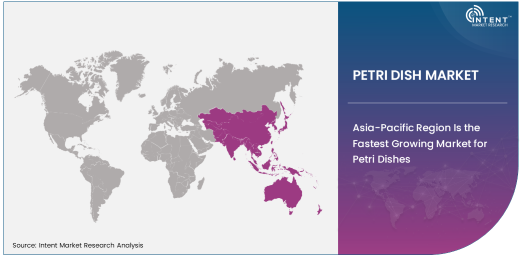
Asia-Pacific Region Is the Fastest Growing Market for Petri Dishes
The Asia-Pacific region is expected to be the fastest-growing market for Petri dishes, driven by the increasing investments in healthcare infrastructure, research, and biotechnology. Countries like China, India, and Japan are making significant strides in expanding their scientific research capabilities, particularly in areas such as microbiology, pharmaceuticals, and environmental sciences. The rise in infectious diseases and the growing emphasis on medical research and diagnostics in these regions are fueling demand for Petri dishes. Additionally, the rapid expansion of the biotechnology sector, particularly in China and India, is further contributing to the region's growth in the Petri dish market.
Increased government funding for scientific research, along with the establishment of new research centers and laboratories, will continue to support the growth of the Petri dish market in the Asia-Pacific region. As the region adopts more advanced technologies and strengthens its research capabilities, the demand for laboratory consumables will see sustained growth, solidifying Asia-Pacific's position as the fastest-growing market for Petri dishes.
Competitive Landscape and Leading Companies
The Petri dish market is highly competitive, with key players striving to expand their product offerings and market presence. Leading companies such as Thermo Fisher Scientific, Corning Inc., and Sigma-Aldrich dominate the market through their extensive portfolios of laboratory consumables, including a wide range of Petri dishes. These companies focus on continuous innovation and the development of high-quality, durable, and cost-effective Petri dishes to meet the diverse needs of laboratories across the globe.
In addition to product innovation, these companies are expanding their distribution channels through both traditional and online retail platforms to enhance their market reach. The increasing emphasis on research and development in life sciences, coupled with the growing trend of e-commerce, is further intensifying competition among these key players. As the market continues to evolve, companies are likely to leverage strategic partnerships, mergers, and acquisitions to strengthen their position in the global Petri dish market.
Recent Developments:
- Thermo Fisher Scientific launched a new range of disposable plastic Petri dishes, providing enhanced clarity and superior performance for microbiology applications.
- Corning Inc. expanded its product portfolio by introducing eco-friendly glass Petri dishes with improved surface properties for cell culture.
- BD Biosciences acquired a leading supplier of laboratory consumables, strengthening its position in the Petri dish and microbiology markets.
- Greiner Bio-One announced the expansion of their laboratory consumables portfolio, including new sizes of Petri dishes designed for high-throughput applications.
- Sartorius AG received regulatory approval for its latest tissue culture Petri dish line, offering greater stability for long-term cell growth and research.
List of Leading Companies:
- Thermo Fisher Scientific
- Corning Inc.
- Sigma-Aldrich
- VWR International
- BD (Becton, Dickinson and Company)
- Falcon (BD Biosciences)
- PerkinElmer
- Eppendorf AG
- Greiner Bio-One
- Sartorius AG
- Labcon North America
- Nunc (Thermo Fisher Scientific)
- Bio-Rad Laboratories
- MilliporeSigma (Merck KGaA)
- Scientific Industries Inc.
Report Scope:
|
Report Features |
Description |
|
Market Size (2024-e) |
USD 0.4 Billion |
|
Forecasted Value (2030) |
USD 0.5 Billion |
|
CAGR (2025 – 2030) |
4.1% |
|
Base Year for Estimation |
2024-e |
|
Historic Year |
2023 |
|
Forecast Period |
2025 – 2030 |
|
Report Coverage |
Market Forecast, Market Dynamics, Competitive Landscape, Recent Developments |
|
Segments Covered |
Petri Dish Market By Material Type (Glass Petri Dishes, Plastic Petri Dishes), By Size (Small, Medium, Large), By Usage (Microbiology, Tissue Culture, Laboratory Research), By End-User (Research Institutes, Hospitals & Diagnostic Labs, Pharmaceutical & Biotechnology Companies, Educational Institutions), By Distribution Channel (Online Retailers, Direct Sales, Distributors, Specialty Stores) |
|
Regional Analysis |
North America (US, Canada, Mexico), Europe (Germany, France, UK, Italy, Spain, and Rest of Europe), Asia-Pacific (China, Japan, South Korea, Australia, India, and Rest of Asia-Pacific), Latin America (Brazil, Argentina, and Rest of Latin America), Middle East & Africa (Saudi Arabia, UAE, Rest of Middle East & Africa) |
|
Major Companies |
Thermo Fisher Scientific, Corning Inc., Sigma-Aldrich, VWR International, BD (Becton, Dickinson and Company), Falcon (BD Biosciences), PerkinElmer, Eppendorf AG, Greiner Bio-One, Sartorius AG, Labcon North America, Nunc (Thermo Fisher Scientific), Bio-Rad Laboratories, MilliporeSigma (Merck KGaA), Scientific Industries Inc. |
|
Customization Scope |
Customization for segments, region/country-level will be provided. Moreover, additional customization can be done based on the requirements |
|
1. Introduction |
|
1.1. Market Definition |
|
1.2. Scope of the Study |
|
1.3. Research Assumptions |
|
1.4. Study Limitations |
|
2. Research Methodology |
|
2.1. Research Approach |
|
2.1.1. Top-Down Method |
|
2.1.2. Bottom-Up Method |
|
2.1.3. Factor Impact Analysis |
|
2.2. Insights & Data Collection Process |
|
2.2.1. Secondary Research |
|
2.2.2. Primary Research |
|
2.3. Data Mining Process |
|
2.3.1. Data Analysis |
|
2.3.2. Data Validation and Revalidation |
|
2.3.3. Data Triangulation |
|
3. Executive Summary |
|
3.1. Major Markets & Segments |
|
3.2. Highest Growing Regions and Respective Countries |
|
3.3. Impact of Growth Drivers & Inhibitors |
|
3.4. Regulatory Overview by Country |
|
4. Petri Dish Market, by Material Type (Market Size & Forecast: USD Million, 2023 – 2030) |
|
4.1. Glass Petri Dishes |
|
4.2. Plastic Petri Dishes |
|
4.3. Others |
|
5. Petri Dish Market, by Size (Market Size & Forecast: USD Million, 2023 – 2030) |
|
5.1. Small (Up to 60 mm) |
|
5.2. Medium (60 mm to 100 mm) |
|
5.3. Large (Above 100 mm) |
|
6. Petri Dish Market, by Usage (Market Size & Forecast: USD Million, 2023 – 2030) |
|
6.1. Microbiology |
|
6.2. Tissue Culture |
|
6.3. Laboratory Research |
|
6.4. Others |
|
7. Petri Dish Market, by End-User (Market Size & Forecast: USD Million, 2023 – 2030) |
|
7.1. Research Institutes |
|
7.2. Hospitals & Diagnostic Labs |
|
7.3. Pharmaceutical & Biotechnology Companies |
|
7.4. Educational Institutions |
|
8. Petri Dish Market, by Distribution Channel (Market Size & Forecast: USD Million, 2023 – 2030) |
|
8.1. Online Retailers |
|
8.2. Direct Sales |
|
8.3. Distributors |
|
8.4. Specialty Stores |
|
9. Regional Analysis (Market Size & Forecast: USD Million, 2023 – 2030) |
|
9.1. Regional Overview |
|
9.2. North America |
|
9.2.1. Regional Trends & Growth Drivers |
|
9.2.2. Barriers & Challenges |
|
9.2.3. Opportunities |
|
9.2.4. Factor Impact Analysis |
|
9.2.5. Technology Trends |
|
9.2.6. North America Petri Dish Market, by Material Type |
|
9.2.7. North America Petri Dish Market, by Size |
|
9.2.8. North America Petri Dish Market, by Usage |
|
9.2.9. North America Petri Dish Market, by End-User |
|
9.2.10. North America Petri Dish Market, by Distribution Channel |
|
9.2.11. By Country |
|
9.2.11.1. US |
|
9.2.11.1.1. US Petri Dish Market, by Material Type |
|
9.2.11.1.2. US Petri Dish Market, by Size |
|
9.2.11.1.3. US Petri Dish Market, by Usage |
|
9.2.11.1.4. US Petri Dish Market, by End-User |
|
9.2.11.1.5. US Petri Dish Market, by Distribution Channel |
|
9.2.11.2. Canada |
|
9.2.11.3. Mexico |
|
*Similar segmentation will be provided for each region and country |
|
9.3. Europe |
|
9.4. Asia-Pacific |
|
9.5. Latin America |
|
9.6. Middle East & Africa |
|
10. Competitive Landscape |
|
10.1. Overview of the Key Players |
|
10.2. Competitive Ecosystem |
|
10.2.1. Level of Fragmentation |
|
10.2.2. Market Consolidation |
|
10.2.3. Product Innovation |
|
10.3. Company Share Analysis |
|
10.4. Company Benchmarking Matrix |
|
10.4.1. Strategic Overview |
|
10.4.2. Product Innovations |
|
10.5. Start-up Ecosystem |
|
10.6. Strategic Competitive Insights/ Customer Imperatives |
|
10.7. ESG Matrix/ Sustainability Matrix |
|
10.8. Manufacturing Network |
|
10.8.1. Locations |
|
10.8.2. Supply Chain and Logistics |
|
10.8.3. Product Flexibility/Customization |
|
10.8.4. Digital Transformation and Connectivity |
|
10.8.5. Environmental and Regulatory Compliance |
|
10.9. Technology Readiness Level Matrix |
|
10.10. Technology Maturity Curve |
|
10.11. Buying Criteria |
|
11. Company Profiles |
|
11.1. Thermo Fisher Scientific |
|
11.1.1. Company Overview |
|
11.1.2. Company Financials |
|
11.1.3. Product/Service Portfolio |
|
11.1.4. Recent Developments |
|
11.1.5. IMR Analysis |
|
*Similar information will be provided for other companies |
|
11.2. Corning Inc. |
|
11.3. Sigma-Aldrich |
|
11.4. VWR International |
|
11.5. BD (Becton, Dickinson and Company) |
|
11.6. Falcon (BD Biosciences) |
|
11.7. PerkinElmer |
|
11.8. Eppendorf AG |
|
11.9. Greiner Bio-One |
|
11.10. Sartorius AG |
|
11.11. Labcon North America |
|
11.12. Nunc (Thermo Fisher Scientific) |
|
11.13. Bio-Rad Laboratories |
|
11.14. MilliporeSigma (Merck KGaA) |
|
11.15. Scientific Industries Inc. |
|
12. Appendix |
A comprehensive market research approach was employed to gather and analyze data on the Petri Dish Market. In the process, the analysis was also done to analyze the parent market and relevant adjacencies to measure the impact of them on the Petri Dish Market. The research methodology encompassed both secondary and primary research techniques, ensuring the accuracy and credibility of the findings.
.jpg)
Secondary Research
Secondary research involved a thorough review of pertinent industry reports, journals, articles, and publications. Additionally, annual reports, press releases, and investor presentations of industry players were scrutinized to gain insights into their market positioning and strategies.
Primary Research
Primary research involved conducting in-depth interviews with industry experts, stakeholders, and market participants across the E-Waste Management ecosystem. The primary research objectives included:
- Validating findings and assumptions derived from secondary research
- Gathering qualitative and quantitative data on market trends, drivers, and challenges
- Understanding the demand-side dynamics, encompassing end-users, component manufacturers, facility providers, and service providers
- Assessing the supply-side landscape, including technological advancements and recent developments
Market Size Assessment
A combination of top-down and bottom-up approaches was utilized to analyze the overall size of the Petri Dish Market. These methods were also employed to assess the size of various subsegments within the market. The market size assessment methodology encompassed the following steps:
- Identification of key industry players and relevant revenues through extensive secondary research
- Determination of the industry's supply chain and market size, in terms of value, through primary and secondary research processes
- Calculation of percentage shares, splits, and breakdowns using secondary sources and verification through primary sources
.jpg)
Data Triangulation
To ensure the accuracy and reliability of the market size, data triangulation was implemented. This involved cross-referencing data from various sources, including demand and supply side factors, market trends, and expert opinions. Additionally, top-down and bottom-up approaches were employed to validate the market size assessment.
NA