
As per Intent Market Research, the Pest Control Services Market was valued at USD 24.7 Billion in 2024-e and will surpass USD 36.8 Billion by 2030; growing at a CAGR of 6.9% during 2025-2030.
The global pest control services market continues to experience significant growth as the demand for effective pest management solutions increases across residential, commercial, and industrial sectors. With urbanization, changing climates, and a growing awareness of health risks posed by pests, the pest control market is evolving to offer comprehensive services, including eco-friendly and integrated pest management (IPM) options. As new pests emerge, the need for specialized services like termite control, rodent management, and pest prevention becomes crucial, driving innovation and competition among market players.
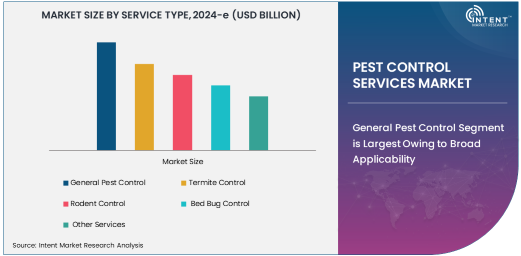
General Pest Control Segment is Largest Owing to Broad Applicability
The general pest control segment remains the largest, driven by its broad applicability across both residential and commercial sectors. This service includes the management of common household and commercial pests like ants, cockroaches, flies, and mosquitoes. These pests are not only a nuisance but also pose health risks, making pest control services essential in maintaining hygiene and safety. The widespread need for general pest control across a variety of environments, from homes to restaurants and office buildings, contributes significantly to its dominance in the market.
General pest control also benefits from the increasing demand for preventative measures that minimize infestations before they become significant issues. With growing concerns about diseases transmitted by pests, such as Zika virus (from mosquitoes) and foodborne illnesses (from rodents), general pest control services are widely sought after. The segment's growth is also supported by the rise of urbanization and population density, making pest management in both private and public spaces a priority across the globe.
Residential End-User Industry is Fastest Growing Due to Urbanization
The residential end-user industry is the fastest-growing segment in the pest control services market. As urbanization accelerates, the demand for pest control in residential buildings is increasing. With more people living in densely populated areas, the risk of pest infestations grows, creating a need for regular pest prevention and extermination services. Additionally, the heightened awareness of pest-related health risks has driven home-owners to seek professional pest control services to protect their living environments.
Rising disposable income in emerging economies also contributes to the growing demand for pest control in residential areas. Consumers are increasingly prioritizing the cleanliness and safety of their homes, and pest control is becoming an integral part of property maintenance. Moreover, the growing trend of sustainable and eco-friendly pest control solutions is attracting more residential customers, further fueling the segment's expansion.
Pest Prevention & Management Application is Largest Owing to Preventative Focus
The pest prevention and management application is the largest in the pest control services market, owing to the growing preference for proactive measures rather than reactive pest control. This application is focused on identifying and addressing the root causes of pest infestations, such as breeding grounds and entry points, before pests become a significant issue. Pest prevention services help reduce the frequency and severity of pest problems, which is increasingly important in both residential and commercial sectors.
The shift towards pest prevention is driven by consumer preferences for long-term solutions that minimize the use of harmful chemicals. Additionally, growing regulatory pressures to maintain hygienic and pest-free environments in food processing, healthcare, and hospitality industries further strengthens the demand for preventive pest management services. Companies are now offering more specialized and sustainable pest control solutions as part of integrated pest management (IPM) strategies, which combine biological, mechanical, and chemical methods to prevent pest issues.
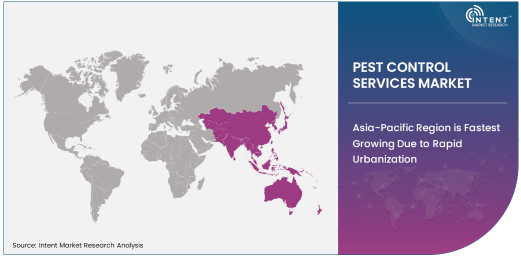
Asia-Pacific Region is Fastest Growing Due to Rapid Urbanization
Asia-Pacific is the fastest-growing region in the global pest control services market. Rapid urbanization, increased population density, and changing climate conditions contribute significantly to the rising demand for pest control services in the region. Countries like India and China are experiencing significant urban growth, leading to increased pest infestations, especially in densely populated cities and towns. These factors, combined with a rising middle-class population and growing consumer awareness about pest-related health risks, make the region a key market for pest control services.
Moreover, the demand for residential, commercial, and industrial pest control services is spurred by the agricultural industry's need for pest management, particularly in countries with large-scale agricultural production. The increasing focus on hygiene, food safety, and pest-free environments in commercial establishments further supports the market growth in this region. With the expansion of cities and the need for pest prevention measures, Asia-Pacific is expected to continue to be a high-growth market for the pest control industry.
Competitive Landscape and Leading Companies
The global pest control services market is highly competitive, with key players focusing on expanding their service offerings, technological advancements, and geographical reach. Leading companies such as Rentokil Initial, Orkin, and Terminix Global Holdings dominate the market, leveraging their established brands, wide service networks, and advanced pest control technologies. These companies are investing heavily in eco-friendly pest management solutions and integrated pest management (IPM) systems to cater to growing consumer demand for sustainable pest control methods.
In addition to global players, regional companies are also gaining market share by offering specialized services tailored to local needs and regulations. The competitive landscape is characterized by mergers and acquisitions, as well as partnerships with local distributors to expand market presence. As the market continues to evolve, companies are focusing on providing value-added services such as pest monitoring technologies, real-time data analytics, and smart pest control systems to stay ahead of the competition. Sustainability and regulatory compliance are key factors driving the innovation and differentiation in the pest control services market.
Recent Developments:
- Rentokil Initial announced its acquisition of Terminix Global Holdings, expanding its market presence and enhancing its pest control services portfolio globally.
- Orkin launched a line of eco-friendly pest control solutions, designed to reduce environmental impact while effectively eliminating pests.
- Arrow Exterminators expanded its service offerings in the southern U.S., providing enhanced pest management services for residential and commercial customers.
- Ecolab launched new pest control solutions focused on the food industry to ensure food safety and hygiene compliance across commercial kitchens and food processing facilities.
- SC Johnson Professional introduced a new range of commercial pest control products aimed at improving the efficacy and safety of pest management in large facilities.
List of Leading Companies:
- Rentokil Initial
- Terminix Global Holdings, Inc.
- Ecolab Inc.
- Rollins Inc.
- Anticimex
- Orkin, LLC (Rollins Inc.)
- SC Johnson Professional
- FMC Corporation
- Bayer AG
- Syngenta AG
- BASF SE
- Killgerm Group Ltd
- Arrow Exterminators
- Arrow Environmental Services
- Massey Services Inc.
Report Scope:
|
Report Features |
Description |
|
Market Size (2024-e) |
USD 24.7 Billion |
|
Forecasted Value (2030) |
USD 36.8 Billion |
|
CAGR (2025 – 2030) |
6.9% |
|
Base Year for Estimation |
2024-e |
|
Historic Year |
2023 |
|
Forecast Period |
2025 – 2030 |
|
Report Coverage |
Market Forecast, Market Dynamics, Competitive Landscape, Recent Developments |
|
Segments Covered |
Pest Control Services Market By Service Type (General Pest Control, Termite Control, Rodent Control, Bed Bug Control), By End-User Industry (Residential, Commercial, Industrial, Agricultural), By Application (Pest Prevention & Management, Pest Inspection, Pest Extermination, Pest Monitoring) |
|
Regional Analysis |
North America (US, Canada, Mexico), Europe (Germany, France, UK, Italy, Spain, and Rest of Europe), Asia-Pacific (China, Japan, South Korea, Australia, India, and Rest of Asia-Pacific), Latin America (Brazil, Argentina, and Rest of Latin America), Middle East & Africa (Saudi Arabia, UAE, Rest of Middle East & Africa) |
|
Major Companies |
Rentokil Initial, Terminix Global Holdings, Inc., Ecolab Inc., Rollins Inc., Anticimex, Orkin, LLC (Rollins Inc.), SC Johnson Professional, FMC Corporation, Bayer AG, Syngenta AG, BASF SE, Killgerm Group Ltd, Arrow Exterminators, Arrow Environmental Services, Massey Services Inc. |
|
Customization Scope |
Customization for segments, region/country-level will be provided. Moreover, additional customization can be done based on the requirements |
|
1. Introduction |
|
1.1. Market Definition |
|
1.2. Scope of the Study |
|
1.3. Research Assumptions |
|
1.4. Study Limitations |
|
2. Research Methodology |
|
2.1. Research Approach |
|
2.1.1. Top-Down Method |
|
2.1.2. Bottom-Up Method |
|
2.1.3. Factor Impact Analysis |
|
2.2. Insights & Data Collection Process |
|
2.2.1. Secondary Research |
|
2.2.2. Primary Research |
|
2.3. Data Mining Process |
|
2.3.1. Data Analysis |
|
2.3.2. Data Validation and Revalidation |
|
2.3.3. Data Triangulation |
|
3. Executive Summary |
|
3.1. Major Markets & Segments |
|
3.2. Highest Growing Regions and Respective Countries |
|
3.3. Impact of Growth Drivers & Inhibitors |
|
3.4. Regulatory Overview by Country |
|
4. Pest Control Services Market, by Service Type (Market Size & Forecast: USD Million, 2023 – 2030) |
|
4.1. General Pest Control |
|
4.2. Termite Control |
|
4.3. Rodent Control |
|
4.4. Bed Bug Control |
|
4.5. Other Services |
|
5. Pest Control Services Market, by End-User Industry (Market Size & Forecast: USD Million, 2023 – 2030) |
|
5.1. Residential |
|
5.2. Commercial |
|
5.3. Industrial |
|
5.4. Agricultural |
|
5.5. Other Industries |
|
6. Pest Control Services Market, by Application (Market Size & Forecast: USD Million, 2023 – 2030) |
|
6.1. Pest Prevention & Management |
|
6.2. Pest Inspection |
|
6.3. Pest Extermination |
|
6.4. Pest Monitoring |
|
7. Regional Analysis (Market Size & Forecast: USD Million, 2023 – 2030) |
|
7.1. Regional Overview |
|
7.2. North America |
|
7.2.1. Regional Trends & Growth Drivers |
|
7.2.2. Barriers & Challenges |
|
7.2.3. Opportunities |
|
7.2.4. Factor Impact Analysis |
|
7.2.5. Technology Trends |
|
7.2.6. North America Pest Control Services Market, by Service Type |
|
7.2.7. North America Pest Control Services Market, by End-User Industry |
|
7.2.8. North America Pest Control Services Market, by Application |
|
7.2.9. By Country |
|
7.2.9.1. US |
|
7.2.9.1.1. US Pest Control Services Market, by Service Type |
|
7.2.9.1.2. US Pest Control Services Market, by End-User Industry |
|
7.2.9.1.3. US Pest Control Services Market, by Application |
|
7.2.9.2. Canada |
|
7.2.9.3. Mexico |
|
*Similar segmentation will be provided for each region and country |
|
7.3. Europe |
|
7.4. Asia-Pacific |
|
7.5. Latin America |
|
7.6. Middle East & Africa |
|
8. Competitive Landscape |
|
8.1. Overview of the Key Players |
|
8.2. Competitive Ecosystem |
|
8.2.1. Level of Fragmentation |
|
8.2.2. Market Consolidation |
|
8.2.3. Product Innovation |
|
8.3. Company Share Analysis |
|
8.4. Company Benchmarking Matrix |
|
8.4.1. Strategic Overview |
|
8.4.2. Product Innovations |
|
8.5. Start-up Ecosystem |
|
8.6. Strategic Competitive Insights/ Customer Imperatives |
|
8.7. ESG Matrix/ Sustainability Matrix |
|
8.8. Manufacturing Network |
|
8.8.1. Locations |
|
8.8.2. Supply Chain and Logistics |
|
8.8.3. Product Flexibility/Customization |
|
8.8.4. Digital Transformation and Connectivity |
|
8.8.5. Environmental and Regulatory Compliance |
|
8.9. Technology Readiness Level Matrix |
|
8.10. Technology Maturity Curve |
|
8.11. Buying Criteria |
|
9. Company Profiles |
|
9.1. Rentokil Initial |
|
9.1.1. Company Overview |
|
9.1.2. Company Financials |
|
9.1.3. Product/Service Portfolio |
|
9.1.4. Recent Developments |
|
9.1.5. IMR Analysis |
|
*Similar information will be provided for other companies |
|
9.2. Terminix Global Holdings, Inc. |
|
9.3. Ecolab Inc. |
|
9.4. Rollins Inc. |
|
9.5. Anticimex |
|
9.6. Orkin, LLC (Rollins Inc.) |
|
9.7. SC Johnson Professional |
|
9.8. FMC Corporation |
|
9.9. Bayer AG |
|
9.10. Syngenta AG |
|
9.11. BASF SE |
|
9.12. Killgerm Group Ltd |
|
9.13. Arrow Exterminators |
|
9.14. Arrow Environmental Services |
|
9.15. Massey Services Inc. |
|
10. Appendix |
A comprehensive market research approach was employed to gather and analyze data on the Pest Control Services Market. In the process, the analysis was also done to analyze the parent market and relevant adjacencies to measure the impact of them on the Pest Control Services Market. The research methodology encompassed both secondary and primary research techniques, ensuring the accuracy and credibility of the findings.
.jpg)
Secondary Research
Secondary research involved a thorough review of pertinent industry reports, journals, articles, and publications. Additionally, annual reports, press releases, and investor presentations of industry players were scrutinized to gain insights into their market positioning and strategies.
Primary Research
Primary research involved conducting in-depth interviews with industry experts, stakeholders, and market participants across the E-Waste Management ecosystem. The primary research objectives included:
- Validating findings and assumptions derived from secondary research
- Gathering qualitative and quantitative data on market trends, drivers, and challenges
- Understanding the demand-side dynamics, encompassing end-users, component manufacturers, facility providers, and service providers
- Assessing the supply-side landscape, including technological advancements and recent developments
Market Size Assessment
A combination of top-down and bottom-up approaches was utilized to analyze the overall size of the Pest Control Services Market. These methods were also employed to assess the size of various subsegments within the market. The market size assessment methodology encompassed the following steps:
- Identification of key industry players and relevant revenues through extensive secondary research
- Determination of the industry's supply chain and market size, in terms of value, through primary and secondary research processes
- Calculation of percentage shares, splits, and breakdowns using secondary sources and verification through primary sources
.jpg)
Data Triangulation
To ensure the accuracy and reliability of the market size, data triangulation was implemented. This involved cross-referencing data from various sources, including demand and supply side factors, market trends, and expert opinions. Additionally, top-down and bottom-up approaches were employed to validate the market size assessment.
NA