
As per Intent Market Research, the Park Assist Camera Market was valued at USD 3.2 Billion in 2024-e and will surpass USD 6.1 Billion by 2030; growing at a CAGR of 9.6% during 2025-2030.
The Park Assist Camera market has witnessed significant growth as automotive safety standards continue to evolve. With increasing consumer demand for enhanced driver assistance features, Park Assist Cameras have become a critical component in modern vehicles. These systems provide real-time visual feedback, reducing blind spots and improving parking and maneuverability. Technological advancements such as artificial intelligence (AI) and machine learning are further enhancing the capabilities of Park Assist Cameras, driving their adoption across various vehicle types and regions.
Front View Cameras Segment is Largest Owing to Their Comprehensive Vehicle Monitoring Capabilities
The Front View Cameras segment dominates the Park Assist Camera market due to their essential role in providing comprehensive visual monitoring of the road ahead. These cameras enable enhanced situational awareness, reducing the risk of collisions during forward motion. As vehicles become more sophisticated and safety-conscious, the demand for Front View Cameras has surged, making them the most widely used subsegment. Their integration into both passenger cars and commercial vehicles highlights their significance in the automotive safety ecosystem.

Rear View Cameras Segment is Fastest Growing Driven by Rising Demand for Enhanced Parking Assistance
The fastest-growing segment within Park Assist Cameras is the Rear View Cameras subsegment. This surge is primarily driven by an increasing need for advanced parking and maneuvering assistance in both passenger cars and commercial vehicles. Rear View Cameras offer critical visual support to reduce the risk of back-over incidents and obstacles during low-speed operations. As vehicle manufacturers continue to focus on improving driver convenience and safety, Rear View Cameras are experiencing rapid adoption, especially in mid-range and premium vehicles.
360-Degree Cameras Segment is Largest Owing to Superior Surround-View Technology
The 360-Degree Cameras segment is gaining traction in the Park Assist Camera market due to their ability to provide a comprehensive bird’s-eye view of the vehicle’s surroundings. This technology is especially valuable for commercial vehicles and larger passenger cars, where navigating tight spaces and ensuring complete situational awareness is paramount. With advancements in AI and object detection, 360-degree cameras are becoming the preferred choice for enhancing vehicle safety in complex urban and rural driving conditions.
Wireless Connectivity Segment is Largest Driven by Seamless Integration with Smart Vehicles
Wireless connectivity has emerged as the dominant segment in the Park Assist Camera market, owing to its ability to provide seamless integration with connected vehicles and advanced driver assistance systems (ADAS). Wireless systems eliminate the need for complex wiring, reducing installation time and enhancing flexibility. The growing adoption of smart vehicles equipped with IoT capabilities has propelled the demand for wireless Park Assist Cameras, making them the preferred choice for modern automotive systems.
Wired Connectivity Segment is Fastest Growing Due to Cost-Effective and Reliable Data Transmission
Despite the rise of wireless solutions, the Wired connectivity segment is the fastest-growing in the Park Assist Camera market. This growth is driven by its cost-effectiveness and reliability in transmitting high-resolution video data without interference. Wired systems are still widely used in entry-level and mid-range vehicles, especially in regions with stringent safety regulations, where a stable, uninterrupted video feed is essential for driver assistance applications.
Passenger Cars Segment is Largest Due to Widespread Adoption in Consumer Vehicles
The Passenger Cars segment dominates the Park Assist Camera market due to their widespread adoption in consumer vehicles across various price ranges. As the automotive industry places a strong emphasis on safety and convenience, more manufacturers are integrating Park Assist Cameras into standard vehicle features. This trend is further supported by advancements in camera technology and increasing consumer awareness about vehicle safety systems.
Commercial Vehicles Segment is Fastest Growing Driven by Enhanced Safety Requirements
The fastest-growing segment within Park Assist Cameras is Commercial Vehicles, driven by the rising need for enhanced safety and maneuverability in transportation and logistics. Fleet operators and businesses are increasingly adopting advanced driver assistance systems, including Park Assist Cameras, to ensure the safety of drivers and cargo. As commercial vehicles operate in diverse and challenging environments, the demand for robust visual assistance solutions continues to expand.
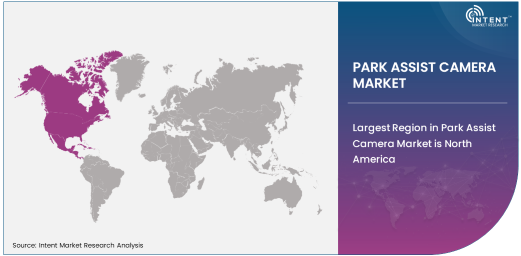
Largest Region in Park Assist Camera Market is North America
North America is the largest region in the Park Assist Camera market, primarily due to its early adoption of advanced automotive technologies and stringent safety regulations. The region’s automotive industry has consistently prioritized safety innovations, driving the widespread implementation of Park Assist Cameras in passenger cars and commercial vehicles. Additionally, the presence of leading automotive manufacturers and technology providers contributes to the region’s dominance in the market.
Competitive Landscape
The Park Assist Camera market is highly competitive, with key players continuously innovating to meet evolving safety standards and consumer preferences. Leading companies such as Continental AG, Robert Bosch GmbH, and Valeo Group are at the forefront, offering cutting-edge camera systems integrated with AI and machine learning capabilities. As the market expands, collaborations and partnerships with technology companies are becoming common, fueling further advancements in camera technologies and driving the market forward. The industry is set to experience continued growth with the increasing integration of smart technologies in vehicles globally.
Recent Developments:
- Continental AG launched a new line of advanced Park Assist Cameras featuring AI-powered obstacle detection.
- Robert Bosch GmbH acquired a tech startup to enhance its Park Assist Camera capabilities for autonomous driving solutions.
- Valeo Group introduced a 360-degree camera system integrated with real-time traffic analytics for safer navigation.
- Mobileye NV secured a partnership to provide Park Assist Camera technology for autonomous vehicle testing.
- LG Electronics expanded its Park Assist Camera solutions to include integration with smart vehicle ecosystems.
List of Leading Companies:
- Continental AG
- Magna International Inc.
- Robert Bosch GmbH
- Valeo Group
- DENSO Corporation
- Aptiv PLC
- ZF Friedrichshafen AG
- Hella GmbH & Co. KGaA
- Ficosa International S.A.
- Mobileye NV
- LG Electronics Inc.
- Aisin Seiki Co., Ltd.
- Autoliv Inc.
- Samsung Electronics Co., Ltd.
- Sony Corporation
Report Scope:
|
Report Features |
Description |
|
Market Size (2024-e) |
USD 3.2 Billion |
|
Forecasted Value (2030) |
USD 6.1 Billion |
|
CAGR (2025 – 2030) |
9.6% |
|
Base Year for Estimation |
2024-e |
|
Historic Year |
2023 |
|
Forecast Period |
2025 – 2030 |
|
Report Coverage |
Market Forecast, Market Dynamics, Competitive Landscape, Recent Developments |
|
Segments Covered |
Park Assist Camera Market By Camera Type (Front View Cameras, Rear View Cameras, 360-Degree Cameras), By Connectivity (Wireless, Wired), By Vehicle Type (Passenger Cars, Commercial Vehicles), and By Region; Global Insights & Forecast (2023 – 2030) |
|
Regional Analysis |
North America (US, Canada, Mexico), Europe (Germany, France, UK, Italy, Spain, and Rest of Europe), Asia-Pacific (China, Japan, South Korea, Australia, India, and Rest of Asia-Pacific), Latin America (Brazil, Argentina, and Rest of Latin America), Middle East & Africa (Saudi Arabia, UAE, Rest of Middle East & Africa) |
|
Major Companies |
Continental AG, Magna International Inc., Robert Bosch GmbH, Valeo Group, DENSO Corporation, Aptiv PLC, ZF Friedrichshafen AG, Hella GmbH & Co. KGaA, Ficosa International S.A., Mobileye NV, LG Electronics Inc., Aisin Seiki Co., Ltd., Autoliv Inc., Samsung Electronics Co., Ltd., Sony Corporation |
|
Customization Scope |
Customization for segments, region/country-level will be provided. Moreover, additional customization can be done based on the requirements |
|
1. Introduction |
|
1.1. Market Definition |
|
1.2. Scope of the Study |
|
1.3. Research Assumptions |
|
1.4. Study Limitations |
|
2. Research Methodology |
|
2.1. Research Approach |
|
2.1.1. Top-Down Method |
|
2.1.2. Bottom-Up Method |
|
2.1.3. Factor Impact Analysis |
|
2.2. Insights & Data Collection Process |
|
2.2.1. Secondary Research |
|
2.2.2. Primary Research |
|
2.3. Data Mining Process |
|
2.3.1. Data Analysis |
|
2.3.2. Data Validation and Revalidation |
|
2.3.3. Data Triangulation |
|
3. Executive Summary |
|
3.1. Major Markets & Segments |
|
3.2. Highest Growing Regions and Respective Countries |
|
3.3. Impact of Growth Drivers & Inhibitors |
|
3.4. Regulatory Overview by Country |
|
4. Park Assist Camera Market, by Camera Type (Market Size & Forecast: USD Million, 2023 – 2030) |
|
4.1. Front View Cameras |
|
4.2. Rear View Cameras |
|
4.3. 360-Degree Cameras |
|
5. Park Assist Camera Market, by Connectivity (Market Size & Forecast: USD Million, 2023 – 2030) |
|
5.1. Wireless |
|
5.2. Wired |
|
6. Park Assist Camera Market, by Vehicle Type (Market Size & Forecast: USD Million, 2023 – 2030) |
|
6.1. Passenger Cars |
|
6.2. Commercial Vehicles |
|
7. Regional Analysis (Market Size & Forecast: USD Million, 2023 – 2030) |
|
7.1. Regional Overview |
|
7.2. North America |
|
7.2.1. Regional Trends & Growth Drivers |
|
7.2.2. Barriers & Challenges |
|
7.2.3. Opportunities |
|
7.2.4. Factor Impact Analysis |
|
7.2.5. Technology Trends |
|
7.2.6. North America Park Assist Camera Market, by Camera Type |
|
7.2.7. North America Park Assist Camera Market, by Connectivity |
|
7.2.8. North America Park Assist Camera Market, by Vehicle Type |
|
7.2.9. By Country |
|
7.2.9.1. US |
|
7.2.9.1.1. US Park Assist Camera Market, by Camera Type |
|
7.2.9.1.2. US Park Assist Camera Market, by Connectivity |
|
7.2.9.1.3. US Park Assist Camera Market, by Vehicle Type |
|
7.2.9.2. Canada |
|
7.2.9.3. Mexico |
|
*Similar segmentation will be provided for each region and country |
|
7.3. Europe |
|
7.4. Asia-Pacific |
|
7.5. Latin America |
|
7.6. Middle East & Africa |
|
8. Competitive Landscape |
|
8.1. Overview of the Key Players |
|
8.2. Competitive Ecosystem |
|
8.2.1. Level of Fragmentation |
|
8.2.2. Market Consolidation |
|
8.2.3. Product Innovation |
|
8.3. Company Share Analysis |
|
8.4. Company Benchmarking Matrix |
|
8.4.1. Strategic Overview |
|
8.4.2. Product Innovations |
|
8.5. Start-up Ecosystem |
|
8.6. Strategic Competitive Insights/ Customer Imperatives |
|
8.7. ESG Matrix/ Sustainability Matrix |
|
8.8. Manufacturing Network |
|
8.8.1. Locations |
|
8.8.2. Supply Chain and Logistics |
|
8.8.3. Product Flexibility/Customization |
|
8.8.4. Digital Transformation and Connectivity |
|
8.8.5. Environmental and Regulatory Compliance |
|
8.9. Technology Readiness Level Matrix |
|
8.10. Technology Maturity Curve |
|
8.11. Buying Criteria |
|
9. Company Profiles |
|
9.1. Continental AG |
|
9.1.1. Company Overview |
|
9.1.2. Company Financials |
|
9.1.3. Product/Service Portfolio |
|
9.1.4. Recent Developments |
|
9.1.5. IMR Analysis |
|
*Similar information will be provided for other companies |
|
9.2. Magna International Inc. |
|
9.3. Robert Bosch GmbH |
|
9.4. Valeo Group |
|
9.5. DENSO Corporation |
|
9.6. Aptiv PLC |
|
9.7. ZF Friedrichshafen AG |
|
9.8. Hella GmbH & Co. KGaA |
|
9.9. Ficosa International S.A. |
|
9.10. Mobileye NV |
|
9.11. LG Electronics Inc. |
|
9.12. Aisin Seiki Co., Ltd. |
|
9.13. Autoliv Inc. |
|
9.14. Samsung Electronics Co., Ltd. |
|
9.15. Sony Corporation |
|
10. Appendix |
A comprehensive market research approach was employed to gather and analyze data on the Park Assist Camera Market. In the process, the analysis was also done to analyze the parent market and relevant adjacencies to measure the impact of them on the Park Assist Camera Market. The research methodology encompassed both secondary and primary research techniques, ensuring the accuracy and credibility of the findings.
.jpg)
Secondary Research
Secondary research involved a thorough review of pertinent industry reports, journals, articles, and publications. Additionally, annual reports, press releases, and investor presentations of industry players were scrutinized to gain insights into their market positioning and strategies.
Primary Research
Primary research involved conducting in-depth interviews with industry experts, stakeholders, and market participants across the E-Waste Management ecosystem. The primary research objectives included:
- Validating findings and assumptions derived from secondary research
- Gathering qualitative and quantitative data on market trends, drivers, and challenges
- Understanding the demand-side dynamics, encompassing end-users, component manufacturers, facility providers, and service providers
- Assessing the supply-side landscape, including technological advancements and recent developments
Market Size Assessment
A combination of top-down and bottom-up approaches was utilized to analyze the overall size of the Park Assist Camera Market. These methods were also employed to assess the size of various subsegments within the market. The market size assessment methodology encompassed the following steps:
- Identification of key industry players and relevant revenues through extensive secondary research
- Determination of the industry's supply chain and market size, in terms of value, through primary and secondary research processes
- Calculation of percentage shares, splits, and breakdowns using secondary sources and verification through primary sources
.jpg)
Data Triangulation
To ensure the accuracy and reliability of the market size, data triangulation was implemented. This involved cross-referencing data from various sources, including demand and supply side factors, market trends, and expert opinions. Additionally, top-down and bottom-up approaches were employed to validate the market size assessment.
NA