
As per Intent Market Research, the Parenteral Nutrition Market was valued at USD 7.4 Billion in 2024-e and will surpass USD 11.8 Billion by 2030; growing at a CAGR of 6.9% during 2025-2030.
The Parenteral Nutrition market is experiencing robust growth driven by the increasing prevalence of chronic diseases, the rising geriatric population, and the demand for advanced nutritional support. With a focus on improving patient outcomes, Parenteral Nutrition provides tailored solutions for individuals with limited or impaired oral intake. The industry is witnessing innovations in both standard and customized formulations, enabling healthcare providers to offer optimal nutritional therapy across various healthcare settings. As advancements in medical technology continue, the market is expected to expand further, offering enhanced care for patients requiring specialized nutritional support.
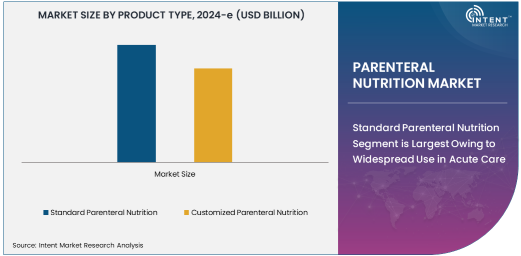
Standard Parenteral Nutrition Segment is Largest Owing to Widespread Use in Acute Care
The Standard Parenteral Nutrition segment holds the largest share in the market, primarily due to its extensive application in acute care settings. This form of nutrition is designed to meet the immediate and basic nutritional needs of critically ill patients or those undergoing surgery. Its broad usage across hospitals and emergency care facilities has solidified its dominance. The ability to provide essential nutrients efficiently in emergency and intensive care units has driven the adoption of Standard Parenteral Nutrition, making it the preferred choice for a wide range of medical conditions requiring urgent nutritional intervention.
Customized Parenteral Nutrition Segment is Fastest Growing Driven by Personalized Patient Care
The Customized Parenteral Nutrition segment is the fastest growing within the market, driven by a growing demand for personalized patient care. As healthcare providers increasingly recognize the importance of tailoring nutritional solutions to individual patient needs, customized formulations are becoming a critical part of long-term treatment plans. This approach enables healthcare professionals to optimize nutrient compositions based on specific patient requirements, improving outcomes for chronic care and rehabilitation. The rising prevalence of conditions such as cancer, malnutrition, and metabolic disorders is fueling the rapid expansion of this segment.
Acute Care Segment is Largest Owing to Immediate Nutritional Support for Critical Conditions
In the application segment, Acute Care is the largest subsegment, primarily due to the immediate need for nutritional support in emergency and critical care situations. Acute care settings, such as hospitals and emergency rooms, require rapid and efficient solutions for patients undergoing surgeries, recovering from trauma, or battling life-threatening conditions. Parenteral Nutrition plays a pivotal role in stabilizing patients’ health during these critical phases, driving the dominance of Acute Care as the largest segment in the market.
Chronic Care Segment is Fastest Growing Owing to Increasing Demand for Long-Term Nutritional Solutions
The fastest growing application segment is Chronic Care, fueled by the rising prevalence of chronic illnesses and the demand for long-term nutritional management. As individuals living with conditions like cancer, gastrointestinal disorders, or diabetes require ongoing nutritional support, the use of Parenteral Nutrition has surged in managing these chronic conditions. This segment’s rapid growth reflects the growing awareness of the importance of tailored nutrition for improving quality of life and managing complex health challenges.
Intravenous Route is Largest Owing to Superior Nutrient Delivery Efficiency
The Intravenous route of administration holds the largest share in the Parenteral Nutrition market due to its superior efficiency in delivering essential nutrients directly into the bloodstream. This method ensures rapid absorption and effectiveness, making it the preferred option for critically ill patients and those requiring immediate nutritional intervention. Hospitals and clinics widely adopt this approach to provide comprehensive support for acute care, fostering the segment’s dominance.
Subcutaneous Route is Fastest Growing Due to Ease of Administration for Long-Term Use
The Subcutaneous route is emerging as the fastest growing method of administration in Parenteral Nutrition, particularly for patients requiring long-term nutritional support. This method is less invasive than Intravenous delivery and is gaining popularity in homecare settings and chronic care management. Its ability to provide consistent nutrient delivery with minimal discomfort is driving its adoption, making it a promising area of growth within the market.
Hospitals Segment is Largest Due to High Patient Volume and Advanced Care Requirements
Hospitals represent the largest end-user industry in the Parenteral Nutrition market, driven by their high patient volumes and the demand for comprehensive, specialized care. Hospitals cater to a wide variety of patients, including those requiring intensive and emergency nutritional support. The use of Parenteral Nutrition in hospitals is critical for managing complex cases, improving recovery rates, and enhancing patient outcomes, establishing it as the largest segment.
Clinics Segment is Fastest Growing Driven by Increasing Demand for Outpatient Care
The fastest growing end-user segment is Clinics, propelled by the rising demand for outpatient care and personalized treatment plans. Clinics provide accessible and efficient solutions for patients needing nutritional support without extended hospital stays. The focus on outpatient services and chronic disease management has fueled the growth of Parenteral Nutrition in this segment, making it a dynamic area for market expansion.
Largest Region in Parenteral Nutrition Market is North America
North America dominates the Parenteral Nutrition market, primarily due to its advanced healthcare infrastructure, well-established homecare services, and high adoption of innovative healthcare solutions. The region benefits from stringent regulatory standards, a growing geriatric population, and the presence of leading healthcare providers who are continuously investing in research and development to enhance nutritional therapies. Additionally, North America’s emphasis on improving patient outcomes through tailored nutritional support further solidifies its position as the largest regional market.

Competitive Landscape
The Parenteral Nutrition market is highly competitive, with major players continuously innovating to meet the evolving needs of healthcare providers and patients. Leading companies such as B. Braun Melsungen AG, Fresenius Kabi AG, and Baxter International Inc. are at the forefront, offering a comprehensive range of products tailored for acute and chronic care. The market is driven by a strong focus on product differentiation, advanced technological solutions, and strategic collaborations to expand their presence in both developed and emerging markets. With the growing demand for customized solutions, competition is expected to intensify, driving further innovation in the field.
Recent Developments:
- B. Braun Melsungen AG introduced a new line of customizable Parenteral Nutrition solutions for specialized care.
- Fresenius Kabi AG acquired a homecare provider to expand its Parenteral Nutrition offerings.
- Baxter International Inc. launched an advanced IV nutrition management system to improve patient care.
- ICU Medical, Inc. received regulatory approval for a next-generation parenteral feeding product.
- Claris Lifesciences Ltd. announced a partnership to develop innovative Parenteral Nutrition solutions for emerging markets.
List of Leading Companies:
- B. Braun Melsungen AG
- Fresenius Kabi AG
- Baxter International Inc.
- Hospira, Inc.
- Terumo Corporation
- Grifols S.A.
- ICU Medical, Inc.
- Otsuka Pharmaceutical Co., Ltd.
- Vifor Pharma Group
- Calea Inc.
- Kawasumi Laboratories Inc.
- Lipogen Ltd.
- Claris Lifesciences Ltd.
- Astellas Pharma Inc.
- Nipro Corporation
Report Scope:
|
Report Features |
Description |
|
Market Size (2024-e) |
USD 7.4 Billion |
|
Forecasted Value (2030) |
USD 11.8 Billion |
|
CAGR (2025 – 2030) |
6.9% |
|
Base Year for Estimation |
2024-e |
|
Historic Year |
2023 |
|
Forecast Period |
2025 – 2030 |
|
Report Coverage |
Market Forecast, Market Dynamics, Competitive Landscape, Recent Developments |
|
Segments Covered |
Parenteral Nutrition Market By Product Type (Standard Parenteral Nutrition, Customized Parenteral Nutrition), By Application (Acute Care, Chronic Care), By Route of Administration (Intravenous, Subcutaneous), By End-User Industry (Hospitals, Clinics, Homecare), and By Region; Global Insights & Forecast (2023 – 2030) |
|
Regional Analysis |
North America (US, Canada, Mexico), Europe (Germany, France, UK, Italy, Spain, and Rest of Europe), Asia-Pacific (China, Japan, South Korea, Australia, India, and Rest of Asia-Pacific), Latin America (Brazil, Argentina, and Rest of Latin America), Middle East & Africa (Saudi Arabia, UAE, Rest of Middle East & Africa) |
|
Major Companies |
B. Braun Melsungen AG, Fresenius Kabi AG, Baxter International Inc., Hospira, Inc., Terumo Corporation, Grifols S.A., ICU Medical, Inc., Otsuka Pharmaceutical Co., Ltd., Vifor Pharma Group, Calea Inc., Kawasumi Laboratories Inc., Lipogen Ltd., Claris Lifesciences Ltd., Astellas Pharma Inc., Nipro Corporation |
|
Customization Scope |
Customization for segments, region/country-level will be provided. Moreover, additional customization can be done based on the requirements |
|
1. Introduction |
|
1.1. Market Definition |
|
1.2. Scope of the Study |
|
1.3. Research Assumptions |
|
1.4. Study Limitations |
|
2. Research Methodology |
|
2.1. Research Approach |
|
2.1.1. Top-Down Method |
|
2.1.2. Bottom-Up Method |
|
2.1.3. Factor Impact Analysis |
|
2.2. Insights & Data Collection Process |
|
2.2.1. Secondary Research |
|
2.2.2. Primary Research |
|
2.3. Data Mining Process |
|
2.3.1. Data Analysis |
|
2.3.2. Data Validation and Revalidation |
|
2.3.3. Data Triangulation |
|
3. Executive Summary |
|
3.1. Major Markets & Segments |
|
3.2. Highest Growing Regions and Respective Countries |
|
3.3. Impact of Growth Drivers & Inhibitors |
|
3.4. Regulatory Overview by Country |
|
4. Parenteral Nutrition Market, by Product Type (Market Size & Forecast: USD Million, 2023 – 2030) |
|
4.1. Standard Parenteral Nutrition |
|
4.2. Customized Parenteral Nutrition |
|
5. Parenteral Nutrition Market, by Application (Market Size & Forecast: USD Million, 2023 – 2030) |
|
5.1. Acute Care |
|
5.2. Chronic Care |
|
6. Parenteral Nutrition Market, by Route of Administration (Market Size & Forecast: USD Million, 2023 – 2030) |
|
6.1. Intravenous |
|
6.2. Subcutaneous |
|
7. Parenteral Nutrition Market, by End-User Industry (Market Size & Forecast: USD Million, 2023 – 2030) |
|
7.1. Hospitals |
|
7.2. Clinics |
|
7.3. Homecare |
|
8. Regional Analysis (Market Size & Forecast: USD Million, 2023 – 2030) |
|
8.1. Regional Overview |
|
8.2. North America |
|
8.2.1. Regional Trends & Growth Drivers |
|
8.2.2. Barriers & Challenges |
|
8.2.3. Opportunities |
|
8.2.4. Factor Impact Analysis |
|
8.2.5. Technology Trends |
|
8.2.6. North America Parenteral Nutrition Market, by Product Type |
|
8.2.7. North America Parenteral Nutrition Market, by Application |
|
8.2.8. North America Parenteral Nutrition Market, by Route of Administration |
|
8.2.9. North America Parenteral Nutrition Market, by End-User Industry |
|
8.2.10. By Country |
|
8.2.10.1. US |
|
8.2.10.1.1. US Parenteral Nutrition Market, by Product Type |
|
8.2.10.1.2. US Parenteral Nutrition Market, by Application |
|
8.2.10.1.3. US Parenteral Nutrition Market, by Route of Administration |
|
8.2.10.1.4. US Parenteral Nutrition Market, by End-User Industry |
|
8.2.10.2. Canada |
|
8.2.10.3. Mexico |
|
*Similar segmentation will be provided for each region and country |
|
8.3. Europe |
|
8.4. Asia-Pacific |
|
8.5. Latin America |
|
8.6. Middle East & Africa |
|
9. Competitive Landscape |
|
9.1. Overview of the Key Players |
|
9.2. Competitive Ecosystem |
|
9.2.1. Level of Fragmentation |
|
9.2.2. Market Consolidation |
|
9.2.3. Product Innovation |
|
9.3. Company Share Analysis |
|
9.4. Company Benchmarking Matrix |
|
9.4.1. Strategic Overview |
|
9.4.2. Product Innovations |
|
9.5. Start-up Ecosystem |
|
9.6. Strategic Competitive Insights/ Customer Imperatives |
|
9.7. ESG Matrix/ Sustainability Matrix |
|
9.8. Manufacturing Network |
|
9.8.1. Locations |
|
9.8.2. Supply Chain and Logistics |
|
9.8.3. Product Flexibility/Customization |
|
9.8.4. Digital Transformation and Connectivity |
|
9.8.5. Environmental and Regulatory Compliance |
|
9.9. Technology Readiness Level Matrix |
|
9.10. Technology Maturity Curve |
|
9.11. Buying Criteria |
|
10. Company Profiles |
|
10.1. B. Braun Melsungen AG |
|
10.1.1. Company Overview |
|
10.1.2. Company Financials |
|
10.1.3. Product/Service Portfolio |
|
10.1.4. Recent Developments |
|
10.1.5. IMR Analysis |
|
*Similar information will be provided for other companies |
|
10.2. Fresenius Kabi AG |
|
10.3. Baxter International Inc. |
|
10.4. Hospira, Inc. |
|
10.5. Terumo Corporation |
|
10.6. Grifols S.A. |
|
10.7. ICU Medical, Inc. |
|
10.8. Otsuka Pharmaceutical Co., Ltd. |
|
10.9. Vifor Pharma Group |
|
10.10. Calea Inc. |
|
10.11. Kawasumi Laboratories Inc. |
|
10.12. Lipogen Ltd. |
|
10.13. Claris Lifesciences Ltd. |
|
10.14. Astellas Pharma Inc. |
|
10.15. Nipro Corporation |
|
11. Appendix |
A comprehensive market research approach was employed to gather and analyze data on the Parenteral Nutrition Market. In the process, the analysis was also done to analyze the parent market and relevant adjacencies to measure the impact of them on the Parenteral Nutrition Market. The research methodology encompassed both secondary and primary research techniques, ensuring the accuracy and credibility of the findings.
.jpg)
Secondary Research
Secondary research involved a thorough review of pertinent industry reports, journals, articles, and publications. Additionally, annual reports, press releases, and investor presentations of industry players were scrutinized to gain insights into their market positioning and strategies.
Primary Research
Primary research involved conducting in-depth interviews with industry experts, stakeholders, and market participants across the E-Waste Management ecosystem. The primary research objectives included:
- Validating findings and assumptions derived from secondary research
- Gathering qualitative and quantitative data on market trends, drivers, and challenges
- Understanding the demand-side dynamics, encompassing end-users, component manufacturers, facility providers, and service providers
- Assessing the supply-side landscape, including technological advancements and recent developments
Market Size Assessment
A combination of top-down and bottom-up approaches was utilized to analyze the overall size of the Parenteral Nutrition Market. These methods were also employed to assess the size of various subsegments within the market. The market size assessment methodology encompassed the following steps:
- Identification of key industry players and relevant revenues through extensive secondary research
- Determination of the industry's supply chain and market size, in terms of value, through primary and secondary research processes
- Calculation of percentage shares, splits, and breakdowns using secondary sources and verification through primary sources
.jpg)
Data Triangulation
To ensure the accuracy and reliability of the market size, data triangulation was implemented. This involved cross-referencing data from various sources, including demand and supply side factors, market trends, and expert opinions. Additionally, top-down and bottom-up approaches were employed to validate the market size assessment.
NA