
As per Intent Market Research, the Orthopedic Surgical Navigation Systems Market was valued at USD 2.7 billion in 2024-e and will surpass USD 8.3 billion by 2030; growing at a CAGR of 20.5% during 2025 - 2030.
The orthopedic surgical navigation systems market is experiencing remarkable growth, driven by technological advancements and the rising prevalence of musculoskeletal disorders globally. These systems have revolutionized orthopedic procedures by enhancing surgical precision, reducing intraoperative errors, and improving patient outcomes. Their ability to integrate with advanced imaging modalities and robotic systems has further cemented their importance in modern surgical practices. The demand for minimally invasive techniques is a significant growth driver, as these systems facilitate accurate navigation, minimizing tissue damage and accelerating recovery times.
The increasing incidence of orthopedic conditions such as osteoarthritis, fractures, and degenerative spinal disorders, coupled with an aging global population, has created a robust demand for these systems. Furthermore, expanding healthcare investments in emerging economies and the growing awareness of advanced surgical techniques have spurred market expansion. Government initiatives promoting healthcare infrastructure development and favorable reimbursement policies in developed regions are additional factors contributing to the market’s upward trajectory.
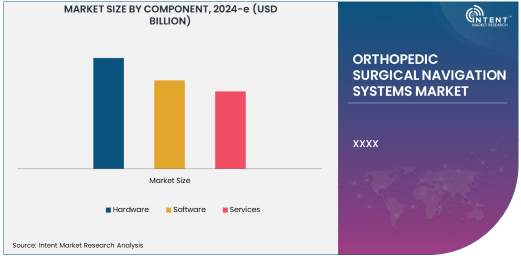
Hardware Segment is Largest Owing to Reliability and Widespread Use
The hardware segment dominates the orthopedic surgical navigation systems market due to its indispensable role in ensuring the functionality and accuracy of these systems. Critical components such as high-resolution cameras, advanced sensors, and sophisticated tracking systems are integral to providing real-time guidance during surgeries. These components’ durability and ability to deliver consistent performance have made hardware a cornerstone of surgical navigation solutions, widely adopted across hospitals, ambulatory surgical centers, and specialty clinics.
Continual innovations in hardware design, such as enhanced imaging capabilities and compact, portable devices, are further solidifying the segment’s dominance. The integration of advanced technologies, including artificial intelligence and machine learning, into hardware systems is transforming surgical workflows and boosting adoption rates. As precision and reliability remain paramount in complex orthopedic procedures, the hardware segment is poised to maintain its leadership position in the market.
Optical Navigation Systems Are Fastest Growing Owing to Precision and Technological Advancements
Optical navigation systems are emerging as the fastest-growing technology type in the market, driven by their exceptional precision and non-invasive operational mechanisms. Utilizing infrared cameras and advanced tracking devices, these systems provide detailed, real-time visualization of the surgical field, significantly enhancing the accuracy of complex procedures. Their ability to mitigate surgical errors and improve safety profiles has positioned them as a preferred choice among surgeons worldwide.
The adoption of optical navigation systems is further accelerated by technological advancements such as augmented reality (AR) integration and high-definition imaging capabilities. These innovations allow surgeons to visualize anatomical structures with unparalleled clarity, facilitating better decision-making and improved patient outcomes. As healthcare providers increasingly prioritize minimally invasive techniques, the demand for optical navigation systems is expected to surge, cementing their status as the fastest-growing segment.
Spine Surgery Segment is Largest Owing to Increasing Spinal Disorders
The spine surgery segment is the largest application area within the orthopedic surgical navigation systems market, primarily due to the rising prevalence of spinal disorders and the complexity of spinal procedures. Conditions such as herniated discs, scoliosis, and spinal stenosis have become increasingly common, necessitating advanced surgical solutions that can ensure precision and reduce risks. Navigation systems play a critical role in these procedures by providing surgeons with real-time, three-dimensional guidance, enabling accurate placement of implants and reducing the likelihood of complications.
The aging population, coupled with sedentary lifestyles, has contributed to a growing demand for spinal surgeries globally. Navigation systems help address the challenges of these intricate procedures by improving surgical efficiency and minimizing patient recovery times. As the need for effective spinal treatments continues to rise, the spine surgery segment’s prominence in the market remains unchallenged.
Ambulatory Surgical Centers Are Fastest Growing Owing to Cost-Effectiveness and Convenience
Ambulatory surgical centers (ASCs) represent the fastest-growing end-user segment, driven by their cost-effectiveness and convenience for both patients and healthcare providers. ASCs specialize in providing high-quality surgical care in an outpatient setting, eliminating the need for extended hospital stays and significantly reducing healthcare costs. This model aligns with the increasing patient preference for efficient, personalized care in a less stressful environment.
The adoption of orthopedic surgical navigation systems in ASCs is bolstered by advancements in compact and mobile navigation devices that are well-suited for smaller-scale facilities. These systems enable ASCs to perform a wide range of complex orthopedic procedures with the same level of precision as large hospitals. As the healthcare industry shifts towards value-based care, ASCs are expected to witness continued growth, further driving the adoption of navigation systems in this segment.
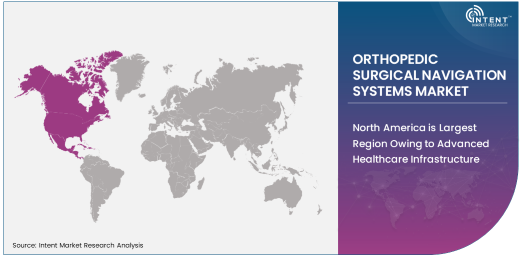
North America is Largest Region Owing to Advanced Healthcare Infrastructure
North America leads the orthopedic surgical navigation systems market, attributed to its advanced healthcare infrastructure, high adoption of cutting-edge technologies, and substantial investments in medical research and development. The region’s robust healthcare system supports widespread implementation of navigation systems across hospitals, specialty clinics, and ambulatory surgical centers. Additionally, the presence of key market players and ongoing technological innovations contribute significantly to North America’s dominance.
The prevalence of orthopedic conditions, including arthritis and sports-related injuries, is particularly high in North America, driving the demand for advanced surgical solutions. Favorable reimbursement policies and strong government support for healthcare initiatives further enhance market growth. As manufacturers in the region continue to launch innovative products and expand their distribution networks, North America’s leadership position is expected to persist.
Leading Companies and Competitive Landscape
The orthopedic surgical navigation systems market is highly competitive, with leading companies focusing on innovation, strategic partnerships, and mergers and acquisitions to gain a competitive edge. Prominent players such as Medtronic, Stryker Corporation, and Brainlab AG dominate the industry, offering comprehensive product portfolios and leveraging their global presence to maintain market leadership. These companies invest heavily in research and development to introduce next-generation solutions that address evolving surgical demands.
The competitive landscape is also characterized by the emergence of smaller players and startups that are targeting niche markets with cost-effective and innovative navigation systems. This dynamic environment fosters continuous advancements, including the integration of artificial intelligence and robotics. As competition intensifies, the market is poised for further evolution, offering a wide array of choices for healthcare providers seeking state-of-the-art surgical navigation systems.
Recent Developments:
- In August 2023, Medtronic launched a next-generation spine surgery navigation platform with enhanced 3D imaging capabilities.
- In September 2023, Stryker Corporation integrated AI-based analytics into its surgical navigation systems for joint replacement.
- In November 2023, Zimmer Biomet collaborated with Brainlab to develop hybrid navigation solutions for minimally invasive orthopedic procedures.
- In December 2023, DePuy Synthes introduced an advanced electromagnetic navigation system optimized for trauma surgery.
- In January 2024, NuVasive, Inc. acquired a navigation software startup to enhance its orthopedic surgical solutions portfolio.
List of Leading Companies:
- Medtronic PLC
- Stryker Corporation
- Zimmer Biomet
- DePuy Synthes (Johnson & Johnson)
- Smith & Nephew
- B. Braun Melsungen AG
- Brainlab AG
- NuVasive, Inc.
- Globus Medical, Inc.
- Integra LifeSciences Corporation
- OrthAlign, Inc.
- Fiagon AG Medical Technologies
- MicroPort Scientific Corporation
- Scopis GmbH (acquired by Stryker)
- KARL STORZ SE & Co. KG
Report Scope:
|
Report Features |
Description |
|
Market Size (2024-e) |
USD 2.7 billion |
|
Forecasted Value (2030) |
USD 8.3 billion |
|
CAGR (2025 – 2030) |
20.5% |
|
Base Year for Estimation |
2024-e |
|
Historic Year |
2023 |
|
Forecast Period |
2025 – 2030 |
|
Report Coverage |
Market Forecast, Market Dynamics, Competitive Landscape, Recent Developments |
|
Segments Covered |
Orthopedic Surgical Navigation Systems Market By Component (Hardware, Software, Services), By Technology Type (Optical Navigation Systems, Electromagnetic Navigation Systems, Hybrid Navigation Systems), By Application (Spine Surgery, Joint Replacement Surgery, Trauma Surgery, Sports Medicine Surgery), By End-User (Hospitals, Ambulatory Surgical Centers, Specialty Clinics, Academic and Research Institutes) |
|
Regional Analysis |
North America (US, Canada, Mexico), Europe (Germany, France, UK, Italy, Spain, and Rest of Europe), Asia-Pacific (China, Japan, South Korea, Australia, India, and Rest of Asia-Pacific), Latin America (Brazil, Argentina, and Rest of Latin America), Middle East & Africa (Saudi Arabia, UAE, Rest of Middle East & Africa) |
|
Major Companies |
Medtronic PLC, Stryker Corporation, Zimmer Biomet, DePuy Synthes (Johnson & Johnson), Smith & Nephew, B. Braun Melsungen AG, Brainlab AG, NuVasive, Inc., Globus Medical, Inc., Integra LifeSciences Corporation, OrthAlign, Inc., Fiagon AG Medical Technologies, MicroPort Scientific Corporation, Scopis GmbH (acquired by Stryker), KARL STORZ SE & Co. KG |
|
Customization Scope |
Customization for segments, region/country-level will be provided. Moreover, additional customization can be done based on the requirements |
|
1. Introduction |
|
1.1. Market Definition |
|
1.2. Scope of the Study |
|
1.3. Research Assumptions |
|
1.4. Study Limitations |
|
2. Research Methodology |
|
2.1. Research Approach |
|
2.1.1. Top-Down Method |
|
2.1.2. Bottom-Up Method |
|
2.1.3. Factor Impact Analysis |
|
2.2. Insights & Data Collection Process |
|
2.2.1. Secondary Research |
|
2.2.2. Primary Research |
|
2.3. Data Mining Process |
|
2.3.1. Data Analysis |
|
2.3.2. Data Validation and Revalidation |
|
2.3.3. Data Triangulation |
|
3. Executive Summary |
|
3.1. Major Markets & Segments |
|
3.2. Highest Growing Regions and Respective Countries |
|
3.3. Impact of Growth Drivers & Inhibitors |
|
3.4. Regulatory Overview by Country |
|
4. Orthopedic Surgical Navigation Systems Market, by Component (Market Size & Forecast: USD Million, 2023 – 2030) |
|
4.1. Hardware |
|
4.2. Software |
|
4.3. Services |
|
5. Orthopedic Surgical Navigation Systems Market, by Technology Type (Market Size & Forecast: USD Million, 2023 – 2030) |
|
5.1. Optical Navigation Systems |
|
5.2. Electromagnetic Navigation Systems |
|
5.3. Hybrid Navigation Systems |
|
6. Orthopedic Surgical Navigation Systems Market, by Application (Market Size & Forecast: USD Million, 2023 – 2030) |
|
6.1. Spine Surgery |
|
6.2. Joint Replacement Surgery |
|
6.3. Trauma Surgery |
|
6.4. Sports Medicine Surgery |
|
6.5. Others |
|
7. Orthopedic Surgical Navigation Systems Market, by End-User (Market Size & Forecast: USD Million, 2023 – 2030) |
|
7.1. Hospitals |
|
7.2. Ambulatory Surgical Centers |
|
7.3. Specialty Clinics |
|
7.4. Academic and Research Institutes |
|
8. Regional Analysis (Market Size & Forecast: USD Million, 2023 – 2030) |
|
8.1. Regional Overview |
|
8.2. North America |
|
8.2.1. Regional Trends & Growth Drivers |
|
8.2.2. Barriers & Challenges |
|
8.2.3. Opportunities |
|
8.2.4. Factor Impact Analysis |
|
8.2.5. Technology Trends |
|
8.2.6. North America Orthopedic Surgical Navigation Systems Market, by Component |
|
8.2.7. North America Orthopedic Surgical Navigation Systems Market, by Technology Type |
|
8.2.8. North America Orthopedic Surgical Navigation Systems Market, by Application |
|
8.2.9. North America Orthopedic Surgical Navigation Systems Market, by End-User |
|
8.2.10. By Country |
|
8.2.10.1. US |
|
8.2.10.1.1. US Orthopedic Surgical Navigation Systems Market, by Component |
|
8.2.10.1.2. US Orthopedic Surgical Navigation Systems Market, by Technology Type |
|
8.2.10.1.3. US Orthopedic Surgical Navigation Systems Market, by Application |
|
8.2.10.1.4. US Orthopedic Surgical Navigation Systems Market, by End-User |
|
8.2.10.2. Canada |
|
8.2.10.3. Mexico |
|
*Similar segmentation will be provided for each region and country |
|
8.3. Europe |
|
8.4. Asia-Pacific |
|
8.5. Latin America |
|
8.6. Middle East & Africa |
|
9. Competitive Landscape |
|
9.1. Overview of the Key Players |
|
9.2. Competitive Ecosystem |
|
9.2.1. Level of Fragmentation |
|
9.2.2. Market Consolidation |
|
9.2.3. Product Innovation |
|
9.3. Company Share Analysis |
|
9.4. Company Benchmarking Matrix |
|
9.4.1. Strategic Overview |
|
9.4.2. Product Innovations |
|
9.5. Start-up Ecosystem |
|
9.6. Strategic Competitive Insights/ Customer Imperatives |
|
9.7. ESG Matrix/ Sustainability Matrix |
|
9.8. Manufacturing Network |
|
9.8.1. Locations |
|
9.8.2. Supply Chain and Logistics |
|
9.8.3. Product Flexibility/Customization |
|
9.8.4. Digital Transformation and Connectivity |
|
9.8.5. Environmental and Regulatory Compliance |
|
9.9. Technology Readiness Level Matrix |
|
9.10. Technology Maturity Curve |
|
9.11. Buying Criteria |
|
10. Company Profiles |
|
10.1. Medtronic PLC |
|
10.1.1. Company Overview |
|
10.1.2. Company Financials |
|
10.1.3. Product/Service Portfolio |
|
10.1.4. Recent Developments |
|
10.1.5. IMR Analysis |
|
*Similar information will be provided for other companies |
|
10.2. Stryker Corporation |
|
10.3. Zimmer Biomet |
|
10.4. DePuy Synthes (Johnson & Johnson) |
|
10.5. Smith & Nephew |
|
10.6. B. Braun Melsungen AG |
|
10.7. Brainlab AG |
|
10.8. NuVasive, Inc. |
|
10.9. Globus Medical, Inc. |
|
10.10. Integra LifeSciences Corporation |
|
10.11. OrthAlign, Inc. |
|
10.12. Fiagon AG Medical Technologies |
|
10.13. MicroPort Scientific Corporation |
|
10.14. Scopis GmbH (acquired by Stryker) |
|
10.15. KARL STORZ SE & Co. KG |
|
11. Appendix |
A comprehensive market research approach was employed to gather and analyze data on the Orthopedic Surgical Navigation Systems Market. In the process, the analysis was also done to analyze the parent market and relevant adjacencies to measure the impact of them on the Orthopedic Surgical Navigation Systems Market. The research methodology encompassed both secondary and primary research techniques, ensuring the accuracy and credibility of the findings.
.jpg)
Secondary Research
Secondary research involved a thorough review of pertinent industry reports, journals, articles, and publications. Additionally, annual reports, press releases, and investor presentations of industry players were scrutinized to gain insights into their market positioning and strategies.
Primary Research
Primary research involved conducting in-depth interviews with industry experts, stakeholders, and market participants across the E-Waste Management ecosystem. The primary research objectives included:
- Validating findings and assumptions derived from secondary research
- Gathering qualitative and quantitative data on market trends, drivers, and challenges
- Understanding the demand-side dynamics, encompassing end-users, component manufacturers, facility providers, and service providers
- Assessing the supply-side landscape, including technological advancements and recent developments
Market Size Assessment
A combination of top-down and bottom-up approaches was utilized to analyze the overall size of the Orthopedic Surgical Navigation Systems Market. These methods were also employed to assess the size of various subsegments within the market. The market size assessment methodology encompassed the following steps:
- Identification of key industry players and relevant revenues through extensive secondary research
- Determination of the industry's supply chain and market size, in terms of value, through primary and secondary research processes
- Calculation of percentage shares, splits, and breakdowns using secondary sources and verification through primary sources
.jpg)
Data Triangulation
To ensure the accuracy and reliability of the market size, data triangulation was implemented. This involved cross-referencing data from various sources, including demand and supply side factors, market trends, and expert opinions. Additionally, top-down and bottom-up approaches were employed to validate the market size assessment.
NA