
As per Intent Market Research, the Organic Tobacco Market was valued at USD 9.1 Billion in 2024-e and will surpass USD 18.5 Billion by 2030; growing at a CAGR of 12.6% during 2025-2030.
The organic tobacco market has seen notable growth as consumer preferences shift toward healthier and more sustainable alternatives in the tobacco industry. Organic tobacco is grown without the use of synthetic pesticides, herbicides, or fertilizers, appealing to individuals seeking a more natural smoking experience. This market segment is gaining traction as consumers become more conscious of the environmental and health impacts of their choices. Additionally, the growing trend towards natural and organic products across various industries is influencing the demand for organic tobacco products, including cigarettes, cigars, and smokeless tobacco.
Increasing awareness of the harmful effects of conventional tobacco products, combined with growing concerns about sustainability, is driving the demand for organic alternatives. Consumers are becoming more discerning, prioritizing eco-friendly farming practices and organic certifications when making their purchasing decisions. As such, manufacturers are responding by diversifying their product offerings to cater to this growing market. With advancements in organic farming techniques and rising support for organic agriculture, the organic tobacco market is expected to continue expanding, driven by both environmental concerns and evolving consumer preferences.
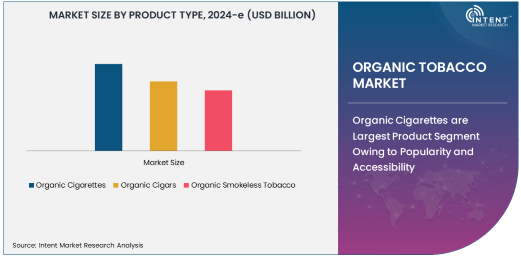
Organic Cigarettes are Largest Product Segment Owing to Popularity and Accessibility
Within the organic tobacco market, organic cigarettes are the largest product segment, driven by their popularity among individual consumers seeking an alternative to traditional tobacco products. Organic cigarettes are made from tobacco grown without synthetic chemicals, and they appeal to health-conscious smokers who want to reduce their exposure to harmful additives commonly found in conventional cigarettes. This segment benefits from increasing consumer interest in natural and sustainable lifestyles, as more people seek products that align with these values.
Organic cigarettes also hold a significant share due to their widespread availability and accessibility, particularly in regions where the demand for natural tobacco products is growing. The growing adoption of organic products in general is helping to boost the organic cigarette market, as many consumers view organic cigarettes as a safer, more environmentally friendly choice. As regulations around smoking continue to tighten globally, the organic cigarette market is poised for continued growth, attracting both health-conscious smokers and those interested in reducing their carbon footprint.
Online Retailers are Fastest Growing Distribution Channel Due to Convenience and Wider Reach
Online retailers are the fastest-growing distribution channel in the organic tobacco market, driven by the increasing trend of e-commerce and the convenience it offers to consumers. Online platforms provide consumers with easy access to a wide variety of organic tobacco products, including cigarettes, cigars, and smokeless tobacco, often with the added benefit of detailed product information and customer reviews. The ability to compare prices and browse through different brands and offerings from the comfort of one's home has made online shopping an attractive option for organic tobacco consumers.
E-commerce platforms also allow for direct-to-consumer sales, bypassing traditional retail stores and enabling manufacturers to reach a global audience. Additionally, online retailing provides consumers with access to niche and premium organic tobacco products that may not be readily available in local stores. As digital shopping continues to grow, online retailers are expected to remain a key driver of growth in the organic tobacco market, offering a seamless, accessible, and customer-friendly way to purchase organic tobacco products.
Individual Consumers are Largest End-User Owing to Health and Sustainability Trends
Individual consumers represent the largest end-user segment in the organic tobacco market, driven by the increasing demand for healthier and more sustainable alternatives to traditional tobacco products. Health-conscious smokers are increasingly turning to organic tobacco products, such as organic cigarettes and smokeless tobacco, in an effort to reduce their exposure to harmful chemicals commonly found in conventional tobacco. The rising awareness of the negative environmental impacts of synthetic farming practices has further fueled this shift toward organic products, as consumers seek out brands that prioritize eco-friendly farming and production methods.
This consumer-driven shift toward organic tobacco is also influenced by broader trends in the food and beverage sector, where demand for organic products is rising across the board. As the desire for sustainability and natural alternatives continues to grow, individual consumers are expected to remain the dominant end-user segment, driving the organic tobacco market's expansion.
Whole Leaf Tobacco is Largest Form Segment Owing to Quality and Traditional Preferences
Whole leaf tobacco holds the largest share in the organic tobacco market's form segment, driven by its high-quality nature and traditional appeal. Whole leaf tobacco is prized for its natural taste and texture, offering a more authentic smoking experience compared to processed tobacco. Many consumers who prefer a premium, handcrafted smoking experience opt for whole leaf tobacco, especially in segments like organic cigars and smokeless tobacco. Additionally, whole leaf tobacco is favored by manufacturers who produce artisanal and premium tobacco products, adding to its dominance in the market.
The preference for whole leaf tobacco is also influenced by the growing trend of natural, unprocessed products across industries. Many smokers of organic tobacco view whole leaf tobacco as a more "pure" form of the product, free from excessive processing and additives. This makes it the preferred choice among both individual consumers and commercial manufacturers, contributing to its large share of the market.
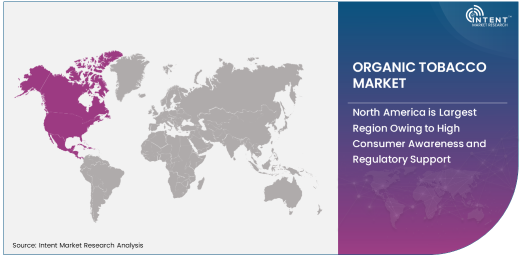
North America is Largest Region Owing to High Consumer Awareness and Regulatory Support
North America is the largest region for the organic tobacco market, driven by high consumer awareness, a growing preference for organic products, and supportive regulatory environments. The United States, in particular, has seen a surge in demand for organic products across various sectors, including tobacco, as consumers increasingly seek healthier, environmentally friendly alternatives. The strong presence of major organic tobacco brands and widespread availability in both online and offline retail channels contribute to North America's leading position in the global market.
Additionally, North America benefits from stringent regulatory frameworks that promote organic farming practices and ensure the authenticity and safety of organic tobacco products. With increasing awareness about the environmental and health impacts of conventional tobacco farming, North America is expected to continue driving the growth of the organic tobacco market, with both individual consumers and manufacturers prioritizing organic and sustainable options.
Leading Companies and Competitive Landscape
Key players in the organic tobacco market include companies like Natural American Spirit (Reynolds American), OCB, and American Organic Cigarettes. These companies lead the market by offering a range of organic tobacco products, including cigarettes, cigars, and smokeless tobacco, catering to both individual consumers and commercial manufacturers. Competitive strategies in the market include product diversification, strong marketing campaigns highlighting the environmental and health benefits of organic tobacco, and partnerships with eco-friendly farming organizations.
The competitive landscape is becoming increasingly dynamic, with both established tobacco companies and smaller, niche organic tobacco producers vying for market share. While large manufacturers are focusing on increasing their organic product lines to appeal to a broader consumer base, smaller companies are emphasizing authenticity, quality, and sustainability to differentiate themselves. As consumer demand for organic and natural products continues to rise, competition in the organic tobacco market is expected to intensify, with companies striving to innovate and provide products that meet the growing expectations of environmentally conscious and health-aware consumers.
Recent Developments:
- In December 2024, Altria Group, Inc. launched a new line of organic smokeless tobacco products.
- In November 2024, Philip Morris International announced a partnership with organic tobacco farmers in Europe to boost sustainable production.
- In October 2024, British American Tobacco introduced its new organic cigar collection in North America.
- In September 2024, Imperial Brands PLC expanded its organic tobacco offerings to the Asian market.
- In August 2024, Natural American Spirit launched an eco-friendly packaging initiative for its organic tobacco products.
List of Leading Companies:
- Altria Group, Inc.
- British American Tobacco
- Imperial Brands PLC
- Japan Tobacco International
- Philip Morris International
- Swisher International, Inc.
- L.&M. Tobacco Company
- Hemp, Inc.
- Natural American Spirit
- Green Smoke Inc.
- R.J. Reynolds Tobacco Company
- Southern Draw Cigars
- Djarum
- Tobacco Free Farm
- Organic Tobacco Ltd.
Report Scope:
|
Report Features |
Description |
|
Market Size (2024-e) |
USD 9.1 Billion |
|
Forecasted Value (2030) |
USD 18.5 Billion |
|
CAGR (2025 – 2030) |
12.6% |
|
Base Year for Estimation |
2024-e |
|
Historic Year |
2023 |
|
Forecast Period |
2025 – 2030 |
|
Report Coverage |
Market Forecast, Market Dynamics, Competitive Landscape, Recent Developments |
|
Segments Covered |
Organic Tobacco Market by Product Type (Organic Cigarettes, Organic Cigars, Organic Smokeless Tobacco), Form (Whole Leaf Tobacco, Ground Tobacco), End-User (Individual Consumers, Commercial Manufacturers), Distribution Channel (Online Retailers, Retail Stores, Direct Sales) |
|
Regional Analysis |
North America (US, Canada, Mexico), Europe (Germany, France, UK, Italy, Spain, and Rest of Europe), Asia-Pacific (China, Japan, South Korea, Australia, India, and Rest of Asia-Pacific), Latin America (Brazil, Argentina, and Rest of Latin America), Middle East & Africa (Saudi Arabia, UAE, Rest of Middle East & Africa) |
|
Major Companies |
Altria Group, Inc., British American Tobacco, Imperial Brands PLC, Japan Tobacco International, Philip Morris International, Swisher International, Inc., L.&M. Tobacco Company, Hemp, Inc., Natural American Spirit, Green Smoke Inc., R.J. Reynolds Tobacco Company, Southern Draw Cigars, Djarum, Tobacco Free Farm, Organic Tobacco Ltd. |
|
Customization Scope |
Customization for segments, region/country-level will be provided. Moreover, additional customization can be done based on the requirements |
|
1. Introduction |
|
1.1. Market Definition |
|
1.2. Scope of the Study |
|
1.3. Research Assumptions |
|
1.4. Study Limitations |
|
2. Research Methodology |
|
2.1. Research Approach |
|
2.1.1. Top-Down Method |
|
2.1.2. Bottom-Up Method |
|
2.1.3. Factor Impact Analysis |
|
2.2. Insights & Data Collection Process |
|
2.2.1. Secondary Research |
|
2.2.2. Primary Research |
|
2.3. Data Mining Process |
|
2.3.1. Data Analysis |
|
2.3.2. Data Validation and Revalidation |
|
2.3.3. Data Triangulation |
|
3. Executive Summary |
|
3.1. Major Markets & Segments |
|
3.2. Highest Growing Regions and Respective Countries |
|
3.3. Impact of Growth Drivers & Inhibitors |
|
3.4. Regulatory Overview by Country |
|
4. Organic Tobacco Market, by Product Type (Market Size & Forecast: USD Million, 2023 – 2030) |
|
4.1. Organic Cigarettes |
|
4.2. Organic Cigars |
|
4.3. Organic Smokeless Tobacco |
|
5. Organic Tobacco Market, by Form (Market Size & Forecast: USD Million, 2023 – 2030) |
|
5.1. Whole Leaf Tobacco |
|
5.2. Ground Tobacco |
|
6. Organic Tobacco Market, by End-User (Market Size & Forecast: USD Million, 2023 – 2030) |
|
6.1. Individual Consumers |
|
6.2. Commercial (Manufacturers) |
|
7. Organic Tobacco Market, by Distribution Channel (Market Size & Forecast: USD Million, 2023 – 2030) |
|
7.1. Online Retailers |
|
7.2. Retail Stores |
|
7.3. Direct Sales |
|
8. Regional Analysis (Market Size & Forecast: USD Million, 2023 – 2030) |
|
8.1. Regional Overview |
|
8.2. North America |
|
8.2.1. Regional Trends & Growth Drivers |
|
8.2.2. Barriers & Challenges |
|
8.2.3. Opportunities |
|
8.2.4. Factor Impact Analysis |
|
8.2.5. Technology Trends |
|
8.2.6. North America Organic Tobacco Market, by Product Type |
|
8.2.7. North America Organic Tobacco Market, by Form |
|
8.2.8. North America Organic Tobacco Market, by End-User |
|
8.2.9. North America Organic Tobacco Market, by Distribution Channel |
|
8.2.10. By Country |
|
8.2.10.1. US |
|
8.2.10.1.1. US Organic Tobacco Market, by Product Type |
|
8.2.10.1.2. US Organic Tobacco Market, by Form |
|
8.2.10.1.3. US Organic Tobacco Market, by End-User |
|
8.2.10.1.4. US Organic Tobacco Market, by Distribution Channel |
|
8.2.10.2. Canada |
|
8.2.10.3. Mexico |
|
*Similar segmentation will be provided for each region and country |
|
8.3. Europe |
|
8.4. Asia-Pacific |
|
8.5. Latin America |
|
8.6. Middle East & Africa |
|
9. Competitive Landscape |
|
9.1. Overview of the Key Players |
|
9.2. Competitive Ecosystem |
|
9.2.1. Level of Fragmentation |
|
9.2.2. Market Consolidation |
|
9.2.3. Product Innovation |
|
9.3. Company Share Analysis |
|
9.4. Company Benchmarking Matrix |
|
9.4.1. Strategic Overview |
|
9.4.2. Product Innovations |
|
9.5. Start-up Ecosystem |
|
9.6. Strategic Competitive Insights/ Customer Imperatives |
|
9.7. ESG Matrix/ Sustainability Matrix |
|
9.8. Manufacturing Network |
|
9.8.1. Locations |
|
9.8.2. Supply Chain and Logistics |
|
9.8.3. Product Flexibility/Customization |
|
9.8.4. Digital Transformation and Connectivity |
|
9.8.5. Environmental and Regulatory Compliance |
|
9.9. Technology Readiness Level Matrix |
|
9.10. Technology Maturity Curve |
|
9.11. Buying Criteria |
|
10. Company Profiles |
|
10.1. Altria Group, Inc. |
|
10.1.1. Company Overview |
|
10.1.2. Company Financials |
|
10.1.3. Product/Service Portfolio |
|
10.1.4. Recent Developments |
|
10.1.5. IMR Analysis |
|
*Similar information will be provided for other companies |
|
10.2. British American Tobacco |
|
10.3. Imperial Brands PLC |
|
10.4. Japan Tobacco International |
|
10.5. Philip Morris International |
|
10.6. Swisher International, Inc. |
|
10.7. L.&M. Tobacco Company |
|
10.8. Hemp, Inc. |
|
10.9. Natural American Spirit |
|
10.10. Green Smoke Inc. |
|
10.11. R.J. Reynolds Tobacco Company |
|
10.12. Southern Draw Cigars |
|
10.13. Djarum |
|
10.14. Tobacco Free Farm |
|
10.15. Organic Tobacco Ltd. |
|
11. Appendix |
A comprehensive market research approach was employed to gather and analyze data on the Organic Tobacco Market. In the process, the analysis was also done to analyze the parent market and relevant adjacencies to measure the impact of them on the Organic Tobacco Market. The research methodology encompassed both secondary and primary research techniques, ensuring the accuracy and credibility of the findings.
.jpg)
Secondary Research
Secondary research involved a thorough review of pertinent industry reports, journals, articles, and publications. Additionally, annual reports, press releases, and investor presentations of industry players were scrutinized to gain insights into their market positioning and strategies.
Primary Research
Primary research involved conducting in-depth interviews with industry experts, stakeholders, and market participants across the E-Waste Management ecosystem. The primary research objectives included:
- Validating findings and assumptions derived from secondary research
- Gathering qualitative and quantitative data on market trends, drivers, and challenges
- Understanding the demand-side dynamics, encompassing end-users, component manufacturers, facility providers, and service providers
- Assessing the supply-side landscape, including technological advancements and recent developments
Market Size Assessment
A combination of top-down and bottom-up approaches was utilized to analyze the overall size of the Organic Tobacco Market. These methods were also employed to assess the size of various subsegments within the market. The market size assessment methodology encompassed the following steps:
- Identification of key industry players and relevant revenues through extensive secondary research
- Determination of the industry's supply chain and market size, in terms of value, through primary and secondary research processes
- Calculation of percentage shares, splits, and breakdowns using secondary sources and verification through primary sources
.jpg)
Data Triangulation
To ensure the accuracy and reliability of the market size, data triangulation was implemented. This involved cross-referencing data from various sources, including demand and supply side factors, market trends, and expert opinions. Additionally, top-down and bottom-up approaches were employed to validate the market size assessment.
NA