
As per Intent Market Research, the Organ-On-A-Chip Market was valued at USD 0.3 Billion in 2024-e and will surpass USD 2.2 Billion by 2030; growing at a CAGR of 41.4% during 2025 - 2030.
The Organ-On-A-Chip Market is witnessing rapid growth, fueled by advancements in biotechnology and pharmaceutical research. Organ-on-a-chip technology is an innovative platform that mimics the structure and function of human organs at a microscale level, enabling researchers to simulate human organ behavior in a controlled environment. This technology is revolutionizing drug discovery, toxicology testing, disease modeling, and personalized medicine by providing more accurate and human-relevant alternatives to traditional animal testing. As pharmaceutical companies, biotechnology firms, and academic institutions increasingly seek more efficient, ethical, and cost-effective ways to test drugs and study diseases, the market for organ-on-a-chip products is expanding.
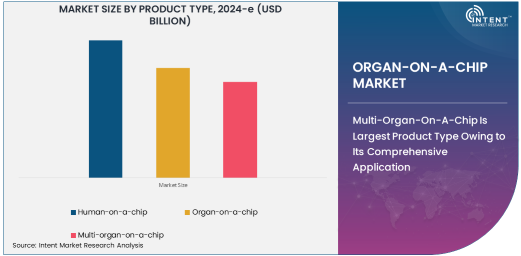
Multi-Organ-On-A-Chip Is Largest Product Type Owing to Its Comprehensive Application
The multi-organ-on-a-chip segment is the largest product type in the organ-on-a-chip market, driven by its ability to simulate the interaction of multiple organs simultaneously. This capability offers a more comprehensive and accurate representation of human physiology compared to single organ models. Multi-organ-on-a-chip systems are increasingly used for drug discovery and development, providing insights into how different organs interact with each other in the context of drug absorption, metabolism, and toxicity. The ability to replicate complex human organ systems, such as the liver, heart, and lungs, on a single chip has revolutionized preclinical testing, making these models highly valuable for pharmaceutical and biotechnology companies.
As regulatory agencies push for more human-relevant testing models, multi-organ-on-a-chip systems are gaining momentum, offering substantial improvements over traditional animal models. This growth is supported by the increasing demand for more efficient drug development processes and the pursuit of personalized medicine, which requires an understanding of how drugs affect individual patients' physiology across multiple organ systems.
Organ-On-A-Chip Is Fastest Growing Product Type Owing to Its Versatility
The organ-on-a-chip segment is the fastest growing product type, owing to its versatility and the growing need for detailed, organ-specific models in drug testing and disease research. Organ-on-a-chip systems are designed to replicate the structure and function of individual human organs, such as the heart, liver, lungs, or kidneys, and offer a more targeted approach to testing than multi-organ systems. These chips are particularly valuable in toxicology testing, drug development, and disease modeling, as they provide an environment where researchers can observe the effects of compounds on a single organ before advancing to more complex models.
The versatility of organ-on-a-chip systems, which can be customized to study a wide range of diseases and treatments, makes them increasingly popular across various research domains. The segment's growth is also driven by the rising demand for personalized medicine and the need for more accurate disease models, as well as the ethical concerns surrounding animal testing.
Drug Discovery and Development Is Largest Application Owing to Growing Demand for Efficient Drug Testing
The drug discovery and development application segment is the largest in the organ-on-a-chip market, driven by the increasing need for efficient and effective drug testing methods. Organ-on-a-chip platforms are revolutionizing how new drugs are tested, providing researchers with a more reliable and cost-effective alternative to animal models. These systems allow for the rapid screening of drug compounds, enabling researchers to observe their effects on human organ systems in real-time and with greater precision. This leads to more accurate predictions of drug efficacy and safety, reducing the time and cost of bringing new drugs to market.
With the rising complexity of diseases and the demand for personalized medicine, the need for human-relevant drug testing is becoming more urgent. Organ-on-a-chip technology is meeting this demand by providing a more realistic environment for drug discovery and development, making this application the largest and most important in the market.
Pharmaceutical Companies Are Largest End-Use Industry Owing to High Adoption Rates in Drug Development
Pharmaceutical companies represent the largest end-use industry for organ-on-a-chip products, as these companies are the primary drivers of innovation and adoption of this technology. The pharmaceutical industry is focused on reducing the cost and time associated with drug development while increasing the accuracy of testing and improving the success rate of clinical trials. Organ-on-a-chip systems provide an advanced platform for pharmaceutical companies to test new drugs, assess their safety, and evaluate their potential before moving on to human trials.
The growing interest in personalized medicine, along with the need to comply with increasingly stringent regulatory requirements, has made organ-on-a-chip technology a valuable tool for pharmaceutical companies. The ability to replicate human organ function in a laboratory setting allows pharmaceutical companies to better understand drug interactions, leading to more efficient and targeted treatments. This makes the pharmaceutical industry the largest and most influential end-user of organ-on-a-chip products.
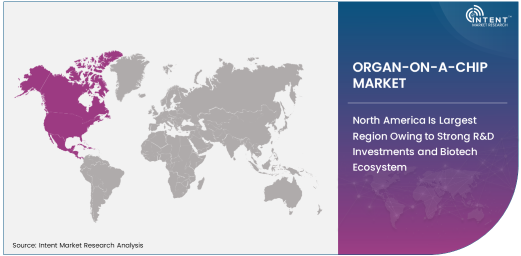
North America Is Largest Region Owing to Strong R&D Investments and Biotech Ecosystem
North America is the largest region in the organ-on-a-chip market, driven by significant research and development investments, a robust biotechnology ecosystem, and strong support for innovation in the pharmaceutical and healthcare industries. The U.S., in particular, is home to numerous pharmaceutical companies, biotechnology firms, and research institutions that are at the forefront of organ-on-a-chip technology development. The region’s advanced healthcare infrastructure, coupled with a high level of funding for medical research and technological advancements, positions North America as the leader in the market.
In addition to government support and funding, North America benefits from a well-established regulatory environment that promotes the use of alternative testing methods. The region’s large number of academic and research institutions further fuels the adoption of organ-on-a-chip technology, as they work in partnership with pharmaceutical companies to advance drug discovery and disease modeling.
Competitive Landscape and Key Players
The organ-on-a-chip market is highly competitive, with several key players leading the development and commercialization of organ-on-a-chip products. Notable companies in this market include Emulate, Inc., MIMETAS, TissUse GmbH, and HµREL Corporation. These companies are focused on developing advanced organ-on-a-chip platforms that can simulate complex human organ systems and provide researchers with more accurate models for drug testing, disease research, and personalized medicine.
The competitive landscape is marked by strong investments in R&D, collaborations between industry players and academic institutions, and partnerships with pharmaceutical companies to drive the adoption of organ-on-a-chip technology. As the market continues to grow, leading companies are expected to expand their product offerings, improve the capabilities of their platforms, and explore new applications for this innovative technology. Competitive strategies such as technological advancements, strategic collaborations, and product innovations will be key drivers of success in this rapidly evolving market.
Recent Developments:
- Emulate, Inc. launched a new multi-organ-on-a-chip platform, enabling more accurate drug testing by simulating interactions between organs.
- Mimetas B.V. expanded its product portfolio with a human liver-on-a-chip model for improved liver disease research and drug testing.
- TissUse GmbH partnered with pharmaceutical companies to integrate their multi-organ-on-a-chip models into routine drug screening processes.
- Hurel Corporation announced the launch of a kidney-on-a-chip device for enhanced nephrotoxicity testing in collaboration with major pharmaceutical firms.
- Labcorp Drug Development launched a new platform using organ-on-a-chip technologies to accelerate drug development and reduce testing timelines.
List of Leading Companies:
- Emulate, Inc.
- Mimetas B.V.
- SynVivo, Inc.
- TissUse GmbH
- Hesperos, Inc.
- Bio-IVT (BioreclamationIVT)
- Charles River Laboratories
- Molecular Devices, LLC
- OncoOne, Inc.
- Organovo Holdings, Inc.
- Allevi, Inc.
- Kirkstall Ltd.
- K3D Labs
- Hurel Corporation
- Labcorp Drug Development
Report Scope:
|
Report Features |
Description |
|
Market Size (2024-e) |
USD 0.3 Billion |
|
Forecasted Value (2030) |
USD 2.2 Billion |
|
CAGR (2025 – 2030) |
41.4% |
|
Base Year for Estimation |
2024-e |
|
Historic Year |
2023 |
|
Forecast Period |
2025 – 2030 |
|
Report Coverage |
Market Forecast, Market Dynamics, Competitive Landscape, Recent Developments |
|
Segments Covered |
Global Organ-On-A-Chip Market by Product Type (Human-on-a-chip, Organ-on-a-chip, Multi-organ-on-a-chip), by Application (Drug Discovery and Development, Toxicology Testing, Disease Modeling, Personalized Medicine), by End-Use Industry (Pharmaceutical Companies, Biotechnology Companies, Academic and Research Institutes, Contract Research Organizations (CROs)
|
|
Regional Analysis |
North America (US, Canada, Mexico), Europe (Germany, France, UK, Italy, Spain, and Rest of Europe), Asia-Pacific (China, Japan, South Korea, Australia, India, and Rest of Asia-Pacific), Latin America (Brazil, Argentina, and Rest of Latin America), Middle East & Africa (Saudi Arabia, UAE, Rest of Middle East & Africa) |
|
Major Companies |
Emulate, Inc., Mimetas B.V., SynVivo, Inc., TissUse GmbH, Hesperos, Inc., Bio-IVT (BioreclamationIVT), Molecular Devices, LLC, OncoOne, Inc., Organovo Holdings, Inc., Allevi, Inc., Kirkstall Ltd., K3D Labs, Labcorp Drug Development |
|
Customization Scope |
Customization for segments, region/country-level will be provided. Moreover, additional customization can be done based on the requirements |
|
1. Introduction |
|
1.1. Market Definition |
|
1.2. Scope of the Study |
|
1.3. Research Assumptions |
|
1.4. Study Limitations |
|
2. Research Methodology |
|
2.1. Research Approach |
|
2.1.1. Top-Down Method |
|
2.1.2. Bottom-Up Method |
|
2.1.3. Factor Impact Analysis |
|
2.2. Insights & Data Collection Process |
|
2.2.1. Secondary Research |
|
2.2.2. Primary Research |
|
2.3. Data Mining Process |
|
2.3.1. Data Analysis |
|
2.3.2. Data Validation and Revalidation |
|
2.3.3. Data Triangulation |
|
3. Executive Summary |
|
3.1. Major Markets & Segments |
|
3.2. Highest Growing Regions and Respective Countries |
|
3.3. Impact of Growth Drivers & Inhibitors |
|
3.4. Regulatory Overview by Country |
|
4. Organ-On-A-Chip Market, by Product Type (Market Size & Forecast: USD Million, 2023 – 2030) |
|
4.1. Human-on-a-chip |
|
4.2. Organ-on-a-chip |
|
4.3. Multi-organ-on-a-chip |
|
5. Organ-On-A-Chip Market, by Application (Market Size & Forecast: USD Million, 2023 – 2030) |
|
5.1. Drug Discovery and Development |
|
5.2. Toxicology Testing |
|
5.3. Disease Modeling |
|
5.4. Personalized Medicine |
|
5.5. Others |
|
6. Organ-On-A-Chip Market, by End-Use Industry (Market Size & Forecast: USD Million, 2023 – 2030) |
|
6.1. Pharmaceutical Companies |
|
6.2. Biotechnology Companies |
|
6.3. Academic and Research Institutes |
|
6.4. Contract Research Organizations (CROs) |
|
7. Regional Analysis (Market Size & Forecast: USD Million, 2023 – 2030) |
|
7.1. Regional Overview |
|
7.2. North America |
|
7.2.1. Regional Trends & Growth Drivers |
|
7.2.2. Barriers & Challenges |
|
7.2.3. Opportunities |
|
7.2.4. Factor Impact Analysis |
|
7.2.5. Technology Trends |
|
7.2.6. North America Organ-On-A-Chip Market, by Product Type |
|
7.2.7. North America Organ-On-A-Chip Market, by Application |
|
7.2.8. North America Organ-On-A-Chip Market, by End-Use Industry |
|
7.2.9. By Country |
|
7.2.9.1. US |
|
7.2.9.1.1. US Organ-On-A-Chip Market, by Product Type |
|
7.2.9.1.2. US Organ-On-A-Chip Market, by Application |
|
7.2.9.1.3. US Organ-On-A-Chip Market, by End-Use Industry |
|
7.2.9.2. Canada |
|
7.2.9.3. Mexico |
|
*Similar segmentation will be provided for each region and country |
|
7.3. Europe |
|
7.4. Asia-Pacific |
|
7.5. Latin America |
|
7.6. Middle East & Africa |
|
8. Competitive Landscape |
|
8.1. Overview of the Key Players |
|
8.2. Competitive Ecosystem |
|
8.2.1. Level of Fragmentation |
|
8.2.2. Market Consolidation |
|
8.2.3. Product Innovation |
|
8.3. Company Share Analysis |
|
8.4. Company Benchmarking Matrix |
|
8.4.1. Strategic Overview |
|
8.4.2. Product Innovations |
|
8.5. Start-up Ecosystem |
|
8.6. Strategic Competitive Insights/ Customer Imperatives |
|
8.7. ESG Matrix/ Sustainability Matrix |
|
8.8. Manufacturing Network |
|
8.8.1. Locations |
|
8.8.2. Supply Chain and Logistics |
|
8.8.3. Product Flexibility/Customization |
|
8.8.4. Digital Transformation and Connectivity |
|
8.8.5. Environmental and Regulatory Compliance |
|
8.9. Technology Readiness Level Matrix |
|
8.10. Technology Maturity Curve |
|
8.11. Buying Criteria |
|
9. Company Profiles |
|
9.1. Emulate, Inc. |
|
9.1.1. Company Overview |
|
9.1.2. Company Financials |
|
9.1.3. Product/Service Portfolio |
|
9.1.4. Recent Developments |
|
9.1.5. IMR Analysis |
|
*Similar information will be provided for other companies |
|
9.2. Mimetas B.V. |
|
9.3. SynVivo, Inc. |
|
9.4. TissUse GmbH |
|
9.5. Hesperos, Inc. |
|
9.6. Bio-IVT (BioreclamationIVT) |
|
9.7. Charles River Laboratories |
|
9.8. Molecular Devices, LLC |
|
9.9. OncoOne, Inc. |
|
9.10. Organovo Holdings, Inc. |
|
9.11. Allevi, Inc. |
|
9.12. Kirkstall Ltd. |
|
9.13. K3D Labs |
|
9.14. Hurel Corporation |
|
9.15. Labcorp Drug Development |
|
10. Appendix |
A comprehensive market research approach was employed to gather and analyze data on the Organ-On-A-Chip Market. In the process, the analysis was also done to analyze the parent market and relevant adjacencies to measure the impact of them on the Organ-On-A-Chip Market. The research methodology encompassed both secondary and primary research techniques, ensuring the accuracy and credibility of the findings.
.jpg)
Secondary Research
Secondary research involved a thorough review of pertinent industry reports, journals, articles, and publications. Additionally, annual reports, press releases, and investor presentations of industry players were scrutinized to gain insights into their market positioning and strategies.
Primary Research
Primary research involved conducting in-depth interviews with industry experts, stakeholders, and market participants across the E-Waste Management ecosystem. The primary research objectives included:
- Validating findings and assumptions derived from secondary research
- Gathering qualitative and quantitative data on market trends, drivers, and challenges
- Understanding the demand-side dynamics, encompassing end-users, component manufacturers, facility providers, and service providers
- Assessing the supply-side landscape, including technological advancements and recent developments
Market Size Assessment
A combination of top-down and bottom-up approaches was utilized to analyze the overall size of the Organ-On-A-Chip Market. These methods were also employed to assess the size of various subsegments within the market. The market size assessment methodology encompassed the following steps:
- Identification of key industry players and relevant revenues through extensive secondary research
- Determination of the industry's supply chain and market size, in terms of value, through primary and secondary research processes
- Calculation of percentage shares, splits, and breakdowns using secondary sources and verification through primary sources
.jpg)
Data Triangulation
To ensure the accuracy and reliability of the market size, data triangulation was implemented. This involved cross-referencing data from various sources, including demand and supply side factors, market trends, and expert opinions. Additionally, top-down and bottom-up approaches were employed to validate the market size assessment.
NA