
As per Intent Market Research, the Orally Disintegrating Tablet Market was valued at USD 16.8 Billion in 2024-e and will surpass USD 30.1 Billion by 2030; growing at a CAGR of 10.1% during 2025 - 2030.
The Orally Disintegrating Tablet (ODT) Market is gaining prominence due to the increasing demand for convenient and patient-friendly drug delivery systems. ODTs dissolve quickly in the mouth without the need for water, making them an ideal solution for patients with difficulty swallowing, such as the elderly and pediatric populations. These tablets are extensively used for treating conditions that require immediate drug action, including neurological disorders, migraines, and allergies. The market is driven by technological advancements, expanding applications across drug classes, and growing acceptance among healthcare providers and patients alike.
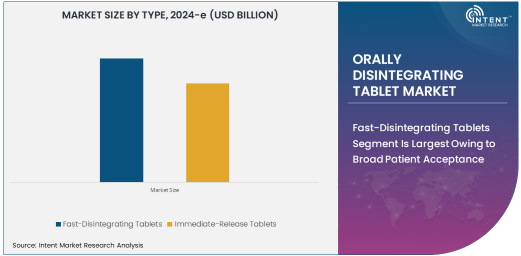
Fast-Disintegrating Tablets Segment Is Largest Owing to Broad Patient Acceptance
The fast-disintegrating tablets segment holds the largest share of the ODT market, primarily due to their wide applicability and broad acceptance among patients. These tablets dissolve rapidly in the mouth, typically within seconds, offering convenience for patients who struggle with traditional oral dosage forms. Fast-disintegrating tablets are particularly beneficial for conditions requiring rapid onset of action, such as migraines and acute allergic reactions, which makes them a preferred choice for both patients and healthcare providers.
The growth of this segment is further fueled by innovations in formulation technologies that enhance the stability, taste, and bioavailability of drugs in ODT form. As pharmaceutical companies continue to expand their product portfolios to include fast-disintegrating tablets for various therapeutic areas, this segment is expected to maintain its dominance in the market.
Anti-Psychotics Segment Is Fastest Growing Owing to Rising Neurological Disorder Cases
The anti-psychotics drug class is the fastest-growing segment in the ODT market, driven by the increasing prevalence of neurological and psychiatric disorders such as schizophrenia and bipolar disorder. Orally disintegrating tablets provide a significant advantage in this therapeutic area by improving medication adherence among patients who may have difficulty swallowing pills or are non-compliant with traditional dosage forms.
The rapid onset of action offered by ODTs ensures timely therapeutic effects, which is critical for managing acute episodes of psychosis. Furthermore, advancements in drug formulation have enabled the development of ODTs that mask the bitter taste of anti-psychotic medications, improving patient acceptability. With the growing awareness of mental health issues and the need for patient-centric drug delivery systems, the anti-psychotics segment is poised for substantial growth.
Home Care Segment Is Largest End-Use Industry Owing to Growing Preference for At-Home Treatment
The home care segment is the largest end-use industry in the ODT market, driven by the rising trend of at-home treatment for chronic and acute conditions. Orally disintegrating tablets are highly convenient for home use, as they eliminate the need for water or additional assistance during administration. This feature makes them particularly suitable for elderly patients, children, and individuals with limited mobility.
The increasing availability of ODTs across various therapeutic areas, coupled with growing consumer preference for self-administered medications, is boosting the demand for ODTs in home care settings. The segment's dominance is also supported by advancements in telemedicine and online pharmacies, which make it easier for patients to access these innovative drug delivery solutions.
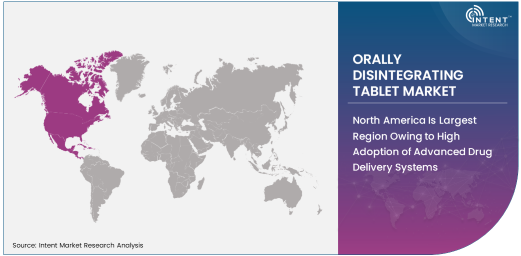
North America Is Largest Region Owing to High Adoption of Advanced Drug Delivery Systems
North America is the largest regional market for orally disintegrating tablets, attributed to the high adoption of advanced drug delivery systems and the strong presence of leading pharmaceutical companies. The region's well-established healthcare infrastructure and favorable reimbursement policies encourage the development and use of ODTs for various therapeutic indications.
The growing prevalence of neurological and chronic disorders in the region, along with the increasing focus on improving medication adherence, further drives the demand for ODTs. Additionally, North America benefits from a proactive regulatory environment that supports the approval and commercialization of innovative drug delivery technologies, solidifying its position as the largest regional market for ODTs.
Competitive Landscape and Key Players
The Orally Disintegrating Tablet Market is characterized by intense competition, with major players such as Pfizer, Novartis, Merck & Co., and Teva Pharmaceuticals leading the market. These companies are focused on developing innovative ODT formulations that address unmet medical needs and improve patient outcomes.
The competitive landscape is also marked by strategic partnerships, mergers, and acquisitions aimed at expanding product portfolios and geographic reach. Additionally, advancements in formulation technologies, such as taste-masking and rapid disintegration, are enabling key players to differentiate their products in a crowded marketplace. As the demand for patient-friendly drug delivery systems continues to rise, the market is expected to witness sustained growth driven by innovation and increasing consumer acceptance.
Recent Developments:
- Pfizer Inc. launched a new fast-dissolving tablet formulation for pain relief targeting both pediatric and geriatric patients.
- Teva Pharmaceutical Industries Ltd. announced the acquisition of a manufacturing plant focused on ODT production in Europe.
- GlaxoSmithKline unveiled an ODT version of a popular allergy medication to improve compliance in younger patients.
- Sun Pharmaceutical Industries Ltd. received FDA approval for an orally disintegrating antiepileptic drug targeting the US market.
- Novartis AG introduced a new ODT for migraine relief, claiming faster onset of action compared to traditional tablets.
List of Leading Companies:
- Pfizer Inc.
- Eli Lilly and Company
- Merck & Co., Inc.
- GlaxoSmithKline plc
- Teva Pharmaceutical Industries Ltd.
- Mylan N.V. (Viatris)
- Johnson & Johnson
- Novartis AG
- Bayer AG
- Takeda Pharmaceutical Company Limited
- Sun Pharmaceutical Industries Ltd.
- Zydus Cadila
- Torrent Pharmaceuticals Ltd.
Report Scope:
|
Report Features |
Description |
|
Market Size (2024-e) |
USD 16.8 Billion |
|
Forecasted Value (2030) |
USD 30.1 Billion |
|
CAGR (2025 – 2030) |
10.1% |
|
Base Year for Estimation |
2024-e |
|
Historic Year |
2023 |
|
Forecast Period |
2025 – 2030 |
|
Report Coverage |
Market Forecast, Market Dynamics, Competitive Landscape, Recent Developments |
|
Segments Covered |
Global Orally Disintegrating Tablet Market by Type (Fast-Disintegrating Tablets, Immediate-Release Tablets), by Drug Class (Anti-Psychotics, Anti-Epileptics, Anti-Migraines, Anti-Allergies), by End-Use Industry (Hospitals, Clinics, Home Care) |
|
Regional Analysis |
North America (US, Canada, Mexico), Europe (Germany, France, UK, Italy, Spain, and Rest of Europe), Asia-Pacific (China, Japan, South Korea, Australia, India, and Rest of Asia-Pacific), Latin America (Brazil, Argentina, and Rest of Latin America), Middle East & Africa (Saudi Arabia, UAE, Rest of Middle East & Africa) |
|
Major Companies |
Pfizer Inc., Eli Lilly and Company, Merck & Co., Inc., GlaxoSmithKline plc, Teva Pharmaceutical Industries Ltd., Mylan N.V. (Viatris), Novartis AG, Bayer AG, Takeda Pharmaceutical Company Limited, Sun Pharmaceutical Industries Ltd., Zydus Cadila, Torrent Pharmaceuticals Ltd. |
|
Customization Scope |
Customization for segments, region/country-level will be provided. Moreover, additional customization can be done based on the requirements |
|
1. Introduction |
|
1.1. Market Definition |
|
1.2. Scope of the Study |
|
1.3. Research Assumptions |
|
1.4. Study Limitations |
|
2. Research Methodology |
|
2.1. Research Approach |
|
2.1.1. Top-Down Method |
|
2.1.2. Bottom-Up Method |
|
2.1.3. Factor Impact Analysis |
|
2.2. Insights & Data Collection Process |
|
2.2.1. Secondary Research |
|
2.2.2. Primary Research |
|
2.3. Data Mining Process |
|
2.3.1. Data Analysis |
|
2.3.2. Data Validation and Revalidation |
|
2.3.3. Data Triangulation |
|
3. Executive Summary |
|
3.1. Major Markets & Segments |
|
3.2. Highest Growing Regions and Respective Countries |
|
3.3. Impact of Growth Drivers & Inhibitors |
|
3.4. Regulatory Overview by Country |
|
4. Orally Disintegrating Tablet Market, by Type (Market Size & Forecast: USD Million, 2023 – 2030) |
|
4.1. Fast-Disintegrating Tablets |
|
4.2. Immediate-Release Tablets |
|
5. Orally Disintegrating Tablet Market, by Drug Class (Market Size & Forecast: USD Million, 2023 – 2030) |
|
5.1. Anti-Psychotics |
|
5.2. Anti-Epileptics |
|
5.3. Anti-Migraines |
|
5.4. Anti-Allergies |
|
5.5. Others |
|
6. Orally Disintegrating Tablet Market, by End-Use Industry (Market Size & Forecast: USD Million, 2023 – 2030) |
|
6.1. Hospitals |
|
6.2. Clinics |
|
6.3. Home Care |
|
7. Regional Analysis (Market Size & Forecast: USD Million, 2023 – 2030) |
|
7.1. Regional Overview |
|
7.2. North America |
|
7.2.1. Regional Trends & Growth Drivers |
|
7.2.2. Barriers & Challenges |
|
7.2.3. Opportunities |
|
7.2.4. Factor Impact Analysis |
|
7.2.5. Technology Trends |
|
7.2.6. North America Orally Disintegrating Tablet Market, by Type |
|
7.2.7. North America Orally Disintegrating Tablet Market, by Drug Class |
|
7.2.8. North America Orally Disintegrating Tablet Market, by End-Use Industry |
|
7.2.9. By Country |
|
7.2.9.1. US |
|
7.2.9.1.1. US Orally Disintegrating Tablet Market, by Type |
|
7.2.9.1.2. US Orally Disintegrating Tablet Market, by Drug Class |
|
7.2.9.1.3. US Orally Disintegrating Tablet Market, by End-Use Industry |
|
7.2.9.2. Canada |
|
7.2.9.3. Mexico |
|
*Similar segmentation will be provided for each region and country |
|
7.3. Europe |
|
7.4. Asia-Pacific |
|
7.5. Latin America |
|
7.6. Middle East & Africa |
|
8. Competitive Landscape |
|
8.1. Overview of the Key Players |
|
8.2. Competitive Ecosystem |
|
8.2.1. Level of Fragmentation |
|
8.2.2. Market Consolidation |
|
8.2.3. Product Innovation |
|
8.3. Company Share Analysis |
|
8.4. Company Benchmarking Matrix |
|
8.4.1. Strategic Overview |
|
8.4.2. Product Innovations |
|
8.5. Start-up Ecosystem |
|
8.6. Strategic Competitive Insights/ Customer Imperatives |
|
8.7. ESG Matrix/ Sustainability Matrix |
|
8.8. Manufacturing Network |
|
8.8.1. Locations |
|
8.8.2. Supply Chain and Logistics |
|
8.8.3. Product Flexibility/Customization |
|
8.8.4. Digital Transformation and Connectivity |
|
8.8.5. Environmental and Regulatory Compliance |
|
8.9. Technology Readiness Level Matrix |
|
8.10. Technology Maturity Curve |
|
8.11. Buying Criteria |
|
9. Company Profiles |
|
9.1. Pfizer Inc. |
|
9.1.1. Company Overview |
|
9.1.2. Company Financials |
|
9.1.3. Product/Service Portfolio |
|
9.1.4. Recent Developments |
|
9.1.5. IMR Analysis |
|
*Similar information will be provided for other companies |
|
9.2. Eli Lilly and Company |
|
9.3. Merck & Co., Inc. |
|
9.4. GlaxoSmithKline plc |
|
9.5. Teva Pharmaceutical Industries Ltd. |
|
9.6. Mylan N.V. (Viatris) |
|
9.7. Johnson & Johnson |
|
9.8. Novartis AG |
|
9.9. Bayer AG |
|
9.10. Takeda Pharmaceutical Company Limited |
|
9.11. Sun Pharmaceutical Industries Ltd. |
|
9.12. Zydus Cadila |
|
9.13. Torrent Pharmaceuticals Ltd. |
|
10. Appendix |
A comprehensive market research approach was employed to gather and analyze data on the Orally Disintegrating Tablet Market. In the process, the analysis was also done to analyze the parent market and relevant adjacencies to measure the impact of them on the Orally Disintegrating Tablet Market. The research methodology encompassed both secondary and primary research techniques, ensuring the accuracy and credibility of the findings.
.jpg)
Secondary Research
Secondary research involved a thorough review of pertinent industry reports, journals, articles, and publications. Additionally, annual reports, press releases, and investor presentations of industry players were scrutinized to gain insights into their market positioning and strategies.
Primary Research
Primary research involved conducting in-depth interviews with industry experts, stakeholders, and market participants across the E-Waste Management ecosystem. The primary research objectives included:
- Validating findings and assumptions derived from secondary research
- Gathering qualitative and quantitative data on market trends, drivers, and challenges
- Understanding the demand-side dynamics, encompassing end-users, component manufacturers, facility providers, and service providers
- Assessing the supply-side landscape, including technological advancements and recent developments
Market Size Assessment
A combination of top-down and bottom-up approaches was utilized to analyze the overall size of the Orally Disintegrating Tablet Market. These methods were also employed to assess the size of various subsegments within the market. The market size assessment methodology encompassed the following steps:
- Identification of key industry players and relevant revenues through extensive secondary research
- Determination of the industry's supply chain and market size, in terms of value, through primary and secondary research processes
- Calculation of percentage shares, splits, and breakdowns using secondary sources and verification through primary sources
.jpg)
Data Triangulation
To ensure the accuracy and reliability of the market size, data triangulation was implemented. This involved cross-referencing data from various sources, including demand and supply side factors, market trends, and expert opinions. Additionally, top-down and bottom-up approaches were employed to validate the market size assessment.
NA