
As per Intent Market Research, the Optical Transceiver Market was valued at USD 7.0 Billion in 2024-e and will surpass USD 14.2 Billion by 2030; growing at a CAGR of 12.4% during 2025-2030.
The optical transceiver market is witnessing robust growth, driven by the increasing demand for high-speed data transmission and the rapid expansion of data-centric industries such as telecommunications, data centers, and enterprise networks. Optical transceivers are crucial components in optical communication systems, converting electrical signals into optical signals and vice versa, enabling efficient and high-performance data transmission over long distances. With the rise in data usage, cloud computing, and the development of 5G networks, optical transceivers have become indispensable for meeting the growing need for high-bandwidth communication. The market is set to expand further as advancements in optical technology continue to meet the increasing demand for higher data rates and better network infrastructure.
The demand for optical transceivers is driven by multiple sectors, including telecommunications, data centers, and cable networks. As businesses and consumers increasingly rely on cloud-based applications, the need for data centers to support higher data rates and more efficient communication is propelling the growth of the optical transceiver market. Moreover, with the ongoing rollout of 5G networks and the expansion of internet-of-things (IoT) devices, the requirement for high-speed and reliable data transmission is intensifying, making optical transceivers an essential part of modern communication systems.
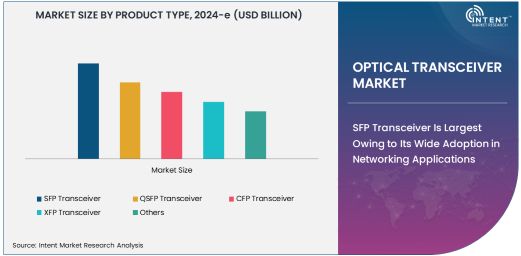
SFP Transceiver Is Largest Owing to Its Wide Adoption in Networking Applications
SFP (Small Form-factor Pluggable) transceivers are the largest segment within the optical transceiver market, owing to their widespread adoption across a variety of networking applications. These transceivers are commonly used in telecommunications, data centers, and enterprise networks for applications that require high-speed and reliable data transmission. SFP transceivers are designed to support a range of data rates and distances, offering flexibility for both short and long-range communication, making them ideal for different network configurations. They are also compact, cost-effective, and easy to install, which has further enhanced their popularity.
In the telecommunications sector, SFP transceivers are integral to supporting backbone networks, including optical networks, and are used in various applications such as fiber-optic broadband connections, voice over IP (VoIP), and other communication services. SFP transceivers' adaptability to different media types, such as single-mode and multi-mode fiber, and their ability to support 10G, 25G, and 40G data rates make them an attractive solution for both new and existing network infrastructure. Their role in enabling cost-efficient, high-speed data transmission ensures they continue to dominate the optical transceiver market.
100G Data Rate Is Fastest Growing Owing to Increased Demand for High-Speed Connectivity
The 100G data rate segment is the fastest growing within the optical transceiver market, fueled by the escalating demand for high-speed connectivity across industries. The transition to higher-speed networks, driven by the increasing need for cloud computing, big data analytics, and high-definition video content, is propelling the adoption of 100G optical transceivers. These transceivers offer the ability to transfer data at 100 gigabits per second, meeting the needs of modern communication systems that require faster data rates and reduced latency.
In data centers, the demand for 100G optical transceivers is particularly high as organizations work to support large volumes of data and complex applications. The growth of 5G networks and the rise in IoT devices are further accelerating the need for high-speed data transfer, where 100G optical transceivers play a key role in enabling seamless communication between servers, storage systems, and other network devices. As the demand for higher-speed internet and enhanced network performance continues to grow, the 100G segment is expected to maintain its rapid growth rate, becoming an essential component for next-generation network infrastructures.
Telecommunications Is Largest Application Owing to Strong Infrastructure Demand
The telecommunications sector is the largest application for optical transceivers, driven by the strong demand for network infrastructure upgrades, especially as global communication networks expand. The need for robust and high-capacity networks to support data-intensive services such as mobile communications, internet access, and cloud services is contributing to the growth of the optical transceiver market in this sector. Telecommunications providers are increasingly relying on optical transceivers to support the backbone of fiber-optic networks, ensuring fast and efficient data transmission across long distances.
As 5G networks are being rolled out globally, the demand for optical transceivers is expected to surge even further, as these networks require high-speed data transmission to support low-latency applications such as autonomous vehicles, virtual reality, and ultra-high-definition video streaming. The integration of optical transceivers into telecommunications infrastructure, such as base stations and routers, is essential to meet the increasing traffic demands and ensure network reliability. Given the ongoing investments in expanding 5G and broadband networks, the telecommunications industry will continue to be the largest application for optical transceivers.
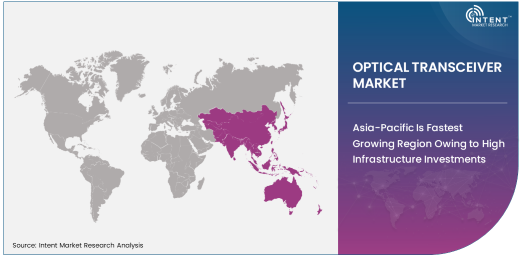
Asia-Pacific Is Fastest Growing Region Owing to High Infrastructure Investments
The Asia-Pacific (APAC) region is the fastest growing market for optical transceivers, driven by significant investments in network infrastructure, particularly in China, India, and other emerging economies. The region is seeing rapid advancements in telecommunications, data center expansion, and the development of 5G networks, all of which contribute to the growing demand for high-speed data transmission and the need for optical transceivers. Additionally, the rise of cloud computing, big data, and IoT applications is fueling the demand for optical transceivers in the region's data centers and enterprise networks.
As APAC countries continue to improve their digital infrastructure, the need for efficient and high-capacity data transmission is increasing, pushing the demand for optical transceivers even further. The rapid expansion of the internet and mobile networks, coupled with ongoing infrastructure development projects, makes APAC a crucial market for optical transceivers. The region is expected to maintain its rapid growth, with key players focusing on offering affordable, high-performance solutions to meet the rising demand for faster and more reliable data transfer.
Leading Companies and Competitive Landscape
The optical transceiver market is highly competitive, with a range of leading players that include Cisco Systems Inc., Finisar Corporation (acquired by II-VI Incorporated), Lumentum Holdings Inc., Broadcom Inc., and Mellanox Technologies (now part of NVIDIA). These companies are heavily investing in R&D to develop innovative optical transceiver solutions that can meet the evolving demands for higher data rates, longer transmission distances, and more compact designs. Strategic partnerships and acquisitions are also common in the market, as companies seek to strengthen their product portfolios and expand their market presence.
With the ongoing advancements in optical communication technologies and the increasing demand for 5G, cloud computing, and high-speed data services, competition in the optical transceiver market is intensifying. Companies are focusing on delivering cost-effective, high-performance solutions that can cater to the needs of telecommunications, data centers, and enterprise networks. As the market continues to grow, the focus will be on providing advanced optical transceivers that support the increasing demand for faster, more reliable, and scalable data transmission systems.
Recent Developments:
- Finisar Corporation launched a new 400G optical transceiver designed for high-performance data center and telecom applications, offering enhanced bandwidth and reduced latency.
- Cisco Systems, Inc. introduced a new line of QSFP optical transceivers optimized for 5G telecom infrastructure, improving network speed and reliability.
- Mellanox Technologies unveiled a next-gen 100G optical transceiver for data center applications, delivering improved performance in high-density environments.
- Intel Corporation expanded its portfolio with a new series of SFP optical transceivers aimed at enterprise networks, providing cost-effective, high-speed connectivity.
- Huawei Technologies Co., Ltd. launched an advanced XFP optical transceiver with enhanced energy efficiency and greater compatibility for next-generation telecom networks.
List of Leading Companies:
- Finisar Corporation
- Lumentum Operations LLC
- Broadcom Inc.
- Cisco Systems, Inc.
- Intel Corporation
- Mellanox Technologies
- II-VI Incorporated
- Juniper Networks, Inc.
- Acacia Communications, Inc.
- Huawei Technologies Co., Ltd.
- ZTE Corporation
- Inphi Corporation
- NeoPhotonics Corporation
- Arista Networks, Inc.
- Fiberhome Telecommunication Technologies Co., Ltd.
Report Scope:
|
Report Features |
Description |
|
Market Size (2024-e) |
USD 7.0 Billion |
|
Forecasted Value (2030) |
USD 14.2 Billion |
|
CAGR (2025 – 2030) |
12.4% |
|
Base Year for Estimation |
2024-e |
|
Historic Year |
2023 |
|
Forecast Period |
2025 – 2030 |
|
Report Coverage |
Market Forecast, Market Dynamics, Competitive Landscape, Recent Developments |
|
Segments Covered |
Optical Transceiver Market By Product Type (SFP Transceiver, QSFP Transceiver, CFP Transceiver, XFP Transceiver), By Data Rate (10G, 25G, 40G, 100G, 400G), and By Application (Telecommunications, Data Centers, Enterprise Networks, Cable Networks) |
|
Regional Analysis |
North America (US, Canada, Mexico), Europe (Germany, France, UK, Italy, Spain, and Rest of Europe), Asia-Pacific (China, Japan, South Korea, Australia, India, and Rest of Asia-Pacific), Latin America (Brazil, Argentina, and Rest of Latin America), Middle East & Africa (Saudi Arabia, UAE, Rest of Middle East & Africa) |
|
Major Companies |
Finisar Corporation, Lumentum Operations LLC, Broadcom Inc., Cisco Systems, Inc., Intel Corporation, Mellanox Technologies, II-VI Incorporated, Juniper Networks, Inc., Acacia Communications, Inc., Huawei Technologies Co., Ltd., ZTE Corporation, Inphi Corporation, NeoPhotonics Corporation, Arista Networks, Inc., Fiberhome Telecommunication Technologies Co., Ltd. |
|
Customization Scope |
Customization for segments, region/country-level will be provided. Moreover, additional customization can be done based on the requirements |
|
1. Introduction |
|
1.1. Market Definition |
|
1.2. Scope of the Study |
|
1.3. Research Assumptions |
|
1.4. Study Limitations |
|
2. Research Methodology |
|
2.1. Research Approach |
|
2.1.1. Top-Down Method |
|
2.1.2. Bottom-Up Method |
|
2.1.3. Factor Impact Analysis |
|
2.2. Insights & Data Collection Process |
|
2.2.1. Secondary Research |
|
2.2.2. Primary Research |
|
2.3. Data Mining Process |
|
2.3.1. Data Analysis |
|
2.3.2. Data Validation and Revalidation |
|
2.3.3. Data Triangulation |
|
3. Executive Summary |
|
3.1. Major Markets & Segments |
|
3.2. Highest Growing Regions and Respective Countries |
|
3.3. Impact of Growth Drivers & Inhibitors |
|
3.4. Regulatory Overview by Country |
|
4. Optical Transceiver Market, by Product Type (Market Size & Forecast: USD Million, 2023 – 2030) |
|
4.1. SFP Transceiver |
|
4.2. QSFP Transceiver |
|
4.3. CFP Transceiver |
|
4.4. XFP Transceiver |
|
4.5. Others |
|
5. Optical Transceiver Market, by Data Rate (Market Size & Forecast: USD Million, 2023 – 2030) |
|
5.1. 10G |
|
5.2. 25G |
|
5.3. 40G |
|
5.4. 100G |
|
5.5. 400G |
|
5.6. Others |
|
6. Optical Transceiver Market, by Application (Market Size & Forecast: USD Million, 2023 – 2030) |
|
6.1. Telecommunications |
|
6.2. Data Centers |
|
6.3. Enterprise Networks |
|
6.4. Cable Networks |
|
6.5. Others |
|
7. Regional Analysis (Market Size & Forecast: USD Million, 2023 – 2030) |
|
7.1. Regional Overview |
|
7.2. North America |
|
7.2.1. Regional Trends & Growth Drivers |
|
7.2.2. Barriers & Challenges |
|
7.2.3. Opportunities |
|
7.2.4. Factor Impact Analysis |
|
7.2.5. Technology Trends |
|
7.2.6. North America Optical Transceiver Market, by Product Type |
|
7.2.7. North America Optical Transceiver Market, by Data Rate |
|
7.2.8. North America Optical Transceiver Market, by Application |
|
7.2.9. By Country |
|
7.2.9.1. US |
|
7.2.9.1.1. US Optical Transceiver Market, by Product Type |
|
7.2.9.1.2. US Optical Transceiver Market, by Data Rate |
|
7.2.9.1.3. US Optical Transceiver Market, by Application |
|
7.2.9.2. Canada |
|
7.2.9.3. Mexico |
|
*Similar segmentation will be provided for each region and country |
|
7.3. Europe |
|
7.4. Asia-Pacific |
|
7.5. Latin America |
|
7.6. Middle East & Africa |
|
8. Competitive Landscape |
|
8.1. Overview of the Key Players |
|
8.2. Competitive Ecosystem |
|
8.2.1. Level of Fragmentation |
|
8.2.2. Market Consolidation |
|
8.2.3. Product Innovation |
|
8.3. Company Share Analysis |
|
8.4. Company Benchmarking Matrix |
|
8.4.1. Strategic Overview |
|
8.4.2. Product Innovations |
|
8.5. Start-up Ecosystem |
|
8.6. Strategic Competitive Insights/ Customer Imperatives |
|
8.7. ESG Matrix/ Sustainability Matrix |
|
8.8. Manufacturing Network |
|
8.8.1. Locations |
|
8.8.2. Supply Chain and Logistics |
|
8.8.3. Product Flexibility/Customization |
|
8.8.4. Digital Transformation and Connectivity |
|
8.8.5. Environmental and Regulatory Compliance |
|
8.9. Technology Readiness Level Matrix |
|
8.10. Technology Maturity Curve |
|
8.11. Buying Criteria |
|
9. Company Profiles |
|
9.1. Finisar Corporation |
|
9.1.1. Company Overview |
|
9.1.2. Company Financials |
|
9.1.3. Product/Service Portfolio |
|
9.1.4. Recent Developments |
|
9.1.5. IMR Analysis |
|
*Similar information will be provided for other companies |
|
9.2. Lumentum Operations LLC |
|
9.3. Broadcom Inc. |
|
9.4. Cisco Systems, Inc. |
|
9.5. Intel Corporation |
|
9.6. Mellanox Technologies |
|
9.7. II-VI Incorporated |
|
9.8. Juniper Networks, Inc. |
|
9.9. Acacia Communications, Inc. |
|
9.10. Huawei Technologies Co., Ltd. |
|
9.11. ZTE Corporation |
|
9.12. Inphi Corporation |
|
9.13. NeoPhotonics Corporation |
|
9.14. Arista Networks, Inc. |
|
9.15. Fiberhome Telecommunication Technologies Co., Ltd. |
|
10. Appendix |
A comprehensive market research approach was employed to gather and analyze data on the Optical Transceiver Market. In the process, the analysis was also done to analyze the parent market and relevant adjacencies to measure the impact of them on the Optical Transceiver Market. The research methodology encompassed both secondary and primary research techniques, ensuring the accuracy and credibility of the findings.
.jpg)
Secondary Research
Secondary research involved a thorough review of pertinent industry reports, journals, articles, and publications. Additionally, annual reports, press releases, and investor presentations of industry players were scrutinized to gain insights into their market positioning and strategies.
Primary Research
Primary research involved conducting in-depth interviews with industry experts, stakeholders, and market participants across the E-Waste Management ecosystem. The primary research objectives included:
- Validating findings and assumptions derived from secondary research
- Gathering qualitative and quantitative data on market trends, drivers, and challenges
- Understanding the demand-side dynamics, encompassing end-users, component manufacturers, facility providers, and service providers
- Assessing the supply-side landscape, including technological advancements and recent developments
Market Size Assessment
A combination of top-down and bottom-up approaches was utilized to analyze the overall size of the Optical Transceiver Market. These methods were also employed to assess the size of various subsegments within the market. The market size assessment methodology encompassed the following steps:
- Identification of key industry players and relevant revenues through extensive secondary research
- Determination of the industry's supply chain and market size, in terms of value, through primary and secondary research processes
- Calculation of percentage shares, splits, and breakdowns using secondary sources and verification through primary sources
.jpg)
Data Triangulation
To ensure the accuracy and reliability of the market size, data triangulation was implemented. This involved cross-referencing data from various sources, including demand and supply side factors, market trends, and expert opinions. Additionally, top-down and bottom-up approaches were employed to validate the market size assessment.
NA