
As per Intent Market Research, the Nanomedicine Market was valued at USD 2.0 Billion in 2024-e and will surpass USD 3.5 Billion by 2030; growing at a CAGR of 9.5% during 2025 - 2030.
The nanomedicine market is at the forefront of revolutionizing healthcare by leveraging nanotechnology to develop innovative medical products and solutions. Nanomedicine involves the use of nanoscale materials such as nanoparticles, nano-carriers, and nano-biologics to improve the diagnosis, treatment, and prevention of various diseases. With the potential to enhance drug delivery, target specific cells, and improve the precision of diagnostics, nanomedicine is transforming the landscape of modern medicine. The market's growth is driven by advancements in nanotechnology, increasing investments in research and development, and the rising prevalence of chronic and life-threatening diseases.
The application of nanomedicine spans diverse therapeutic areas, including oncology, cardiovascular diseases, neurological disorders, and anti-infective therapies. As healthcare systems worldwide focus on improving patient outcomes and reducing side effects associated with conventional treatments, the adoption of nanomedicine is expected to witness significant growth.
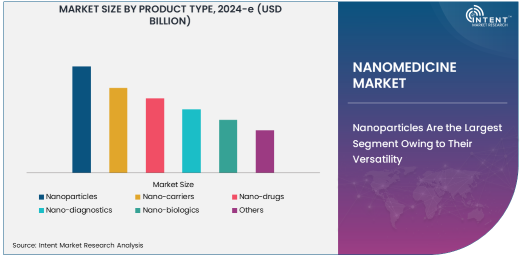
Nanoparticles Are the Largest Segment Owing to Their Versatility
The nanoparticles segment dominates the nanomedicine market due to its versatile applications across various medical fields. Nanoparticles are widely used for drug delivery, imaging, and diagnostics, providing unique advantages such as increased bioavailability, targeted delivery, and reduced toxicity. These properties make nanoparticles an essential component of innovative treatments, especially in oncology and cardiovascular medicine.
In oncology, nanoparticles enable the precise delivery of chemotherapeutic agents directly to cancer cells, minimizing damage to healthy tissues. This targeted approach not only enhances the efficacy of cancer treatments but also reduces adverse side effects. The growing prevalence of cancer globally, coupled with the increasing adoption of nanoparticle-based therapies, is propelling the segment's growth. With ongoing research into novel nanoparticle formulations and their applications, this segment is expected to maintain its leading position in the market.
Oncology Is the Fastest-Growing Application Due to Rising Cancer Incidence
The oncology segment is the fastest-growing application of nanomedicine, driven by the rising global burden of cancer and the urgent need for effective and less invasive treatment options. Nanomedicine offers groundbreaking solutions in oncology by enabling targeted drug delivery, improving imaging techniques, and enhancing the efficacy of therapies such as radiation and chemotherapy.
Nanomedicine's ability to deliver drugs directly to tumor sites while sparing healthy tissues has revolutionized cancer treatment. For instance, nano-drugs and nano-carriers are being used to encapsulate chemotherapeutic agents, ensuring their stability and controlled release within the body. Additionally, the use of nanoparticles in imaging has improved the early detection of tumors, leading to better patient outcomes. With continued advancements in nanotechnology and increasing investment in cancer research, the oncology segment is poised for exponential growth.
Hospitals Are the Largest End-Use Industry Owing to Advanced Infrastructure
The hospitals segment represents the largest end-use industry for nanomedicine, driven by their advanced medical infrastructure and capacity to adopt cutting-edge technologies. Hospitals are the primary centers for the implementation of nanomedicine in diagnostics, treatments, and patient care. Their ability to integrate nanotechnology-based solutions into existing healthcare practices makes them a key contributor to the market's growth.
Nanomedicine products, such as nano-diagnostics and nano-biologics, are increasingly used in hospitals to improve the precision and effectiveness of treatments for complex conditions like cancer and cardiovascular diseases. Additionally, the rising prevalence of chronic diseases has led to a surge in hospital-based applications of nanomedicine, further solidifying their role as the largest end-use industry. As healthcare systems continue to evolve, hospitals are expected to remain the primary adopters of nanomedicine solutions.
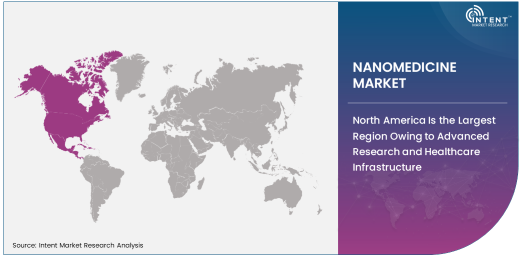
North America Is the Largest Region Owing to Advanced Research and Healthcare Infrastructure
North America holds the largest share in the nanomedicine market, attributed to its advanced research capabilities, robust healthcare infrastructure, and significant investments in nanotechnology. The United States, in particular, is a global leader in the development and commercialization of nanomedicine products, supported by strong government funding and active participation from pharmaceutical and biotechnology companies.
The region's dominance is further reinforced by the high prevalence of chronic diseases and the increasing adoption of nanotechnology in healthcare. North America's strong regulatory framework and well-established clinical trial processes have also facilitated the rapid development and approval of nanomedicine products. As the region continues to prioritize innovation and advanced patient care, it is expected to maintain its leading position in the global nanomedicine market.
Leading Companies and Competitive Landscape
The nanomedicine market is highly competitive, with several key players driving innovation and expanding the scope of nanotechnology in healthcare. Prominent companies in the market include Pfizer Inc., AstraZeneca, Amgen Inc., Celgene Corporation, and Johnson & Johnson. These companies are focusing on developing advanced nano-drugs, diagnostics, and delivery systems to cater to the growing demand for personalized and targeted therapies.
Collaborations between pharmaceutical giants, biotechnology firms, and research institutions are accelerating the development of innovative nanomedicine solutions. The competitive landscape is characterized by continuous advancements in product offerings and a strong emphasis on research and development. As nanomedicine continues to transform healthcare, the market is expected to witness increased competition and significant breakthroughs in the coming years.
Recent Developments:
- Pfizer launched a new nanomedicine-based drug for breast cancer treatment in collaboration with a nanotechnology startup in December 2024.
- AstraZeneca expanded its nanomedicine R&D unit with a focus on nano-biologics for cardiovascular diseases.
- Johnson & Johnson received FDA approval for its nanoparticle-based diagnostic platform for early detection of neurological disorders.
- Roche announced a partnership with Biogen to develop nano-enabled therapies for Alzheimer's disease.
- Sanofi unveiled a new production facility for nanomedicine drugs in Europe, strengthening its manufacturing capabilities.
List of Leading Companies:
- Pfizer Inc.
- AstraZeneca PLC
- Johnson & Johnson
- Novartis International AG
- Amgen Inc.
- Merck & Co., Inc.
- F. Hoffmann-La Roche Ltd.
- Teva Pharmaceutical Industries Ltd.
- Sanofi S.A.
- Bristol-Myers Squibb Company
- Abbott Laboratories
- Celgene Corporation
- Biogen Inc.
- GlaxoSmithKline PLC
- UCB S.A.
Report Scope:
|
Report Features |
Description |
|
Market Size (2024-e) |
USD XX billion |
|
Forecasted Value (2030) |
USD XX billion |
|
CAGR (2025 – 2030) |
XX% |
|
Base Year for Estimation |
2024-e |
|
Historic Year |
2023 |
|
Forecast Period |
2025 – 2030 |
|
Report Coverage |
Market Forecast, Market Dynamics, Competitive Landscape, Recent Developments |
|
Segments Covered |
Nanomedicine Market by Product Type (Nanoparticles, Nano-carriers, Nano-drugs, Nano-diagnostics, Nano-biologics), Application (Oncology, Cardiovascular Diseases, Neurological Disorders, Anti-infective Therapies, Orthopedics), End-Use Industry (Hospitals, Specialty Clinics) and Regions |
|
Regional Analysis |
North America (US, Canada, Mexico), Europe (Germany, France, UK, Italy, Spain, and Rest of Europe), Asia-Pacific (China, Japan, South Korea, Australia, India, and Rest of Asia-Pacific), Latin America (Brazil, Argentina, and Rest of Latin America), Middle East & Africa (Saudi Arabia, UAE, Rest of Middle East & Africa) |
|
Major Companies |
Pfizer Inc., AstraZeneca PLC, Johnson & Johnson, Novartis International AG, Amgen Inc., Merck & Co., Inc., Teva Pharmaceutical Industries Ltd., Sanofi S.A., Bristol-Myers Squibb Company, Abbott Laboratories, Celgene Corporation, Biogen Inc., UCB S.A. |
|
Customization Scope |
Customization for segments, region/country-level will be provided. Moreover, additional customization can be done based on the requirements |
|
1. Introduction |
|
1.1. Market Definition |
|
1.2. Scope of the Study |
|
1.3. Research Assumptions |
|
1.4. Study Limitations |
|
2. Research Methodology |
|
2.1. Research Approach |
|
2.1.1. Top-Down Method |
|
2.1.2. Bottom-Up Method |
|
2.1.3. Factor Impact Analysis |
|
2.2. Insights & Data Collection Process |
|
2.2.1. Secondary Research |
|
2.2.2. Primary Research |
|
2.3. Data Mining Process |
|
2.3.1. Data Analysis |
|
2.3.2. Data Validation and Revalidation |
|
2.3.3. Data Triangulation |
|
3. Executive Summary |
|
3.1. Major Markets & Segments |
|
3.2. Highest Growing Regions and Respective Countries |
|
3.3. Impact of Growth Drivers & Inhibitors |
|
3.4. Regulatory Overview by Country |
|
4. Nanomedicine Market, by Product Type (Market Size & Forecast: USD Million, 2023 – 2030) |
|
4.1. Nanoparticles |
|
4.2. Nano-carriers |
|
4.3. Nano-drugs |
|
4.4. Nano-diagnostics |
|
4.5. Nano-biologics |
|
4.6. Others |
|
5. Nanomedicine Market, by Application (Market Size & Forecast: USD Million, 2023 – 2030) |
|
5.1. Oncology |
|
5.2. Cardiovascular Diseases |
|
5.3. Neurological Disorders |
|
5.4. Anti-infective Therapies |
|
5.5. Orthopedics |
|
5.6. Others |
|
6. Nanomedicine Market, by End-Use Industry (Market Size & Forecast: USD Million, 2023 – 2030) |
|
6.1. Hospitals |
|
6.2. Specialty Clinics |
|
6.3. Others |
|
7. Regional Analysis (Market Size & Forecast: USD Million, 2023 – 2030) |
|
7.1. Regional Overview |
|
7.2. North America |
|
7.2.1. Regional Trends & Growth Drivers |
|
7.2.2. Barriers & Challenges |
|
7.2.3. Opportunities |
|
7.2.4. Factor Impact Analysis |
|
7.2.5. Technology Trends |
|
7.2.6. North America Nanomedicine Market, by Product Type |
|
7.2.7. North America Nanomedicine Market, by Application |
|
7.2.8. North America Nanomedicine Market, by End-Use Industry |
|
7.2.9. By Country |
|
7.2.9.1. US |
|
7.2.9.1.1. US Nanomedicine Market, by Product Type |
|
7.2.9.1.2. US Nanomedicine Market, by Application |
|
7.2.9.1.3. US Nanomedicine Market, by End-Use Industry |
|
7.2.9.2. Canada |
|
7.2.9.3. Mexico |
|
*Similar segmentation will be provided for each region and country |
|
7.3. Europe |
|
7.4. Asia-Pacific |
|
7.5. Latin America |
|
7.6. Middle East & Africa |
|
8. Competitive Landscape |
|
8.1. Overview of the Key Players |
|
8.2. Competitive Ecosystem |
|
8.2.1. Level of Fragmentation |
|
8.2.2. Market Consolidation |
|
8.2.3. Product Innovation |
|
8.3. Company Share Analysis |
|
8.4. Company Benchmarking Matrix |
|
8.4.1. Strategic Overview |
|
8.4.2. Product Innovations |
|
8.5. Start-up Ecosystem |
|
8.6. Strategic Competitive Insights/ Customer Imperatives |
|
8.7. ESG Matrix/ Sustainability Matrix |
|
8.8. Manufacturing Network |
|
8.8.1. Locations |
|
8.8.2. Supply Chain and Logistics |
|
8.8.3. Product Flexibility/Customization |
|
8.8.4. Digital Transformation and Connectivity |
|
8.8.5. Environmental and Regulatory Compliance |
|
8.9. Technology Readiness Level Matrix |
|
8.10. Technology Maturity Curve |
|
8.11. Buying Criteria |
|
9. Company Profiles |
|
9.1. Pfizer Inc. |
|
9.1.1. Company Overview |
|
9.1.2. Company Financials |
|
9.1.3. Product/Service Portfolio |
|
9.1.4. Recent Developments |
|
9.1.5. IMR Analysis |
|
*Similar information will be provided for other companies |
|
9.2. AstraZeneca PLC |
|
9.3. Johnson & Johnson |
|
9.4. Novartis International AG |
|
9.5. Amgen Inc. |
|
9.6. Merck & Co., Inc. |
|
9.7. F. Hoffmann-La Roche Ltd. |
|
9.8. Teva Pharmaceutical Industries Ltd. |
|
9.9. Sanofi S.A. |
|
9.10. Bristol-Myers Squibb Company |
|
9.11. Abbott Laboratories |
|
9.12. Celgene Corporation |
|
9.13. Biogen Inc. |
|
9.14. GlaxoSmithKline PLC |
|
9.15. UCB S.A. |
|
10. Appendix |
A comprehensive market research approach was employed to gather and analyze data on the Nanomedicine Market. In the process, the analysis was also done to analyze the parent market and relevant adjacencies to measure the impact of them on the Nanomedicine Market. The research methodology encompassed both secondary and primary research techniques, ensuring the accuracy and credibility of the findings.
.jpg)
Secondary Research
Secondary research involved a thorough review of pertinent industry reports, journals, articles, and publications. Additionally, annual reports, press releases, and investor presentations of industry players were scrutinized to gain insights into their market positioning and strategies.
Primary Research
Primary research involved conducting in-depth interviews with industry experts, stakeholders, and market participants across the E-Waste Management ecosystem. The primary research objectives included:
- Validating findings and assumptions derived from secondary research
- Gathering qualitative and quantitative data on market trends, drivers, and challenges
- Understanding the demand-side dynamics, encompassing end-users, component manufacturers, facility providers, and service providers
- Assessing the supply-side landscape, including technological advancements and recent developments
Market Size Assessment
A combination of top-down and bottom-up approaches was utilized to analyze the overall size of the Nanomedicine Market. These methods were also employed to assess the size of various subsegments within the market. The market size assessment methodology encompassed the following steps:
- Identification of key industry players and relevant revenues through extensive secondary research
- Determination of the industry's supply chain and market size, in terms of value, through primary and secondary research processes
- Calculation of percentage shares, splits, and breakdowns using secondary sources and verification through primary sources
.jpg)
Data Triangulation
To ensure the accuracy and reliability of the market size, data triangulation was implemented. This involved cross-referencing data from various sources, including demand and supply side factors, market trends, and expert opinions. Additionally, top-down and bottom-up approaches were employed to validate the market size assessment.
NA