
As per Intent Market Research, the Muslin Curtains Market was valued at USD 0.5 billion in 2024-e and will surpass USD 0.7 billion by 2030; growing at a CAGR of 8.2% during 2025 - 2030.
The muslin curtains market is experiencing significant growth driven by consumer demand for natural, breathable, and stylish window treatments. Muslin curtains are favored for their lightweight and airy texture, providing a soft, diffused light that enhances the ambiance of living spaces. The market is also benefiting from the increasing trend towards sustainable and eco-friendly home decor, with muslin being a natural fabric that aligns with these preferences.
As consumers become more focused on aesthetics and functionality, muslin curtains are gaining popularity in both residential and commercial applications. With their versatility and the growing availability of customized options, the muslin curtains market is well-positioned to continue expanding. Additionally, the surge in e-commerce platforms has made muslin curtains more accessible, allowing consumers to explore a wide range of designs and sizes suited to various tastes and room styles.
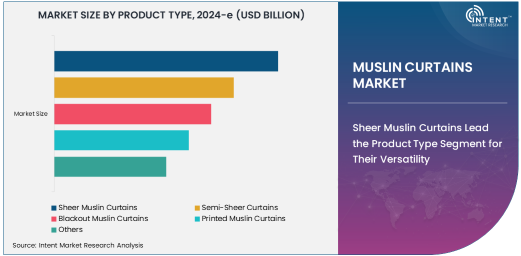
Sheer Muslin Curtains Lead the Product Type Segment for Their Versatility
Sheer muslin curtains are the most popular product type in the market due to their ability to create a soft, elegant ambiance while allowing natural light to filter through. These curtains offer privacy without sacrificing brightness, making them a favored choice for living rooms, bedrooms, and other areas that require a balance of light control and aesthetic appeal.
Semi-sheer and blackout muslin curtains are also in demand, with semi-sheer offering a slightly more opaque option and blackout curtains providing total light control for specific needs, such as in bedrooms or home theaters. Printed muslin curtains are gaining popularity in the fashion-forward segment, offering vibrant patterns and designs that cater to various interior design themes.
100% Cotton Muslin Dominates the Material Type Segment Due to Natural Appeal
100% cotton muslin dominates the material type segment, as it is lightweight, breathable, and hypoallergenic. This natural fabric appeals to consumers looking for sustainable and eco-friendly products that contribute to a healthier home environment. Cotton muslin is also easy to maintain and comes in a variety of colors and finishes, making it a versatile choice for many design preferences.
Organic muslin is also gaining traction due to the increasing consumer demand for environmentally conscious products. These curtains are made from organically grown cotton, free from pesticides and chemicals, which appeals to consumers looking for a more sustainable and eco-friendly option. Blended muslin offers additional durability and texture, attracting a different segment of the market focused on longevity and practical use.
Residential End-User Segment Leads Demand for Muslin Curtains
The residential end-user segment is the largest market driver for muslin curtains, as consumers continue to prioritize the aesthetics and functionality of their home interiors. Muslin curtains offer an ideal balance of light filtration, privacy, and style, making them a popular choice for various living spaces, from bedrooms to living rooms and dining areas. The growing trend towards minimalist and natural design elements in homes has also contributed to the increased adoption of muslin curtains.
The commercial segment, including offices, retail stores, and corporate spaces, is also witnessing significant growth, as businesses seek aesthetically pleasing yet functional window treatments. Muslin curtains offer an elegant touch that complements modern office designs while maintaining a casual, comfortable vibe. The hospitality sector, including hotels and resorts, further enhances demand by using muslin curtains in guest rooms to create cozy, inviting atmospheres.
Online Retailers Dominate Distribution Channels for Muslin Curtains
Online retailers have become the leading distribution channel for muslin curtains, driven by the convenience and wide variety of options available to consumers. E-commerce platforms allow customers to browse extensive product catalogs, compare prices, and read reviews, all from the comfort of their homes. The ease of online shopping has also helped to introduce muslin curtains to a global audience, providing access to products from different regions and manufacturers.
Offline stores, such as home decor retailers and specialty curtain shops, continue to play a significant role for consumers who prefer to see and feel the fabric before making a purchase. These stores provide an opportunity for customers to experience the quality of muslin curtains firsthand and seek expert guidance on selecting the right style and size.
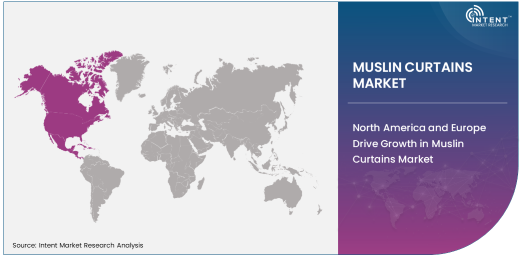
North America and Europe Drive Growth in Muslin Curtains Market
North America and Europe are the key regions driving growth in the muslin curtains market, as consumer demand for high-quality and stylish home decor products continues to rise. In these regions, muslin curtains are favored for their versatile, natural appearance and ability to complement various interior design styles, from traditional to contemporary.
Asia-Pacific is emerging as a rapidly growing market due to the region's expanding middle class and increased disposable income. As consumers in countries like China and India seek to enhance their living environments, muslin curtains are becoming a popular choice due to their affordable luxury and sustainable qualities.
Competitive Landscape
The muslin curtains market is characterized by several prominent players, including IKEA, West Elm, Pottery Barn, and Anthropologie, which offer a wide range of muslin curtain products in various styles and sizes. These companies compete based on quality, design innovation, and pricing to appeal to different segments of consumers.
Many companies are focusing on sustainability, with eco-friendly collections made from organic or recycled materials, responding to the growing demand for environmentally responsible home products. Additionally, online retailers such as Amazon, Wayfair, and Etsy are expanding their offerings, providing a competitive landscape for smaller, independent brands that emphasize customization and unique designs.
Recent Developments:
- In December 2024, IKEA launched a new line of eco-friendly muslin curtains with blackout options.
- In November 2024, H&M Home introduced organic muslin curtain panels for sustainable living.
- In October 2024, West Elm expanded its muslin curtain collection with bold printed designs.
- In September 2024, Wayfair announced a collaboration with designers for customizable muslin curtain sets.
- In August 2024, Pottery Barn added semi-sheer muslin draperies to its eco-friendly home collection.
List of Leading Companies:
- IKEA
- Pottery Barn
- West Elm
- Crate & Barrel
- Urban Outfitters
- H&M Home
- Anthropologie
- Restoration Hardware
- Wayfair
- JCPenney
- Laura Ashley
- Target
- Walmart
- Dunelm
- Bed Bath & Beyond
Report Scope:
|
Report Features |
Description |
|
Market Size (2024-e) |
USD 0.5 billion |
|
Forecasted Value (2030) |
USD 0.7 billion |
|
CAGR (2025 – 2030) |
8.2% |
|
Base Year for Estimation |
2024-e |
|
Historic Year |
2023 |
|
Forecast Period |
2025 – 2030 |
|
Report Coverage |
Market Forecast, Market Dynamics, Competitive Landscape, Recent Developments |
|
Segments Covered |
Muslin Curtains Market By Product Type (Sheer Muslin Curtains, Semi-Sheer Curtains, Blackout Muslin Curtains, Printed Muslin Curtains), By Material Type (100% Cotton Muslin, Blended Muslin, Organic Muslin), By End-User (Residential, Commercial, Hospitality (Hotels, etc.)), By Distribution Channel (Online Retailers, Offline Stores, Specialty Curtain Stores) |
|
Regional Analysis |
North America (US, Canada, Mexico), Europe (Germany, France, UK, Italy, Spain, and Rest of Europe), Asia-Pacific (China, Japan, South Korea, Australia, India, and Rest of Asia-Pacific), Latin America (Brazil, Argentina, and Rest of Latin America), Middle East & Africa (Saudi Arabia, UAE, Rest of Middle East & Africa) |
|
Major Companies |
IKEA, Pottery Barn, West Elm, Crate & Barrel, Urban Outfitters, H&M Home, Anthropologie, Restoration Hardware, Wayfair, JCPenney, Laura Ashley, Target, Walmart, Dunelm, Bed Bath & Beyond |
|
Customization Scope |
Customization for segments, region/country-level will be provided. Moreover, additional customization can be done based on the requirements |
|
1. Introduction |
|
1.1. Market Definition |
|
1.2. Scope of the Study |
|
1.3. Research Assumptions |
|
1.4. Study Limitations |
|
2. Research Methodology |
|
2.1. Research Approach |
|
2.1.1. Top-Down Method |
|
2.1.2. Bottom-Up Method |
|
2.1.3. Factor Impact Analysis |
|
2.2. Insights & Data Collection Process |
|
2.2.1. Secondary Research |
|
2.2.2. Primary Research |
|
2.3. Data Mining Process |
|
2.3.1. Data Analysis |
|
2.3.2. Data Validation and Revalidation |
|
2.3.3. Data Triangulation |
|
3. Executive Summary |
|
3.1. Major Markets & Segments |
|
3.2. Highest Growing Regions and Respective Countries |
|
3.3. Impact of Growth Drivers & Inhibitors |
|
3.4. Regulatory Overview by Country |
|
4. Muslin Curtains Market, by Product Type (Market Size & Forecast: USD Million, 2023 – 2030) |
|
4.1. Sheer Muslin Curtains |
|
4.2. Semi-Sheer Curtains |
|
4.3. Blackout Muslin Curtains |
|
4.4. Printed Muslin Curtains |
|
4.5. Others |
|
5. Muslin Curtains Market, by Material Type (Market Size & Forecast: USD Million, 2023 – 2030) |
|
5.1. 100% Cotton Muslin |
|
5.2. Blended Muslin |
|
5.3. Organic Muslin |
|
5.4. Others |
|
6. Muslin Curtains Market, by End-User (Market Size & Forecast: USD Million, 2023 – 2030) |
|
6.1. Residential |
|
6.2. Commercial |
|
6.3. Hospitality (Hotels, etc.) |
|
6.4. Others |
|
7. Muslin Curtains Market, by Distribution Channel (Market Size & Forecast: USD Million, 2023 – 2030) |
|
7.1. Online Retailers |
|
7.2. Offline Stores |
|
7.3. Specialty Curtain Stores |
|
7.4. Others |
|
8. Regional Analysis (Market Size & Forecast: USD Million, 2023 – 2030) |
|
8.1. Regional Overview |
|
8.2. North America |
|
8.2.1. Regional Trends & Growth Drivers |
|
8.2.2. Barriers & Challenges |
|
8.2.3. Opportunities |
|
8.2.4. Factor Impact Analysis |
|
8.2.5. Technology Trends |
|
8.2.6. North America Muslin Curtains Market, by Product Type |
|
8.2.7. North America Muslin Curtains Market, by Material Type |
|
8.2.8. North America Muslin Curtains Market, by End-User |
|
8.2.9. North America Muslin Curtains Market, by Distribution Channel |
|
8.2.10. By Country |
|
8.2.10.1. US |
|
8.2.10.1.1. US Muslin Curtains Market, by Product Type |
|
8.2.10.1.2. US Muslin Curtains Market, by Material Type |
|
8.2.10.1.3. US Muslin Curtains Market, by End-User |
|
8.2.10.1.4. US Muslin Curtains Market, by Distribution Channel |
|
8.2.10.2. Canada |
|
8.2.10.3. Mexico |
|
*Similar segmentation will be provided for each region and country |
|
8.3. Europe |
|
8.4. Asia-Pacific |
|
8.5. Latin America |
|
8.6. Middle East & Africa |
|
9. Competitive Landscape |
|
9.1. Overview of the Key Players |
|
9.2. Competitive Ecosystem |
|
9.2.1. Level of Fragmentation |
|
9.2.2. Market Consolidation |
|
9.2.3. Product Innovation |
|
9.3. Company Share Analysis |
|
9.4. Company Benchmarking Matrix |
|
9.4.1. Strategic Overview |
|
9.4.2. Product Innovations |
|
9.5. Start-up Ecosystem |
|
9.6. Strategic Competitive Insights/ Customer Imperatives |
|
9.7. ESG Matrix/ Sustainability Matrix |
|
9.8. Manufacturing Network |
|
9.8.1. Locations |
|
9.8.2. Supply Chain and Logistics |
|
9.8.3. Product Flexibility/Customization |
|
9.8.4. Digital Transformation and Connectivity |
|
9.8.5. Environmental and Regulatory Compliance |
|
9.9. Technology Readiness Level Matrix |
|
9.10. Technology Maturity Curve |
|
9.11. Buying Criteria |
|
10. Company Profiles |
|
10.1. IKEA |
|
10.1.1. Company Overview |
|
10.1.2. Company Financials |
|
10.1.3. Product/Service Portfolio |
|
10.1.4. Recent Developments |
|
10.1.5. IMR Analysis |
|
*Similar information will be provided for other companies |
|
10.2. Pottery Barn |
|
10.3. West Elm |
|
10.4. Crate & Barrel |
|
10.5. Urban Outfitters |
|
10.6. H&M Home |
|
10.7. Anthropologie |
|
10.8. Restoration Hardware |
|
10.9. Wayfair |
|
10.10. JCPenney |
|
10.11. Laura Ashley |
|
10.12. Target |
|
10.13. Walmart |
|
10.14. Dunelm |
|
10.15. Bed Bath & Beyond |
|
11. Appendix |
A comprehensive market research approach was employed to gather and analyze data on the Muslin Curtains Market. In the process, the analysis was also done to analyze the parent market and relevant adjacencies to measure the impact of them on the Muslin Curtains Market. The research methodology encompassed both secondary and primary research techniques, ensuring the accuracy and credibility of the findings.
.jpg)
Secondary Research
Secondary research involved a thorough review of pertinent industry reports, journals, articles, and publications. Additionally, annual reports, press releases, and investor presentations of industry players were scrutinized to gain insights into their market positioning and strategies.
Primary Research
Primary research involved conducting in-depth interviews with industry experts, stakeholders, and market participants across the E-Waste Management ecosystem. The primary research objectives included:
- Validating findings and assumptions derived from secondary research
- Gathering qualitative and quantitative data on market trends, drivers, and challenges
- Understanding the demand-side dynamics, encompassing end-users, component manufacturers, facility providers, and service providers
- Assessing the supply-side landscape, including technological advancements and recent developments
Market Size Assessment
A combination of top-down and bottom-up approaches was utilized to analyze the overall size of the Muslin Curtains Market. These methods were also employed to assess the size of various subsegments within the market. The market size assessment methodology encompassed the following steps:
- Identification of key industry players and relevant revenues through extensive secondary research
- Determination of the industry's supply chain and market size, in terms of value, through primary and secondary research processes
- Calculation of percentage shares, splits, and breakdowns using secondary sources and verification through primary sources
.jpg)
Data Triangulation
To ensure the accuracy and reliability of the market size, data triangulation was implemented. This involved cross-referencing data from various sources, including demand and supply side factors, market trends, and expert opinions. Additionally, top-down and bottom-up approaches were employed to validate the market size assessment.
NA