
As per Intent Market Research, the Multiplexed Diagnostic Market was valued at USD 3.6 billion in 2024-e and will surpass USD 5.8 billion by 2030; growing at a CAGR of 8.5% during 2025 - 2030.
The multiplexed diagnostic market is growing rapidly as healthcare and diagnostics continue to evolve toward more precise, efficient, and cost-effective solutions. Multiplexed diagnostics enable the simultaneous detection of multiple biomarkers from a single sample, allowing for a broader, more comprehensive analysis of diseases. This technology is particularly impactful in the areas of infectious disease diagnosis, cancer detection, and genetic testing, as it provides quicker results with less patient involvement. By consolidating tests into a single process, multiplexed diagnostics offer improvements in both workflow and diagnostic accuracy, reducing turnaround times and enhancing patient outcomes.
The global market for multiplexed diagnostics is expected to continue expanding as demand increases for faster, more reliable diagnostic solutions. With the growing prevalence of chronic and infectious diseases, healthcare providers and research institutes are increasingly adopting multiplexed diagnostic technologies to address the challenges posed by these complex conditions. The integration of multiplexed diagnostic platforms with automated systems and digital health solutions is also contributing to market growth, allowing for faster and more precise diagnoses, with a shift toward personalized medicine.
Kits Are Largest Product Type Owing to Comprehensive Testing Solutions
Kits represent the largest product type within the multiplexed diagnostic market, owing to their convenience and comprehensive testing solutions. Multiplexed diagnostic kits typically come with all the required reagents, instructions, and tools necessary to perform the test, making them a go-to choice for diagnostic laboratories and research institutions. These kits are especially valued in clinical settings where efficiency and accuracy are crucial, and they provide a cost-effective way to conduct multiple tests simultaneously from a single sample.
The versatility of multiplexed diagnostic kits is a major driver of their dominance in the market. They can be adapted for a wide range of applications, from infectious disease testing to cancer and genetic diagnostics, making them indispensable in both clinical and research environments. As healthcare systems seek to streamline diagnostic workflows and reduce the number of tests and patient visits required, the use of multiplexed diagnostic kits is expected to grow steadily, maintaining their position as the largest product type in the market.

PCR-based Multiplexing Is Fastest Growing Technology Owing to Sensitivity and Versatility
PCR-based multiplexing is the fastest growing technology in the multiplexed diagnostic market, driven by its unparalleled sensitivity and versatility. Polymerase chain reaction (PCR) enables the amplification of specific DNA or RNA sequences, which allows for the detection of even minute amounts of target genetic material. PCR-based multiplexing allows for the simultaneous detection of multiple pathogens or genetic markers, making it an invaluable tool in diagnosing a range of diseases, from infectious agents like viruses and bacteria to cancer and genetic disorders.
The growing adoption of PCR-based multiplexing in clinical diagnostics is fueled by its ability to provide accurate, rapid results with high throughput. The COVID-19 pandemic further underscored the importance of PCR diagnostics, as the technology proved critical in large-scale testing efforts worldwide. As PCR technology continues to improve in terms of speed, cost-effectiveness, and multiplexing capacity, it is expected to remain the fastest growing technology in the multiplexed diagnostic market.
Infectious Disease Diagnosis Is Largest Application Owing to Ongoing Global Health Threats
Infectious disease diagnosis is the largest application segment in the multiplexed diagnostic market, driven by the ongoing global health threats posed by infectious diseases. The ability to rapidly detect multiple pathogens from a single sample is critical in managing and controlling outbreaks, whether they involve bacterial, viral, or parasitic infections. Multiplexed diagnostic tools enable healthcare providers to quickly identify and differentiate between various pathogens, allowing for more accurate diagnoses and faster treatment decisions.
The increasing global burden of infectious diseases, such as influenza, tuberculosis, HIV, and more recently, COVID-19, has intensified the demand for multiplexed diagnostic technologies. These technologies are also essential in regions with limited access to healthcare, where they can help streamline diagnostic processes and reduce the need for multiple testing sessions. As the demand for rapid, accurate, and cost-effective diagnostic solutions continues to grow, infectious disease diagnosis remains the largest application for multiplexed diagnostics.
Hospitals Are Largest End-User Owing to High Diagnostic Demand and Patient Volume
Hospitals are the largest end-user segment in the multiplexed diagnostic market, owing to the high diagnostic demand and patient volume in these settings. With the increasing complexity of diseases and the need for rapid, accurate diagnostic results, hospitals are adopting multiplexed diagnostic technologies to improve patient care and streamline clinical workflows. The use of multiplexed diagnostics in hospitals helps clinicians make faster, more informed decisions, which is crucial in the treatment of patients with complex or multiple conditions.
The significant patient volume and diverse diagnostic needs in hospitals make them an ideal environment for multiplexed diagnostic systems. These technologies allow hospitals to enhance their diagnostic capabilities, particularly in areas such as infectious disease control, cancer diagnostics, and genetic testing. As hospitals increasingly embrace precision medicine and the need for faster diagnostics grows, they are expected to continue driving the demand for multiplexed diagnostic solutions, keeping them as the largest end-user segment.
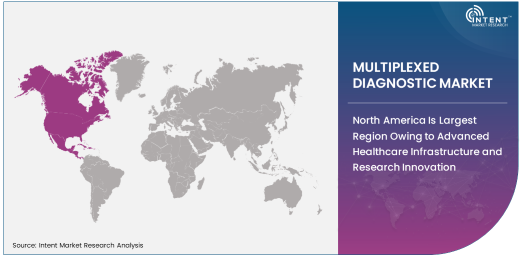
North America Is Largest Region Owing to Advanced Healthcare Infrastructure and Research Innovation
North America is the largest region in the multiplexed diagnostic market, owing to its advanced healthcare infrastructure, strong research base, and high levels of healthcare spending. The United States, in particular, is a leader in adopting advanced diagnostic technologies, including multiplexed diagnostics, driven by a robust healthcare system, leading academic research institutions, and private sector innovation. The region also benefits from significant investments in biotechnology and diagnostics, which have led to the development of cutting-edge multiplexed diagnostic systems.
North America’s dominance in the multiplexed diagnostic market is further supported by its high levels of healthcare expenditure, which allow for the adoption of the latest diagnostic tools and technologies. The region’s regulatory environment also facilitates the rapid approval and deployment of new diagnostic innovations, making it a hotbed for the development and commercialization of multiplexed diagnostic technologies. As personalized medicine and rapid diagnostic solutions continue to gain traction, North America is expected to maintain its leadership position in the global multiplexed diagnostic market.
Leading Companies and Competitive Landscape
The multiplexed diagnostic market is highly competitive, with several prominent players leading the way in technology development and market expansion. Key companies include Thermo Fisher Scientific, Abbott Laboratories, Roche Diagnostics, Qiagen, Bio-Rad Laboratories, and Danaher Corporation. These companies offer a wide range of multiplexed diagnostic products, including reagents, kits, and systems, for various applications in infectious disease diagnosis, cancer detection, and genetic testing.
The competitive landscape is marked by continuous innovation and the development of new, more efficient diagnostic solutions. Companies are investing heavily in research and development to enhance the sensitivity, speed, and ease of use of multiplexed diagnostic technologies. Partnerships and collaborations with academic institutions and healthcare providers are also common, as companies seek to expand their reach and access new markets. With the growing demand for more accurate, timely, and cost-effective diagnostic solutions, the competitive environment in the multiplexed diagnostic market is expected to remain dynamic and rapidly evolving.
Recent Developments:
- XXXX
List of Leading Companies:
- Thermo Fisher Scientific
- Bio-Rad Laboratories
- Roche Diagnostics
- Abbott Laboratories
- Siemens Healthineers
- Illumina Inc.
- PerkinElmer Inc.
- Luminex Corporation
- BioMérieux S.A.
- Qiagen N.V.
- Becton, Dickinson and Company (BD)
- Cepheid (Danaher Corporation)
- LabCorp (Laboratory Corporation of America)
- Hologic Inc.
- Beckman Coulter Inc.
Report Scope:
|
Report Features |
Description |
|
Market Size (2024-e) |
USD 3.6 billion |
|
Forecasted Value (2030) |
USD 5.8 billion |
|
CAGR (2025 – 2030) |
8.5% |
|
Base Year for Estimation |
2024-e |
|
Historic Year |
2023 |
|
Forecast Period |
2025 – 2030 |
|
Report Coverage |
Market Forecast, Market Dynamics, Competitive Landscape, Recent Developments |
|
Segments Covered |
Multiplexed Diagnostic Market By Product Type (Reagents, Kits, Systems), By Technology (PCR-based Multiplexing, Immunoassays), By Application (Infectious Disease Diagnosis, Cancer Diagnosis, Genetic Testing), By End-User (Hospitals, Diagnostic Laboratories, Research Institutes, Pharmaceutical & Biotechnology Companies) |
|
Regional Analysis |
North America (US, Canada, Mexico), Europe (Germany, France, UK, Italy, Spain, and Rest of Europe), Asia-Pacific (China, Japan, South Korea, Australia, India, and Rest of Asia-Pacific), Latin America (Brazil, Argentina, and Rest of Latin America), Middle East & Africa (Saudi Arabia, UAE, Rest of Middle East & Africa) |
|
Major Companies |
Thermo Fisher Scientific, Bio-Rad Laboratories, Roche Diagnostics, Abbott Laboratories, Siemens Healthineers, Illumina Inc., PerkinElmer Inc., Luminex Corporation, BioMérieux S.A., Qiagen N.V., Becton, Dickinson and Company (BD), Cepheid (Danaher Corporation), LabCorp (Laboratory Corporation of America), Hologic Inc., Beckman Coulter Inc. |
|
Customization Scope |
Customization for segments, region/country-level will be provided. Moreover, additional customization can be done based on the requirements |
|
1. Introduction |
|
1.1. Market Definition |
|
1.2. Scope of the Study |
|
1.3. Research Assumptions |
|
1.4. Study Limitations |
|
2. Research Methodology |
|
2.1. Research Approach |
|
2.1.1. Top-Down Method |
|
2.1.2. Bottom-Up Method |
|
2.1.3. Factor Impact Analysis |
|
2.2. Insights & Data Collection Process |
|
2.2.1. Secondary Research |
|
2.2.2. Primary Research |
|
2.3. Data Mining Process |
|
2.3.1. Data Analysis |
|
2.3.2. Data Validation and Revalidation |
|
2.3.3. Data Triangulation |
|
3. Executive Summary |
|
3.1. Major Markets & Segments |
|
3.2. Highest Growing Regions and Respective Countries |
|
3.3. Impact of Growth Drivers & Inhibitors |
|
3.4. Regulatory Overview by Country |
|
4. Multiplexed Diagnostic Market, by Product Type (Market Size & Forecast: USD Million, 2023 – 2030) |
|
4.1. Reagents |
|
4.2. Kits |
|
4.3. Systems |
|
5. Multiplexed Diagnostic Market, by Technology (Market Size & Forecast: USD Million, 2023 – 2030) |
|
5.1. PCR-based Multiplexing |
|
5.1.1. Real-Time PCR |
|
5.1.2. Digital PCR |
|
5.2. Immunoassays |
|
5.2.1. Enzyme-Linked Immunosorbent Assay (ELISA) |
|
5.2.2. Luminex XMAP Technology |
|
6. Multiplexed Diagnostic Market, by Application (Market Size & Forecast: USD Million, 2023 – 2030) |
|
6.1. Infectious Disease Diagnosis |
|
6.1.1. Respiratory Infections |
|
6.1.2. Gastrointestinal Infections |
|
6.1.3. Others |
|
6.2. Cancer Diagnosis |
|
6.3. Genetic Testing |
|
6.4. Others |
|
7. Multiplexed Diagnostic Market, by End-User (Market Size & Forecast: USD Million, 2023 – 2030) |
|
7.1. Hospitals |
|
7.2. Diagnostic Laboratories |
|
7.3. Research Institutes |
|
7.4. Pharmaceutical & Biotechnology Companies |
|
8. Regional Analysis (Market Size & Forecast: USD Million, 2023 – 2030) |
|
8.1. Regional Overview |
|
8.2. North America |
|
8.2.1. Regional Trends & Growth Drivers |
|
8.2.2. Barriers & Challenges |
|
8.2.3. Opportunities |
|
8.2.4. Factor Impact Analysis |
|
8.2.5. Technology Trends |
|
8.2.6. North America Multiplexed Diagnostic Market, by Product Type |
|
8.2.7. North America Multiplexed Diagnostic Market, by Technology |
|
8.2.8. North America Multiplexed Diagnostic Market, by Application |
|
8.2.9. By Country |
|
8.2.9.1. US |
|
8.2.9.1.1. US Multiplexed Diagnostic Market, by Product Type |
|
8.2.9.1.2. US Multiplexed Diagnostic Market, by Technology |
|
8.2.9.1.3. US Multiplexed Diagnostic Market, by Application |
|
8.2.9.2. Canada |
|
8.2.9.3. Mexico |
|
*Similar segmentation will be provided for each region and country |
|
8.3. Europe |
|
8.4. Asia-Pacific |
|
8.5. Latin America |
|
8.6. Middle East & Africa |
|
9. Competitive Landscape |
|
9.1. Overview of the Key Players |
|
9.2. Competitive Ecosystem |
|
9.2.1. Level of Fragmentation |
|
9.2.2. Market Consolidation |
|
9.2.3. Product Innovation |
|
9.3. Company Share Analysis |
|
9.4. Company Benchmarking Matrix |
|
9.4.1. Strategic Overview |
|
9.4.2. Product Innovations |
|
9.5. Start-up Ecosystem |
|
9.6. Strategic Competitive Insights/ Customer Imperatives |
|
9.7. ESG Matrix/ Sustainability Matrix |
|
9.8. Manufacturing Network |
|
9.8.1. Locations |
|
9.8.2. Supply Chain and Logistics |
|
9.8.3. Product Flexibility/Customization |
|
9.8.4. Digital Transformation and Connectivity |
|
9.8.5. Environmental and Regulatory Compliance |
|
9.9. Technology Readiness Level Matrix |
|
9.10. Technology Maturity Curve |
|
9.11. Buying Criteria |
|
10. Company Profiles |
|
10.1. Thermo Fisher Scientific |
|
10.1.1. Company Overview |
|
10.1.2. Company Financials |
|
10.1.3. Product/Service Portfolio |
|
10.1.4. Recent Developments |
|
10.1.5. IMR Analysis |
|
*Similar information will be provided for other companies |
|
10.2. Bio-Rad Laboratories |
|
10.3. Roche Diagnostics |
|
10.4. Abbott Laboratories |
|
10.5. Siemens Healthineers |
|
10.6. Illumina Inc. |
|
10.7. PerkinElmer Inc. |
|
10.8. Luminex Corporation |
|
10.9. BioMérieux S.A. |
|
10.10. Qiagen N.V. |
|
10.11. Becton, Dickinson and Company (BD) |
|
10.12. Cepheid (Danaher Corporation) |
|
10.13. LabCorp (Laboratory Corporation of America) |
|
10.14. Hologic Inc. |
|
10.15. Beckman Coulter Inc. |
|
11. Appendix |
A comprehensive market research approach was employed to gather and analyze data on the Multiplexed Diagnostic Market. In the process, the analysis was also done to analyze the parent market and relevant adjacencies to measure the impact of them on the Multiplexed Diagnostic Market. The research methodology encompassed both secondary and primary research techniques, ensuring the accuracy and credibility of the findings.
.jpg)
Secondary Research
Secondary research involved a thorough review of pertinent industry reports, journals, articles, and publications. Additionally, annual reports, press releases, and investor presentations of industry players were scrutinized to gain insights into their market positioning and strategies.
Primary Research
Primary research involved conducting in-depth interviews with industry experts, stakeholders, and market participants across the E-Waste Management ecosystem. The primary research objectives included:
- Validating findings and assumptions derived from secondary research
- Gathering qualitative and quantitative data on market trends, drivers, and challenges
- Understanding the demand-side dynamics, encompassing end-users, component manufacturers, facility providers, and service providers
- Assessing the supply-side landscape, including technological advancements and recent developments
Market Size Assessment
A combination of top-down and bottom-up approaches was utilized to analyze the overall size of the Multiplexed Diagnostic Market. These methods were also employed to assess the size of various subsegments within the market. The market size assessment methodology encompassed the following steps:
- Identification of key industry players and relevant revenues through extensive secondary research
- Determination of the industry's supply chain and market size, in terms of value, through primary and secondary research processes
- Calculation of percentage shares, splits, and breakdowns using secondary sources and verification through primary sources
.jpg)
Data Triangulation
To ensure the accuracy and reliability of the market size, data triangulation was implemented. This involved cross-referencing data from various sources, including demand and supply side factors, market trends, and expert opinions. Additionally, top-down and bottom-up approaches were employed to validate the market size assessment.
NA