
As per Intent Market Research, the Mosquito Repellent Market was valued at USD 2.8 Billion in 2024-e and will surpass USD 4.7 Billion by 2030; growing at a CAGR of 7.9% during 2025-2030.
The mosquito repellent market is rapidly growing as consumer awareness surrounding the dangers of mosquito-borne diseases, such as malaria, dengue, and Zika virus, increases. Mosquito repellents serve as a preventive measure against these diseases and have seen a surge in demand due to the global prevalence of such infections. The market is driven by advancements in repellent technologies, a rise in outdoor activities, and a growing need for household protection. With multiple product types, application sectors, and distribution channels, the mosquito repellent market is experiencing a transformation, with a clear shift toward more innovative and eco-friendly solutions.
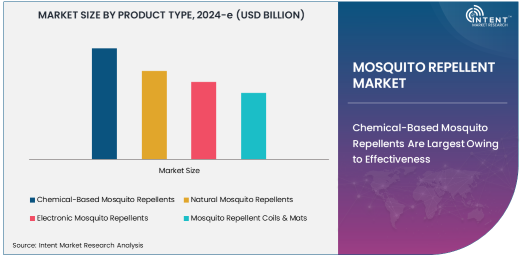
Chemical-Based Mosquito Repellents Are Largest Owing to Effectiveness
Chemical-based mosquito repellents dominate the global market due to their high effectiveness in preventing mosquito bites. These products contain active ingredients like DEET (N,N-Diethyl-meta-toluamide), picaridin, and permethrin, which are known to offer longer-lasting protection compared to natural alternatives. Chemical-based repellents are commonly found in sprays, lotions, and wipes and are widely used in both residential and commercial applications. Their strong efficacy in repelling mosquitoes, especially in regions with high mosquito-borne disease prevalence, has solidified their position as the largest subsegment in the market. Furthermore, their extensive availability in stores and ease of application make them the go-to choice for consumers worldwide.
As awareness of mosquito-borne diseases continues to grow, the demand for chemical-based repellents is expected to remain strong. Additionally, new product formulations with enhanced safety profiles are being developed to reduce concerns related to the potential side effects of prolonged use of chemicals. This has driven innovation in the sector, ensuring the continued growth and dominance of chemical-based repellents.
Residential Application Is Fastest Growing Owing to Increased Health Concerns
The residential application segment is witnessing the fastest growth in the mosquito repellent market. The increasing prevalence of mosquito-borne diseases, especially in tropical and subtropical regions, has made homeowners more vigilant about protecting themselves and their families. As the demand for personal protection rises, people are increasingly turning to various mosquito repellent products to prevent bites in their homes. Additionally, the shift towards eco-friendly and non-toxic mosquito repellents is helping drive growth in this segment, as consumers seek safer alternatives for both themselves and the environment.
The growing popularity of outdoor spaces and recreational activities, such as barbecues and family gatherings, has further boosted the demand for residential mosquito repellent products. Homeowners now prioritize comprehensive protection, leading to increased sales of sprays, repellent mats, and plug-in devices. Moreover, the rise of health-conscious consumers who are aware of the risks associated with mosquito bites has solidified residential applications as the fastest-growing segment in the market.
Households Lead the Market as Primary End-User
Among the various end-users, households are the leading segment in the mosquito repellent market. This is driven by the growing awareness of the health risks posed by mosquitoes, leading consumers to take protective measures at home. The increasing number of households in regions prone to mosquito-borne diseases has further fueled the demand for effective repellent solutions. In regions such as Southeast Asia, Africa, and South America, the prevalence of mosquito-borne diseases like malaria and dengue has heightened the need for protective measures, making households the largest segment for mosquito repellents.
Moreover, as more people spend time at home, especially post-pandemic, the demand for mosquito repellent products within household settings continues to rise. The market is seeing the introduction of innovative, easy-to-use products designed for indoor use, such as plug-in devices and mosquito repellent candles, further contributing to the growth of the household segment.
Sprays Are the Most Common Mode of Application Due to Convenience
Sprays represent the largest mode of application in the mosquito repellent market, owing to their convenience, portability, and effectiveness. Mosquito repellent sprays are highly preferred by consumers for their ease of use, especially when they need immediate protection from mosquitoes. These sprays are available in various sizes, catering to different consumer needs, from travel-sized bottles to larger family-sized options. Their application is straightforward, and they are ideal for use in both indoor and outdoor settings.
The growing popularity of portable sprays, especially in regions with high mosquito activity, has ensured that sprays remain the dominant form of repellent in the market. The convenience factor combined with the ability to provide long-lasting protection has made sprays the preferred choice for consumers across all demographics.
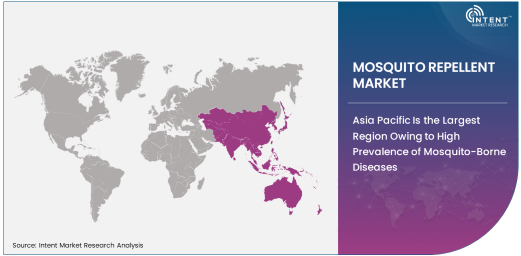
Asia Pacific Is the Largest Region Owing to High Prevalence of Mosquito-Borne Diseases
Asia Pacific is the largest region in the mosquito repellent market, driven by the high prevalence of mosquito-borne diseases such as malaria, dengue, and chikungunya. Countries like India, China, Indonesia, and Brazil have large populations living in areas prone to mosquito infestations, which significantly boosts the demand for mosquito repellents. Government initiatives aimed at controlling the spread of these diseases further contribute to the market growth in the region.
In addition to the health risks, a growing middle class in these regions is increasingly adopting preventive health measures, further pushing the demand for mosquito repellents. The region’s vast geographic area, along with urbanization and the expansion of outdoor activities, ensures that the demand for mosquito repellent products will continue to grow in the coming years.
Competitive Landscape and Leading Companies
The mosquito repellent market is highly competitive, with numerous global and regional players vying for market share. Leading companies such as SC Johnson, Reckitt Benckiser, and Godrej Consumer Products dominate the market due to their established brands and wide distribution networks. These companies continually innovate by offering new and effective repellent formulations to meet consumer demands for safety and environmental sustainability.
Furthermore, several new entrants are emerging, particularly in the natural mosquito repellent segment, as consumers increasingly seek eco-friendly alternatives. The competitive landscape is marked by significant product diversification, with companies investing heavily in research and development to create non-toxic, long-lasting, and efficient solutions. Strategic acquisitions and partnerships are also common, as major players look to expand their product portfolios and reach new markets.
Recent Developments:
- SC Johnson announced the launch of a new mosquito repellent product line targeted at eco-conscious consumers in North America.
- Reckitt Benckiser expanded its mosquito repellent portfolio with the introduction of an innovative natural mosquito repellent that uses plant-based ingredients.
- Godrej Consumer Products has strengthened its position in the mosquito repellent market by acquiring a local brand in Southeast Asia, enhancing its regional footprint.
- 3M launched a new plug-in electronic mosquito repellent aimed at consumers seeking an alternative to traditional sprays and lotions.
- BASF has entered into a strategic partnership with a startup to develop innovative, biodegradable mosquito repellents, addressing the growing demand for environmentally friendly products.
List of Leading Companies:
- SC Johnson Professional
- Reckitt Benckiser Group
- Godrej Consumer Products Limited
- S. C. Johnson & Son Inc.
- Avon Products, Inc.
- Spectrum Brands Inc.
- ExOfficio LLC
- Sawyer Products, Inc.
- 3M
- Cutter Brands
- Para'Kito
- Odomos (Dabur India Ltd)
- Stepan Company
- BASF SE
- Mosquito Magnet (Woodstream Corporation)
Report Scope:
|
Report Features |
Description |
|
Market Size (2024-e) |
USD 2.8 Billion |
|
Forecasted Value (2030) |
USD 4.7 Billion |
|
CAGR (2025 – 2030) |
7.9% |
|
Base Year for Estimation |
2024-e |
|
Historic Year |
2023 |
|
Forecast Period |
2025 – 2030 |
|
Report Coverage |
Market Forecast, Market Dynamics, Competitive Landscape, Recent Developments |
|
Segments Covered |
Mosquito Repellent Market Insights & Forecast (2023 – 2030) By Product Type (Chemical-Based Mosquito Repellents, Natural Mosquito Repellents, Electronic Mosquito Repellents, Mosquito Repellent Coils & Mats), By Application (Residential, Commercial, Industrial), By End-User (Households, Hotels & Restaurants, Healthcare Facilities, Outdoor Activities), By Mode of Application (Sprays, Creams & Lotions, Repellent Patches, Plug-In Devices, Mosquito Repellent Candles) |
|
Regional Analysis |
North America (US, Canada, Mexico), Europe (Germany, France, UK, Italy, Spain, and Rest of Europe), Asia-Pacific (China, Japan, South Korea, Australia, India, and Rest of Asia-Pacific), Latin America (Brazil, Argentina, and Rest of Latin America), Middle East & Africa (Saudi Arabia, UAE, Rest of Middle East & Africa) |
|
Major Companies |
SC Johnson Professional, Reckitt Benckiser Group, Godrej Consumer Products Limited, S. C. Johnson & Son Inc., Avon Products, Inc., Spectrum Brands Inc., ExOfficio LLC, Sawyer Products, Inc., 3M, Cutter Brands, Para'Kito, Odomos (Dabur India Ltd), Stepan Company, BASF SE, Mosquito Magnet (Woodstream Corporation) |
|
Customization Scope |
Customization for segments, region/country-level will be provided. Moreover, additional customization can be done based on the requirements |
|
1. Introduction |
|
1.1. Market Definition |
|
1.2. Scope of the Study |
|
1.3. Research Assumptions |
|
1.4. Study Limitations |
|
2. Research Methodology |
|
2.1. Research Approach |
|
2.1.1. Top-Down Method |
|
2.1.2. Bottom-Up Method |
|
2.1.3. Factor Impact Analysis |
|
2.2. Insights & Data Collection Process |
|
2.2.1. Secondary Research |
|
2.2.2. Primary Research |
|
2.3. Data Mining Process |
|
2.3.1. Data Analysis |
|
2.3.2. Data Validation and Revalidation |
|
2.3.3. Data Triangulation |
|
3. Executive Summary |
|
3.1. Major Markets & Segments |
|
3.2. Highest Growing Regions and Respective Countries |
|
3.3. Impact of Growth Drivers & Inhibitors |
|
3.4. Regulatory Overview by Country |
|
4. Mosquito Repellent Market, by Product Type (Market Size & Forecast: USD Million, 2023 – 2030) |
|
4.1. Chemical-Based Mosquito Repellents |
|
4.2. Natural Mosquito Repellents |
|
4.3. Electronic Mosquito Repellents |
|
4.4. Mosquito Repellent Coils & Mats |
|
5. Mosquito Repellent Market, by Application (Market Size & Forecast: USD Million, 2023 – 2030) |
|
5.1. Residential |
|
5.2. Commercial |
|
5.3. Industrial |
|
6. Mosquito Repellent Market, by End-User (Market Size & Forecast: USD Million, 2023 – 2030) |
|
6.1. Households |
|
6.2. Hotels & Restaurants |
|
6.3. Healthcare Facilities |
|
6.4. Outdoor Activities |
|
7. Mosquito Repellent Market, by Mode of Application (Market Size & Forecast: USD Million, 2023 – 2030) |
|
7.1. Sprays |
|
7.2. Creams & Lotions |
|
7.3. Repellent Patches |
|
7.4. Plug-In Devices |
|
7.5. Mosquito Repellent Candles |
|
8. Regional Analysis (Market Size & Forecast: USD Million, 2023 – 2030) |
|
8.1. Regional Overview |
|
8.2. North America |
|
8.2.1. Regional Trends & Growth Drivers |
|
8.2.2. Barriers & Challenges |
|
8.2.3. Opportunities |
|
8.2.4. Factor Impact Analysis |
|
8.2.5. Technology Trends |
|
8.2.6. North America Mosquito Repellent Market, by Product Type |
|
8.2.7. North America Mosquito Repellent Market, by Application |
|
8.2.8. North America Mosquito Repellent Market, by End-User |
|
8.2.9. North America Mosquito Repellent Market, by Mode of Application |
|
8.2.10. By Country |
|
8.2.10.1. US |
|
8.2.10.1.1. US Mosquito Repellent Market, by Product Type |
|
8.2.10.1.2. US Mosquito Repellent Market, by Application |
|
8.2.10.1.3. US Mosquito Repellent Market, by End-User |
|
8.2.10.1.4. US Mosquito Repellent Market, by Mode of Application |
|
8.2.10.2. Canada |
|
8.2.10.3. Mexico |
|
*Similar segmentation will be provided for each region and country |
|
8.3. Europe |
|
8.4. Asia-Pacific |
|
8.5. Latin America |
|
8.6. Middle East & Africa |
|
9. Competitive Landscape |
|
9.1. Overview of the Key Players |
|
9.2. Competitive Ecosystem |
|
9.2.1. Level of Fragmentation |
|
9.2.2. Market Consolidation |
|
9.2.3. Product Innovation |
|
9.3. Company Share Analysis |
|
9.4. Company Benchmarking Matrix |
|
9.4.1. Strategic Overview |
|
9.4.2. Product Innovations |
|
9.5. Start-up Ecosystem |
|
9.6. Strategic Competitive Insights/ Customer Imperatives |
|
9.7. ESG Matrix/ Sustainability Matrix |
|
9.8. Manufacturing Network |
|
9.8.1. Locations |
|
9.8.2. Supply Chain and Logistics |
|
9.8.3. Product Flexibility/Customization |
|
9.8.4. Digital Transformation and Connectivity |
|
9.8.5. Environmental and Regulatory Compliance |
|
9.9. Technology Readiness Level Matrix |
|
9.10. Technology Maturity Curve |
|
9.11. Buying Criteria |
|
10. Company Profiles |
|
10.1. SC Johnson Professional |
|
10.1.1. Company Overview |
|
10.1.2. Company Financials |
|
10.1.3. Product/Service Portfolio |
|
10.1.4. Recent Developments |
|
10.1.5. IMR Analysis |
|
*Similar information will be provided for other companies |
|
10.2. Reckitt Benckiser Group |
|
10.3. Godrej Consumer Products Limited |
|
10.4. S. C. Johnson & Son Inc. |
|
10.5. Avon Products, Inc. |
|
10.6. Spectrum Brands Inc. |
|
10.7. ExOfficio LLC |
|
10.8. Sawyer Products, Inc. |
|
10.9. 3M |
|
10.10. Cutter Brands |
|
10.11. Para'Kito |
|
10.12. Odomos (Dabur India Ltd) |
|
10.13. Stepan Company |
|
10.14. BASF SE |
|
10.15. Mosquito Magnet (Woodstream Corporation) |
|
11. Appendix |
A comprehensive market research approach was employed to gather and analyze data on the Mosquito Repellent Market. In the process, the analysis was also done to analyze the parent market and relevant adjacencies to measure the impact of them on the Mosquito Repellent Market. The research methodology encompassed both secondary and primary research techniques, ensuring the accuracy and credibility of the findings.
.jpg)
Secondary Research
Secondary research involved a thorough review of pertinent industry reports, journals, articles, and publications. Additionally, annual reports, press releases, and investor presentations of industry players were scrutinized to gain insights into their market positioning and strategies.
Primary Research
Primary research involved conducting in-depth interviews with industry experts, stakeholders, and market participants across the E-Waste Management ecosystem. The primary research objectives included:
- Validating findings and assumptions derived from secondary research
- Gathering qualitative and quantitative data on market trends, drivers, and challenges
- Understanding the demand-side dynamics, encompassing end-users, component manufacturers, facility providers, and service providers
- Assessing the supply-side landscape, including technological advancements and recent developments
Market Size Assessment
A combination of top-down and bottom-up approaches was utilized to analyze the overall size of the Mosquito Repellent Market. These methods were also employed to assess the size of various subsegments within the market. The market size assessment methodology encompassed the following steps:
- Identification of key industry players and relevant revenues through extensive secondary research
- Determination of the industry's supply chain and market size, in terms of value, through primary and secondary research processes
- Calculation of percentage shares, splits, and breakdowns using secondary sources and verification through primary sources
.jpg)
Data Triangulation
To ensure the accuracy and reliability of the market size, data triangulation was implemented. This involved cross-referencing data from various sources, including demand and supply side factors, market trends, and expert opinions. Additionally, top-down and bottom-up approaches were employed to validate the market size assessment.
NA