
As per Intent Market Research, the Mosquito Borne Disease Market was valued at USD 3.7 Billion in 2024-e and will surpass USD 6.1 Billion by 2030; growing at a CAGR of 7.5% during 2025-2030.
The mosquito-borne disease market has been growing steadily due to the rising incidences of vector-borne diseases across the globe. These diseases, such as Malaria, Dengue, and Zika, have become increasingly prevalent, especially in tropical and subtropical regions. With the growing focus on both preventive measures (like vaccines) and treatment options, the market for mosquito-borne diseases continues to evolve. This market is heavily influenced by advancements in disease diagnosis, vaccines, antiviral drugs, and improved healthcare infrastructure to combat such diseases. Furthermore, the emergence of new and more efficient diagnostic methods has significantly influenced market growth.
In addition to pharmaceutical interventions, vector control strategies, like controlling mosquito populations and eliminating breeding grounds, are being integrated into public health programs to combat the rise of mosquito-borne diseases globally. As nations ramp up their healthcare responses to epidemics and pandemics, the mosquito-borne disease market is expected to continue to expand.
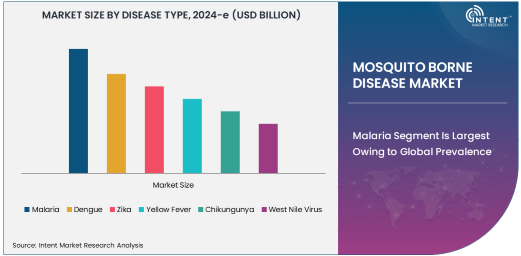
Malaria Segment Is Largest Owing to Global Prevalence
The malaria segment remains the largest within the mosquito-borne disease market due to its widespread prevalence, particularly in sub-Saharan Africa. Malaria continues to be a leading cause of death and disease in many low-income countries, with more than 200 million cases reported globally each year. The disease is caused by the Plasmodium parasite, transmitted through the bite of infected Anopheles mosquitoes, and is typically treated with anti-malarial drugs or vaccines.
The high demand for anti-malarial drugs and vaccines like RTS,S/AS01 has driven market growth. Efforts by global health organizations, such as the World Health Organization (WHO), to combat malaria through enhanced treatment, prevention, and control programs, have further increased investment in this market. The continued focus on eradicating malaria, especially in endemic regions, ensures that this segment will maintain its dominant position in the market.
Aedes Mosquito Is Fastest Growing Vector
The Aedes mosquito, responsible for transmitting diseases such as Dengue, Zika, and Chikungunya, is the fastest growing vector in the market. With the increasing frequency of urbanization and climate change leading to more favorable conditions for Aedes mosquitoes to thrive, the incidence of Aedes-borne diseases has been steadily increasing worldwide. These mosquitoes are aggressive daytime feeders and have a wide distribution, including in densely populated urban areas, making them a major concern for public health.
As a result, the demand for innovative solutions for controlling Aedes mosquito populations and preventing the spread of diseases like Dengue and Zika has surged. Both chemical and biological mosquito control methods, including the release of genetically modified mosquitoes, are being explored to reduce the spread of these diseases. This growth trend highlights the increasing need for effective surveillance, monitoring, and mosquito control strategies, positioning the Aedes mosquito vector as the fastest growing segment.
Vaccines Are Fastest Growing Treatment Option
Vaccines have emerged as the fastest growing treatment type in the mosquito-borne disease market. Vaccines, such as those for Malaria (RTS,S/AS01), Dengue, and Zika, are being increasingly adopted due to their ability to prevent widespread epidemics and reduce the burden of disease transmission. As public health efforts intensify, the demand for these preventive measures is growing, particularly in regions where these diseases are endemic.
The increasing availability of vaccines, along with their inclusion in national immunization programs, is expected to drive the market further. The development of combination vaccines and more effective formulations will likely continue to propel growth, making vaccines the fastest-growing segment in this market. This growing acceptance of vaccines for prevention underscores their critical role in controlling mosquito-borne diseases.
PCR-Based Tests Are Fastest Growing Diagnostic Type
PCR-based tests have become the fastest growing diagnostic method in the mosquito-borne disease market due to their high accuracy and ability to rapidly detect pathogens in patients. PCR (Polymerase Chain Reaction) technology is crucial for diagnosing diseases like Malaria, Zika, and Dengue, as it provides faster results compared to traditional blood tests. This method allows for precise identification of the specific virus or parasite responsible for the infection, enabling healthcare providers to deliver the appropriate treatment.
The demand for PCR-based tests is also driven by the increasing need for rapid, reliable diagnostic tools in both clinical and field settings. These tests are particularly useful in regions with limited access to advanced healthcare infrastructure, making PCR testing essential for disease surveillance and management. As the need for accurate diagnostics grows, PCR-based tests are becoming an indispensable part of the healthcare response to mosquito-borne diseases.
Hospitals Are Largest End-User in the Market
Hospitals remain the largest end-user in the mosquito-borne disease market due to their critical role in providing comprehensive healthcare services for patients affected by diseases such as Malaria, Dengue, and Zika. Hospitals are equipped with the necessary infrastructure, including diagnostic tools, medical professionals, and treatment facilities, to manage these diseases efficiently. Given the severity and complexity of these diseases, especially in high-risk areas, hospitals play an essential role in both treatment and prevention.
Hospitals also serve as key locations for the distribution of vaccines and antiviral drugs, which are administered to both inpatient and outpatient populations. The increasing focus on disease management and control within healthcare facilities is expected to sustain the dominance of hospitals in the mosquito-borne disease market.
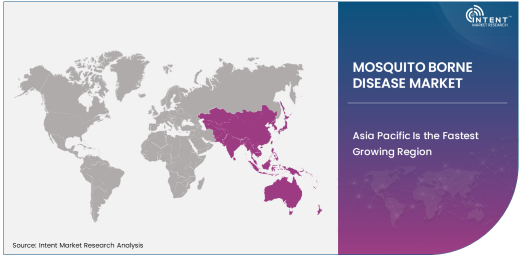
Asia Pacific Is the Fastest Growing Region
The Asia Pacific region is the fastest growing region in the mosquito-borne disease market. This region has the highest burden of mosquito-borne diseases, particularly Malaria, Dengue, and Zika, with countries like India, Indonesia, Thailand, and the Philippines being heavily impacted. The rise in urbanization, coupled with climate change, has created more favorable conditions for mosquito vectors to thrive, leading to higher incidences of these diseases.
Additionally, the rapid economic growth in the region is driving improvements in healthcare infrastructure, enabling better disease detection, treatment, and prevention programs. The implementation of nationwide vaccination programs and the growing awareness about mosquito-borne diseases further contribute to the market's growth in this region. As a result, Asia Pacific is expected to remain a key player in the global mosquito-borne disease market.
Competitive Landscape
Leading companies in the mosquito-borne disease market include major pharmaceutical and biotechnology firms such as GlaxoSmithKline, Sanofi, Merck & Co., and Bharat Biotech, all of which are making significant strides in vaccine and drug development. These companies are collaborating with governmental organizations and NGOs to improve access to treatments and vaccines in endemic regions. The market is highly competitive, with companies focusing on innovation, regulatory approvals, and strategic partnerships to expand their presence.
The competitive landscape also includes diagnostic companies like BioMérieux, Roche, and Siemens Healthineers, which are developing rapid diagnostic tests (RDTs) and PCR-based tools to support the global fight against mosquito-borne diseases. As the market continues to grow, companies are investing in research and development to bring new therapies, vaccines, and diagnostic technologies to market, strengthening their position in the industry.
Recent Developments:
- Merck & Co. launched a new malaria vaccine, RTS,S/AS01, aiming to reduce the burden of malaria, especially in sub-Saharan Africa.
- Bharat Biotech has developed an innovative dengue vaccine, which is undergoing advanced trials in Southeast Asia and Latin America.
- Sanofi received regulatory approval for its Dengue vaccine in several countries, marking a significant step in dengue prevention worldwide.
- Valneva SE entered a partnership with global health organizations to distribute its Zika vaccine candidate to endemic regions in Latin America.
- Johnson & Johnson expanded its portfolio in mosquito-borne disease prevention by acquiring a startup focusing on novel anti-malaria treatments
List of Leading Companies:
- GlaxoSmithKline
- Sanofi
- Merck & Co.
- Johnson & Johnson
- Roche Holding AG
- Pfizer Inc.
- AbbVie Inc.
- Novartis AG
- Bayer AG
- Bharat Biotech
- Takeda Pharmaceutical Company
- Emergent BioSolutions
- Valneva SE
- BioMérieux
- Siemens Healthineers
Report Scope:
|
Report Features |
Description |
|
Market Size (2024-e) |
USD 3.7 Billion |
|
Forecasted Value (2030) |
USD 6.1 Billion |
|
CAGR (2025 – 2030) |
7.5% |
|
Base Year for Estimation |
2024-e |
|
Historic Year |
2023 |
|
Forecast Period |
2025 – 2030 |
|
Report Coverage |
Market Forecast, Market Dynamics, Competitive Landscape, Recent Developments |
|
Segments Covered |
Mosquito-Borne Disease Market By Disease Type (Malaria, Dengue, Zika, Yellow Fever, Chikungunya, West Nile Virus), By Transmission Vector (Aedes Mosquito, Anopheles Mosquito, Culex Mosquito), By Treatment Type (Vaccines, Anti-Malarial Drugs, Antiviral Drugs, Supportive Care), By Diagnostic Type (Blood Tests, PCR-Based Tests, Rapid Diagnostic Tests, Serological Tests), By End-User (Hospitals, Clinics, Research Institutions, Diagnostic Laboratories), and By Region; Global Insights & Forecast (2023 – 2030) |
|
Regional Analysis |
North America (US, Canada, Mexico), Europe (Germany, France, UK, Italy, Spain, and Rest of Europe), Asia-Pacific (China, Japan, South Korea, Australia, India, and Rest of Asia-Pacific), Latin America (Brazil, Argentina, and Rest of Latin America), Middle East & Africa (Saudi Arabia, UAE, Rest of Middle East & Africa) |
|
Major Companies |
GlaxoSmithKline, Sanofi, Merck & Co., Johnson & Johnson, Roche Holding AG, Pfizer Inc., AbbVie Inc., Novartis AG, Bayer AG, Bharat Biotech, Takeda Pharmaceutical Company, Emergent BioSolutions, Valneva SE, BioMérieux, Siemens Healthineers |
|
Customization Scope |
Customization for segments, region/country-level will be provided. Moreover, additional customization can be done based on the requirements |
|
1. Introduction |
|
1.1. Market Definition |
|
1.2. Scope of the Study |
|
1.3. Research Assumptions |
|
1.4. Study Limitations |
|
2. Research Methodology |
|
2.1. Research Approach |
|
2.1.1. Top-Down Method |
|
2.1.2. Bottom-Up Method |
|
2.1.3. Factor Impact Analysis |
|
2.2. Insights & Data Collection Process |
|
2.2.1. Secondary Research |
|
2.2.2. Primary Research |
|
2.3. Data Mining Process |
|
2.3.1. Data Analysis |
|
2.3.2. Data Validation and Revalidation |
|
2.3.3. Data Triangulation |
|
3. Executive Summary |
|
3.1. Major Markets & Segments |
|
3.2. Highest Growing Regions and Respective Countries |
|
3.3. Impact of Growth Drivers & Inhibitors |
|
3.4. Regulatory Overview by Country |
|
4. Mosquito Borne Disease Market, by Disease Type (Market Size & Forecast: USD Million, 2023 – 2030) |
|
4.1. Malaria |
|
4.2. Dengue |
|
4.3. Zika |
|
4.4. Yellow Fever |
|
4.5. Chikungunya |
|
4.6. West Nile Virus |
|
5. Mosquito Borne Disease Market, by Transmission Vector (Market Size & Forecast: USD Million, 2023 – 2030) |
|
5.1. Aedes Mosquito |
|
5.2. Anopheles Mosquito |
|
5.3. Culex Mosquito |
|
6. Mosquito Borne Disease Market, by Treatment Type (Market Size & Forecast: USD Million, 2023 – 2030) |
|
6.1. Vaccines |
|
6.2. Anti-malarial Drugs |
|
6.3. Antiviral Drugs |
|
6.4. Supportive Care |
|
7. Mosquito Borne Disease Market, by Diagnostic Type (Market Size & Forecast: USD Million, 2023 – 2030) |
|
7.1. Blood Tests |
|
7.2. PCR-based Tests |
|
7.3. Rapid Diagnostic Tests (RDT) |
|
7.4. Serological Tests |
|
8. Mosquito Borne Disease Market, by End-User (Market Size & Forecast: USD Million, 2023 – 2030) |
|
8.1. Hospitals |
|
8.2. Clinics |
|
8.3. Research Institutions |
|
8.4. Diagnostic Laboratories |
|
9. Regional Analysis (Market Size & Forecast: USD Million, 2023 – 2030) |
|
9.1. Regional Overview |
|
9.2. North America |
|
9.2.1. Regional Trends & Growth Drivers |
|
9.2.2. Barriers & Challenges |
|
9.2.3. Opportunities |
|
9.2.4. Factor Impact Analysis |
|
9.2.5. Technology Trends |
|
9.2.6. North America Mosquito Borne Disease Market, by Disease Type |
|
9.2.7. North America Mosquito Borne Disease Market, by Transmission Vector |
|
9.2.8. North America Mosquito Borne Disease Market, by Treatment Type |
|
9.2.9. North America Mosquito Borne Disease Market, by Diagnostic Type |
|
9.2.10. North America Mosquito Borne Disease Market, by End-User |
|
9.2.11. By Country |
|
9.2.11.1. US |
|
9.2.11.1.1. US Mosquito Borne Disease Market, by Disease Type |
|
9.2.11.1.2. US Mosquito Borne Disease Market, by Transmission Vector |
|
9.2.11.1.3. US Mosquito Borne Disease Market, by Treatment Type |
|
9.2.11.1.4. US Mosquito Borne Disease Market, by Diagnostic Type |
|
9.2.11.1.5. US Mosquito Borne Disease Market, by End-User |
|
9.2.11.2. Canada |
|
9.2.11.3. Mexico |
|
*Similar segmentation will be provided for each region and country |
|
9.3. Europe |
|
9.4. Asia-Pacific |
|
9.5. Latin America |
|
9.6. Middle East & Africa |
|
10. Competitive Landscape |
|
10.1. Overview of the Key Players |
|
10.2. Competitive Ecosystem |
|
10.2.1. Level of Fragmentation |
|
10.2.2. Market Consolidation |
|
10.2.3. Product Innovation |
|
10.3. Company Share Analysis |
|
10.4. Company Benchmarking Matrix |
|
10.4.1. Strategic Overview |
|
10.4.2. Product Innovations |
|
10.5. Start-up Ecosystem |
|
10.6. Strategic Competitive Insights/ Customer Imperatives |
|
10.7. ESG Matrix/ Sustainability Matrix |
|
10.8. Manufacturing Network |
|
10.8.1. Locations |
|
10.8.2. Supply Chain and Logistics |
|
10.8.3. Product Flexibility/Customization |
|
10.8.4. Digital Transformation and Connectivity |
|
10.8.5. Environmental and Regulatory Compliance |
|
10.9. Technology Readiness Level Matrix |
|
10.10. Technology Maturity Curve |
|
10.11. Buying Criteria |
|
11. Company Profiles |
|
11.1. GlaxoSmithKline |
|
11.1.1. Company Overview |
|
11.1.2. Company Financials |
|
11.1.3. Product/Service Portfolio |
|
11.1.4. Recent Developments |
|
11.1.5. IMR Analysis |
|
*Similar information will be provided for other companies |
|
11.2. Sanofi |
|
11.3. Merck & Co. |
|
11.4. Johnson & Johnson |
|
11.5. Roche Holding AG |
|
11.6. Pfizer Inc. |
|
11.7. AbbVie Inc. |
|
11.8. Novartis AG |
|
11.9. Bayer AG |
|
11.10. Bharat Biotech |
|
11.11. Takeda Pharmaceutical Company |
|
11.12. Emergent BioSolutions |
|
11.13. Valneva SE |
|
11.14. BioMérieux |
|
11.15. Siemens Healthineers |
|
12. Appendix |
A comprehensive market research approach was employed to gather and analyze data on the Mosquito-Borne Disease Market. In the process, the analysis was also done to analyze the parent market and relevant adjacencies to measure the impact of them on the Mosquito-Borne Disease Market. The research methodology encompassed both secondary and primary research techniques, ensuring the accuracy and credibility of the findings.
.jpg)
Secondary Research
Secondary research involved a thorough review of pertinent industry reports, journals, articles, and publications. Additionally, annual reports, press releases, and investor presentations of industry players were scrutinized to gain insights into their market positioning and strategies.
Primary Research
Primary research involved conducting in-depth interviews with industry experts, stakeholders, and market participants across the E-Waste Management ecosystem. The primary research objectives included:
- Validating findings and assumptions derived from secondary research
- Gathering qualitative and quantitative data on market trends, drivers, and challenges
- Understanding the demand-side dynamics, encompassing end-users, component manufacturers, facility providers, and service providers
- Assessing the supply-side landscape, including technological advancements and recent developments
Market Size Assessment
A combination of top-down and bottom-up approaches was utilized to analyze the overall size of the Mosquito-Borne Disease Market. These methods were also employed to assess the size of various subsegments within the market. The market size assessment methodology encompassed the following steps:
- Identification of key industry players and relevant revenues through extensive secondary research
- Determination of the industry's supply chain and market size, in terms of value, through primary and secondary research processes
- Calculation of percentage shares, splits, and breakdowns using secondary sources and verification through primary sources
.jpg)
Data Triangulation
To ensure the accuracy and reliability of the market size, data triangulation was implemented. This involved cross-referencing data from various sources, including demand and supply side factors, market trends, and expert opinions. Additionally, top-down and bottom-up approaches were employed to validate the market size assessment.
NA