
As per Intent Market Research, the Low Voltage Wire and Cable Market was valued at USD 12.2 Billion in 2024-e and will surpass USD 19.8 Billion by 2030; growing at a CAGR of 8.3% during 2025-2030.
The low voltage wire and cable market plays a crucial role in the overall electrical infrastructure, providing essential connectivity for various applications such as power distribution, telecommunications, and energy utilities. These wires and cables are designed to operate at voltages up to 1,000 volts, and they are widely used in residential, commercial, and industrial applications. As urbanization and industrialization continue to expand, the demand for efficient and reliable electrical wiring solutions is increasing. The growth of renewable energy, smart grid systems, and the construction sector further fuels the need for low voltage wires and cables to ensure the safe and efficient transmission of electricity.
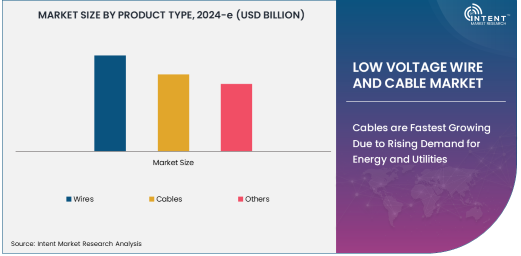
Among the different product types, wires represent the largest segment of the low voltage wire and cable market. Wires are essential for transmitting electrical power across residential, commercial, and industrial infrastructures. With the increasing global demand for electricity and the expansion of electrical networks, wires are the go-to solution for providing stable and reliable connections. The continuous development of energy-efficient, high-performance wire products, coupled with the growing need for electricity distribution, ensures that wires remain the dominant segment in the low voltage wire and cable market.
Cables are Fastest Growing Due to Rising Demand for Energy and Utilities
Cables represent the fastest-growing product segment in the low voltage wire and cable market. Cables are used in a variety of applications, including power distribution, telecommunications, and energy systems, and they offer a flexible and secure means of delivering electricity and data. As industries increasingly rely on complex electrical systems and high-speed communication networks, the need for durable and high-capacity cables has surged. This growth is particularly noticeable in the energy and utilities sector, where cables are crucial for the efficient transmission of electricity across long distances and varying terrains.
The rising global demand for energy, particularly in emerging economies, and the expansion of infrastructure projects are key factors driving the demand for low voltage cables. In addition, the growth of renewable energy sources like solar and wind, which require specialized cable systems for efficient energy transmission, is further boosting the cable segment. As energy infrastructure becomes more complex and interconnected, the need for advanced cables that can withstand higher loads and provide reliable performance continues to rise, making cables the fastest-growing product segment in the low voltage wire and cable market.
Industrial End-User Industry is Largest Due to Manufacturing and Automation Growth
The industrial sector is the largest end-user industry in the low voltage wire and cable market. With the growth of manufacturing, automation, and industrial machinery, the demand for reliable and efficient wiring systems has increased substantially. Low voltage wires and cables are used extensively to power and connect machinery, equipment, and automated systems in factories, plants, and production facilities. The increasing adoption of industrial automation, which relies on interconnected electrical systems, is driving the need for high-quality wire and cable solutions to ensure smooth and efficient operations.
The industrial sector's substantial growth is supported by a global push for digitalization and increased production capacities. As more factories adopt smart manufacturing technologies, the need for robust and high-performance wiring systems in machinery and power distribution networks continues to grow. This trend reinforces the industrial sector's position as the largest end-user industry in the low voltage wire and cable market, with the continuous expansion of automation and industrialization ensuring sustained demand for these products.
Power Distribution Application is Largest Due to Infrastructure Expansion
The power distribution application is the largest segment within the low voltage wire and cable market. Power distribution involves the transmission of electricity from substations to end-users, and low voltage wires and cables are crucial in ensuring that this electricity is delivered safely and efficiently to homes, businesses, and industries. As global energy consumption rises, there is a pressing need to expand and modernize power distribution networks to meet growing demand and improve reliability.
The ongoing development of infrastructure, particularly in emerging economies, is driving the demand for low voltage wiring solutions for power distribution. Additionally, the increasing use of renewable energy sources, which require advanced power distribution systems to manage intermittent energy flows, further supports the growth of this segment. With urbanization and industrialization continuing worldwide, the need for dependable power distribution networks remains high, ensuring that the power distribution application remains the dominant segment in the low voltage wire and cable market.
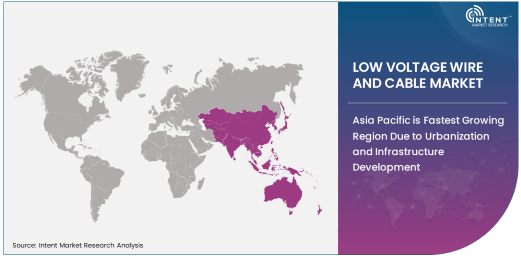
Asia Pacific is Fastest Growing Region Due to Urbanization and Infrastructure Development
Asia Pacific is the fastest-growing region in the low voltage wire and cable market. The region's rapid urbanization, coupled with extensive infrastructure development, is a key driver of this growth. Countries such as China, India, and Southeast Asian nations are heavily investing in the expansion and modernization of their electrical and telecommunications infrastructure to support their growing populations and industrial sectors. As these nations continue to develop their economies, the demand for reliable and efficient wire and cable solutions is increasing to ensure uninterrupted power supply and communication networks.
Furthermore, the growing emphasis on renewable energy, smart grid systems, and electric vehicle infrastructure in the Asia Pacific region is further boosting the demand for low voltage wires and cables. As these countries shift towards more sustainable energy solutions, the need for advanced wiring and cabling systems that can handle complex energy flows and data transmissions is expected to increase. With these factors in mind, Asia Pacific is poised to remain the fastest-growing region in the low voltage wire and cable market.
Leading Companies and Competitive Landscape
The low voltage wire and cable market is highly competitive, with several prominent players leading the industry. Major companies such as Nexans, Prysmian Group, Southwire Company, LS Cable & System, and General Cable dominate the market. These companies offer a wide range of low voltage wire and cable products for various applications, including power distribution, telecommunications, and industrial uses. Their strong global presence, extensive product portfolios, and technological expertise enable them to maintain leadership positions in the market.
In the competitive landscape, key strategies include product innovation, regional expansion, and strategic partnerships. Leading companies are increasingly focusing on developing energy-efficient and environmentally friendly wire and cable solutions to meet the growing demand for sustainable infrastructure. Additionally, companies are exploring opportunities in emerging markets, particularly in Asia Pacific, where rapid urbanization and industrialization are driving demand. With growing competition and technological advancements, the low voltage wire and cable market is expected to see continued growth, with leading companies working to meet the evolving needs of end-users across industries.
Recent Developments:
- Nexans S.A. launched a new range of low voltage cables optimized for energy-efficient power distribution in smart cities.
- Prysmian Group introduced advanced low voltage cables with enhanced durability for industrial and commercial buildings.
- General Cable expanded its product line with low voltage wiring solutions designed to meet the latest energy efficiency standards.
- Southwire Company unveiled a new series of low voltage cables for use in solar and renewable energy applications.
- LS Cable & System announced the development of a low voltage cable that reduces energy loss in power distribution networks.
List of Leading Companies:
- Nexans S.A.
- Prysmian Group
- General Cable
- Southwire Company
- LS Cable & System
- Sumitomo Electric Industries
- Furukawa Electric Co., Ltd.
- Leoni AG
- Hengtong Group
- Shanghai Electric Group Company
- Oman Cables Industry
- Kablenet
- TPC Wire & Cable Corp.
- Dubai Cable Company
- Hangzhou Cable Company
Report Scope:
|
Report Features |
Description |
|
Market Size (2024-e) |
USD 12.2 Billion |
|
Forecasted Value (2030) |
USD 19.8 Billion |
|
CAGR (2025 – 2030) |
8.3% |
|
Base Year for Estimation |
2024-e |
|
Historic Year |
2023 |
|
Forecast Period |
2025 – 2030 |
|
Report Coverage |
Market Forecast, Market Dynamics, Competitive Landscape, Recent Developments |
|
Segments Covered |
Low Voltage Wire and Cable Market By Product Type (Wires, Cables), By End-User Industry (Residential, Commercial, Industrial, Telecommunication), and By Application (Power Distribution, Telecommunications, Energy and Utilities, Construction) |
|
Regional Analysis |
North America (US, Canada, Mexico), Europe (Germany, France, UK, Italy, Spain, and Rest of Europe), Asia-Pacific (China, Japan, South Korea, Australia, India, and Rest of Asia-Pacific), Latin America (Brazil, Argentina, and Rest of Latin America), Middle East & Africa (Saudi Arabia, UAE, Rest of Middle East & Africa) |
|
Major Companies |
Nexans S.A., Prysmian Group, General Cable, Southwire Company, LS Cable & System, Sumitomo Electric Industries, Furukawa Electric Co., Ltd., Leoni AG, Hengtong Group, Shanghai Electric Group Company, Oman Cables Industry, Kablenet, TPC Wire & Cable Corp., Dubai Cable Company, Hangzhou Cable Company |
|
Customization Scope |
Customization for segments, region/country-level will be provided. Moreover, additional customization can be done based on the requirements |
|
1. Introduction |
|
1.1. Market Definition |
|
1.2. Scope of the Study |
|
1.3. Research Assumptions |
|
1.4. Study Limitations |
|
2. Research Methodology |
|
2.1. Research Approach |
|
2.1.1. Top-Down Method |
|
2.1.2. Bottom-Up Method |
|
2.1.3. Factor Impact Analysis |
|
2.2. Insights & Data Collection Process |
|
2.2.1. Secondary Research |
|
2.2.2. Primary Research |
|
2.3. Data Mining Process |
|
2.3.1. Data Analysis |
|
2.3.2. Data Validation and Revalidation |
|
2.3.3. Data Triangulation |
|
3. Executive Summary |
|
3.1. Major Markets & Segments |
|
3.2. Highest Growing Regions and Respective Countries |
|
3.3. Impact of Growth Drivers & Inhibitors |
|
3.4. Regulatory Overview by Country |
|
4. Low Voltage Wire and Cable Market, by Product Type (Market Size & Forecast: USD Million, 2023 – 2030) |
|
4.1. Wires |
|
4.2. Cables |
|
4.3. Others |
|
5. Low Voltage Wire and Cable Market, by End-User Industry (Market Size & Forecast: USD Million, 2023 – 2030) |
|
5.1. Residential |
|
5.2. Commercial |
|
5.3. Industrial |
|
5.4. Telecommunication |
|
5.5. Others |
|
6. Low Voltage Wire and Cable Market, by Application (Market Size & Forecast: USD Million, 2023 – 2030) |
|
6.1. Power Distribution |
|
6.2. Telecommunications |
|
6.3. Energy and Utilities |
|
6.4. Construction |
|
6.5. Others |
|
7. Regional Analysis (Market Size & Forecast: USD Million, 2023 – 2030) |
|
7.1. Regional Overview |
|
7.2. North America |
|
7.2.1. Regional Trends & Growth Drivers |
|
7.2.2. Barriers & Challenges |
|
7.2.3. Opportunities |
|
7.2.4. Factor Impact Analysis |
|
7.2.5. Technology Trends |
|
7.2.6. North America Low Voltage Wire and Cable Market, by Product Type |
|
7.2.7. North America Low Voltage Wire and Cable Market, by End-User Industry |
|
7.2.8. North America Low Voltage Wire and Cable Market, by Application |
|
7.2.9. By Country |
|
7.2.9.1. US |
|
7.2.9.1.1. US Low Voltage Wire and Cable Market, by Product Type |
|
7.2.9.1.2. US Low Voltage Wire and Cable Market, by End-User Industry |
|
7.2.9.1.3. US Low Voltage Wire and Cable Market, by Application |
|
7.2.9.2. Canada |
|
7.2.9.3. Mexico |
|
*Similar segmentation will be provided for each region and country |
|
7.3. Europe |
|
7.4. Asia-Pacific |
|
7.5. Latin America |
|
7.6. Middle East & Africa |
|
8. Competitive Landscape |
|
8.1. Overview of the Key Players |
|
8.2. Competitive Ecosystem |
|
8.2.1. Level of Fragmentation |
|
8.2.2. Market Consolidation |
|
8.2.3. Product Innovation |
|
8.3. Company Share Analysis |
|
8.4. Company Benchmarking Matrix |
|
8.4.1. Strategic Overview |
|
8.4.2. Product Innovations |
|
8.5. Start-up Ecosystem |
|
8.6. Strategic Competitive Insights/ Customer Imperatives |
|
8.7. ESG Matrix/ Sustainability Matrix |
|
8.8. Manufacturing Network |
|
8.8.1. Locations |
|
8.8.2. Supply Chain and Logistics |
|
8.8.3. Product Flexibility/Customization |
|
8.8.4. Digital Transformation and Connectivity |
|
8.8.5. Environmental and Regulatory Compliance |
|
8.9. Technology Readiness Level Matrix |
|
8.10. Technology Maturity Curve |
|
8.11. Buying Criteria |
|
9. Company Profiles |
|
9.1. Nexans S.A. |
|
9.1.1. Company Overview |
|
9.1.2. Company Financials |
|
9.1.3. Product/Service Portfolio |
|
9.1.4. Recent Developments |
|
9.1.5. IMR Analysis |
|
*Similar information will be provided for other companies |
|
9.2. Prysmian Group |
|
9.3. General Cable |
|
9.4. Southwire Company |
|
9.5. LS Cable & System |
|
9.6. Sumitomo Electric Industries |
|
9.7. Furukawa Electric Co., Ltd. |
|
9.8. Leoni AG |
|
9.9. Hengtong Group |
|
9.10. Shanghai Electric Group Company |
|
9.11. Oman Cables Industry |
|
9.12. Kablenet |
|
9.13. TPC Wire & Cable Corp. |
|
9.14. Dubai Cable Company |
|
9.15. Hangzhou Cable Company |
|
10. Appendix |
A comprehensive market research approach was employed to gather and analyze data on the Low Voltage Wire and Cable Market. In the process, the analysis was also done to analyze the parent market and relevant adjacencies to measure the impact of them on the Low Voltage Wire and Cable Market. The research methodology encompassed both secondary and primary research techniques, ensuring the accuracy and credibility of the findings.
.jpg)
Secondary Research
Secondary research involved a thorough review of pertinent industry reports, journals, articles, and publications. Additionally, annual reports, press releases, and investor presentations of industry players were scrutinized to gain insights into their market positioning and strategies.
Primary Research
Primary research involved conducting in-depth interviews with industry experts, stakeholders, and market participants across the E-Waste Management ecosystem. The primary research objectives included:
- Validating findings and assumptions derived from secondary research
- Gathering qualitative and quantitative data on market trends, drivers, and challenges
- Understanding the demand-side dynamics, encompassing end-users, component manufacturers, facility providers, and service providers
- Assessing the supply-side landscape, including technological advancements and recent developments
Market Size Assessment
A combination of top-down and bottom-up approaches was utilized to analyze the overall size of the Low Voltage Wire and Cable Market. These methods were also employed to assess the size of various subsegments within the market. The market size assessment methodology encompassed the following steps:
- Identification of key industry players and relevant revenues through extensive secondary research
- Determination of the industry's supply chain and market size, in terms of value, through primary and secondary research processes
- Calculation of percentage shares, splits, and breakdowns using secondary sources and verification through primary sources
.jpg)
Data Triangulation
To ensure the accuracy and reliability of the market size, data triangulation was implemented. This involved cross-referencing data from various sources, including demand and supply side factors, market trends, and expert opinions. Additionally, top-down and bottom-up approaches were employed to validate the market size assessment.
NA