
As per Intent Market Research, the Laser-Induced Breakdown Spectroscopy Market was valued at USD 0.2 billion in 2024-e and will surpass USD 0.4 billion by 2030; growing at a CAGR of 9.2% during 2025 - 2030.
The global Laser-Induced Breakdown Spectroscopy (LIBS) market is witnessing significant growth as industries increasingly recognize the technology’s ability to provide real-time, precise chemical analysis of materials. LIBS is employed across various sectors, including environmental monitoring, industrial applications, mining, and forensic science, due to its capability to identify elements in solid, liquid, and gaseous samples with minimal sample preparation. With advancements in laser technology, LIBS is becoming more reliable and accurate, leading to its widespread adoption across industries that require material composition analysis and quality control.
The LIBS market is highly fragmented, with diverse applications driving growth in different sectors. Environmental monitoring, industrial applications, and material analysis are some of the dominant applications fueling the demand. Additionally, the evolution of portable and compact LIBS systems is making the technology more accessible to a range of industries. As environmental regulations tighten and demand for quick, on-site analysis grows, the market is expected to expand, with innovations in portable systems and multi-pulse technology gaining attention.
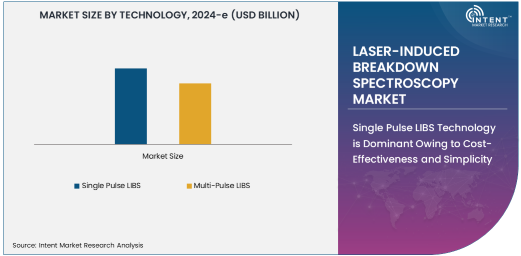
Single Pulse LIBS Technology is Dominant Owing to Cost-Effectiveness and Simplicity
In the LIBS technology segment, Single Pulse LIBS is the largest owing to its cost-effectiveness, simplicity, and ease of implementation in industrial applications. This technology uses a single laser pulse to create a plasma and then measures the light emitted by the plasma to determine the composition of materials. Single Pulse LIBS systems are generally more affordable, making them attractive to a variety of sectors that require straightforward, reliable analysis without the need for complex setups. Industries such as mining and material analysis particularly favor this method due to its efficiency in analyzing solid materials with minimal preparation.
The technology's straightforward nature has also contributed to its dominance in the market, where users prioritize speed and simplicity. Single Pulse LIBS systems are often portable, making them ideal for on-site analyses in remote areas. These features are especially valuable for environmental monitoring, where rapid field testing is essential. The increased need for fast analysis in industrial applications and the adoption of these systems across various sectors will likely continue driving the dominance of Single Pulse LIBS technology.
Portable LIBS Systems Capture the Largest Share in Product Type
Among the product types, Portable LIBS Systems hold the largest market share due to their versatility, mobility, and ability to perform on-site analysis. The portability of these systems allows industries, particularly in environmental monitoring and mining, to conduct analyses directly at the point of interest without the need for laboratory testing. Portable systems also reduce downtime and transportation costs, which is vital for companies working in remote locations or in the field. With environmental concerns and safety regulations becoming more stringent, the demand for on-site solutions is rapidly growing.
These portable systems are often equipped with advanced features, such as real-time data collection and processing capabilities, making them highly efficient. As a result, industries that require immediate material analysis and environmental testing are investing heavily in portable LIBS systems. This growth is expected to accelerate as technological advancements continue to make these systems more compact, user-friendly, and cost-effective, thereby solidifying their position as the dominant product type in the market.
Environmental Monitoring is the Fastest Growing Application for LIBS
Environmental monitoring is the fastest growing application in the LIBS market, driven by increasing concerns over pollution, resource management, and regulatory compliance. LIBS is particularly suited for environmental analysis due to its ability to quickly analyze elements in air, water, and soil samples, making it ideal for detecting contaminants or assessing the quality of natural resources. As governments and organizations enforce stricter environmental regulations and sustainability practices, the demand for fast, non-destructive, and accurate analysis has surged.
LIBS technology is increasingly being utilized for monitoring pollutants, hazardous substances, and the health of ecosystems in real-time. This has led to a significant rise in adoption across government agencies, environmental organizations, and research institutions. Additionally, as the global emphasis on climate change and environmental preservation intensifies, the LIBS market for environmental monitoring is expected to grow at a rapid pace, driving the broader adoption of the technology in this application.
Mining and Exploration End-User is Leading in Demand for LIBS Solutions
The mining sector stands out as the leading end-user of LIBS systems, largely due to the technology's ability to provide fast and accurate analysis of mineral compositions in various types of ore. Mining companies utilize LIBS for real-time, on-site analysis of ores, which helps in decision-making regarding extraction processes and optimizing resource management. The high demand for LIBS in mining can be attributed to its ability to analyze materials in remote locations without the need for complex sample preparation or expensive laboratory setups.
As the mining industry seeks more efficient and cost-effective methods for exploration and processing, the adoption of LIBS technology is expected to continue to rise. With the global demand for minerals increasing, particularly in emerging economies, the mining sector will remain a key driver in the growth of the LIBS market. Furthermore, LIBS offers advantages in terms of reducing environmental impact, as it minimizes the need for chemical reagents and waste generation, aligning with the sector's growing sustainability focus.
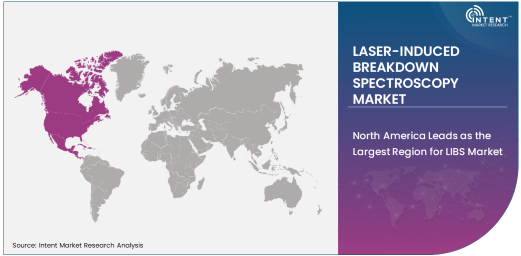
North America Leads as the Largest Region for LIBS Market
North America is the largest region for the Laser-Induced Breakdown Spectroscopy market, largely driven by high demand across industrial applications, environmental monitoring, and material analysis sectors. The presence of advanced research institutions and a robust industrial infrastructure, particularly in the United States, is fueling market growth. Additionally, North America is home to several key players in the LIBS technology market, contributing to innovations and the commercialization of portable systems.
The increasing adoption of LIBS for environmental monitoring in the region is also playing a significant role in the market’s expansion. As stricter regulations on environmental testing and resource management continue to evolve, North America remains at the forefront of integrating LIBS technology into various sectors, providing a competitive edge to businesses in the region. The market’s growth in North America is also supported by strong government funding for research and development, along with the rising demand for sustainable solutions.
Competitive Landscape and Leading Companies
The LIBS market is highly competitive, with several key players dominating the landscape. Leading companies in the market include Teledyne Leeman Labs, Horiba, Analytik Jena, and Rigaku Corporation, among others. These companies are continually innovating to provide advanced LIBS systems with greater precision, portability, and ease of use. The competitive landscape is characterized by technological advancements, with companies focusing on the development of more compact, affordable, and efficient systems to cater to a broad range of industries.
Strategic partnerships and mergers and acquisitions are also common in the market as companies seek to expand their product portfolios and geographic reach. The competitive environment in the LIBS market is expected to remain dynamic, with continuous research and development efforts aimed at addressing evolving customer needs, particularly in environmental monitoring, mining, and industrial applications. The market's future will be shaped by advancements in laser technology, miniaturization of systems, and increasing emphasis on on-site, real-time analysis capabilities.
Recent Developments:
- In December 2024, Thermo Fisher Scientific launched a new portable LIBS system aimed at industrial applications, offering high-speed material analysis for manufacturing plants.
- In November 2024, Horiba Ltd. unveiled a new multi-pulse LIBS instrument designed for environmental monitoring applications, providing enhanced sensitivity for detecting trace elements in air and water.
- In October 2024, Renishaw PLC introduced an upgraded laboratory-based LIBS system with improved precision for chemical analysis in forensic science.
- In September 2024, Applied Spectra, Inc. announced a partnership with a major mining company to deploy LIBS technology for real-time analysis of ore samples in remote locations.
- In August 2024, SciAps, Inc. released a new portable LIBS tool for use in medical diagnostics, enabling on-site elemental analysis of tissue samples.
List of Leading Companies:
- Thermo Fisher Scientific
- Horiba Ltd.
- Renishaw PLC
- Applied Spectra, Inc.
- SciAps, Inc.
- JDS Uniphase Corporation (II-VI Incorporated)
- Ametek Inc.
- LaserInduced Breakdown Spectroscopy (LIBS) Solutions
- Teledyne Instruments
- Macinnis Instruments
- Mettler Toledo
- PerkinElmer Inc.
- Analytik Jena AG
- B&W Tek, Inc.
- New Wave Research
Report Scope:
|
Report Features |
Description |
|
Market Size (2024-e) |
USD 0.2 Billion |
|
Forecasted Value (2030) |
USD 0.4 Billion |
|
CAGR (2025 – 2030) |
9.2% |
|
Base Year for Estimation |
2024-e |
|
Historic Year |
2023 |
|
Forecast Period |
2025 – 2030 |
|
Report Coverage |
Market Forecast, Market Dynamics, Competitive Landscape, Recent Developments |
|
Segments Covered |
Laser-Induced Breakdown Spectroscopy (LIBS) Market by Technology (Single Pulse, Multi-Pulse), Product Type (Portable, Laboratory-based), Application (Environmental Monitoring, Material Analysis, Mining, Forensic Science, Medical Diagnostics), and End-User (Laboratories, Industrial Manufacturers, Mining, Environmental Agencies) |
|
Regional Analysis |
North America (US, Canada, Mexico), Europe (Germany, France, UK, Italy, Spain, and Rest of Europe), Asia-Pacific (China, Japan, South Korea, Australia, India, and Rest of Asia-Pacific), Latin America (Brazil, Argentina, and Rest of Latin America), Middle East & Africa (Saudi Arabia, UAE, Rest of Middle East & Africa) |
|
Major Companies |
Thermo Fisher Scientific, Horiba Ltd., Renishaw PLC, Applied Spectra, Inc., SciAps, Inc., JDS Uniphase Corporation (II-VI Incorporated), Ametek Inc., LaserInduced Breakdown Spectroscopy (LIBS) Solutions, Teledyne Instruments, Macinnis Instruments, Mettler Toledo, PerkinElmer Inc., Analytik Jena AG, B&W Tek, Inc., New Wave Research |
|
Customization Scope |
Customization for segments, region/country-level will be provided. Moreover, additional customization can be done based on the requirements |
|
1. Introduction |
|
1.1. Market Definition |
|
1.2. Scope of the Study |
|
1.3. Research Assumptions |
|
1.4. Study Limitations |
|
2. Research Methodology |
|
2.1. Research Approach |
|
2.1.1. Top-Down Method |
|
2.1.2. Bottom-Up Method |
|
2.1.3. Factor Impact Analysis |
|
2.2. Insights & Data Collection Process |
|
2.2.1. Secondary Research |
|
2.2.2. Primary Research |
|
2.3. Data Mining Process |
|
2.3.1. Data Analysis |
|
2.3.2. Data Validation and Revalidation |
|
2.3.3. Data Triangulation |
|
3. Executive Summary |
|
3.1. Major Markets & Segments |
|
3.2. Highest Growing Regions and Respective Countries |
|
3.3. Impact of Growth Drivers & Inhibitors |
|
3.4. Regulatory Overview by Country |
|
4. Laser-Induced Breakdown Spectroscopy Market, by Technology (Market Size & Forecast: USD Million, 2023 – 2030) |
|
4.1. Single Pulse LIBS |
|
4.2. Multi-Pulse LIBS |
|
5. Laser-Induced Breakdown Spectroscopy Market, by Product Type (Market Size & Forecast: USD Million, 2023 – 2030) |
|
5.1. Portable LIBS Systems |
|
5.2. Laboratory-based LIBS Systems |
|
6. Laser-Induced Breakdown Spectroscopy Market, by Application (Market Size & Forecast: USD Million, 2023 – 2030) |
|
6.1. Environmental Monitoring |
|
6.2. Industrial Applications |
|
6.3. Material Analysis |
|
6.4. Mining and Exploration |
|
6.5. Forensic Science |
|
6.6. Medical Diagnostics |
|
7. Laser-Induced Breakdown Spectroscopy Market, by End-User (Market Size & Forecast: USD Million, 2023 – 2030) |
|
7.1. Laboratories |
|
7.2. Industrial Manufacturers |
|
7.3. Mining Companies |
|
7.4. Environmental Agencies |
|
8. Regional Analysis (Market Size & Forecast: USD Million, 2023 – 2030) |
|
8.1. Regional Overview |
|
8.2. North America |
|
8.2.1. Regional Trends & Growth Drivers |
|
8.2.2. Barriers & Challenges |
|
8.2.3. Opportunities |
|
8.2.4. Factor Impact Analysis |
|
8.2.5. Technology Trends |
|
8.2.6. North America Laser-Induced Breakdown Spectroscopy Market, by Technology |
|
8.2.7. North America Laser-Induced Breakdown Spectroscopy Market, by Product Type |
|
8.2.8. North America Laser-Induced Breakdown Spectroscopy Market, by Application |
|
8.2.9. North America Laser-Induced Breakdown Spectroscopy Market, by End-User |
|
8.2.10. By Country |
|
8.2.10.1. US |
|
8.2.10.1.1. US Laser-Induced Breakdown Spectroscopy Market, by Technology |
|
8.2.10.1.2. US Laser-Induced Breakdown Spectroscopy Market, by Product Type |
|
8.2.10.1.3. US Laser-Induced Breakdown Spectroscopy Market, by Application |
|
8.2.10.1.4. US Laser-Induced Breakdown Spectroscopy Market, by End-User |
|
8.2.10.2. Canada |
|
8.2.10.3. Mexico |
|
*Similar segmentation will be provided for each region and country |
|
8.3. Europe |
|
8.4. Asia-Pacific |
|
8.5. Latin America |
|
8.6. Middle East & Africa |
|
9. Competitive Landscape |
|
9.1. Overview of the Key Players |
|
9.2. Competitive Ecosystem |
|
9.2.1. Level of Fragmentation |
|
9.2.2. Market Consolidation |
|
9.2.3. Product Innovation |
|
9.3. Company Share Analysis |
|
9.4. Company Benchmarking Matrix |
|
9.4.1. Strategic Overview |
|
9.4.2. Product Innovations |
|
9.5. Start-up Ecosystem |
|
9.6. Strategic Competitive Insights/ Customer Imperatives |
|
9.7. ESG Matrix/ Sustainability Matrix |
|
9.8. Manufacturing Network |
|
9.8.1. Locations |
|
9.8.2. Supply Chain and Logistics |
|
9.8.3. Product Flexibility/Customization |
|
9.8.4. Digital Transformation and Connectivity |
|
9.8.5. Environmental and Regulatory Compliance |
|
9.9. Technology Readiness Level Matrix |
|
9.10. Technology Maturity Curve |
|
9.11. Buying Criteria |
|
10. Company Profiles |
|
10.1. Thermo Fisher Scientific |
|
10.1.1. Company Overview |
|
10.1.2. Company Financials |
|
10.1.3. Product/Service Portfolio |
|
10.1.4. Recent Developments |
|
10.1.5. IMR Analysis |
|
*Similar information will be provided for other companies |
|
10.2. Horiba Ltd. |
|
10.3. Renishaw PLC |
|
10.4. Applied Spectra, Inc. |
|
10.5. SciAps, Inc. |
|
10.6. JDS Uniphase Corporation (II-VI Incorporated) |
|
10.7. Ametek Inc. |
|
10.8. LaserInduced Breakdown Spectroscopy (LIBS) Solutions |
|
10.9. Teledyne Instruments |
|
10.10. Macinnis Instruments |
|
10.11. Mettler Toledo |
|
10.12. PerkinElmer Inc. |
|
10.13. Analytik Jena AG |
|
10.14. B&W Tek, Inc. |
|
10.15. New Wave Research |
|
11. Appendix |
A comprehensive market research approach was employed to gather and analyze data on the Laser-Induced Breakdown Spectroscopy (LIBS) Market. In the process, the analysis was also done to analyze the parent market and relevant adjacencies to measure the impact of them on the Laser-Induced Breakdown Spectroscopy (LIBS) Market. The research methodology encompassed both secondary and primary research techniques, ensuring the accuracy and credibility of the findings.
.jpg)
Secondary Research
Secondary research involved a thorough review of pertinent industry reports, journals, articles, and publications. Additionally, annual reports, press releases, and investor presentations of industry players were scrutinized to gain insights into their market positioning and strategies.
Primary Research
Primary research involved conducting in-depth interviews with industry experts, stakeholders, and market participants across the E-Waste Management ecosystem. The primary research objectives included:
- Validating findings and assumptions derived from secondary research
- Gathering qualitative and quantitative data on market trends, drivers, and challenges
- Understanding the demand-side dynamics, encompassing end-users, component manufacturers, facility providers, and service providers
- Assessing the supply-side landscape, including technological advancements and recent developments
Market Size Assessment
A combination of top-down and bottom-up approaches was utilized to analyze the overall size of the Laser-Induced Breakdown Spectroscopy (LIBS) Market. These methods were also employed to assess the size of various subsegments within the market. The market size assessment methodology encompassed the following steps:
- Identification of key industry players and relevant revenues through extensive secondary research
- Determination of the industry's supply chain and market size, in terms of value, through primary and secondary research processes
- Calculation of percentage shares, splits, and breakdowns using secondary sources and verification through primary sources
.jpg)
Data Triangulation
To ensure the accuracy and reliability of the market size, data triangulation was implemented. This involved cross-referencing data from various sources, including demand and supply side factors, market trends, and expert opinions. Additionally, top-down and bottom-up approaches were employed to validate the market size assessment.
NA