
As per Intent Market Research, the Injection Pen Market was valued at USD 46.0 Billion in 2024-e and will surpass USD 72.7 Billion by 2030; growing at a CAGR of 7.9% during 2025-2030.
The injection pen market has witnessed significant growth in recent years, driven by the increasing prevalence of chronic conditions such as diabetes, cancer, and growth hormone deficiencies, as well as the growing demand for self-administration of medications. Injection pens offer a convenient and reliable way to administer injectable drugs at home or on-the-go, making them a preferred choice for patients. These devices are designed to provide ease of use, accuracy, and consistent dosing, ensuring better treatment outcomes. The market is expected to continue expanding as healthcare systems emphasize patient-centric solutions and as technological advancements make injection pens more user-friendly and efficient.
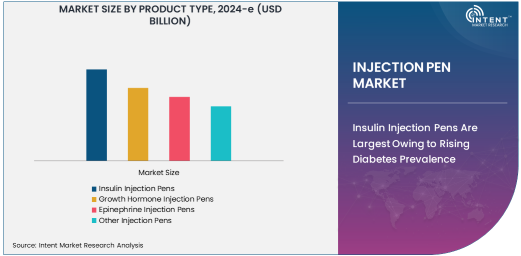
Insulin Injection Pens Are Largest Owing to Rising Diabetes Prevalence
Among the various product types in the injection pen market, insulin injection pens hold the largest share. The global rise in diabetes, particularly type 2 diabetes, has fueled the demand for insulin injection pens. These pens offer a more convenient alternative to traditional syringes, enabling patients to self-administer insulin at home with ease. The growth in the diabetic population, coupled with the increasing awareness about diabetes management, has made insulin injection pens the most widely adopted product in the injection pen market.
In addition, insulin pens are designed for both adults and children, making them suitable for a wide range of age groups. The ease of use, portability, and precise dosage provided by insulin pens have enhanced their acceptance among diabetic patients. Furthermore, innovations such as disposable insulin pens and smart insulin pens that track doses and sync with mobile applications are expected to drive the growth of this subsegment in the coming years.
Cancer Treatment Application Is Fastest Growing Due to Rising Oncology Cases
The cancer treatment application is emerging as the fastest-growing segment in the injection pen market. As cancer incidence rates continue to rise globally, there is an increasing demand for more efficient treatment options, including injectable drugs delivered through pens. These pens are particularly beneficial for patients undergoing chemotherapy or targeted therapies, as they offer a less invasive and more convenient alternative to intravenous injections. The ability to administer chemotherapy or other cancer treatments at home, under the supervision of healthcare professionals, is a key driver of this growth.
Additionally, the development of advanced biologic drugs and monoclonal antibodies for cancer treatment, often administered via injection pens, is expected to further propel this subsegment. The shift toward at-home administration of medications for cancer patients, in combination with the growing prevalence of oncology-related diseases, positions this application as a key growth area in the injection pen market.
Hospitals Are Largest End-User Owing to High Patient Volume
Hospitals account for the largest share of end-users in the injection pen market. Hospitals are primary care centers for patients with chronic conditions such as diabetes, cancer, and growth hormone deficiencies, making them significant consumers of injection pens. The high volume of patients who require injectable medications makes hospitals the largest segment for injection pen usage. Hospitals are equipped with the infrastructure to support both the administration and monitoring of injectable drugs, which further enhances the demand for these devices.
Additionally, hospitals often require bulk procurement of injection pens, given the sheer number of patients they treat daily. As hospitals increasingly adopt advanced injection pen technology, such as insulin pens and smart pens, they contribute substantially to the overall market share. The continuous growth in hospital admissions related to chronic diseases is expected to sustain the dominance of this segment over the forecast period.
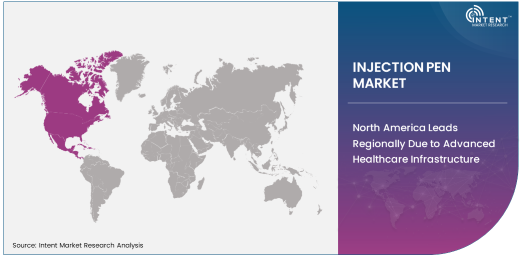
North America Leads Regionally Due to Advanced Healthcare Infrastructure
North America is the largest region in the injection pen market, driven by the region’s advanced healthcare infrastructure, high patient awareness, and significant prevalence of chronic conditions such as diabetes. The U.S., in particular, is home to a large diabetic population, which contributes to the demand for insulin injection pens. Additionally, the region has a well-established healthcare system that supports the widespread adoption of injection pens for various applications, including diabetes management, cancer treatment, and hormone deficiency therapy.
The growing adoption of smart devices and technological innovations in the region, such as insulin pens that track doses and sync with mobile apps, further strengthens North America's dominance. The presence of major market players and ongoing research and development activities in the region are expected to maintain North America’s leadership in the injection pen market.
Leading Companies and Competitive Landscape
The injection pen market is characterized by the presence of several well-established companies that dominate the landscape. Novo Nordisk, Sanofi S.A., and Becton Dickinson and Company are among the leading players in the market. These companies have strong product portfolios, with Novo Nordisk leading the insulin injection pen market through its innovations in insulin delivery devices. The competition in the market is intense, with companies focusing on technological advancements, such as the development of smart injection pens, to differentiate themselves.
Other companies, such as Ypsomed AG and Mylan N.V., are also making significant strides in the market through product launches and strategic partnerships. Mergers and acquisitions are becoming increasingly common as companies seek to expand their market share and innovate their product offerings. The competitive landscape is expected to remain dynamic, with key players continuing to focus on enhancing the functionality, ease of use, and patient experience associated with injection pens.
Recent Developments:
- Novo Nordisk recently launched a new insulin pen with improved dosage accuracy, further expanding its market presence in diabetes care.
- Sanofi and Regeneron announced a strategic collaboration to develop new biologic-based injection pens for the treatment of autoimmune diseases, advancing their product portfolio.
- Ypsomed acquired innovative injection pen technology, aiming to improve its existing portfolio and enhance patient experiences with user-friendly designs.
- Medtronic’s smart insulin pen received FDA approval, incorporating connectivity features that enable patients to track insulin doses via mobile apps, promoting better diabetes management.
- Mylan launched a new, affordable epinephrine auto-injection pen aimed at providing a cost-effective solution for anaphylaxis, addressing both market demand and affordability concerns.
List of Leading Companies:
- Novo Nordisk
- Sanofi S.A.
- Becton Dickinson and Company
- Owen Mumford Ltd.
- Mylan N.V.
- Ypsomed AG
- Eli Lilly and Co.
- Terumo Corporation
- Medtronic
- F. Hoffmann-La Roche AG
- Merck & Co., Inc.
- Panasonic Healthcare Co., Ltd.
- Tandem Diabetes Care, Inc.
- Biocon Limited
- Sandoz International GmbH
Report Scope:
|
Report Features |
Description |
|
Market Size (2024-e) |
USD 46.0 Billion |
|
Forecasted Value (2030) |
USD 72.7 Billion |
|
CAGR (2025 – 2030) |
7.9% |
|
Base Year for Estimation |
2024-e |
|
Historic Year |
2023 |
|
Forecast Period |
2025 – 2030 |
|
Report Coverage |
Market Forecast, Market Dynamics, Competitive Landscape, Recent Developments |
|
Segments Covered |
Injection Pen Market by Product Type (Insulin Injection Pens, Growth Hormone Injection Pens, Epinephrine Injection Pens), By Application (Diabetes Treatment, Cancer Treatment, Growth Hormone Deficiency, Anaphylaxis Treatment), By End-User (Hospitals, Homecare Settings, Clinics, Ambulatory Surgical Centers) |
|
Regional Analysis |
North America (US, Canada, Mexico), Europe (Germany, France, UK, Italy, Spain, and Rest of Europe), Asia-Pacific (China, Japan, South Korea, Australia, India, and Rest of Asia-Pacific), Latin America (Brazil, Argentina, and Rest of Latin America), Middle East & Africa (Saudi Arabia, UAE, Rest of Middle East & Africa) |
|
Major Companies |
Novo Nordisk, Sanofi S.A., Becton Dickinson and Company, Owen Mumford Ltd., Mylan N.V., Ypsomed AG, Eli Lilly and Co., Terumo Corporation, Medtronic, F. Hoffmann-La Roche AG, Merck & Co., Inc., Panasonic Healthcare Co., Ltd., Tandem Diabetes Care, Inc., Biocon Limited, Sandoz International GmbH |
|
Customization Scope |
Customization for segments, region/country-level will be provided. Moreover, additional customization can be done based on the requirements |
|
1. Introduction |
|
1.1. Market Definition |
|
1.2. Scope of the Study |
|
1.3. Research Assumptions |
|
1.4. Study Limitations |
|
2. Research Methodology |
|
2.1. Research Approach |
|
2.1.1. Top-Down Method |
|
2.1.2. Bottom-Up Method |
|
2.1.3. Factor Impact Analysis |
|
2.2. Insights & Data Collection Process |
|
2.2.1. Secondary Research |
|
2.2.2. Primary Research |
|
2.3. Data Mining Process |
|
2.3.1. Data Analysis |
|
2.3.2. Data Validation and Revalidation |
|
2.3.3. Data Triangulation |
|
3. Executive Summary |
|
3.1. Major Markets & Segments |
|
3.2. Highest Growing Regions and Respective Countries |
|
3.3. Impact of Growth Drivers & Inhibitors |
|
3.4. Regulatory Overview by Country |
|
4. Injection Pen Market, by Product Type (Market Size & Forecast: USD Million, 2023 – 2030) |
|
4.1. Insulin Injection Pens |
|
4.2. Growth Hormone Injection Pens |
|
4.3. Epinephrine Injection Pens |
|
4.4. Other Injection Pens |
|
5. Injection Pen Market, by Application (Market Size & Forecast: USD Million, 2023 – 2030) |
|
5.1. Diabetes Treatment |
|
5.2. Cancer Treatment |
|
5.3. Growth Hormone Deficiency |
|
5.4. Anaphylaxis Treatment |
|
5.5. Other Applications |
|
6. Injection Pen Market, by End-User (Market Size & Forecast: USD Million, 2023 – 2030) |
|
6.1. Hospitals |
|
6.2. Homecare Settings |
|
6.3. Clinics |
|
6.4. Ambulatory Surgical Centers |
|
6.5. Other End-Users |
|
7. Regional Analysis (Market Size & Forecast: USD Million, 2023 – 2030) |
|
7.1. Regional Overview |
|
7.2. North America |
|
7.2.1. Regional Trends & Growth Drivers |
|
7.2.2. Barriers & Challenges |
|
7.2.3. Opportunities |
|
7.2.4. Factor Impact Analysis |
|
7.2.5. Technology Trends |
|
7.2.6. North America Injection Pen Market, by Product Type |
|
7.2.7. North America Injection Pen Market, by Application |
|
7.2.8. North America Injection Pen Market, by End-User |
|
7.2.9. By Country |
|
7.2.9.1. US |
|
7.2.9.1.1. US Injection Pen Market, by Product Type |
|
7.2.9.1.2. US Injection Pen Market, by Application |
|
7.2.9.1.3. US Injection Pen Market, by End-User |
|
7.2.9.2. Canada |
|
7.2.9.3. Mexico |
|
*Similar segmentation will be provided for each region and country |
|
7.3. Europe |
|
7.4. Asia-Pacific |
|
7.5. Latin America |
|
7.6. Middle East & Africa |
|
8. Competitive Landscape |
|
8.1. Overview of the Key Players |
|
8.2. Competitive Ecosystem |
|
8.2.1. Level of Fragmentation |
|
8.2.2. Market Consolidation |
|
8.2.3. Product Innovation |
|
8.3. Company Share Analysis |
|
8.4. Company Benchmarking Matrix |
|
8.4.1. Strategic Overview |
|
8.4.2. Product Innovations |
|
8.5. Start-up Ecosystem |
|
8.6. Strategic Competitive Insights/ Customer Imperatives |
|
8.7. ESG Matrix/ Sustainability Matrix |
|
8.8. Manufacturing Network |
|
8.8.1. Locations |
|
8.8.2. Supply Chain and Logistics |
|
8.8.3. Product Flexibility/Customization |
|
8.8.4. Digital Transformation and Connectivity |
|
8.8.5. Environmental and Regulatory Compliance |
|
8.9. Technology Readiness Level Matrix |
|
8.10. Technology Maturity Curve |
|
8.11. Buying Criteria |
|
9. Company Profiles |
|
9.1. Novo Nordisk |
|
9.1.1. Company Overview |
|
9.1.2. Company Financials |
|
9.1.3. Product/Service Portfolio |
|
9.1.4. Recent Developments |
|
9.1.5. IMR Analysis |
|
*Similar information will be provided for other companies |
|
9.2. Sanofi S.A. |
|
9.3. Becton Dickinson and Company |
|
9.4. Owen Mumford Ltd. |
|
9.5. Mylan N.V. |
|
9.6. Ypsomed AG |
|
9.7. Eli Lilly and Co. |
|
9.8. Terumo Corporation |
|
9.9. Medtronic |
|
9.10. F. Hoffmann-La Roche AG |
|
9.11. Merck & Co., Inc. |
|
9.12. Panasonic Healthcare Co., Ltd. |
|
9.13. Tandem Diabetes Care, Inc. |
|
9.14. Biocon Limited |
|
9.15. Sandoz International GmbH |
|
10. Appendix |
A comprehensive market research approach was employed to gather and analyze data on the Injection Pen Market. In the process, the analysis was also done to analyze the parent market and relevant adjacencies to measure the impact of them on the Injection Pen Market. The research methodology encompassed both secondary and primary research techniques, ensuring the accuracy and credibility of the findings.
.jpg)
Secondary Research
Secondary research involved a thorough review of pertinent industry reports, journals, articles, and publications. Additionally, annual reports, press releases, and investor presentations of industry players were scrutinized to gain insights into their market positioning and strategies.
Primary Research
Primary research involved conducting in-depth interviews with industry experts, stakeholders, and market participants across the E-Waste Management ecosystem. The primary research objectives included:
- Validating findings and assumptions derived from secondary research
- Gathering qualitative and quantitative data on market trends, drivers, and challenges
- Understanding the demand-side dynamics, encompassing end-users, component manufacturers, facility providers, and service providers
- Assessing the supply-side landscape, including technological advancements and recent developments
Market Size Assessment
A combination of top-down and bottom-up approaches was utilized to analyze the overall size of the Injection Pen Market. These methods were also employed to assess the size of various subsegments within the market. The market size assessment methodology encompassed the following steps:
- Identification of key industry players and relevant revenues through extensive secondary research
- Determination of the industry's supply chain and market size, in terms of value, through primary and secondary research processes
- Calculation of percentage shares, splits, and breakdowns using secondary sources and verification through primary sources
.jpg)
Data Triangulation
To ensure the accuracy and reliability of the market size, data triangulation was implemented. This involved cross-referencing data from various sources, including demand and supply side factors, market trends, and expert opinions. Additionally, top-down and bottom-up approaches were employed to validate the market size assessment.
NA