
As per Intent Market Research, the Oral Rinse Market was valued at USD 4.3 Billion in 2024-e and will surpass USD 6.8 Billion by 2030; growing at a CAGR of 8.0% during 2025 - 2030.
The Oral Rinse Market is expanding as consumers and healthcare providers increasingly recognize the importance of maintaining oral hygiene beyond regular brushing and flossing. Oral rinses, which include both therapeutic and cosmetic types, are used for various purposes such as reducing plaque, preventing gum disease, whitening teeth, and refreshing breath. With growing awareness about oral health and hygiene, coupled with innovations in product formulations, the market for oral rinses is seeing robust growth. From antiseptic and fluoride mouthwashes to whitening solutions, these products cater to different needs and preferences, contributing to the ongoing demand for oral care products.
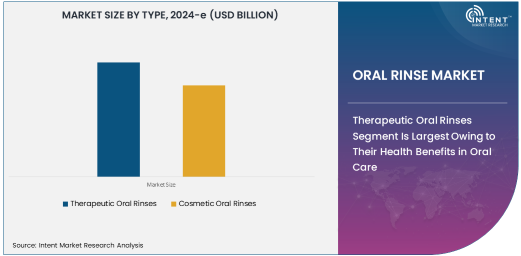
Therapeutic Oral Rinses Segment Is Largest Owing to Their Health Benefits in Oral Care
The therapeutic oral rinses segment is the largest in the oral rinse market, driven by their proven health benefits in managing and preventing oral diseases. These mouthwashes are formulated with active ingredients like antiseptic agents, fluoride, and antimicrobial compounds that help combat oral health issues such as gingivitis, periodontal disease, and tooth decay. Therapeutic oral rinses provide targeted treatment for common oral problems and are often recommended by dental professionals as part of a comprehensive oral care routine.
Their effectiveness in preventing and treating oral conditions contributes to the segment’s dominance. Therapeutic rinses are used not only for general oral hygiene but also for specific oral health concerns, making them a popular choice in both clinical settings and at-home care. As people become more health-conscious and proactive about oral health, the demand for therapeutic oral rinses continues to grow.
Whitening Mouthwash Segment Is Fastest Growing Owing to Increasing Focus on Aesthetic Oral Care
The whitening mouthwash segment is the fastest growing in the oral rinse market, driven by the rising consumer interest in aesthetic oral care. As people seek ways to maintain bright, white teeth, whitening mouthwashes have gained popularity for their ability to remove surface stains and maintain tooth whiteness. These mouthwashes often contain ingredients like hydrogen peroxide or activated charcoal, which are effective in whitening teeth and improving overall oral appearance.
The growing desire for cosmetic dental care, influenced by factors such as social media and the increasing focus on personal appearance, is propelling the demand for whitening products. Whitening mouthwashes provide a convenient and non-invasive alternative to professional dental whitening procedures, contributing to the rapid growth of this segment.
Antiseptic Mouthwash Segment Is Largest Product Type Owing to Its Role in Preventing Oral Diseases
The antiseptic mouthwash segment is the largest product type in the oral rinse market, owing to its key role in preventing oral diseases, controlling plaque, and maintaining oral hygiene. Antiseptic mouthwashes are formulated with active ingredients like chlorhexidine, which have proven antimicrobial properties that help reduce bacteria in the mouth, preventing infections and promoting healthier gums.
This product type is widely recommended by dental professionals for individuals at risk of gum disease, tooth decay, and bad breath. The growing emphasis on preventive healthcare and the increasing prevalence of oral diseases continue to drive the demand for antiseptic mouthwashes, making them the dominant product category in the market.
Retail Pharmacies Segment Is Largest End-Use Industry Owing to Accessibility and Consumer Preferences
Retail pharmacies are the largest end-use industry in the oral rinse market, driven by their widespread accessibility and the growing preference for self-care products. Consumers increasingly purchase oral rinses from retail pharmacies, where they can find a wide range of mouthwashes for different oral care needs. These pharmacies offer both prescription and over-the-counter oral rinses, ensuring that individuals have easy access to products for oral hygiene, therapeutic treatments, and cosmetic dental care.
Retail pharmacies also provide a convenient shopping experience, both in-store and online, making them the primary point of purchase for oral rinse products. With the growing availability of oral care products in pharmacies and consumers’ increasing reliance on retail pharmacies for oral health solutions, this segment dominates the oral rinse market.
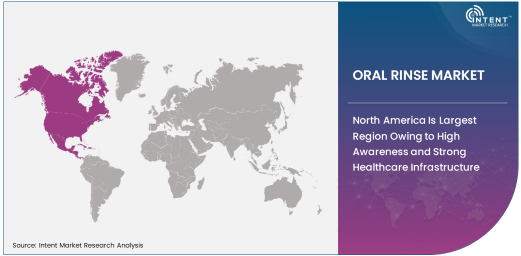
North America Is Largest Region Owing to High Awareness and Strong Healthcare Infrastructure
North America leads the oral rinse market, owing to high awareness of oral hygiene, advanced healthcare infrastructure, and widespread consumer access to oral care products. In the United States and Canada, the importance of maintaining good oral health is well-promoted through public health campaigns and dental professional recommendations. North American consumers are highly engaged in preventive healthcare practices, contributing to the high demand for both therapeutic and cosmetic oral rinses.
Retail pharmacies and healthcare providers in the region offer a wide range of oral rinse products, catering to different consumer needs, from general hygiene to specific treatments. The region’s advanced healthcare systems and the growing demand for aesthetic oral care further solidify North America’s dominance in the global oral rinse market.
Competitive Landscape and Key Players
The Oral Rinse Market is highly competitive, with key players such as Procter & Gamble, Colgate-Palmolive, Johnson & Johnson, and GlaxoSmithKline leading the industry. These companies offer a broad range of oral rinse products, including antiseptic mouthwashes, fluoride rinses, and whitening mouthwashes, addressing the diverse needs of consumers.
The competitive landscape is marked by continuous product innovation, with brands focusing on developing mouthwashes with added health benefits, such as alcohol-free formulations, natural ingredients, and multifunctional benefits. Companies are also expanding their product offerings through partnerships and acquisitions, along with increasing their distribution networks, both online and in retail pharmacies, to maintain market dominance.
Recent Developments:
- Thermo Fisher Scientific acquired a leading optogenetics tool manufacturer to enhance its capabilities in the genetic research sector.
- Carl Zeiss AG introduced a new imaging system designed for optogenetic research, offering enhanced resolution and data capture capabilities.
- Merck Group launched an optogenetics kit tailored for neuroscience research, enabling advanced cellular manipulation using light.
- Bluebird Bio, Inc. entered into a partnership with a biotech company to integrate optogenetics into their gene therapy development pipeline for neurological diseases.
List of Leading Companies:
- Optogenetics Technologies
- Synchronicity Pharmaceuticals
- Merck Group
- Synthego Corporation
- Emd Millipore (Merck KGaA)
- Thorlabs, Inc.
- GenSight Biologics
- Bluebird Bio, Inc.
- Channel Biosciences
- Carl Zeiss AG
- Bionova Scientific
- Quantum Biosystems
- Addgene
Report Scope:
|
Report Features |
Description |
|
Market Size (2024-e) |
USD 4.3 Billion |
|
Forecasted Value (2030) |
USD 6.8 Billion |
|
CAGR (2025 – 2030) |
8.0% |
|
Base Year for Estimation |
2024-e |
|
Historic Year |
2023 |
|
Forecast Period |
2025 – 2030 |
|
Report Coverage |
Market Forecast, Market Dynamics, Competitive Landscape, Recent Developments |
|
Segments Covered |
Global Oral Rinse Market by Type (Therapeutic Oral Rinses, Cosmetic Oral Rinses), by Product (Antiseptic Mouthwash, Fluoride Mouthwash, Whitening Mouthwash), by End-Use Industry (Hospitals & Clinics, Retail Pharmacies, Supermarkets & Hypermarkets) |
|
Regional Analysis |
North America (US, Canada, Mexico), Europe (Germany, France, UK, Italy, Spain, and Rest of Europe), Asia-Pacific (China, Japan, South Korea, Australia, India, and Rest of Asia-Pacific), Latin America (Brazil, Argentina, and Rest of Latin America), Middle East & Africa (Saudi Arabia, UAE, Rest of Middle East & Africa) |
|
Major Companies |
Optogenetics Technologies, Synchronicity Pharmaceuticals, Merck Group, Synthego Corporation, Emd Millipore (Merck KGaA), Thorlabs, Inc., Bluebird Bio, Inc., Channel Biosciences, Carl Zeiss AG, Bionova Scientific, Quantum Biosystems, Addgene |
|
Customization Scope |
Customization for segments, region/country-level will be provided. Moreover, additional customization can be done based on the requirements |
|
1. Introduction |
|
1.1. Market Definition |
|
1.2. Scope of the Study |
|
1.3. Research Assumptions |
|
1.4. Study Limitations |
|
2. Research Methodology |
|
2.1. Research Approach |
|
2.1.1. Top-Down Method |
|
2.1.2. Bottom-Up Method |
|
2.1.3. Factor Impact Analysis |
|
2.2. Insights & Data Collection Process |
|
2.2.1. Secondary Research |
|
2.2.2. Primary Research |
|
2.3. Data Mining Process |
|
2.3.1. Data Analysis |
|
2.3.2. Data Validation and Revalidation |
|
2.3.3. Data Triangulation |
|
3. Executive Summary |
|
3.1. Major Markets & Segments |
|
3.2. Highest Growing Regions and Respective Countries |
|
3.3. Impact of Growth Drivers & Inhibitors |
|
3.4. Regulatory Overview by Country |
|
4. Oral Rinse Market, by Type (Market Size & Forecast: USD Million, 2023 – 2030) |
|
4.1. Therapeutic Oral Rinses |
|
4.2. Cosmetic Oral Rinses |
|
5. Oral Rinse Market, by Product (Market Size & Forecast: USD Million, 2023 – 2030) |
|
5.1. Antiseptic Mouthwash |
|
5.2. Fluoride Mouthwash |
|
5.3. Whitening Mouthwash |
|
6. Oral Rinse Market, by End-Use Industry (Market Size & Forecast: USD Million, 2023 – 2030) |
|
6.1. Hospitals & Clinics |
|
6.2. Retail Pharmacies |
|
6.3. Supermarkets & Hypermarkets |
|
6.4. Biotechnology |
|
7. Regional Analysis (Market Size & Forecast: USD Million, 2023 – 2030) |
|
7.1. Regional Overview |
|
7.2. North America |
|
7.2.1. Regional Trends & Growth Drivers |
|
7.2.2. Barriers & Challenges |
|
7.2.3. Opportunities |
|
7.2.4. Factor Impact Analysis |
|
7.2.5. Technology Trends |
|
7.2.6. North America Oral Rinse Market, by Type |
|
7.2.7. North America Oral Rinse Market, by Product |
|
7.2.8. North America Oral Rinse Market, by End-Use Industry |
|
7.2.9. By Country |
|
7.2.9.1. US |
|
7.2.9.1.1. US Oral Rinse Market, by Type |
|
7.2.9.1.2. US Oral Rinse Market, by Product |
|
7.2.9.1.3. US Oral Rinse Market, by End-Use Industry |
|
7.2.9.2. Canada |
|
7.2.9.3. Mexico |
|
*Similar segmentation will be provided for each region and country |
|
7.3. Europe |
|
7.4. Asia-Pacific |
|
7.5. Latin America |
|
7.6. Middle East & Africa |
|
8. Competitive Landscape |
|
8.1. Overview of the Key Players |
|
8.2. Competitive Ecosystem |
|
8.2.1. Level of Fragmentation |
|
8.2.2. Market Consolidation |
|
8.2.3. Product Innovation |
|
8.3. Company Share Analysis |
|
8.4. Company Benchmarking Matrix |
|
8.4.1. Strategic Overview |
|
8.4.2. Product Innovations |
|
8.5. Start-up Ecosystem |
|
8.6. Strategic Competitive Insights/ Customer Imperatives |
|
8.7. ESG Matrix/ Sustainability Matrix |
|
8.8. Manufacturing Network |
|
8.8.1. Locations |
|
8.8.2. Supply Chain and Logistics |
|
8.8.3. Product Flexibility/Customization |
|
8.8.4. Digital Transformation and Connectivity |
|
8.8.5. Environmental and Regulatory Compliance |
|
8.9. Technology Readiness Level Matrix |
|
8.10. Technology Maturity Curve |
|
8.11. Buying Criteria |
|
9. Company Profiles |
|
9.1. Optogenetics Technologies |
|
9.1.1. Company Overview |
|
9.1.2. Company Financials |
|
9.1.3. Product/Service Portfolio |
|
9.1.4. Recent Developments |
|
9.1.5. IMR Analysis |
|
*Similar information will be provided for other companies |
|
9.2. Synchronicity Pharmaceuticals |
|
9.3. Merck Group |
|
9.4. Synthego Corporation |
|
9.5. Emd Millipore (Merck KGaA) |
|
9.6. Thorlabs, Inc. |
|
9.7. GenSight Biologics |
|
9.8. Bluebird Bio, Inc. |
|
9.9. Channel Biosciences |
|
9.10. Carl Zeiss AG |
|
9.11. Bionova Scientific |
|
9.12. Quantum Biosystems |
|
9.13. Addgene |
|
10. Appendix |
A comprehensive market research approach was employed to gather and analyze data on the Global Oral Rinse Market. In the process, the analysis was also done to analyze the parent market and relevant adjacencies to measure the impact of them on the Global Oral Rinse Market. The research methodology encompassed both secondary and primary research techniques, ensuring the accuracy and credibility of the findings.
.jpg)
Secondary Research
Secondary research involved a thorough review of pertinent industry reports, journals, articles, and publications. Additionally, annual reports, press releases, and investor presentations of industry players were scrutinized to gain insights into their market positioning and strategies.
Primary Research
Primary research involved conducting in-depth interviews with industry experts, stakeholders, and market participants across the E-Waste Management ecosystem. The primary research objectives included:
- Validating findings and assumptions derived from secondary research
- Gathering qualitative and quantitative data on market trends, drivers, and challenges
- Understanding the demand-side dynamics, encompassing end-users, component manufacturers, facility providers, and service providers
- Assessing the supply-side landscape, including technological advancements and recent developments
Market Size Assessment
A combination of top-down and bottom-up approaches was utilized to analyze the overall size of the Global Oral Rinse Market. These methods were also employed to assess the size of various subsegments within the market. The market size assessment methodology encompassed the following steps:
- Identification of key industry players and relevant revenues through extensive secondary research
- Determination of the industry's supply chain and market size, in terms of value, through primary and secondary research processes
- Calculation of percentage shares, splits, and breakdowns using secondary sources and verification through primary sources
.jpg)
Data Triangulation
To ensure the accuracy and reliability of the market size, data triangulation was implemented. This involved cross-referencing data from various sources, including demand and supply side factors, market trends, and expert opinions. Additionally, top-down and bottom-up approaches were employed to validate the market size assessment.
NA