
As per Intent Market Research, the Optical Imaging Market was valued at USD 2.3 Billion in 2024-e and will surpass USD 4.3 Billion by 2030; growing at a CAGR of 10.7% during 2025 - 2030.
The Optical Imaging Market is experiencing steady growth driven by technological advancements in non-invasive diagnostic tools and imaging techniques. The ability to capture high-resolution images in real-time without the need for biopsy or invasive procedures has revolutionized various industries, particularly in healthcare and research. With diverse applications ranging from medical diagnostics to environmental monitoring, optical imaging continues to advance across multiple sectors, making it a pivotal component in modern scientific and medical workflows.
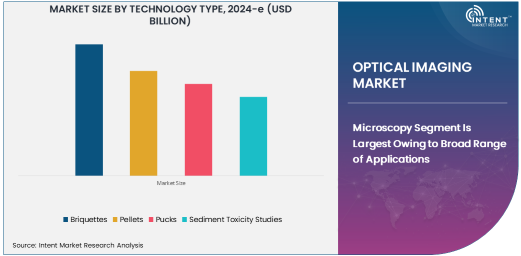
Microscopy Segment Is Largest Owing to Broad Range of Applications
The microscopy technology segment is the largest in the optical imaging market due to its widespread use in both medical and research applications. Optical microscopes have been essential in the life sciences for detailed cellular and tissue analysis, making them indispensable tools in laboratories worldwide.
The ability to visualize samples at high magnification and resolution, combined with advancements in fluorescence and confocal microscopy techniques, has enhanced the precision and capabilities of these instruments. Microscopy remains critical in diagnostics, drug discovery, and molecular biology, driving the segment's continuous dominance.
Fluorescence Imaging Segment Is Fastest Growing Owing to Enhanced Sensitivity
Fluorescence imaging is the fastest-growing technology type segment, propelled by its unmatched sensitivity and ability to capture real-time biological processes at the molecular level. This imaging technique is particularly valuable in medical diagnostics and life sciences research for visualizing tissue and cellular structures by tagging them with fluorescent markers.
Fluorescence imaging offers high contrast and specificity, making it ideal for detecting biomarkers in disease research, cancer diagnostics, and tracking cellular interactions. The expansion of its applications, especially in molecular biology and genomics, is driving rapid growth in this segment.
Medical Diagnostics Segment Is Largest Owing to High Demand for Non-Invasive Solutions
Medical diagnostics remains the largest application segment for optical imaging, as these technologies provide clinicians with critical tools for non-invasive diagnostics. Optical imaging systems, such as OCT and fluorescence imaging, are widely used to detect and monitor conditions like cancer, heart disease, and retinal disorders.
The growing demand for early detection of diseases, coupled with the rise in chronic conditions, further fuels the need for optical imaging in healthcare. Additionally, advancements in imaging technologies that enhance diagnostic accuracy, combined with the push for patient-friendly, non-invasive procedures, solidify medical diagnostics as the primary application for optical imaging systems.
Healthcare Segment Is Largest End-Use Industry Owing to High Adoption in Clinical Settings
The healthcare segment is the largest in the end-use industry category, driven by the increasing adoption of optical imaging technologies in hospitals, clinics, and diagnostic centers. The demand for precise imaging tools to support early detection, disease monitoring, and surgical procedures is rapidly increasing.
Optical imaging technologies like OCT, fluorescence, and microscopy are now integral to ophthalmology, oncology, and cardiology practices, aiding clinicians in making more accurate diagnoses and treatment decisions. As healthcare systems worldwide embrace cutting-edge technologies to improve patient outcomes, the healthcare sector remains the dominant end-use industry for optical imaging devices.
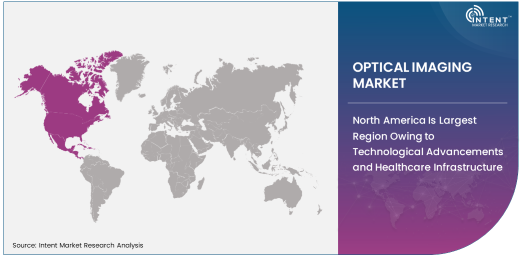
North America Is Largest Region Owing to Technological Advancements and Healthcare Infrastructure
North America leads the Optical Imaging Market, driven by technological advancements, a well-established healthcare infrastructure, and strong investment in medical research and innovation. The region benefits from the presence of leading manufacturers, along with widespread adoption of advanced imaging systems in clinical settings.
In addition to a high demand for medical imaging solutions, North America's commitment to research and development ensures continuous advancements in optical imaging technologies. The region's healthcare systems, supported by favorable reimbursement policies and rapid adoption of new technologies, position North America as the largest market for optical imaging devices.
Competitive Landscape and Key Players
The Optical Imaging Market is highly competitive, with key players such as Leica Microsystems, Nikon Corporation, Olympus Corporation, and Canon Inc. dominating the landscape. These companies focus on developing innovative optical imaging solutions that cater to a range of applications in medical diagnostics, research, and industry.
Additionally, emerging players are focusing on expanding the portfolio of portable and user-friendly imaging devices to meet the growing demand in underserved markets. The competitive landscape is shaped by continuous product innovation, strategic partnerships, and acquisitions aimed at enhancing technology capabilities and extending market reach.
Recent Developments:
- Carl Zeiss AG launched a new high-speed optical imaging system aimed at advancing medical diagnostics and research applications.
- Olympus Corporation introduced an enhanced fluorescence imaging system for early cancer detection during endoscopic procedures.
- Nikon Corporation unveiled a cutting-edge confocal microscope designed for live cell imaging with improved resolution.
- Medtronic PLC acquired a leading provider of optical imaging technologies to enhance its minimally invasive surgical solutions.
- GE Healthcare developed a new optical imaging platform that integrates AI for real-time analysis in medical imaging.
List of Leading Companies:
- Carl Zeiss AG
- Nikon Corporation
- Olympus Corporation
- Leica Microsystems (Danaher Corporation)
- Thorlabs, Inc.
- Fujifilm Holdings Corporation
- Medtronic PLC
- Agilent Technologies, Inc.
- Abbott Laboratories
- PerkinElmer, Inc.
- GE Healthcare
- Hamamatsu Photonics K.K.
- Topcon Corporation
- Bio-Rad Laboratories, Inc.
- Hitachi High-Technologies Corporation
Report Scope:
|
Report Features |
Description |
|
Market Size (2024-e) |
USD 2.3 Billion |
|
Forecasted Value (2030) |
USD 4.3 Billion |
|
CAGR (2025 – 2030) |
10.7% |
|
Base Year for Estimation |
2024-e |
|
Historic Year |
2023 |
|
Forecast Period |
2025 – 2030 |
|
Report Coverage |
Market Forecast, Market Dynamics, Competitive Landscape, Recent Developments |
|
Segments Covered |
Global Optical Imaging Market by Technology Type (Microscopy, Endoscopy, Optical Coherence Tomography (OCT), Fluorescence Imaging), by Application (Medical Diagnostics, Life Sciences Research, Industrial Imaging, Environmental Monitoring), by End-Use Industry (Healthcare, Research and Academic Institutes, Industrial and Manufacturing, Environmental Agencies) |
|
Regional Analysis |
North America (US, Canada, Mexico), Europe (Germany, France, UK, Italy, Spain, and Rest of Europe), Asia-Pacific (China, Japan, South Korea, Australia, India, and Rest of Asia-Pacific), Latin America (Brazil, Argentina, and Rest of Latin America), Middle East & Africa (Saudi Arabia, UAE, Rest of Middle East & Africa) |
|
Major Companies |
Carl Zeiss AG, Nikon Corporation, Olympus Corporation, Leica Microsystems (Danaher Corporation), Thorlabs, Inc., Fujifilm Holdings Corporation, Agilent Technologies, Inc., Abbott Laboratories, PerkinElmer, Inc., GE Healthcare, Hamamatsu Photonics K.K., Topcon Corporation, Hitachi High-Technologies Corporation |
|
Customization Scope |
Customization for segments, region/country-level will be provided. Moreover, additional customization can be done based on the requirements |
|
1. Introduction |
|
1.1. Market Definition |
|
1.2. Scope of the Study |
|
1.3. Research Assumptions |
|
1.4. Study Limitations |
|
2. Research Methodology |
|
2.1. Research Approach |
|
2.1.1. Top-Down Method |
|
2.1.2. Bottom-Up Method |
|
2.1.3. Factor Impact Analysis |
|
2.2. Insights & Data Collection Process |
|
2.2.1. Secondary Research |
|
2.2.2. Primary Research |
|
2.3. Data Mining Process |
|
2.3.1. Data Analysis |
|
2.3.2. Data Validation and Revalidation |
|
2.3.3. Data Triangulation |
|
3. Executive Summary |
|
3.1. Major Markets & Segments |
|
3.2. Highest Growing Regions and Respective Countries |
|
3.3. Impact of Growth Drivers & Inhibitors |
|
3.4. Regulatory Overview by Country |
|
4. Optical Imaging Market, by Technology Type (Market Size & Forecast: USD Million, 2023 – 2030) |
|
4.1. Microscopy |
|
4.2. Endoscopy |
|
4.3. Optical Coherence Tomography (OCT) |
|
4.4. Fluorescence Imaging |
|
5. Optical Imaging Market, by Application (Market Size & Forecast: USD Million, 2023 – 2030) |
|
5.1. Medical Diagnostics |
|
5.2. Life Sciences Research |
|
5.3. Industrial Imaging |
|
5.4. Environmental Monitoring |
|
6. Optical Imaging Market, by End-Use Industry (Market Size & Forecast: USD Million, 2023 – 2030) |
|
6.1. Healthcare |
|
6.2. Research and Academic Institutes |
|
6.3. Industrial and Manufacturing |
|
6.4. Environmental Agencies |
|
7. Regional Analysis (Market Size & Forecast: USD Million, 2023 – 2030) |
|
7.1. Regional Overview |
|
7.2. North America |
|
7.2.1. Regional Trends & Growth Drivers |
|
7.2.2. Barriers & Challenges |
|
7.2.3. Opportunities |
|
7.2.4. Factor Impact Analysis |
|
7.2.5. Technology Trends |
|
7.2.6. North America Optical Imaging Market, by Technology Type |
|
7.2.7. North America Optical Imaging Market, by Application |
|
7.2.8. North America Optical Imaging Market, by End-Use Industry |
|
7.2.9. By Country |
|
7.2.9.1. US |
|
7.2.9.1.1. US Optical Imaging Market, by Technology Type |
|
7.2.9.1.2. US Optical Imaging Market, by Application |
|
7.2.9.1.3. US Optical Imaging Market, by End-Use Industry |
|
7.2.9.2. Canada |
|
7.2.9.3. Mexico |
|
*Similar segmentation will be provided for each region and country |
|
7.3. Europe |
|
7.4. Asia-Pacific |
|
7.5. Latin America |
|
7.6. Middle East & Africa |
|
8. Competitive Landscape |
|
8.1. Overview of the Key Players |
|
8.2. Competitive Ecosystem |
|
8.2.1. Level of Fragmentation |
|
8.2.2. Market Consolidation |
|
8.2.3. Product Innovation |
|
8.3. Company Share Analysis |
|
8.4. Company Benchmarking Matrix |
|
8.4.1. Strategic Overview |
|
8.4.2. Product Innovations |
|
8.5. Start-up Ecosystem |
|
8.6. Strategic Competitive Insights/ Customer Imperatives |
|
8.7. ESG Matrix/ Sustainability Matrix |
|
8.8. Manufacturing Network |
|
8.8.1. Locations |
|
8.8.2. Supply Chain and Logistics |
|
8.8.3. Product Flexibility/Customization |
|
8.8.4. Digital Transformation and Connectivity |
|
8.8.5. Environmental and Regulatory Compliance |
|
8.9. Technology Readiness Level Matrix |
|
8.10. Technology Maturity Curve |
|
8.11. Buying Criteria |
|
9. Company Profiles |
|
9.1. Carl Zeiss AG |
|
9.1.1. Company Overview |
|
9.1.2. Company Financials |
|
9.1.3. Product/Service Portfolio |
|
9.1.4. Recent Developments |
|
9.1.5. IMR Analysis |
|
*Similar information will be provided for other companies |
|
9.2. Nikon Corporation |
|
9.3. Olympus Corporation |
|
9.4. Leica Microsystems (Danaher Corporation) |
|
9.5. Thorlabs, Inc. |
|
9.6. Fujifilm Holdings Corporation |
|
9.7. Medtronic PLC |
|
9.8. Agilent Technologies, Inc. |
|
9.9. Abbott Laboratories |
|
9.10. PerkinElmer, Inc. |
|
9.11. GE Healthcare |
|
9.12. Hamamatsu Photonics K.K. |
|
9.13. Topcon Corporation |
|
9.14. Bio-Rad Laboratories, Inc. |
|
9.15. Hitachi High-Technologies Corporation |
|
10. Appendix |
A comprehensive market research approach was employed to gather and analyze data on the Global Optical Imaging Market. In the process, the analysis was also done to analyze the parent market and relevant adjacencies to measure the impact of them on the Global Optical Imaging Market. The research methodology encompassed both secondary and primary research techniques, ensuring the accuracy and credibility of the findings.
.jpg)
Secondary Research
Secondary research involved a thorough review of pertinent industry reports, journals, articles, and publications. Additionally, annual reports, press releases, and investor presentations of industry players were scrutinized to gain insights into their market positioning and strategies.
Primary Research
Primary research involved conducting in-depth interviews with industry experts, stakeholders, and market participants across the E-Waste Management ecosystem. The primary research objectives included:
- Validating findings and assumptions derived from secondary research
- Gathering qualitative and quantitative data on market trends, drivers, and challenges
- Understanding the demand-side dynamics, encompassing end-users, component manufacturers, facility providers, and service providers
- Assessing the supply-side landscape, including technological advancements and recent developments
Market Size Assessment
A combination of top-down and bottom-up approaches was utilized to analyze the overall size of the Global Optical Imaging Market. These methods were also employed to assess the size of various subsegments within the market. The market size assessment methodology encompassed the following steps:
- Identification of key industry players and relevant revenues through extensive secondary research
- Determination of the industry's supply chain and market size, in terms of value, through primary and secondary research processes
- Calculation of percentage shares, splits, and breakdowns using secondary sources and verification through primary sources
.jpg)
Data Triangulation
To ensure the accuracy and reliability of the market size, data triangulation was implemented. This involved cross-referencing data from various sources, including demand and supply side factors, market trends, and expert opinions. Additionally, top-down and bottom-up approaches were employed to validate the market size assessment.
NA