
As per Intent Market Research, the Generative AI in Legal Market was valued at USD 1.2 billion in 2024-e and will surpass USD 21.2 billion by 2030; growing at a CAGR of 50.6% during 2025 - 2030.
The generative AI in legal market is revolutionizing how the legal industry operates, automating repetitive tasks, enhancing research accuracy, and enabling predictive insights. By integrating advanced technologies, legal professionals can now achieve faster turnaround times, mitigate risks, and provide better client services. This market is experiencing significant growth, driven by the increasing adoption of AI in legal processes and the growing need for data-driven decision-making.
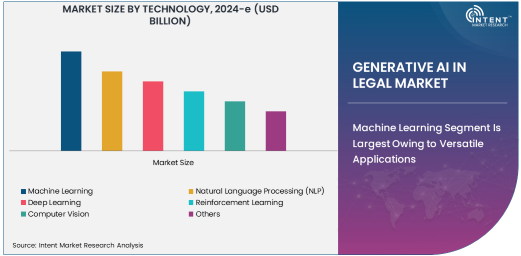
Machine Learning Segment Is Largest Owing to Versatile Applications
Machine learning stands as the largest technology segment in this market due to its broad applicability across various legal functions. From automating document review to predicting case outcomes, machine learning algorithms empower legal professionals with actionable insights. This versatility has made it indispensable for law firms and corporate legal departments seeking efficiency.
Moreover, the integration of machine learning in legal tools enables the identification of patterns in historical data, offering predictive analytics that assist in strategy formulation. Its adaptability ensures widespread adoption across applications, making it a cornerstone of generative AI in legal services.
Legal Research Segment Is Fastest Growing Owing to Enhanced NLP Integration
Legal research is witnessing exponential growth, fueled by the integration of natural language processing (NLP) technologies. These advancements allow for precise querying and contextual understanding of legal texts, reducing research time significantly.
Generative AI-powered research tools, such as those leveraging NLP, enable professionals to access comprehensive case law databases, statutes, and regulations efficiently. This technology is particularly valuable in reducing costs and improving accuracy, making it a vital segment for both small and large law firms.
Corporate Legal Departments Segment Is Largest Owing to Demand for Streamlined Operations
Corporate legal departments dominate the end-user landscape, driven by the need to streamline operations and reduce legal costs. These departments leverage AI for tasks like contract management, compliance monitoring, and risk assessment, ensuring efficiency and scalability.
Generative AI tools empower corporate legal teams to automate repetitive processes, enabling them to focus on strategic initiatives. With rising complexities in regulatory environments, these departments are investing heavily in AI technologies, further solidifying their position as the largest end-user segment.
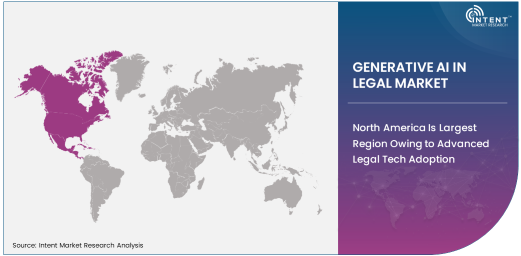
North America Is Largest Region Owing to Advanced Legal Tech Adoption
North America leads the global generative AI in the legal market, attributed to early adoption of technology and a robust legal technology ecosystem. The region boasts significant investments in AI-driven legal solutions, with major players headquartered in the United States and Canada.
Additionally, the presence of stringent regulatory frameworks has accelerated the demand for AI tools that ensure compliance and operational efficiency. With continuous advancements and a strong emphasis on innovation, North America remains at the forefront of this transformative market.
Leading Companies and Competitive Landscape
Key players in the generative AI in the legal market include Thomson Reuters, LexisNexis, Casetext, Luminance, and LawGeex. These companies are leveraging cutting-edge technologies to offer innovative solutions tailored to various legal functions.
The competitive landscape is marked by strategic partnerships, mergers, and continuous product innovations. For instance, companies are increasingly integrating AI capabilities with existing legal platforms, enabling seamless workflows for users. As the market matures, the focus will remain on delivering solutions that enhance efficiency and drive value across the legal industry
Recent Developments:
- Thomson Reuters announced a partnership with Microsoft to integrate AI-powered legal drafting tools in Microsoft Word.
- Luminance launched a new version of its contract analysis platform featuring advanced NLP capabilities.
- Casetext was acquired by OpenAI to enhance generative AI applications in legal research.
- LawGeex secured $15 million in funding to expand its AI-driven contract review solutions globally.
- Relativity introduced a regulatory compliance feature to its legal e-discovery platform using machine learning
List of Leading Companies:
- Thomson Reuters
- LexisNexis
- Casetext
- ROSS Intelligence
- Everlaw
- Luminance
- Kira Systems
- LawGeex
- OpenAI
- IBM Corporation
- Microsoft Corporation
- Relativity
- Exterro
- iManage
- Eigen Technologies
Report Scope:
|
Report Features |
Description |
|
Market Size (2024-e) |
USD 1.2 Billion |
|
Forecasted Value (2030) |
USD 21.2 Billion |
|
CAGR (2025 – 2030) |
50.6% |
|
Base Year for Estimation |
2024-e |
|
Historic Year |
2023 |
|
Forecast Period |
2025 – 2030 |
|
Report Coverage |
Market Forecast, Market Dynamics, Competitive Landscape, Recent Developments |
|
Segments Covered |
Generative AI in Legal Market by Technology (Machine Learning, Natural Language Processing, Deep Learning, Reinforcement Learning, Computer Vision), by Application (Legal Research, Contract Analysis & Review, Predictive Analytics for Case Outcomes, Document Automation, Compliance Management, Intellectual Property Management), by End-User Industry (Law Firms, Corporate Legal Departments, Government & Regulatory Agencies, Judicial Bodies, Legal Tech Companies) |
|
Regional Analysis |
North America (US, Canada, Mexico), Europe (Germany, France, UK, Italy, Spain, and Rest of Europe), Asia-Pacific (China, Japan, South Korea, Australia, India, and Rest of Asia-Pacific), Latin America (Brazil, Argentina, and Rest of Latin America), Middle East & Africa (Saudi Arabia, UAE, Rest of Middle East & Africa) |
|
Major Companies |
Thomson Reuters, LexisNexis, Casetext, ROSS Intelligence, Everlaw, Luminance, Kira Systems, LawGeex, OpenAI, IBM Corporation, Microsoft Corporation, Relativity, Exterro, iManage, Eigen Technologies |
|
Customization Scope |
Customization for segments, region/country-level will be provided. Moreover, additional customization can be done based on the requirements |
|
1. Introduction |
|
1.1. Market Definition |
|
1.2. Scope of the Study |
|
1.3. Research Assumptions |
|
1.4. Study Limitations |
|
2. Research Methodology |
|
2.1. Research Approach |
|
2.1.1. Top-Down Method |
|
2.1.2. Bottom-Up Method |
|
2.1.3. Factor Impact Analysis |
|
2.2. Insights & Data Collection Process |
|
2.2.1. Secondary Research |
|
2.2.2. Primary Research |
|
2.3. Data Mining Process |
|
2.3.1. Data Analysis |
|
2.3.2. Data Validation and Revalidation |
|
2.3.3. Data Triangulation |
|
3. Executive Summary |
|
3.1. Major Markets & Segments |
|
3.2. Highest Growing Regions and Respective Countries |
|
3.3. Impact of Growth Drivers & Inhibitors |
|
3.4. Regulatory Overview by Country |
|
4. Generative AI in Legal Market, by Technology (Market Size & Forecast: USD Million, 2023 – 2030) |
|
4.1. Machine Learning |
|
4.2. Natural Language Processing (NLP) |
|
4.3. Deep Learning |
|
4.4. Reinforcement Learning |
|
4.5. Computer Vision |
|
4.6. Others |
|
5. Generative AI in Legal Market, by Application (Market Size & Forecast: USD Million, 2023 – 2030) |
|
5.1. Legal Research |
|
5.2. Contract Analysis & Review |
|
5.3. Predictive Analytics for Case Outcomes |
|
5.4. Document Automation |
|
5.5. Compliance Management |
|
5.6. Intellectual Property (IP) Management |
|
5.7. Others |
|
6. Generative AI in Legal Market, by End-User Industry (Market Size & Forecast: USD Million, 2023 – 2030) |
|
6.1. Law Firms |
|
6.2. Corporate Legal Departments |
|
6.3. Government & Regulatory Agencies |
|
6.4. Judicial Bodies |
|
6.5. Legal Tech Companies |
|
6.6. Others |
|
7. Regional Analysis (Market Size & Forecast: USD Million, 2023 – 2030) |
|
7.1. Regional Overview |
|
7.2. North America |
|
7.2.1. Regional Trends & Growth Drivers |
|
7.2.2. Barriers & Challenges |
|
7.2.3. Opportunities |
|
7.2.4. Factor Impact Analysis |
|
7.2.5. Technology Trends |
|
7.2.6. North America Generative AI in Legal Market, by Technology |
|
7.2.7. North America Generative AI in Legal Market, by Application |
|
7.2.8. North America Generative AI in Legal Market, by End-User Industry |
|
7.2.9. By Country |
|
7.2.9.1. US |
|
7.2.9.1.1. US Generative AI in Legal Market, by Technology |
|
7.2.9.1.2. US Generative AI in Legal Market, by Application |
|
7.2.9.1.3. US Generative AI in Legal Market, by End-User Industry |
|
7.2.9.2. Canada |
|
7.2.9.3. Mexico |
|
*Similar segmentation will be provided for each region and country |
|
7.3. Europe |
|
7.4. Asia-Pacific |
|
7.5. Latin America |
|
7.6. Middle East & Africa |
|
8. Competitive Landscape |
|
8.1. Overview of the Key Players |
|
8.2. Competitive Ecosystem |
|
8.2.1. Level of Fragmentation |
|
8.2.2. Market Consolidation |
|
8.2.3. Product Innovation |
|
8.3. Company Share Analysis |
|
8.4. Company Benchmarking Matrix |
|
8.4.1. Strategic Overview |
|
8.4.2. Product Innovations |
|
8.5. Start-up Ecosystem |
|
8.6. Strategic Competitive Insights/ Customer Imperatives |
|
8.7. ESG Matrix/ Sustainability Matrix |
|
8.8. Manufacturing Network |
|
8.8.1. Locations |
|
8.8.2. Supply Chain and Logistics |
|
8.8.3. Product Flexibility/Customization |
|
8.8.4. Digital Transformation and Connectivity |
|
8.8.5. Environmental and Regulatory Compliance |
|
8.9. Technology Readiness Level Matrix |
|
8.10. Technology Maturity Curve |
|
8.11. Buying Criteria |
|
9. Company Profiles |
|
9.1. Thomson Reuters |
|
9.1.1. Company Overview |
|
9.1.2. Company Financials |
|
9.1.3. Product/Service Portfolio |
|
9.1.4. Recent Developments |
|
9.1.5. IMR Analysis |
|
*Similar information will be provided for other companies |
|
9.2. LexisNexis |
|
9.3. Casetext |
|
9.4. ROSS Intelligence |
|
9.5. Everlaw |
|
9.6. Luminance |
|
9.7. Kira Systems |
|
9.8. LawGeex |
|
9.9. OpenAI |
|
9.10. IBM Corporation |
|
9.11. Microsoft Corporation |
|
9.12. Relativity |
|
9.13. Exterro |
|
9.14. iManage |
|
9.15. Eigen Technologies |
|
10. Appendix |
A comprehensive market research approach was employed to gather and analyze data on the Generative AI in Legal Market. In the process, the analysis was also done to analyze the parent market and relevant adjacencies to measure the impact of them on the Generative AI in Legal Market. The research methodology encompassed both secondary and primary research techniques, ensuring the accuracy and credibility of the findings.
.jpg)
Secondary Research
Secondary research involved a thorough review of pertinent industry reports, journals, articles, and publications. Additionally, annual reports, press releases, and investor presentations of industry players were scrutinized to gain insights into their market positioning and strategies.
Primary Research
Primary research involved conducting in-depth interviews with industry experts, stakeholders, and market participants across the E-Waste Management ecosystem. The primary research objectives included:
- Validating findings and assumptions derived from secondary research
- Gathering qualitative and quantitative data on market trends, drivers, and challenges
- Understanding the demand-side dynamics, encompassing end-users, component manufacturers, facility providers, and service providers
- Assessing the supply-side landscape, including technological advancements and recent developments
Market Size Assessment
A combination of top-down and bottom-up approaches was utilized to analyze the overall size of the Generative AI in Legal Market. These methods were also employed to assess the size of various subsegments within the market. The market size assessment methodology encompassed the following steps:
- Identification of key industry players and relevant revenues through extensive secondary research
- Determination of the industry's supply chain and market size, in terms of value, through primary and secondary research processes
- Calculation of percentage shares, splits, and breakdowns using secondary sources and verification through primary sources
.jpg)
Data Triangulation
To ensure the accuracy and reliability of the market size, data triangulation was implemented. This involved cross-referencing data from various sources, including demand and supply side factors, market trends, and expert opinions. Additionally, top-down and bottom-up approaches were employed to validate the market size assessment.
NA