
As per Intent Market Research, the Environmental Remediation Services Market was valued at USD 106.6 billion in 2023 and will surpass USD 175.9 billion by 2030; growing at a CAGR of 7.4% during 2024 - 2030.
The Environmental Remediation Services market is an essential component of environmental management, aimed at restoring ecosystems that have been affected by pollution and contaminants. This market involves various services and technologies designed to clean, restore, and protect natural resources, ensuring that industrial activities do not harm the environment or human health. As environmental regulations become more stringent and the need for sustainable practices grows, the market for environmental remediation services is poised for significant growth. It covers diverse service types, technologies, and industries, with increasing demand for advanced solutions to tackle complex environmental challenges.
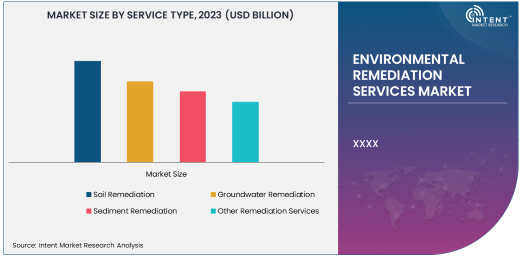
Soil Remediation Segment is Largest Owing to Its Widespread Applications
Soil remediation is the largest service segment in the environmental remediation market due to its broad application across various industries. Soil contamination is a common issue, particularly in industries like manufacturing, agriculture, and construction. Contaminants such as heavy metals, pesticides, and petroleum products can severely impact soil health, human safety, and plant growth. As a result, effective soil remediation techniques are in high demand to restore contaminated land for agricultural use, construction, or simply to meet regulatory requirements.
The widespread adoption of soil remediation techniques is driven by both regulatory pressure and the increasing awareness of environmental sustainability. Governments around the world are enforcing stricter environmental laws, requiring industries to address soil contamination. Bioremediation and chemical treatments are among the most common methods used, as they are cost-effective and highly efficient. This segment is expected to continue to dominate the market, with growing investments in sustainable remediation solutions and an expanding global focus on environmental conservation.
Bioremediation Technology is Fastest Growing Owing to Its Eco-Friendly Approach
Bioremediation is the fastest-growing technology segment within the environmental remediation market, owing to its environmentally friendly and cost-effective approach. This method uses natural microorganisms or plants to degrade, absorb, or neutralize pollutants, making it a sustainable solution for addressing soil, groundwater, and sediment contamination. The rise in bioremediation’s popularity is also supported by its ability to treat a wide range of contaminants, including organic pollutants, heavy metals, and petroleum products.
The demand for bioremediation is increasing as industries and governments seek greener, more sustainable ways to manage environmental contamination. This method is less invasive and often requires fewer resources than traditional methods, making it an attractive option for companies looking to reduce their environmental footprint. The continuous research and development into more efficient bioremediation techniques are further driving the growth of this segment. As environmental regulations become more stringent, bioremediation is likely to play an even more prominent role in the remediation services market.
Oil & Gas Industry Drives Demand for Environmental Remediation Services
The oil & gas industry is one of the largest end-user industries driving the demand for environmental remediation services. This sector is prone to oil spills, contamination from drilling operations, and the release of hazardous substances, which necessitate extensive environmental cleanup efforts. The oil and gas industry's need for remediation services is amplified by increasingly strict environmental regulations, which require companies to restore ecosystems that have been harmed by their operations. As a result, oil and gas companies are investing heavily in remediation technologies and services to mitigate their environmental impact.
In addition, the growing demand for sustainable energy sources and the shift towards cleaner practices in the oil and gas industry are further influencing the adoption of advanced remediation services. The focus on reducing environmental footprints and achieving sustainability targets has led to an uptick in the need for technologies like chemical and bioremediation. This trend is expected to continue, with the oil and gas sector being a significant contributor to market growth.
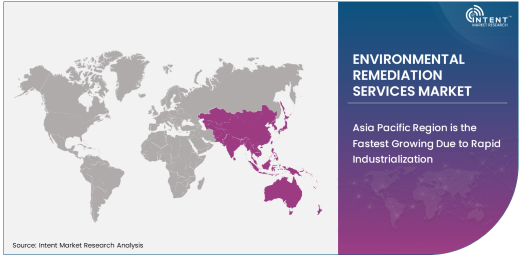
Asia Pacific Region is the Fastest Growing Due to Rapid Industrialization
The Asia Pacific region is experiencing the fastest growth in the environmental remediation services market, driven by rapid industrialization, urbanization, and increasing environmental concerns. Countries such as China and India are facing significant environmental challenges due to their large-scale industrial activities, which often result in soil, water, and air contamination. As a response, these nations are implementing stricter environmental regulations and investing in remediation technologies to address contamination and improve environmental conditions.
This region's rapid economic growth and industrialization are coupled with an increasing focus on sustainable development and environmental preservation. The governments in Asia Pacific are prioritizing the cleanup of contaminated sites to ensure public health and environmental safety, thereby creating a significant demand for remediation services. Additionally, the growing awareness of climate change and environmental sustainability is pushing businesses and industries to adopt more effective remediation solutions, further boosting market growth in the region.
Leading Companies and Competitive Landscape
The environmental remediation services market is highly competitive, with several key players dominating the global landscape. Leading companies such as Clean Harbors, AECOM, Jacobs Engineering Group, and Veolia North America are at the forefront of this market, offering comprehensive services in soil, groundwater, and sediment remediation. These companies leverage advanced technologies and have established a strong presence across various regions, ensuring that they can meet the diverse needs of their clients.
The competitive landscape is characterized by a mix of large multinational companies and regional players, each offering specialized services tailored to the specific needs of various industries. With the increasing demand for eco-friendly and cost-effective remediation solutions, these companies are continuously innovating and expanding their service offerings. Strategic partnerships, mergers, and acquisitions are common in this market, as companies aim to enhance their technological capabilities and expand their geographical reach. As the market continues to grow, the leading companies are expected to strengthen their positions by focusing on sustainability and compliance with ever-evolving environmental regulations.
Recent Developments:
- Clean Harbors announced the launch of new innovative services for hazardous waste remediation, strengthening their position in the U.S. market.
- AECOM acquired an environmental remediation company specializing in groundwater treatment, expanding their capabilities in the oil and gas sector.
- SUEZ Water Technologies unveiled new AI-driven technologies aimed at improving soil and groundwater remediation efficiency, reducing costs, and improving environmental safety.
- Tetra Tech expanded its global environmental remediation services through a strategic acquisition of a European-based environmental firm, boosting its presence in Europe.
- Veolia received approval from environmental regulators for a new, more efficient groundwater treatment technology, positioning itself as a leader in sustainable remediation solutions.
List of Leading Companies:
- Clean Harbors, Inc.
- AECOM
- Jacobs Engineering Group
- Tetra Tech, Inc.
- Veolia North America
- EnviroServe Ltd.
- REMEDIATION Services, Inc.
- SUEZ Water Technologies & Solutions
- Terrapure Environmental
- Golder Associates
- HDR, Inc.
- Waste Management, Inc.
- Arcadis NV
- TRC Companies, Inc.
- Geo-Environmental Technologies, Inc.
Report Scope:
|
Report Features |
Description |
|
Market Size (2023) |
USD 106.6 Billion |
|
Forecasted Value (2030) |
USD 175.9 Billion |
|
CAGR (2024 – 2030) |
7.4% |
|
Base Year for Estimation |
2023 |
|
Historic Year |
2022 |
|
Forecast Period |
2024 – 2030 |
|
Report Coverage |
Market Forecast, Market Dynamics, Competitive Landscape, Recent Developments |
|
Segments Covered |
Environmental Remediation Services Market By Service Type (Soil Remediation, Groundwater Remediation, Sediment Remediation), By Technology (Bioremediation, Chemical Remediation, Thermal Remediation, Physical Remediation), By End-User Industry (Oil & Gas, Mining, Manufacturing, Chemicals, Construction, Government, Utilities) |
|
Regional Analysis |
North America (US, Canada, Mexico), Europe (Germany, France, UK, Italy, Spain, and Rest of Europe), Asia-Pacific (China, Japan, South Korea, Australia, India, and Rest of Asia-Pacific), Latin America (Brazil, Argentina, and Rest of Latin America), Middle East & Africa (Saudi Arabia, UAE, Rest of Middle East & Africa) |
|
Major Companies |
Clean Harbors, Inc., AECOM, Jacobs Engineering Group, Tetra Tech, Inc., Veolia North America, EnviroServe Ltd., REMEDIATION Services, Inc., SUEZ Water Technologies & Solutions, Terrapure Environmental, Golder Associates, HDR, Inc., Waste Management, Inc., Arcadis NV, TRC Companies, Inc., Geo-Environmental Technologies, Inc. |
|
Customization Scope |
Customization for segments, region/country-level will be provided. Moreover, additional customization can be done based on the requirements |
|
1. Introduction |
|
1.1. Market Definition |
|
1.2. Scope of the Study |
|
1.3. Research Assumptions |
|
1.4. Study Limitations |
|
2. Research Methodology |
|
2.1. Research Approach |
|
2.1.1. Top-Down Method |
|
2.1.2. Bottom-Up Method |
|
2.1.3. Factor Impact Analysis |
|
2.2. Insights & Data Collection Process |
|
2.2.1. Secondary Research |
|
2.2.2. Primary Research |
|
2.3. Data Mining Process |
|
2.3.1. Data Analysis |
|
2.3.2. Data Validation and Revalidation |
|
2.3.3. Data Triangulation |
|
3. Executive Summary |
|
3.1. Major Markets & Segments |
|
3.2. Highest Growing Regions and Respective Countries |
|
3.3. Impact of Growth Drivers & Inhibitors |
|
3.4. Regulatory Overview by Country |
|
4. Environmental Remediation Services Market, by Service Type (Market Size & Forecast: USD Million, 2022 – 2030) |
|
4.1. Soil Remediation |
|
4.2. Groundwater Remediation |
|
4.3. Sediment Remediation |
|
4.4. Other Remediation Services |
|
5. Environmental Remediation Services Market, by Technology (Market Size & Forecast: USD Million, 2022 – 2030) |
|
5.1. Bioremediation |
|
5.2. Chemical Remediation |
|
5.3. Thermal Remediation |
|
5.4. Physical Remediation |
|
5.5. Other Technologies |
|
6. Environmental Remediation Services Market, by End-User Industry (Market Size & Forecast: USD Million, 2022 – 2030) |
|
6.1. Oil & Gas |
|
6.2. Mining |
|
6.3. Manufacturing |
|
6.4. Chemicals |
|
6.5. Construction |
|
6.6. Government |
|
6.7. Utilities |
|
6.8. Other Industries |
|
7. Regional Analysis (Market Size & Forecast: USD Million, 2022 – 2030) |
|
7.1. Regional Overview |
|
7.2. North America |
|
7.2.1. Regional Trends & Growth Drivers |
|
7.2.2. Barriers & Challenges |
|
7.2.3. Opportunities |
|
7.2.4. Factor Impact Analysis |
|
7.2.5. Technology Trends |
|
7.2.6. North America Environmental Remediation Services Market, by Service Type |
|
7.2.7. North America Environmental Remediation Services Market, by Technology |
|
7.2.8. North America Environmental Remediation Services Market, by End-User Industry |
|
7.2.9. By Country |
|
7.2.9.1. US |
|
7.2.9.1.1. US Environmental Remediation Services Market, by Service Type |
|
7.2.9.1.2. US Environmental Remediation Services Market, by Technology |
|
7.2.9.1.3. US Environmental Remediation Services Market, by End-User Industry |
|
7.2.9.2. Canada |
|
7.2.9.3. Mexico |
|
*Similar segmentation will be provided for each region and country |
|
7.3. Europe |
|
7.4. Asia-Pacific |
|
7.5. Latin America |
|
7.6. Middle East & Africa |
|
8. Competitive Landscape |
|
8.1. Overview of the Key Players |
|
8.2. Competitive Ecosystem |
|
8.2.1. Level of Fragmentation |
|
8.2.2. Market Consolidation |
|
8.2.3. Product Innovation |
|
8.3. Company Share Analysis |
|
8.4. Company Benchmarking Matrix |
|
8.4.1. Strategic Overview |
|
8.4.2. Product Innovations |
|
8.5. Start-up Ecosystem |
|
8.6. Strategic Competitive Insights/ Customer Imperatives |
|
8.7. ESG Matrix/ Sustainability Matrix |
|
8.8. Manufacturing Network |
|
8.8.1. Locations |
|
8.8.2. Supply Chain and Logistics |
|
8.8.3. Product Flexibility/Customization |
|
8.8.4. Digital Transformation and Connectivity |
|
8.8.5. Environmental and Regulatory Compliance |
|
8.9. Technology Readiness Level Matrix |
|
8.10. Technology Maturity Curve |
|
8.11. Buying Criteria |
|
9. Company Profiles |
|
9.1. Clean Harbors, Inc. |
|
9.1.1. Company Overview |
|
9.1.2. Company Financials |
|
9.1.3. Product/Service Portfolio |
|
9.1.4. Recent Developments |
|
9.1.5. IMR Analysis |
|
*Similar information will be provided for other companies |
|
9.2. AECOM |
|
9.3. Jacobs Engineering Group |
|
9.4. Tetra Tech, Inc. |
|
9.5. Veolia North America |
|
9.6. EnviroServe Ltd. |
|
9.7. REMEDIATION Services, Inc. |
|
9.8. SUEZ Water Technologies & Solutions |
|
9.9. Terrapure Environmental |
|
9.10. Golder Associates |
|
9.11. HDR, Inc. |
|
9.12. Waste Management, Inc. |
|
9.13. Arcadis NV |
|
9.14. TRC Companies, Inc. |
|
9.15. Geo-Environmental Technologies, Inc. |
|
10. Appendix |
A comprehensive market research approach was employed to gather and analyze data on the Environmental Remediation Services Market. In the process, the analysis was also done to analyze the parent market and relevant adjacencies to measure the impact of them on the Environmental Remediation Services Market. The research methodoloagy encompassed both secondary and primary research techniques, ensuring the accuracy and credibility of the findings.
.jpg)
Secondary Research
Secondary research involved a thorough review of pertinent industry reports, journals, articles, and publications. Additionally, annual reports, press releases, and investor presentations of industry players were scrutinized to gain insights into their market positioning and strategies.
Primary Research
Primary research involved conducting in-depth interviews with industry experts, stakeholders, and market participants across the E-Waste Management ecosystem. The primary research objectives included:
- Validating findings and assumptions derived from secondary research
- Gathering qualitative and quantitative data on market trends, drivers, and challenges
- Understanding the demand-side dynamics, encompassing end-users, component manufacturers, facility providers, and service providers
- Assessing the supply-side landscape, including technological advancements and recent developments
Market Size Assessment
A combination of top-down and bottom-up approaches was utilized to analyze the overall size of the Environmental Remediation Services Market. These methods were also employed to assess the size of various subsegments within the market. The market size assessment methodology encompassed the following steps:
- Identification of key industry players and relevant revenues through extensive secondary research
- Determination of the industry's supply chain and market size, in terms of value, through primary and secondary research processes
- Calculation of percentage shares, splits, and breakdowns using secondary sources and verification through primary sources
.jpg)
Data Triangulation
To ensure the accuracy and reliability of the market size, data triangulation was implemented. This involved cross-referencing data from various sources, including demand and supply side factors, market trends, and expert opinions. Additionally, top-down and bottom-up approaches were employed to validate the market size assessment.
NA