
As per Intent Market Research, the Entertainment Robots Market was valued at USD 4.8 billion in 2023 and will surpass USD 19.1 billion by 2030; growing at a CAGR of 21.8% during 2024 - 2030.
The entertainment robots market has experienced significant growth, driven by technological advancements in artificial intelligence (AI), robotics, and machine learning (ML). Entertainment robots are increasingly being used across various applications such as home entertainment, amusement parks, retail, and commercial spaces to enhance customer experiences. The market is expected to continue expanding as consumers and businesses embrace automation for more personalized and interactive entertainment experiences. The growing demand for robots that offer engaging, lifelike interactions is leading to rapid innovation in humanoid robots and animal-like robots, making these products increasingly integral to the entertainment and leisure industry.
Humanoid Robots Segment is Largest Owing to Their Versatility
Among the various types of entertainment robots, humanoid robots are the largest segment. These robots are designed to resemble humans and often feature advanced capabilities such as facial recognition, voice interaction, and autonomous movement. Their versatility makes them suitable for a wide range of applications, including home entertainment, theme parks, and retail spaces. Humanoid robots are capable of offering personalized and interactive experiences that appeal to both children and adults, thus creating new avenues for customer engagement.
Humanoid robots, such as those developed by companies like SoftBank Robotics, are able to interact with people in a way that mimics human behavior. This is a significant advantage in sectors like theme parks and retail, where customer experience is a key driver of success. Their ability to provide unique, memorable experiences gives businesses a competitive edge in attracting and retaining customers. As a result, the humanoid robots segment is expected to dominate the market for the foreseeable future, with technological enhancements in AI and machine learning further boosting their capabilities.

Home Entertainment Application is Leading the Way in Adoption
The home entertainment application segment is one of the fastest-growing within the entertainment robots market. With the rise of smart homes and the increasing popularity of interactive technology, robots designed for home entertainment are becoming a key feature of modern households. These robots can serve multiple functions, such as providing interactive play for children, assisting with household chores, or serving as personal companions for elderly individuals. As AI technology becomes more advanced, these robots are increasingly capable of adapting to the needs and preferences of individual users.
The growing trend of consumer interest in automated home environments is one of the key factors propelling the adoption of entertainment robots in homes. Companies like Sony and iRobot have been at the forefront of this shift, creating robots that not only entertain but also provide practical value by integrating with other smart devices. As consumers seek more personalized, engaging entertainment options, the demand for home entertainment robots is expected to increase rapidly, making it one of the fastest-growing subsegments in the entertainment robots market.
AI Technology Segment is Fastest Growing
Artificial Intelligence (AI) is the fastest-growing technology segment within the entertainment robots market. AI enables robots to learn from user interactions, adapt to new environments, and perform tasks autonomously, making them more engaging and interactive. With machine learning algorithms becoming more advanced, robots can improve their responses, recognize complex gestures, and understand natural language. This capability is especially important in applications such as home entertainment, retail, and theme parks, where robots are expected to provide personalized, human-like interactions.
AI's potential to transform entertainment robots is immense, and it is driving innovation in how robots engage with users. Companies are increasingly integrating AI with other technologies, such as voice and gesture recognition, to create robots that offer seamless, real-time interactions. As the capabilities of AI continue to evolve, the demand for AI-powered entertainment robots will rise, making this segment crucial to the market's growth.
Consumer Electronics Industry is Key to Market Expansion
The consumer electronics industry is a major driver of growth in the entertainment robots market, particularly as consumers seek more interactive and technologically advanced entertainment solutions. Robots designed for home entertainment and personal use are increasingly seen as part of the larger trend of integrating advanced technology into everyday life. With companies like Sony, Samsung, and Xiaomi leading the charge, the demand for robots capable of engaging users in new ways is skyrocketing. These companies are not only focusing on the design and functionality of robots but are also integrating them into broader ecosystems of smart home devices.
The rise of consumer interest in personal robotics for home use, entertainment, and companionship is opening up new opportunities within the consumer electronics sector. These robots offer various functions, from performing household tasks to acting as interactive companions for children and elderly individuals. As the demand for multifunctional, user-friendly robots increases, the consumer electronics industry will continue to drive the growth of the entertainment robots market.
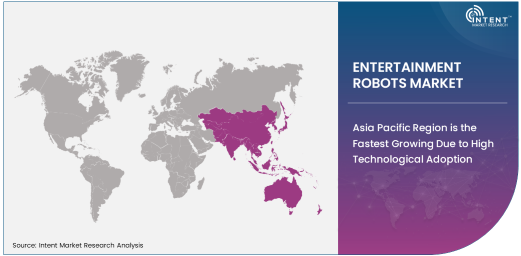
Asia Pacific Region is the Fastest Growing Due to High Technological Adoption
Asia Pacific is the fastest-growing region in the entertainment robots market. Countries like Japan, South Korea, and China are leading the way in adopting robotics and AI technologies, particularly in the entertainment and leisure sectors. Japan, in particular, has long been a leader in robotics, and its culture of technological innovation is fueling the development of new entertainment robots. The region's robust infrastructure and high levels of investment in R&D are enabling companies to create advanced robots that cater to both consumer and business needs.
The rapid adoption of robotics in the Asia Pacific region is further supported by the increasing presence of theme parks, retail spaces, and entertainment centers that seek to offer unique, high-tech experiences. As companies like SoftBank Robotics and UBTECH Robotics expand their operations in this region, the demand for entertainment robots is expected to rise sharply, making Asia Pacific a key area for growth in the coming years.
Leading Companies and Competitive Landscape
The competitive landscape of the entertainment robots market is characterized by the presence of both established global players and innovative startups. Companies such as Sony Corporation, SoftBank Robotics, and UBTECH Robotics are at the forefront of the market, offering a wide range of robots for various entertainment applications. These companies are investing heavily in R&D to enhance the functionality of their robots, with a particular focus on AI, machine learning, and interactive capabilities.
The market is also seeing increasing competition from consumer electronics companies like Xiaomi and Samsung, which are leveraging their expertise in AI and robotics to enter the entertainment robots space. Additionally, startups focused on robotics and AI are pushing the boundaries of what is possible, introducing new robots that provide more personalized and engaging experiences for consumers. As the market grows, these companies will continue to drive innovation and shape the future of entertainment robots.
Recent Developments:
- In 2024, Sony Corporation launched a next-generation humanoid robot designed for use in home entertainment, showcasing enhanced AI capabilities for personalized interactions.
- SoftBank Robotics acquired a robotics start-up specializing in entertainment robots to expand its product offerings for retail and theme park applications.
- Xiaomi Corporation unveiled a new AI-powered robot designed for customer engagement in retail environments, featuring advanced gesture and voice recognition capabilities.
- UBTECH Robotics entered into a partnership with major theme park chains to supply humanoid robots for customer interaction and entertainment purposes.
- The European Union granted regulatory approval for a series of entertainment robots developed by Blue Frog Robotics, which will be used in retail and public spaces across Europe.
List of Leading Companies:
- Sony Corporation
- Honda Motor Co., Ltd.
- SoftBank Robotics
- Samsung Electronics Co., Ltd.
- UBTECH Robotics
- Xiaomi Corporation
- WowWee Group Ltd.
- Sphero, Inc.
- Blue Frog Robotics
- LOOXIS Robotics
- Robosen Robotics
- Neato Robotics
- iRobot Corporation
- Toyota Engineering Society
- Moley Robotics
Report Scope:
|
Report Features |
Description |
|
Market Size (2023) |
USD 4.8 Billion |
|
Forecasted Value (2030) |
USD 19.1 Billion |
|
CAGR (2024 – 2030) |
21.8% |
|
Base Year for Estimation |
2023 |
|
Historic Year |
2022 |
|
Forecast Period |
2024 – 2030 |
|
Report Coverage |
Market Forecast, Market Dynamics, Competitive Landscape, Recent Developments |
|
Segments Covered |
Entertainment Robots Market by Type (Humanoid Robots, Animal-Like Robots, Other Robots), by Application (Home Entertainment, Amusement Parks & Theme Parks, Retail & Commercial Spaces), by Technology (Artificial Intelligence, Machine Learning, Voice & Gesture Recognition), by End-User Industry (Consumer Electronics, Entertainment & Leisure, Retail) |
|
Regional Analysis |
North America (US, Canada, Mexico), Europe (Germany, France, UK, Italy, Spain, and Rest of Europe), Asia-Pacific (China, Japan, South Korea, Australia, India, and Rest of Asia-Pacific), Latin America (Brazil, Argentina, and Rest of Latin America), Middle East & Africa (Saudi Arabia, UAE, Rest of Middle East & Africa) |
|
Major Companies |
Sony Corporation, Honda Motor Co., Ltd., SoftBank Robotics, Samsung Electronics Co., Ltd., UBTECH Robotics, Xiaomi Corporation, WowWee Group Ltd., Sphero, Inc., Blue Frog Robotics, LOOXIS Robotics, Robosen Robotics, Neato Robotics, iRobot Corporation, Toyota Engineering Society, Moley Robotics |
|
Customization Scope |
Customization for segments, region/country-level will be provided. Moreover, additional customization can be done based on the requirements |
|
1. Introduction |
|
1.1. Market Definition |
|
1.2. Scope of the Study |
|
1.3. Research Assumptions |
|
1.4. Study Limitations |
|
2. Research Methodology |
|
2.1. Research Approach |
|
2.1.1. Top-Down Method |
|
2.1.2. Bottom-Up Method |
|
2.1.3. Factor Impact Analysis |
|
2.2. Insights & Data Collection Process |
|
2.2.1. Secondary Research |
|
2.2.2. Primary Research |
|
2.3. Data Mining Process |
|
2.3.1. Data Analysis |
|
2.3.2. Data Validation and Revalidation |
|
2.3.3. Data Triangulation |
|
3. Executive Summary |
|
3.1. Major Markets & Segments |
|
3.2. Highest Growing Regions and Respective Countries |
|
3.3. Impact of Growth Drivers & Inhibitors |
|
3.4. Regulatory Overview by Country |
|
4. Entertainment Robots Market, by Type (Market Size & Forecast: USD Million, 2022 – 2030) |
|
4.1. Humanoid Robots |
|
4.2. Animal-Like Robots |
|
4.3. Other Robots |
|
5. Entertainment Robots Market, by Application (Market Size & Forecast: USD Million, 2022 – 2030) |
|
5.1. Home Entertainment |
|
5.2. Amusement Parks & Theme Parks |
|
5.3. Retail & Commercial Spaces |
|
5.4. Other Applications |
|
6. Entertainment Robots Market, by Technology (Market Size & Forecast: USD Million, 2022 – 2030) |
|
6.1. Artificial Intelligence (AI) |
|
6.2. Machine Learning (ML) |
|
6.3. Voice & Gesture Recognition |
|
6.4. Other Technologies |
|
7. Entertainment Robots Market, by End-User Industry (Market Size & Forecast: USD Million, 2022 – 2030) |
|
7.1. Consumer Electronics |
|
7.2. Entertainment & Leisure |
|
7.3. Retail |
|
7.4. Other Industries |
|
8. Regional Analysis (Market Size & Forecast: USD Million, 2022 – 2030) |
|
8.1. Regional Overview |
|
8.2. North America |
|
8.2.1. Regional Trends & Growth Drivers |
|
8.2.2. Barriers & Challenges |
|
8.2.3. Opportunities |
|
8.2.4. Factor Impact Analysis |
|
8.2.5. Technology Trends |
|
8.2.6. North America Entertainment Robots Market, by Type |
|
8.2.7. North America Entertainment Robots Market, by Application |
|
8.2.8. North America Entertainment Robots Market, by Technology |
|
8.2.9. North America Entertainment Robots Market, by End-User Industry |
|
8.2.10. By Country |
|
8.2.10.1. US |
|
8.2.10.1.1. US Entertainment Robots Market, by Type |
|
8.2.10.1.2. US Entertainment Robots Market, by Application |
|
8.2.10.1.3. US Entertainment Robots Market, by Technology |
|
8.2.10.1.4. US Entertainment Robots Market, by End-User Industry |
|
8.2.10.2. Canada |
|
8.2.10.3. Mexico |
|
*Similar segmentation will be provided for each region and country |
|
8.3. Europe |
|
8.4. Asia-Pacific |
|
8.5. Latin America |
|
8.6. Middle East & Africa |
|
9. Competitive Landscape |
|
9.1. Overview of the Key Players |
|
9.2. Competitive Ecosystem |
|
9.2.1. Level of Fragmentation |
|
9.2.2. Market Consolidation |
|
9.2.3. Product Innovation |
|
9.3. Company Share Analysis |
|
9.4. Company Benchmarking Matrix |
|
9.4.1. Strategic Overview |
|
9.4.2. Product Innovations |
|
9.5. Start-up Ecosystem |
|
9.6. Strategic Competitive Insights/ Customer Imperatives |
|
9.7. ESG Matrix/ Sustainability Matrix |
|
9.8. Manufacturing Network |
|
9.8.1. Locations |
|
9.8.2. Supply Chain and Logistics |
|
9.8.3. Product Flexibility/Customization |
|
9.8.4. Digital Transformation and Connectivity |
|
9.8.5. Environmental and Regulatory Compliance |
|
9.9. Technology Readiness Level Matrix |
|
9.10. Technology Maturity Curve |
|
9.11. Buying Criteria |
|
10. Company Profiles |
|
10.1. Sony Corporation |
|
10.1.1. Company Overview |
|
10.1.2. Company Financials |
|
10.1.3. Product/Service Portfolio |
|
10.1.4. Recent Developments |
|
10.1.5. IMR Analysis |
|
*Similar information will be provided for other companies |
|
10.2. Honda Motor Co., Ltd. |
|
10.3. SoftBank Robotics |
|
10.4. Samsung Electronics Co., Ltd. |
|
10.5. UBTECH Robotics |
|
10.6. Xiaomi Corporation |
|
10.7. WowWee Group Ltd. |
|
10.8. Sphero, Inc. |
|
10.9. Blue Frog Robotics |
|
10.10. LOOXIS Robotics |
|
10.11. Robosen Robotics |
|
10.12. Neato Robotics |
|
10.13. iRobot Corporation |
|
10.14. Toyota Engineering Society |
|
10.15. Moley Robotics |
|
11. Appendix |
A comprehensive market research approach was employed to gather and analyze data on the Entertainment Robots Market. In the process, the analysis was also done to analyze the parent market and relevant adjacencies to measure the impact of them on the Entertainment Robots Market. The research methodoloagy encompassed both secondary and primary research techniques, ensuring the accuracy and credibility of the findings.
.jpg)
Secondary Research
Secondary research involved a thorough review of pertinent industry reports, journals, articles, and publications. Additionally, annual reports, press releases, and investor presentations of industry players were scrutinized to gain insights into their market positioning and strategies.
Primary Research
Primary research involved conducting in-depth interviews with industry experts, stakeholders, and market participants across the E-Waste Management ecosystem. The primary research objectives included:
- Validating findings and assumptions derived from secondary research
- Gathering qualitative and quantitative data on market trends, drivers, and challenges
- Understanding the demand-side dynamics, encompassing end-users, component manufacturers, facility providers, and service providers
- Assessing the supply-side landscape, including technological advancements and recent developments
Market Size Assessment
A combination of top-down and bottom-up approaches was utilized to analyze the overall size of the Entertainment Robots Market. These methods were also employed to assess the size of various subsegments within the market. The market size assessment methodology encompassed the following steps:
- Identification of key industry players and relevant revenues through extensive secondary research
- Determination of the industry's supply chain and market size, in terms of value, through primary and secondary research processes
- Calculation of percentage shares, splits, and breakdowns using secondary sources and verification through primary sources
.jpg)
Data Triangulation
To ensure the accuracy and reliability of the market size, data triangulation was implemented. This involved cross-referencing data from various sources, including demand and supply side factors, market trends, and expert opinions. Additionally, top-down and bottom-up approaches were employed to validate the market size assessment.
NA