
As per Intent Market Research, the Dental Equipment and Consumables Market was valued at USD 36.0 Billion in 2024-e and will surpass USD 60.0 Billion by 2030; growing at a CAGR of 7.6% during 2025-2030.
The global dental equipment and consumables market is poised for significant growth as increasing awareness of oral hygiene and advancements in dental technology drive demand for improved dental care products. The market includes a wide variety of products ranging from diagnostic and imaging equipment to consumables, with an emphasis on enhancing patient care, increasing procedural efficiency, and improving treatment outcomes. Technological innovations, including the shift to digital tools, lasers, and computer-assisted navigation, are reshaping the dental care landscape, contributing to a more effective and streamlined treatment process. With an expanding middle-class population and a greater focus on dental aesthetics, the demand for dental equipment and consumables continues to rise, spurring market expansion.
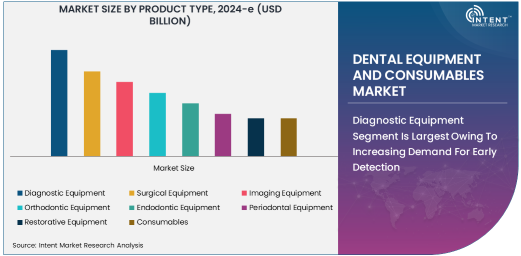
Diagnostic Equipment Segment Is Largest Owing To Increasing Demand For Early Detection
Diagnostic equipment is the largest segment in the dental equipment market. This category includes tools essential for diagnosing dental conditions, such as X-ray systems, intraoral cameras, and digital radiography systems. The rise in preventive healthcare and the increasing adoption of early diagnostic techniques are key drivers for the growth of this segment. With innovations in digital radiography, dentists can now provide quicker, more accurate diagnoses, leading to faster treatments. As early detection of oral diseases like cavities, gum disease, and oral cancer becomes more vital, the demand for advanced diagnostic equipment continues to surge.
The growing focus on patient safety and reduced radiation exposure also contributes to the dominance of digital diagnostic equipment. Products such as intraoral sensors and cone beam CT scanners are gaining traction due to their ability to capture high-resolution images with minimal discomfort for patients. As more dental clinics and hospitals invest in modern diagnostic tools, this segment is expected to maintain its lead in the dental equipment and consumables market.
Surgical Equipment Segment Is Fastest Growing Owing To Rising Surgical Interventions
The surgical equipment segment is the fastest-growing area in the dental market, driven by the increasing number of dental surgeries being performed globally. Procedures such as dental implants, root canal treatments, and oral surgeries require specialized surgical tools. The demand for more advanced, precise, and minimally invasive surgical equipment is increasing as dental practices strive for enhanced treatment outcomes and patient comfort. Surgical kits, hand instruments, and tools like dental lasers are among the fastest-growing products in this category.
The rise in cosmetic dental surgeries and oral rehabilitation treatments, coupled with the growth of the geriatric population requiring more complex procedures, further drives the growth of surgical equipment. Laser-based surgical devices, in particular, are seeing robust demand for their ability to perform non-invasive surgeries with reduced pain and recovery time. As the industry evolves, technological advancements in surgical instruments will continue to contribute to the rapid expansion of this segment.
End-User Industry in Dental Clinics Is Largest Owing To High Demand for Routine Care
Dental clinics represent the largest end-user industry in the dental equipment and consumables market. With the increasing prevalence of oral diseases and a growing awareness of dental hygiene, dental clinics remain the primary point of care for most patients. The expansion of these clinics and the rise in dental professionals offering a wide range of treatments drive the demand for both equipment and consumables. From routine check-ups to specialized treatments, dental clinics are equipped with diagnostic tools, surgical instruments, and restorative devices, ensuring comprehensive care for patients.
Additionally, the increasing focus on cosmetic dentistry, orthodontics, and periodontics further boosts the demand for specialized dental equipment within these clinics. As dental care becomes more accessible in both developed and emerging economies, the demand from dental clinics for advanced equipment will continue to lead the market in terms of volume.
Application Segment in Diagnostic Applications Is Largest Owing To Demand for Early Disease Detection
The diagnostic applications segment is the largest within the overall dental applications category. As patients and healthcare providers increasingly prioritize preventive care and early disease detection, diagnostic tools like X-rays, intraoral cameras, and digital radiography systems are in high demand. Diagnostic procedures are essential for detecting issues such as cavities, gum diseases, and more severe conditions like oral cancer before they become critical, enabling timely intervention and better patient outcomes.
Diagnostic tools are integral to the routine dental check-ups that many patients undergo, as well as for emergency assessments. With the continuous development of digital imaging technologies that allow for higher precision and lower radiation exposure, diagnostic applications are likely to remain the largest and most essential area within the dental market.
Digital Technology Segment Is Fastest Growing Owing To Shift Toward Precision and Efficiency
The digital technology segment is the fastest growing within the dental equipment and consumables market. Digital tools, including digital X-rays, CAD/CAM systems, and 3D imaging technologies, have revolutionized dental practices by providing higher precision, speed, and patient comfort. These technologies enable faster diagnosis, more accurate treatment planning, and improved patient outcomes. With the increasing affordability and accessibility of digital dental tools, more dental clinics are adopting these technologies to enhance their service offerings.
Additionally, digital technology reduces human error, increases workflow efficiency, and provides dentists with advanced treatment options such as virtual treatment simulations. As dental professionals embrace these innovations, the digital segment is expected to continue growing rapidly, further transforming the landscape of dental care.
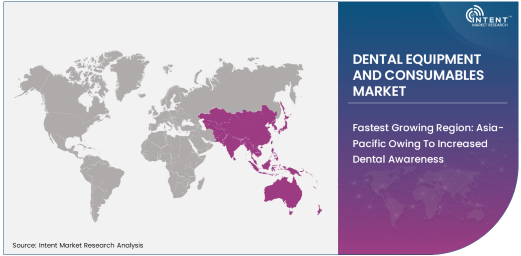
Fastest Growing Region: Asia-Pacific Owing To Increased Dental Awareness
The Asia-Pacific region is the fastest growing in the global dental equipment and consumables market. This growth is largely attributed to the expanding middle class in countries such as China, India, and Japan, where increasing disposable income and a heightened awareness of dental health are driving demand for dental products and services. The region's growing population, coupled with rising government investments in healthcare infrastructure, presents significant opportunities for market growth.
In addition, there is a marked shift toward cosmetic and orthodontic dental procedures in these countries, further fueling the demand for dental equipment. As the dental industry becomes more accessible and affordable in emerging markets, the Asia-Pacific region is expected to lead global growth in the coming years.
Leading Companies and Competitive Landscape
The global dental equipment and consumables market is highly competitive, with several leading players dominating various segments. Dentsply Sirona, Henry Schein, Danaher Corporation, 3M, and Planmeca are among the top players shaping the industry's direction. These companies offer a wide range of dental products and solutions, from diagnostic equipment and surgical tools to consumables and digital technologies. Their continued investment in research and development, along with strategic acquisitions, allows them to maintain a strong market presence.
The competitive landscape also includes a growing number of regional and specialized players focusing on specific dental technologies, such as 3D imaging systems and laser-based equipment. Innovation, technological advancements, and expansion into emerging markets will remain key factors that influence the competition in this sector. As dental care becomes more technologically advanced, these companies will continue to drive the evolution of the dental equipment and consumables market.
Recent Developments:
- Dentsply Sirona announced the launch of its new CEREC Primemill, a highly efficient dental milling machine designed to streamline restorative procedures.
- Henry Schein acquired Biolase, expanding its range of laser dentistry equipment and enhancing its portfolio in the dental equipment space.
- 3M received FDA approval for its 3M™ True Definition Scanner, a state-of-the-art intraoral scanner for accurate digital impressions.
- Danaher Corporation launched an upgraded version of its KaVo Kerr imaging system, featuring enhanced resolution and faster diagnostics for dental professionals.
- Ivoclar Vivadent launched a new line of Nano-Hybrid Restorative Materials for aesthetic and durable dental fillings, further expanding its product offerings in restorative dentistry
List of Leading Companies:
- Dentsply Sirona
- Henry Schein
- 3M
- Danaher Corporation
- Planmeca
- A-Dec
- KaVo Kerr
- Ivoclar Vivadent
- Straumann
- Coltene
- Sirona Dental Systems
- GE Healthcare
- Carestream Health
- Zimmer Biomet
- Medtronic
Report Scope:
|
Report Features |
Description |
|
Market Size (2024-e) |
USD 36.0 Billion |
|
Forecasted Value (2030) |
USD 60.0 Billion |
|
CAGR (2025 – 2030) |
7.6% |
|
Base Year for Estimation |
2024-e |
|
Historic Year |
2023 |
|
Forecast Period |
2025 – 2030 |
|
Report Coverage |
Market Forecast, Market Dynamics, Competitive Landscape, Recent Developments |
|
Segments Covered |
Dental Equipment and Consumables Market By Product Type (Diagnostic Equipment, Surgical Equipment, Imaging Equipment, Orthodontic Equipment, Endodontic Equipment, Periodontal Equipment, Restorative Equipment, Consumables), By End-User Industry (Dental Clinics, Hospitals, Dental Laboratories, Research Institutions, Dental Academies), By Application (Diagnostic Applications, Surgical Applications, Cosmetic Dentistry, Orthodontics, Periodontics, Restorative Dentistry), and By Technology (Digital, Analog, Laser-Based Technology, Computer-Assisted Navigation) |
|
Regional Analysis |
North America (US, Canada, Mexico), Europe (Germany, France, UK, Italy, Spain, and Rest of Europe), Asia-Pacific (China, Japan, South Korea, Australia, India, and Rest of Asia-Pacific), Latin America (Brazil, Argentina, and Rest of Latin America), Middle East & Africa (Saudi Arabia, UAE, Rest of Middle East & Africa) |
|
Major Companies |
Dentsply Sirona, Henry Schein, 3M, Danaher Corporation, Planmeca, A-Dec, KaVo Kerr, Ivoclar Vivadent, Straumann, Coltene, Sirona Dental Systems, GE Healthcare, Carestream Health, Zimmer Biomet, Medtronic |
|
Customization Scope |
Customization for segments, region/country-level will be provided. Moreover, additional customization can be done based on the requirements |
|
1. Introduction |
|
1.1. Market Definition |
|
1.2. Scope of the Study |
|
1.3. Research Assumptions |
|
1.4. Study Limitations |
|
2. Research Methodology |
|
2.1. Research Approach |
|
2.1.1. Top-Down Method |
|
2.1.2. Bottom-Up Method |
|
2.1.3. Factor Impact Analysis |
|
2.2. Insights & Data Collection Process |
|
2.2.1. Secondary Research |
|
2.2.2. Primary Research |
|
2.3. Data Mining Process |
|
2.3.1. Data Analysis |
|
2.3.2. Data Validation and Revalidation |
|
2.3.3. Data Triangulation |
|
3. Executive Summary |
|
3.1. Major Markets & Segments |
|
3.2. Highest Growing Regions and Respective Countries |
|
3.3. Impact of Growth Drivers & Inhibitors |
|
3.4. Regulatory Overview by Country |
|
4. Dental Equipment and Consumables Market, by Product Type (Market Size & Forecast: USD Million, 2023 – 2030) |
|
4.1. Diagnostic Equipment |
|
4.2. Surgical Equipment |
|
4.3. Imaging Equipment |
|
4.4. Orthodontic Equipment |
|
4.5. Endodontic Equipment |
|
4.6. Periodontal Equipment |
|
4.7. Restorative Equipment |
|
4.8. Consumables |
|
5. Dental Equipment and Consumables Market, by End-User Industry (Market Size & Forecast: USD Million, 2023 – 2030) |
|
5.1. Dental Clinics |
|
5.2. Hospitals |
|
5.3. Dental Laboratories |
|
5.4. Research Institutions |
|
5.5. Dental Academies |
|
6. Dental Equipment and Consumables Market, by Application (Market Size & Forecast: USD Million, 2023 – 2030) |
|
6.1. Diagnostic Applications |
|
6.2. Surgical Applications |
|
6.3. Cosmetic Dentistry |
|
6.4. Orthodontics |
|
6.5. Periodontics |
|
6.6. Restorative Dentistry |
|
7. Dental Equipment and Consumables Market, by Technology (Market Size & Forecast: USD Million, 2023 – 2030) |
|
7.1. Digital |
|
7.2. Analog |
|
7.3. Laser-Based Technology |
|
7.4. Computer-Assisted Navigation |
|
8. Regional Analysis (Market Size & Forecast: USD Million, 2023 – 2030) |
|
8.1. Regional Overview |
|
8.2. North America |
|
8.2.1. Regional Trends & Growth Drivers |
|
8.2.2. Barriers & Challenges |
|
8.2.3. Opportunities |
|
8.2.4. Factor Impact Analysis |
|
8.2.5. Technology Trends |
|
8.2.6. North America Dental Equipment and Consumables Market, by Product Type |
|
8.2.7. North America Dental Equipment and Consumables Market, by End-User Industry |
|
8.2.8. North America Dental Equipment and Consumables Market, by Application |
|
8.2.9. North America Dental Equipment and Consumables Market, by Technology |
|
8.2.10. By Country |
|
8.2.10.1. US |
|
8.2.10.1.1. US Dental Equipment and Consumables Market, by Product Type |
|
8.2.10.1.2. US Dental Equipment and Consumables Market, by End-User Industry |
|
8.2.10.1.3. US Dental Equipment and Consumables Market, by Application |
|
8.2.10.1.4. US Dental Equipment and Consumables Market, by Technology |
|
8.2.10.2. Canada |
|
8.2.10.3. Mexico |
|
*Similar segmentation will be provided for each region and country |
|
8.3. Europe |
|
8.4. Asia-Pacific |
|
8.5. Latin America |
|
8.6. Middle East & Africa |
|
9. Competitive Landscape |
|
9.1. Overview of the Key Players |
|
9.2. Competitive Ecosystem |
|
9.2.1. Level of Fragmentation |
|
9.2.2. Market Consolidation |
|
9.2.3. Product Innovation |
|
9.3. Company Share Analysis |
|
9.4. Company Benchmarking Matrix |
|
9.4.1. Strategic Overview |
|
9.4.2. Product Innovations |
|
9.5. Start-up Ecosystem |
|
9.6. Strategic Competitive Insights/ Customer Imperatives |
|
9.7. ESG Matrix/ Sustainability Matrix |
|
9.8. Manufacturing Network |
|
9.8.1. Locations |
|
9.8.2. Supply Chain and Logistics |
|
9.8.3. Product Flexibility/Customization |
|
9.8.4. Digital Transformation and Connectivity |
|
9.8.5. Environmental and Regulatory Compliance |
|
9.9. Technology Readiness Level Matrix |
|
9.10. Technology Maturity Curve |
|
9.11. Buying Criteria |
|
10. Company Profiles |
|
10.1. Dentsply Sirona |
|
10.1.1. Company Overview |
|
10.1.2. Company Financials |
|
10.1.3. Product/Service Portfolio |
|
10.1.4. Recent Developments |
|
10.1.5. IMR Analysis |
|
*Similar information will be provided for other companies |
|
10.2. Henry Schein |
|
10.3. 3M |
|
10.4. Danaher Corporation |
|
10.5. Planmeca |
|
10.6. A-Dec |
|
10.7. KaVo Kerr |
|
10.8. Ivoclar Vivadent |
|
10.9. Straumann |
|
10.10. Coltene |
|
10.11. Sirona Dental Systems |
|
10.12. GE Healthcare |
|
10.13. Carestream Health |
|
10.14. Zimmer Biomet |
|
10.15. Medtronic |
|
11. Appendix |
A comprehensive market research approach was employed to gather and analyze data on the Dental Equipment and Consumables Market. In the process, the analysis was also done to analyze the parent market and relevant adjacencies to measure the impact of them on the Dental Equipment and Consumables Market. The research methodology encompassed both secondary and primary research techniques, ensuring the accuracy and credibility of the findings.
.jpg)
Secondary Research
Secondary research involved a thorough review of pertinent industry reports, journals, articles, and publications. Additionally, annual reports, press releases, and investor presentations of industry players were scrutinized to gain insights into their market positioning and strategies.
Primary Research
Primary research involved conducting in-depth interviews with industry experts, stakeholders, and market participants across the E-Waste Management ecosystem. The primary research objectives included:
- Validating findings and assumptions derived from secondary research
- Gathering qualitative and quantitative data on market trends, drivers, and challenges
- Understanding the demand-side dynamics, encompassing end-users, component manufacturers, facility providers, and service providers
- Assessing the supply-side landscape, including technological advancements and recent developments
Market Size Assessment
A combination of top-down and bottom-up approaches was utilized to analyze the overall size of the Dental Equipment and Consumables Market. These methods were also employed to assess the size of various subsegments within the market. The market size assessment methodology encompassed the following steps:
- Identification of key industry players and relevant revenues through extensive secondary research
- Determination of the industry's supply chain and market size, in terms of value, through primary and secondary research processes
- Calculation of percentage shares, splits, and breakdowns using secondary sources and verification through primary sources
.jpg)
Data Triangulation
To ensure the accuracy and reliability of the market size, data triangulation was implemented. This involved cross-referencing data from various sources, including demand and supply side factors, market trends, and expert opinions. Additionally, top-down and bottom-up approaches were employed to validate the market size assessment.
NA