
As per Intent Market Research, the Dental Emergency Kit Market was valued at USD 0.4 Billion in 2024-e and will surpass USD 0.8 Billion by 2030; growing at a CAGR of 10.7% during 2025-2030.
The dental emergency kit market is integral to managing dental injuries and providing immediate care for trauma, tooth displacement, and other urgent dental needs. These kits are essential in a variety of settings, ranging from dental clinics to emergency medical services, allowing for rapid intervention until patients can receive professional care. The market is seeing steady growth, driven by the increasing awareness of dental health and the rising number of dental accidents globally. Dental emergency kits are becoming increasingly sophisticated, with customized options available to cater to the unique needs of different institutions and regions.
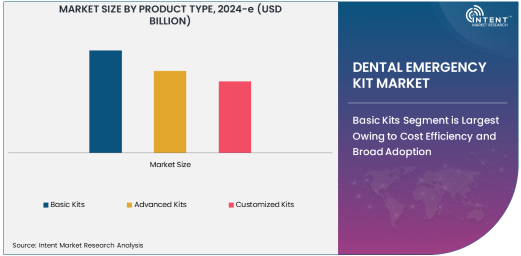
Basic Kits Segment is Largest Owing to Cost Efficiency and Broad Adoption
Among the various product types in the dental emergency kit market, Basic Kits dominate due to their cost-efficiency and widespread adoption, especially in dental clinics and emergency care centers. These kits typically include essential items such as pain relievers, gauze, and temporary filling materials, allowing practitioners to stabilize dental injuries in the short term. Basic kits are often preferred in settings where cost constraints are a significant factor, yet a reliable level of care is required. They are ideal for general use and cater to the immediate needs of most dental trauma cases, thus forming a large share of the overall market.
The popularity of basic kits is also fueled by their ability to cater to a wide range of dental injuries, including minor fractures, toothaches, and mild displacements. Their affordability and simplicity make them a staple in many dental emergency settings, ensuring they remain the largest segment in the market. As a result, manufacturers are constantly innovating within this subsegment to offer practical solutions that are easy to use, durable, and effective for a range of dental emergencies.
Emergency Medical Services Segment is Fastest Growing Due to Rising Demand for On-Site Care
The Emergency Medical Services (EMS) segment is the fastest-growing within the end-user industry category. This growth is attributed to the increasing number of dental emergencies occurring in outdoor and high-risk environments, where immediate on-site care is critical. EMS teams often need dental emergency kits to address injuries sustained in accidents or traumatic events, such as sports injuries or traffic accidents. As awareness of the need for immediate dental care grows, EMS providers are more frequently incorporating dental emergency kits into their standard medical equipment.
Moreover, the shift toward mobile healthcare services and the increasing deployment of paramedics and mobile clinics in remote areas are contributing to the growing demand for EMS-specific dental kits. The need for fast intervention in traumatic dental injuries to prevent further damage or infections has driven this market’s rapid expansion. Consequently, EMS teams are increasingly investing in specialized kits that can handle a broad spectrum of dental emergencies in diverse environments.
Online Sales Channel is Growing Rapidly as Consumers Seek Convenience
The Online Sales channel is witnessing the most rapid growth in the distribution of dental emergency kits. Consumers, including dental professionals and institutions, are increasingly turning to online platforms to purchase dental kits due to the convenience, broader product selection, and competitive pricing. E-commerce platforms allow for easy comparison of prices, specifications, and user reviews, making it easier for buyers to choose the right kit for their needs.
As the global adoption of e-commerce continues to rise, dental emergency kit manufacturers and distributors are expanding their online presence to cater to this growing demand. The ability to directly reach consumers and institutions has made online sales the fastest-growing distribution channel. In addition, online sales allow for easier restocking and timely deliveries, ensuring that dental kits are readily available for emergencies.
Trauma and Injury Management Application is Largest Due to Prevalence of Dental Injuries
The Trauma and Injury Management application is the largest in the dental emergency kit market, driven by the high frequency of dental injuries. From accidents and falls to sports injuries, trauma is one of the most common causes of dental emergencies. As such, dental emergency kits are often tailored to provide immediate relief for trauma-related injuries, offering tools and medications to stabilize the patient until they can be treated by a professional. These kits typically include items for controlling bleeding, relieving pain, and temporarily managing tooth displacement, ensuring that patients receive appropriate care in the critical first moments after injury.
The importance of trauma management has led to the widespread adoption of dental emergency kits by both professional and emergency medical settings, further driving growth in this application segment. Additionally, the focus on preventative care and better management of dental trauma cases in hospitals and dental clinics is contributing to the expansion of this market segment.
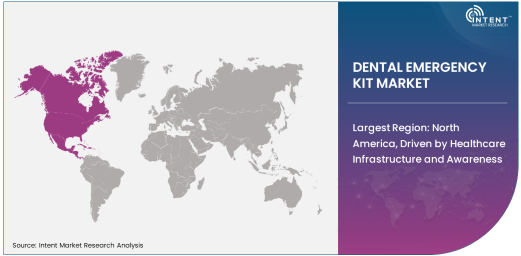
Largest Region: North America, Driven by Healthcare Infrastructure and Awareness
North America remains the largest region in the dental emergency kit market, with the U.S. and Canada leading the charge. The region's well-established healthcare infrastructure, high awareness levels regarding dental health, and widespread access to dental care make it the largest market for these products. Moreover, the high incidence of dental injuries in this region, especially in sports and road traffic accidents, increases the demand for dental emergency kits. North America also benefits from a strong network of dental clinics, hospitals, and emergency medical services, all of which require these kits for effective trauma and injury management.
In addition, technological advancements and the growing trend of customized kits tailored to specific patient needs in the U.S. have contributed significantly to the market's expansion. The region's strong e-commerce platform further supports the growth of online sales, making dental emergency kits easily accessible to professionals and individuals alike.
Competitive Landscape and Leading Companies
The dental emergency kit market is competitive, with several global and regional players involved in the production and distribution of these essential healthcare products. Leading companies in this market include Henry Schein, Dentsply Sirona, 3M, Coltene Holding AG, and Medline Industries. These companies focus on continuous innovation, ensuring that their products cater to the ever-evolving needs of dental professionals and emergency medical services.
The market is characterized by the introduction of new product features, such as customizable kits and enhanced portability, to meet the demands of various end-users. Competitive strategies include mergers and acquisitions, partnerships with healthcare providers, and expanding online sales channels. These companies are investing in R&D to improve the functionality and accessibility of dental emergency kits, ensuring they can offer the most effective solutions in trauma care. Additionally, regulatory compliance and adherence to quality standards are critical factors that shape the competitive dynamics of the market
Recent Developments:
- Henry Schein has launched a new line of advanced dental emergency kits designed to cater to a broader range of dental trauma and urgent care needs, enhancing response times and patient care.
- 3M announced the acquisition of a key dental supplies distributor to expand its portfolio, focusing on dental emergency products to increase market share in the U.S. and Canada.
- Dentsply Sirona unveiled its latest dental emergency kit aimed at providing immediate pain relief and injury management in critical situations, catering to clinics and hospitals.
- A-Dec Inc. introduced a more compact and portable dental emergency kit targeted at emergency medical responders and remote healthcare units, simplifying on-site care.
- Medline Industries received FDA approval for its new line of dental emergency kits designed for use in hospitals and emergency rooms, featuring advanced materials and enhanced storage options.
List of Leading Companies:
- Henry Schein
- Dentsply Sirona
- 3M
- Coltene Holding AG
- KaVo Kerr
- Medline Industries
- BD (Becton Dickinson)
- A-Dec Inc.
- Soredex
- Planmeca Oy
- Bracon Ltd
- Dental Creations
- Swedish Ortopedics
- Tampax
- Crest
Report Scope:
|
Report Features |
Description |
|
Market Size (2024-e) |
USD 0.4 Billion |
|
Forecasted Value (2030) |
USD 0.8 Billion |
|
CAGR (2025 – 2030) |
10.7% |
|
Base Year for Estimation |
2024-e |
|
Historic Year |
2023 |
|
Forecast Period |
2025 – 2030 |
|
Report Coverage |
Market Forecast, Market Dynamics, Competitive Landscape, Recent Developments |
|
Segments Covered |
Dental Emergency Kit by Product Type (Basic Kits, Advanced Kits, Customized Kits), End-User Industry (Dental Clinics, Hospitals, Emergency Medical Services, Research Institutions), Distribution Channel (Online Sales, Retail Sales, Direct Sales), and Application (Trauma and Injury Management, Tooth Displacement Treatment, Pain Management) |
|
Regional Analysis |
North America (US, Canada, Mexico), Europe (Germany, France, UK, Italy, Spain, and Rest of Europe), Asia-Pacific (China, Japan, South Korea, Australia, India, and Rest of Asia-Pacific), Latin America (Brazil, Argentina, and Rest of Latin America), Middle East & Africa (Saudi Arabia, UAE, Rest of Middle East & Africa) |
|
Major Companies |
Henry Schein, Dentsply Sirona, 3M, Coltene Holding AG, KaVo Kerr, Medline Industries, BD (Becton Dickinson), A-Dec Inc., Soredex, Planmeca Oy, Bracon Ltd, Dental Creations, Swedish Ortopedics, Tampax, Crest |
|
Customization Scope |
Customization for segments, region/country-level will be provided. Moreover, additional customization can be done based on the requirements |
|
1. Introduction |
|
1.1. Market Definition |
|
1.2. Scope of the Study |
|
1.3. Research Assumptions |
|
1.4. Study Limitations |
|
2. Research Methodology |
|
2.1. Research Approach |
|
2.1.1. Top-Down Method |
|
2.1.2. Bottom-Up Method |
|
2.1.3. Factor Impact Analysis |
|
2.2. Insights & Data Collection Process |
|
2.2.1. Secondary Research |
|
2.2.2. Primary Research |
|
2.3. Data Mining Process |
|
2.3.1. Data Analysis |
|
2.3.2. Data Validation and Revalidation |
|
2.3.3. Data Triangulation |
|
3. Executive Summary |
|
3.1. Major Markets & Segments |
|
3.2. Highest Growing Regions and Respective Countries |
|
3.3. Impact of Growth Drivers & Inhibitors |
|
3.4. Regulatory Overview by Country |
|
4. Dental Emergency Kit Market, by Product Type (Market Size & Forecast: USD Million, 2023 – 2030) |
|
4.1. Basic Kits |
|
4.2. Advanced Kits |
|
4.3. Customized Kits |
|
5. Dental Emergency Kit Market, by End-User Industry (Market Size & Forecast: USD Million, 2023 – 2030) |
|
5.1. Dental Clinics |
|
5.2. Hospitals |
|
5.3. Emergency Medical Services |
|
5.4. Research Institutions |
|
6. Dental Emergency Kit Market, by Distribution Channel (Market Size & Forecast: USD Million, 2023 – 2030) |
|
6.1. Online Sales |
|
6.2. Retail Sales |
|
6.3. Direct Sales |
|
7. Dental Emergency Kit Market, by Application (Market Size & Forecast: USD Million, 2023 – 2030) |
|
7.1. Trauma and Injury Management |
|
7.2. Tooth Displacement Treatment |
|
7.3. Pain Management |
|
7.4. Others |
|
8. Regional Analysis (Market Size & Forecast: USD Million, 2023 – 2030) |
|
8.1. Regional Overview |
|
8.2. North America |
|
8.2.1. Regional Trends & Growth Drivers |
|
8.2.2. Barriers & Challenges |
|
8.2.3. Opportunities |
|
8.2.4. Factor Impact Analysis |
|
8.2.5. Technology Trends |
|
8.2.6. North America Dental Emergency Kit Market, by Product Type |
|
8.2.7. North America Dental Emergency Kit Market, by End-User Industry |
|
8.2.8. North America Dental Emergency Kit Market, by Distribution Channel |
|
8.2.9. North America Dental Emergency Kit Market, by Application |
|
8.2.10. By Country |
|
8.2.10.1. US |
|
8.2.10.1.1. US Dental Emergency Kit Market, by Product Type |
|
8.2.10.1.2. US Dental Emergency Kit Market, by End-User Industry |
|
8.2.10.1.3. US Dental Emergency Kit Market, by Distribution Channel |
|
8.2.10.1.4. US Dental Emergency Kit Market, by Application |
|
8.2.10.2. Canada |
|
8.2.10.3. Mexico |
|
*Similar segmentation will be provided for each region and country |
|
8.3. Europe |
|
8.4. Asia-Pacific |
|
8.5. Latin America |
|
8.6. Middle East & Africa |
|
9. Competitive Landscape |
|
9.1. Overview of the Key Players |
|
9.2. Competitive Ecosystem |
|
9.2.1. Level of Fragmentation |
|
9.2.2. Market Consolidation |
|
9.2.3. Product Innovation |
|
9.3. Company Share Analysis |
|
9.4. Company Benchmarking Matrix |
|
9.4.1. Strategic Overview |
|
9.4.2. Product Innovations |
|
9.5. Start-up Ecosystem |
|
9.6. Strategic Competitive Insights/ Customer Imperatives |
|
9.7. ESG Matrix/ Sustainability Matrix |
|
9.8. Manufacturing Network |
|
9.8.1. Locations |
|
9.8.2. Supply Chain and Logistics |
|
9.8.3. Product Flexibility/Customization |
|
9.8.4. Digital Transformation and Connectivity |
|
9.8.5. Environmental and Regulatory Compliance |
|
9.9. Technology Readiness Level Matrix |
|
9.10. Technology Maturity Curve |
|
9.11. Buying Criteria |
|
10. Company Profiles |
|
10.1. Henry Schein |
|
10.1.1. Company Overview |
|
10.1.2. Company Financials |
|
10.1.3. Product/Service Portfolio |
|
10.1.4. Recent Developments |
|
10.1.5. IMR Analysis |
|
*Similar information will be provided for other companies |
|
10.2. Dentsply Sirona |
|
10.3. 3M |
|
10.4. Coltene Holding AG |
|
10.5. KaVo Kerr |
|
10.6. Medline Industries |
|
10.7. BD (Becton Dickinson) |
|
10.8. A-Dec Inc. |
|
10.9. Soredex |
|
10.10. Planmeca Oy |
|
10.11. Bracon Ltd |
|
10.12. Dental Creations |
|
10.13. Swedish Ortopedics |
|
10.14. Tampax |
|
10.15. Crest |
|
11. Appendix |
A comprehensive market research approach was employed to gather and analyze data on the Dental Emergency Kit Market. In the process, the analysis was also done to analyze the parent market and relevant adjacencies to measure the impact of them on the Dental Emergency Kit Market. The research methodology encompassed both secondary and primary research techniques, ensuring the accuracy and credibility of the findings.
.jpg)
Secondary Research
Secondary research involved a thorough review of pertinent industry reports, journals, articles, and publications. Additionally, annual reports, press releases, and investor presentations of industry players were scrutinized to gain insights into their market positioning and strategies.
Primary Research
Primary research involved conducting in-depth interviews with industry experts, stakeholders, and market participants across the E-Waste Management ecosystem. The primary research objectives included:
- Validating findings and assumptions derived from secondary research
- Gathering qualitative and quantitative data on market trends, drivers, and challenges
- Understanding the demand-side dynamics, encompassing end-users, component manufacturers, facility providers, and service providers
- Assessing the supply-side landscape, including technological advancements and recent developments
Market Size Assessment
A combination of top-down and bottom-up approaches was utilized to analyze the overall size of the Dental Emergency Kit Market. These methods were also employed to assess the size of various subsegments within the market. The market size assessment methodology encompassed the following steps:
- Identification of key industry players and relevant revenues through extensive secondary research
- Determination of the industry's supply chain and market size, in terms of value, through primary and secondary research processes
- Calculation of percentage shares, splits, and breakdowns using secondary sources and verification through primary sources
.jpg)
Data Triangulation
To ensure the accuracy and reliability of the market size, data triangulation was implemented. This involved cross-referencing data from various sources, including demand and supply side factors, market trends, and expert opinions. Additionally, top-down and bottom-up approaches were employed to validate the market size assessment.
NA