
As per Intent Market Research, the Dental Biomaterials Market was valued at USD 1.6 billion in 2024-e and will surpass USD 2.5 billion by 2030; growing at a CAGR of 8.0% during 2025 - 2030.
The dental biomaterials market is witnessing robust growth, driven by the increasing prevalence of dental disorders and the rising demand for advanced dental restorative solutions. Biomaterials, known for their biocompatibility and superior performance, are extensively used in restorative, prosthetic, and orthodontic applications. The market's expansion is fueled by the growing awareness of dental aesthetics and the adoption of minimally invasive procedures.
Technological advancements, such as nanotechnology-based biomaterials and innovative fabrication methods, have further enhanced the functional properties of dental biomaterials, boosting their adoption. Moreover, the rise in dental tourism, particularly in developing regions, has significantly contributed to market growth.
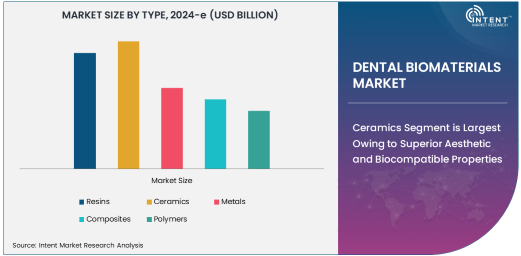
Ceramics Segment is Largest Owing to Superior Aesthetic and Biocompatible Properties
The ceramics segment holds the largest share in the type category, driven by its superior aesthetic appeal and high biocompatibility. Ceramic biomaterials are extensively used for crowns, bridges, and veneers due to their natural tooth-like appearance and durability.
The growing demand for cosmetic dentistry, coupled with advancements in ceramic materials like zirconia and lithium disilicate, has propelled this segment. Additionally, ceramics are preferred for their resistance to staining and corrosion, making them ideal for long-term dental applications. Their widespread adoption in both restorative and prosthetic dentistry underpins their market dominance.
Restorative Dentistry is Fastest Owing to Increasing Demand for Tooth Repair
Restorative dentistry is the fastest-growing application segment, fueled by the rising prevalence of tooth decay, fractures, and wear. The segment encompasses a range of procedures aimed at restoring the functionality and appearance of damaged teeth, making it a critical focus area for dental professionals.
Innovative biomaterials, such as resin composites and glass ionomers, have significantly improved the success rate of restorative procedures. The segment also benefits from the growing aging population, which is more prone to dental issues, and the increasing adoption of digital technologies for precise restorations.
Powders Segment Leads Owing to Versatile Usage
Among forms, powders dominate the market due to their versatile usage in creating customized dental solutions. Powders are widely used in the fabrication of dental implants, crowns, and inlays, offering flexibility in material preparation and application.
The segment's growth is bolstered by the adoption of 3D printing technology, which utilizes biomaterial powders to produce high-precision dental structures. Their ease of storage, extended shelf life, and ability to blend with other materials further enhance their appeal in the dental industry.
Dental Laboratories Segment is Fastest Owing to Rising Outsourcing Trends
Dental laboratories are the fastest-growing end-use segment, driven by the rising trend of outsourcing complex dental procedures. Laboratories specialize in fabricating high-quality dental prosthetics and restorations, leveraging advanced biomaterials and cutting-edge technologies.
This segment's growth is also fueled by the increasing preference for custom-made dental solutions, which require precision and expertise. Collaboration between dental clinics and laboratories has become more prevalent, enabling faster turnaround times and enhanced patient satisfaction.
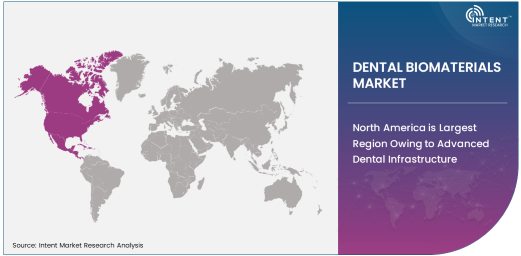
North America is Largest Region Owing to Advanced Dental Infrastructure
North America leads the dental biomaterials market, attributed to its advanced dental care infrastructure and high adoption of innovative technologies. The region boasts a large number of skilled dental professionals and well-equipped dental clinics, driving the demand for high-performance biomaterials.
The presence of key market players, coupled with robust research and development activities, further cements North America's dominance. Additionally, the high disposable income and increasing awareness of dental health contribute to the region's market leadership.
Competitive Landscape and Leading Companies
The dental biomaterials market is highly competitive, with major players focusing on innovation and strategic collaborations to gain a competitive edge. Companies like Dentsply Sirona, Ivoclar Vivadent, and 3M dominate the market, offering a wide range of biomaterials tailored to diverse applications.
Emerging players are introducing cost-effective and eco-friendly biomaterials, catering to the growing demand for sustainable solutions. The competitive landscape is characterized by rapid advancements, such as bioactive materials and smart biomaterials, which are poised to shape the future of dental care.
Recent Developments:
- In December 2024, Dentsply Sirona launched a new bioactive dental composite, designed to release minerals that enhance tooth remineralization and reduce post-operative sensitivity.
- In November 2024, 3M introduced a new line of dental ceramics for crowns and bridges, offering improved durability and aesthetics compared to traditional materials.
- In October 2024, Ivoclar Vivadent expanded its product portfolio by adding a high-strength composite resin designed for use in orthodontic applications.
- In September 2024, Kuraray Noritake Dental unveiled an advanced adhesive system, aimed at providing better bonding strength and longevity for dental restorations.
- In August 2024, GC Corporation launched a new generation of dental implants, incorporating bioactive materials to support faster healing and improved osseointegration.
List of Leading Companies:
- Dentsply Sirona
- 3M
- Ivoclar Vivadent
- Kuraray Noritake Dental
- Straumann Group
- Henry Schein
- Coltene
- GC Corporation
- Zimmer Biomet
- Shofu Dental Corporation
- Mitsui Chemicals
- Voco GmbH
- Heraeus Kulzer
- BISCO Dental
- DenMat Holdings LLC
Report Scope:
|
Report Features |
Description |
|
Market Size (2024-e) |
USD 1.6 billion |
|
Forecasted Value (2030) |
USD 2.5 billion |
|
CAGR (2025 – 2030) |
8.0% |
|
Base Year for Estimation |
2024-e |
|
Historic Year |
2023 |
|
Forecast Period |
2025 – 2030 |
|
Report Coverage |
Market Forecast, Market Dynamics, Competitive Landscape, Recent Developments |
|
Segments Covered |
Dental Biomaterials Market By Type (Resins, Ceramics, Metals, Composites, Polymers), By Application (Restorative Dentistry, Prosthetic Dentistry, Orthodontics, Periodontics), By Form (Powders, Pastes, Gels), By End-Use (Dental Clinics, Dental Laboratories, Hospitals) |
|
Regional Analysis |
North America (US, Canada, Mexico), Europe (Germany, France, UK, Italy, Spain, and Rest of Europe), Asia-Pacific (China, Japan, South Korea, Australia, India, and Rest of Asia-Pacific), Latin America (Brazil, Argentina, and Rest of Latin America), Middle East & Africa (Saudi Arabia, UAE, Rest of Middle East & Africa) |
|
Major Companies |
Dentsply Sirona, 3M, Ivoclar Vivadent, Kuraray Noritake Dental, Straumann Group, Henry Schein, Coltene, GC Corporation, Zimmer Biomet, Shofu Dental Corporation, Mitsui Chemicals, Voco GmbH, Heraeus Kulzer, BISCO Dental, DenMat Holdings LLC |
|
Customization Scope |
Customization for segments, region/country-level will be provided. Moreover, additional customization can be done based on the requirements |
|
1. Introduction |
|
1.1. Market Definition |
|
1.2. Scope of the Study |
|
1.3. Research Assumptions |
|
1.4. Study Limitations |
|
2. Research Methodology |
|
2.1. Research Approach |
|
2.1.1. Top-Down Method |
|
2.1.2. Bottom-Up Method |
|
2.1.3. Factor Impact Analysis |
|
2.2. Insights & Data Collection Process |
|
2.2.1. Secondary Research |
|
2.2.2. Primary Research |
|
2.3. Data Mining Process |
|
2.3.1. Data Analysis |
|
2.3.2. Data Validation and Revalidation |
|
2.3.3. Data Triangulation |
|
3. Executive Summary |
|
3.1. Major Markets & Segments |
|
3.2. Highest Growing Regions and Respective Countries |
|
3.3. Impact of Growth Drivers & Inhibitors |
|
3.4. Regulatory Overview by Country |
|
4. Dental Biomaterials Market, by Type (Market Size & Forecast: USD Million, 2023 – 2030) |
|
4.1. Resins |
|
4.2. Ceramics |
|
4.3. Metals |
|
4.4. Composites |
|
4.5. Polymers |
|
5. Dental Biomaterials Market, by Application (Market Size & Forecast: USD Million, 2023 – 2030) |
|
5.1. Restorative Dentistry |
|
5.2. Prosthetic Dentistry |
|
5.3. Orthodontics |
|
5.4. Periodontics |
|
6. Dental Biomaterials Market, by Form (Market Size & Forecast: USD Million, 2023 – 2030) |
|
6.1. Powders |
|
6.2. Pastes |
|
6.3. Gels |
|
7. Dental Biomaterials Market, by End-Use (Market Size & Forecast: USD Million, 2023 – 2030) |
|
7.1. Dental Clinics |
|
7.2. Dental Laboratories |
|
7.3. Hospitals |
|
8. Regional Analysis (Market Size & Forecast: USD Million, 2023 – 2030) |
|
8.1. Regional Overview |
|
8.2. North America |
|
8.2.1. Regional Trends & Growth Drivers |
|
8.2.2. Barriers & Challenges |
|
8.2.3. Opportunities |
|
8.2.4. Factor Impact Analysis |
|
8.2.5. Technology Trends |
|
8.2.6. North America Dental Biomaterials Market, by Type |
|
8.2.7. North America Dental Biomaterials Market, by Application |
|
8.2.8. North America Dental Biomaterials Market, by Form |
|
8.2.9. North America Dental Biomaterials Market, by End-Use |
|
8.2.10. By Country |
|
8.2.10.1. US |
|
8.2.10.1.1. US Dental Biomaterials Market, by Type |
|
8.2.10.1.2. US Dental Biomaterials Market, by Application |
|
8.2.10.1.3. US Dental Biomaterials Market, by Form |
|
8.2.10.1.4. US Dental Biomaterials Market, by End-Use |
|
8.2.10.2. Canada |
|
8.2.10.3. Mexico |
|
*Similar segmentation will be provided for each region and country |
|
8.3. Europe |
|
8.4. Asia-Pacific |
|
8.5. Latin America |
|
8.6. Middle East & Africa |
|
9. Competitive Landscape |
|
9.1. Overview of the Key Players |
|
9.2. Competitive Ecosystem |
|
9.2.1. Level of Fragmentation |
|
9.2.2. Market Consolidation |
|
9.2.3. Product Innovation |
|
9.3. Company Share Analysis |
|
9.4. Company Benchmarking Matrix |
|
9.4.1. Strategic Overview |
|
9.4.2. Product Innovations |
|
9.5. Start-up Ecosystem |
|
9.6. Strategic Competitive Insights/ Customer Imperatives |
|
9.7. ESG Matrix/ Sustainability Matrix |
|
9.8. Manufacturing Network |
|
9.8.1. Locations |
|
9.8.2. Supply Chain and Logistics |
|
9.8.3. Product Flexibility/Customization |
|
9.8.4. Digital Transformation and Connectivity |
|
9.8.5. Environmental and Regulatory Compliance |
|
9.9. Technology Readiness Level Matrix |
|
9.10. Technology Maturity Curve |
|
9.11. Buying Criteria |
|
10. Company Profiles |
|
10.1. Dentsply Sirona |
|
10.1.1. Company Overview |
|
10.1.2. Company Financials |
|
10.1.3. Product/Service Portfolio |
|
10.1.4. Recent Developments |
|
10.1.5. IMR Analysis |
|
*Similar information will be provided for other companies |
|
10.2. 3M |
|
10.3. Ivoclar Vivadent |
|
10.4. Kuraray Noritake Dental |
|
10.5. Straumann Group |
|
10.6. Henry Schein |
|
10.7. Coltene |
|
10.8. GC Corporation |
|
10.9. Zimmer Biomet |
|
10.10. Shofu Dental Corporation |
|
10.11. Mitsui Chemicals |
|
10.12. Voco GmbH |
|
10.13. Heraeus Kulzer |
|
10.14. BISCO Dental |
|
10.15. DenMat Holdings LLC |
|
11. Appendix |
A comprehensive market research approach was employed to gather and analyze data on the Dental Biomaterials Market. In the process, the analysis was also done to analyze the parent market and relevant adjacencies to measure the impact of them on the Dental Biomaterials Market. The research methodology encompassed both secondary and primary research techniques, ensuring the accuracy and credibility of the findings.
.jpg)
Secondary Research
Secondary research involved a thorough review of pertinent industry reports, journals, articles, and publications. Additionally, annual reports, press releases, and investor presentations of industry players were scrutinized to gain insights into their market positioning and strategies.
Primary Research
Primary research involved conducting in-depth interviews with industry experts, stakeholders, and market participants across the E-Waste Management ecosystem. The primary research objectives included:
- Validating findings and assumptions derived from secondary research
- Gathering qualitative and quantitative data on market trends, drivers, and challenges
- Understanding the demand-side dynamics, encompassing end-users, component manufacturers, facility providers, and service providers
- Assessing the supply-side landscape, including technological advancements and recent developments
Market Size Assessment
A combination of top-down and bottom-up approaches was utilized to analyze the overall size of the Dental Biomaterials Market. These methods were also employed to assess the size of various subsegments within the market. The market size assessment methodology encompassed the following steps:
- Identification of key industry players and relevant revenues through extensive secondary research
- Determination of the industry's supply chain and market size, in terms of value, through primary and secondary research processes
- Calculation of percentage shares, splits, and breakdowns using secondary sources and verification through primary sources
.jpg)
Data Triangulation
To ensure the accuracy and reliability of the market size, data triangulation was implemented. This involved cross-referencing data from various sources, including demand and supply side factors, market trends, and expert opinions. Additionally, top-down and bottom-up approaches were employed to validate the market size assessment.
NA