
As per Intent Market Research, the Decision Intelligence Market was valued at USD 13.4 Billion in 2024-e and will surpass USD 49.5 Billion by 2030; growing at a CAGR of 24.3% during 2025-2030.
The Decision Intelligence market is witnessing rapid growth as organizations increasingly leverage artificial intelligence (AI), machine learning (ML), and advanced analytics to enhance decision-making processes. By integrating data-driven insights with human expertise, Decision Intelligence solutions empower businesses to make informed and strategic decisions. This market spans multiple industries, with demand being driven by the need for real-time analytics, automation, and predictive insights.
Platform Segment is Largest Owing to Scalability and Integration Capabilities
The platform segment holds the largest share in the Decision Intelligence market, driven by its ability to integrate diverse data sources, perform complex analyses, and generate actionable insights. These platforms provide a unified interface for businesses to optimize decision-making across various functions, from finance to supply chain management. Their scalability and flexibility make them a preferred choice for enterprises seeking robust decision-support frameworks.
Companies are increasingly adopting AI-powered decision intelligence platforms that facilitate real-time data processing and automation. These platforms seamlessly integrate with existing enterprise software, enhancing business agility. The growing reliance on cloud computing and big data analytics further amplifies the adoption of decision intelligence platforms, making them a cornerstone for modern business operations.
.JPG)
Solutions Segment is Fastest Growing Due to Industry-Specific Customization
Decision Intelligence solutions are witnessing significant growth due to their ability to cater to industry-specific needs. Unlike general-purpose platforms, tailored solutions offer specialized functionalities that align with sector-specific challenges. Industries such as BFSI and healthcare are increasingly investing in customized decision intelligence solutions to enhance risk management, fraud detection, and patient care.
The demand for industry-focused AI-driven solutions is surging as companies seek precise and effective decision-making tools. Advancements in AI and predictive analytics enable solutions that provide actionable insights tailored to unique business challenges. This trend is expected to accelerate as enterprises continue to prioritize efficiency, risk mitigation, and data-driven strategies.
Cloud-Based Deployment is Leading Due to Flexibility and Cost Efficiency
Cloud-based deployment dominates the Decision Intelligence market as businesses seek scalable and cost-effective solutions. Cloud platforms offer seamless integration, remote accessibility, and real-time analytics, making them the preferred choice for enterprises across industries. The ability to deploy AI-driven decision systems without extensive infrastructure investments further fuels adoption.
With the rise of hybrid and multi-cloud strategies, organizations are leveraging cloud-based Decision Intelligence for enhanced operational agility. Cloud solutions enable rapid scalability and continuous updates, ensuring businesses stay ahead of market dynamics. The shift towards cloud-driven AI capabilities is expected to accelerate in the coming years.
Large Enterprises Lead the Market Due to High AI Adoption Rates
Large enterprises dominate the Decision Intelligence market due to their extensive data-driven strategies and strong investments in AI-driven decision-making. These companies leverage Decision Intelligence to optimize operations, enhance customer experiences, and drive profitability.
With vast datasets and complex decision-making needs, large enterprises prioritize AI-powered solutions for automation, predictive analytics, and risk assessment. Their ability to invest in cutting-edge AI technologies positions them as early adopters of Decision Intelligence platforms and solutions.
Decision Support is the Largest Application Due to Widespread Adoption
Decision support remains the largest application of Decision Intelligence, enabling businesses to analyze vast datasets and make informed choices. AI-powered decision support systems assist in financial planning, risk assessment, and operational efficiency.
Organizations rely on these systems to reduce uncertainties and optimize strategic planning. With industries increasingly adopting data-driven decision-making, the demand for decision support applications continues to rise.
BFSI Leads the Market Due to Risk Management and Fraud Prevention
The BFSI sector is the largest adopter of Decision Intelligence, leveraging AI for fraud detection, credit scoring, and investment optimization. Financial institutions rely on advanced analytics to mitigate risks and improve customer experiences.
With stringent regulatory requirements, BFSI firms are investing in AI-driven decision-making to enhance security and compliance. The sector’s focus on predictive analytics and real-time decisioning ensures sustained growth in the Decision Intelligence market.
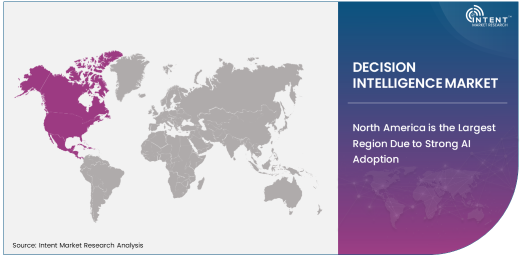
North America is the Largest Region Due to Strong AI Adoption
North America leads the Decision Intelligence market due to widespread AI adoption across industries. The presence of major tech firms, robust investments in AI research, and early adoption of cloud-based solutions drive market growth.
Enterprises in the region leverage Decision Intelligence for competitive advantage, regulatory compliance, and operational efficiency. With continued AI advancements, North America is expected to maintain its dominance in the market.
Competitive Landscape and Leading Companies
The Decision Intelligence market is highly competitive, with key players such as IBM, Oracle, Microsoft, Google, and Intel driving innovation. These companies are investing in AI research, partnerships, and acquisitions to expand their market presence.
Startups and niche players are also entering the market, offering industry-specific AI solutions. The competitive landscape is characterized by continuous technological advancements and increasing collaborations between enterprises and AI solution providers. As organizations prioritize data-driven strategies, competition in the Decision Intelligence market is set to intensify.
List of Leading Companies:
- Taiwan Semiconductor Manufacturing Company (TSMC)
- Samsung Electronics
- Intel Corporation
- GlobalFoundries
- STMicroelectronics
- SK Hynix
- Micron Technology
- ASML
- Texas Instruments
- Renesas Electronics Corporation
- NXP Semiconductors
- Broadcom Inc.
- Analog Devices
- ON Semiconductor
- Infineon Technologies
Recent Developments:
- IBM has launched an AI-driven Decision Intelligence platform to enhance business decision-making processes.
- Oracle acquired DataRobot to strengthen its AI and machine learning capabilities in Decision Intelligence solutions.
- Microsoft integrated Azure AI into its Decision Support Systems, offering advanced analytics and predictive insights.
- SAP SE introduced a new predictive analytics tool to assist businesses in demand forecasting and logistics optimization.
- AWS expanded its Decision Intelligence services, providing scalable solutions for data-driven decision-making.
Report Scope:
|
Report Features |
Description |
|
Market Size (2024-e) |
USD 27.5 Billion |
|
Forecasted Value (2030) |
USD 36.8 Billion |
|
CAGR (2025 – 2030) |
4.9% |
|
Base Year for Estimation |
2024-e |
|
Historic Year |
2023 |
|
Forecast Period |
2025 – 2030 |
|
Report Coverage |
Market Forecast, Market Dynamics, Competitive Landscape, Recent Developments |
|
Segments Covered |
Semiconductor Wafer Market By Wafer Type (Single Crystal Wafer, Polycrystalline Wafer, Amorphous Wafer), By Material (Silicon Wafer, Gallium Arsenide Wafer, Silicon Carbide Wafer, Germanium Wafer, Compound Semiconductor Wafer), By Technology (Photolithography, Etching, Doping, Chemical Vapor Deposition (CVD), Chemical Mechanical Planarization (CMP)), By Application (Integrated Circuits (ICs), Optoelectronics, MEMS (Micro-Electromechanical Systems), Power Devices, Solar Cells), By End-User Industry (Consumer Electronics, Automotive, Telecommunication, Industrial, Aerospace & Defense, Healthcare) |
|
Regional Analysis |
North America (US, Canada, Mexico), Europe (Germany, France, UK, Italy, Spain, and Rest of Europe), Asia-Pacific (China, Japan, South Korea, Australia, India, and Rest of Asia-Pacific), Latin America (Brazil, Argentina, and Rest of Latin America), Middle East & Africa (Saudi Arabia, UAE, Rest of Middle East & Africa) |
|
Major Companies |
Taiwan Semiconductor Manufacturing Company (TSMC), Samsung Electronics, Intel Corporation, GlobalFoundries, STMicroelectronics, SK Hynix, Micron Technology, ASML, Texas Instruments, Renesas Electronics Corporation, NXP Semiconductors, Broadcom Inc., Analog Devices, ON Semiconductor, Infineon Technologies |
|
Customization Scope |
Customization for segments, region/country-level will be provided. Moreover, additional customization can be done based on the requirements |
Frequently Asked Questions
The Semiconductor Wafer Market was valued at USD 27.5 Billion in 2024-e and is expected to grow at a CAGR of over 4.9% from 2025 to 2030
The demand for semiconductor wafers in integrated circuits (ICs) is growing rapidly, driven by advancements in consumer electronics, automotive applications, and telecommunications.
SiC wafers offer high thermal conductivity, wide bandgap properties, and are used in power devices, electric vehicles, and renewable energy applications.
Asia-Pacific, particularly countries like Taiwan, South Korea, and Japan, holds the largest market share due to the presence of major semiconductor manufacturers and consumer electronics demand.
|
1. Introduction |
|
1.1. Market Definition |
|
1.2. Scope of the Study |
|
1.3. Research Assumptions |
|
1.4. Study Limitations |
|
2. Research Methodology |
|
2.1. Research Approach |
|
2.1.1. Top-Down Method |
|
2.1.2. Bottom-Up Method |
|
2.1.3. Factor Impact Analysis |
|
2.2. Insights & Data Collection Process |
|
2.2.1. Secondary Research |
|
2.2.2. Primary Research |
|
2.3. Data Mining Process |
|
2.3.1. Data Analysis |
|
2.3.2. Data Validation and Revalidation |
|
2.3.3. Data Triangulation |
|
3. Executive Summary |
|
3.1. Major Markets & Segments |
|
3.2. Highest Growing Regions and Respective Countries |
|
3.3. Impact of Growth Drivers & Inhibitors |
|
3.4. Regulatory Overview by Country |
|
4. Decision Intelligence Market, by Component (Market Size & Forecast: USD Million, 2023 – 2030) |
|
4.1. Platform |
|
4.2. Solutions |
|
4.3. Services |
|
5. Decision Intelligence Market, by Deployment Mode (Market Size & Forecast: USD Million, 2023 – 2030) |
|
5.1. Cloud-Based |
|
5.2. On-Premises |
|
6. Decision Intelligence Market, by Organization Size (Market Size & Forecast: USD Million, 2023 – 2030) |
|
6.1. Large Enterprises |
|
6.2. Small and Medium-Sized Enterprises (SMEs) |
|
7. Decision Intelligence Market, by Application (Market Size & Forecast: USD Million, 2023 – 2030) |
|
7.1. Decision Support |
|
7.2. Decision Automation |
|
7.3. Decision Augmentation |
|
8. Decision Intelligence Market, by Industry Vertical (Market Size & Forecast: USD Million, 2023 – 2030) |
|
8.1. Banking, Financial Services, and Insurance (BFSI) |
|
8.2. Retail and E-commerce |
|
8.3. Healthcare and Life Sciences |
|
8.4. Telecommunications |
|
8.5. Energy and Utilities |
|
8.6. Manufacturing |
|
8.7. Government and Defense |
|
8.8. Others |
|
9. Regional Analysis (Market Size & Forecast: USD Million, 2023 – 2030) |
|
9.1. Regional Overview |
|
9.2. North America |
|
9.2.1. Regional Trends & Growth Drivers |
|
9.2.2. Barriers & Challenges |
|
9.2.3. Opportunities |
|
9.2.4. Factor Impact Analysis |
|
9.2.5. Technology Trends |
|
9.2.6. North America Decision Intelligence Market, by Component |
|
9.2.7. North America Decision Intelligence Market, by Deployment Mode |
|
9.2.8. North America Decision Intelligence Market, by Organization Size |
|
9.2.9. North America Decision Intelligence Market, by Application |
|
9.2.10. North America Decision Intelligence Market, by Industry Vertical |
|
9.2.11. By Country |
|
9.2.11.1. US |
|
9.2.11.1.1. US Decision Intelligence Market, by Component |
|
9.2.11.1.2. US Decision Intelligence Market, by Deployment Mode |
|
9.2.11.1.3. US Decision Intelligence Market, by Organization Size |
|
9.2.11.1.4. US Decision Intelligence Market, by Application |
|
9.2.11.1.5. US Decision Intelligence Market, by Industry Vertical |
|
9.2.11.2. Canada |
|
9.2.11.3. Mexico |
|
*Similar segmentation will be provided for each region and country |
|
9.3. Europe |
|
9.4. Asia-Pacific |
|
9.5. Latin America |
|
9.6. Middle East & Africa |
|
10. Competitive Landscape |
|
10.1. Overview of the Key Players |
|
10.2. Competitive Ecosystem |
|
10.2.1. Level of Fragmentation |
|
10.2.2. Market Consolidation |
|
10.2.3. Product Innovation |
|
10.3. Company Share Analysis |
|
10.4. Company Benchmarking Matrix |
|
10.4.1. Strategic Overview |
|
10.4.2. Product Innovations |
|
10.5. Start-up Ecosystem |
|
10.6. Strategic Competitive Insights/ Customer Imperatives |
|
10.7. ESG Matrix/ Sustainability Matrix |
|
10.8. Manufacturing Network |
|
10.8.1. Locations |
|
10.8.2. Supply Chain and Logistics |
|
10.8.3. Product Flexibility/Customization |
|
10.8.4. Digital Transformation and Connectivity |
|
10.8.5. Environmental and Regulatory Compliance |
|
10.9. Technology Readiness Level Matrix |
|
10.10. Technology Maturity Curve |
|
10.11. Buying Criteria |
|
11. Company Profiles |
|
11.1. IBM Corporation |
|
11.1.1. Company Overview |
|
11.1.2. Company Financials |
|
11.1.3. Product/Service Portfolio |
|
11.1.4. Recent Developments |
|
11.1.5. IMR Analysis |
|
*Similar information will be provided for other companies |
|
11.2. Oracle Corporation |
|
11.3. Google LLC |
|
11.4. Microsoft Corporation |
|
11.5. Intel Corporation |
|
11.6. Board International S.A. |
|
11.7. H2O.ai, Inc. |
|
11.8. Domo, Inc. |
|
11.9. Provenir |
|
11.10. Pyramid Analytics BV |
|
11.11. Clarifai, Inc. |
|
11.12. Diwo.ai |
|
11.13. Metaphacts GmbH |
|
11.14. Cerebra |
|
11.15. Peak.ai |
|
12. Appendix |
A comprehensive market research approach was employed to gather and analyze data on the Decision Intelligence Market . In the process, the analysis was also done to analyze the parent market and relevant adjacencies to measure the impact of them on the Decision Intelligence Market . The research methodology encompassed both secondary and primary research techniques, ensuring the accuracy and credibility of the findings.
.jpg)
Secondary Research
Secondary research involved a thorough review of pertinent industry reports, journals, articles, and publications. Additionally, annual reports, press releases, and investor presentations of industry players were scrutinized to gain insights into their market positioning and strategies.
Primary Research
Primary research involved conducting in-depth interviews with industry experts, stakeholders, and market participants across the E-Waste Management ecosystem. The primary research objectives included:
- Validating findings and assumptions derived from secondary research
- Gathering qualitative and quantitative data on market trends, drivers, and challenges
- Understanding the demand-side dynamics, encompassing end-users, component manufacturers, facility providers, and service providers
- Assessing the supply-side landscape, including technological advancements and recent developments
Market Size Assessment
A combination of top-down and bottom-up approaches was utilized to analyze the overall size of the Decision Intelligence Market . These methods were also employed to assess the size of various subsegments within the market. The market size assessment methodology encompassed the following steps:
- Identification of key industry players and relevant revenues through extensive secondary research
- Determination of the industry's supply chain and market size, in terms of value, through primary and secondary research processes
- Calculation of percentage shares, splits, and breakdowns using secondary sources and verification through primary sources
.jpg)
Data Triangulation
To ensure the accuracy and reliability of the market size, data triangulation was implemented. This involved cross-referencing data from various sources, including demand and supply side factors, market trends, and expert opinions. Additionally, top-down and bottom-up approaches were employed to validate the market size assessment.