
As per Intent Market Research, the Blood Pressure Monitoring Devices Market was valued at USD 2.5 billion in 2024-e and will surpass USD 4.1 billion by 2030; growing at a CAGR of 8.4% during 2025 - 2030.
The blood pressure monitoring devices market is experiencing steady growth, driven by the increasing prevalence of hypertension and other chronic cardiovascular diseases. As the global population ages and the incidence of lifestyle-related health conditions rises, the demand for accurate and efficient blood pressure monitoring devices is escalating. These devices are crucial for diagnosing hypertension, monitoring chronic diseases, and providing post-surgical care, making them indispensable tools in healthcare settings. Additionally, the growing adoption of home healthcare solutions and wearable technologies is further propelling market growth.
Technological advancements in the field of blood pressure monitoring, such as the development of automated and wearable devices, are revolutionizing the way patients and healthcare providers manage hypertension. These innovations enable continuous monitoring and early detection of health issues, leading to more personalized treatment approaches. As health awareness increases and patients seek more convenient monitoring options, the blood pressure monitoring devices market is poised for further expansion in the coming years.
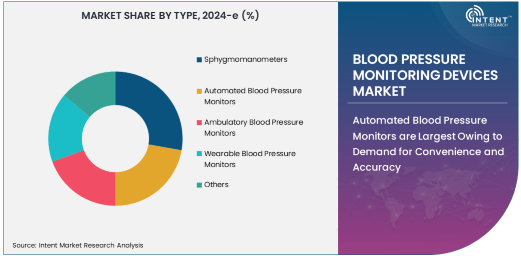
Automated Blood Pressure Monitors are Largest Owing to Demand for Convenience and Accuracy
Automated blood pressure monitors represent the largest product type in the blood pressure monitoring devices market, driven by their convenience, ease of use, and accuracy. These devices eliminate the need for manual readings, making them suitable for both home use and clinical settings. Automated monitors are equipped with advanced features such as digital displays, memory storage, and user-friendly interfaces, ensuring accurate readings without requiring specialized training.
The demand for automated blood pressure monitors is fueled by the growing preference for home healthcare solutions, as they provide patients with the ability to monitor their blood pressure independently. With the increasing awareness of hypertension and its associated risks, these devices offer a practical solution for regular monitoring, positioning automated blood pressure monitors as the largest segment in the market.
Hypertension Diagnosis is Largest Product Application Owing to Rising Prevalence of High Blood Pressure
Hypertension diagnosis is the largest application in the blood pressure monitoring devices market, driven by the rising global prevalence of high blood pressure and the associated health risks. Hypertension is one of the leading risk factors for cardiovascular diseases, including heart attacks and strokes, making early detection and management critical. Blood pressure monitoring devices are essential tools in diagnosing hypertension, allowing healthcare professionals to make timely and informed decisions regarding patient care.
The increasing focus on preventive healthcare and the growing awareness of hypertension's impact on public health are fueling the demand for these diagnostic devices. As more individuals undergo regular check-ups and seek accurate monitoring solutions, hypertension diagnosis remains the largest application within the blood pressure monitoring devices market.
Hospitals are Largest End-User Owing to the Need for Accurate and Reliable Monitoring
Hospitals are the largest end-users of blood pressure monitoring devices, primarily due to the need for accurate and reliable blood pressure measurement in clinical settings. Blood pressure monitoring is a standard procedure in hospitals, used for patient assessment in emergency care, intensive care units (ICUs), and routine check-ups. These devices provide essential data that aid in diagnosing and monitoring cardiovascular conditions, making them indispensable in hospital care.
The high volume of patients, especially those with chronic diseases and post-surgical recovery needs, ensures a continuous demand for blood pressure monitoring devices. Furthermore, hospitals often require advanced devices with additional features such as continuous monitoring and real-time data transmission, further driving the growth of this end-user segment.
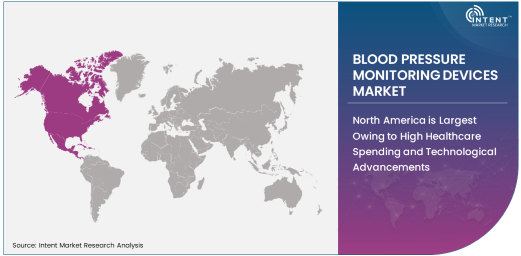
North America is Largest Owing to High Healthcare Spending and Technological Advancements
North America is the largest region in the blood pressure monitoring devices market, driven by high healthcare spending, technological advancements, and the rising incidence of cardiovascular diseases. The United States, in particular, is a key contributor to market growth, with healthcare facilities and home healthcare providers increasingly adopting advanced blood pressure monitoring devices to manage hypertension and other chronic conditions.
The region's well-established healthcare infrastructure, coupled with an aging population, contributes to the high demand for blood pressure monitoring solutions. Moreover, innovations in wearable technologies and automated devices are widely embraced in North America, further strengthening the region's position as the largest market for blood pressure monitoring devices.
Leading Companies and Competitive Landscape
The blood pressure monitoring devices market is highly competitive, with key players such as Omron Healthcare, Welch Allyn (Hill-Rom), A&D Company, Inc., and Withings dominating the market. These companies offer a wide range of blood pressure monitoring devices, including sphygmomanometers, automated monitors, and wearable devices, catering to various customer needs across healthcare settings.
The competitive landscape is shaped by constant innovation, with companies investing in research and development to improve device accuracy, user experience, and integration with digital health platforms. Strategic partnerships, mergers, and acquisitions are common as companies seek to expand their product offerings and market reach. Additionally, advancements in connectivity and cloud-based data solutions are expected to drive the next wave of growth in the blood pressure monitoring devices market.
Recent Developments:
- In December 2024, Omron Corporation introduced a new line of wearable blood pressure monitors. The product is designed for continuous, real-time health tracking.
- In November 2024, Philips Healthcare announced an upgrade to its automated BP monitoring system. The update focuses on improved accuracy and patient comfort.
- In October 2024, Withings launched an advanced smartwatch with integrated blood pressure monitoring capabilities. This wearable device aims to enhance daily health management.
- In September 2024, A&D Medical expanded its product range with a new series of home blood pressure monitors. The new models offer enhanced connectivity with mobile apps.
- In August 2024, Medtronic received FDA approval for its next-generation non-invasive blood pressure monitoring device. This approval marks a milestone in non-invasive diagnostic technology.
List of Leading Companies:
- Omron Corporation
- Philips Healthcare
- A&D Medical
- Welch Allyn (Hill-Rom)
- Panasonic Corporation
- Withings
- Beurer GmbH
- SunTech Medical, Inc.
- Bosch + Siemens Home Appliances Group (BSH)
- American Diagnostic Corporation
- GE Healthcare
- Medtronic
- iHealth Labs, Inc.
- Microlife Corporation
- Blood Pressure Monitoring Systems, Inc.
Report Scope:
|
Report Features |
Description |
|
Market Size (2024-e) |
USD 2.5 billion |
|
Forecasted Value (2030) |
USD 4.1 billion |
|
CAGR (2025 – 2030) |
8.4% |
|
Base Year for Estimation |
2024-e |
|
Historic Year |
2023 |
|
Forecast Period |
2025 – 2030 |
|
Report Coverage |
Market Forecast, Market Dynamics, Competitive Landscape, Recent Developments |
|
Segments Covered |
Blood Pressure Monitoring Devices Market By Type (Sphygmomanometers, Automated Blood Pressure Monitors, Ambulatory Blood Pressure Monitors, Wearable Blood Pressure Monitors), By Technology (Oscillometric, Auscultatory), By End-User (Hospitals, Clinics, Home Healthcare, Ambulatory Surgical Centers (ASCs)), By Product Application (Hypertension Diagnosis, Monitoring Chronic Disease, Post-Surgical Care) |
|
Regional Analysis |
North America (US, Canada, Mexico), Europe (Germany, France, UK, Italy, Spain, and Rest of Europe), Asia-Pacific (China, Japan, South Korea, Australia, India, and Rest of Asia-Pacific), Latin America (Brazil, Argentina, and Rest of Latin America), Middle East & Africa (Saudi Arabia, UAE, Rest of Middle East & Africa) |
|
Major Companies |
Omron Corporation, Philips Healthcare, A&D Medical, Welch Allyn (Hill-Rom), Panasonic Corporation, Withings, Beurer GmbH, SunTech Medical, Inc., Bosch + Siemens Home Appliances Group (BSH), American Diagnostic Corporation, GE Healthcare, Medtronic, iHealth Labs, Inc., Microlife Corporation, Blood Pressure Monitoring Systems, Inc. |
|
Customization Scope |
Customization for segments, region/country-level will be provided. Moreover, additional customization can be done based on the requirements |
|
1. Introduction |
|
1.1. Market Definition |
|
1.2. Scope of the Study |
|
1.3. Research Assumptions |
|
1.4. Study Limitations |
|
2. Research Methodology |
|
2.1. Research Approach |
|
2.1.1. Top-Down Method |
|
2.1.2. Bottom-Up Method |
|
2.1.3. Factor Impact Analysis |
|
2.2. Insights & Data Collection Process |
|
2.2.1. Secondary Research |
|
2.2.2. Primary Research |
|
2.3. Data Mining Process |
|
2.3.1. Data Analysis |
|
2.3.2. Data Validation and Revalidation |
|
2.3.3. Data Triangulation |
|
3. Executive Summary |
|
3.1. Major Markets & Segments |
|
3.2. Highest Growing Regions and Respective Countries |
|
3.3. Impact of Growth Drivers & Inhibitors |
|
3.4. Regulatory Overview by Country |
|
4. Blood Pressure Monitoring Devices Market, by Type (Market Size & Forecast: USD Million, 2023 – 2030) |
|
4.1. Sphygmomanometers |
|
4.2. Automated Blood Pressure Monitors |
|
4.3. Ambulatory Blood Pressure Monitors |
|
4.4. Wearable Blood Pressure Monitors |
|
4.5. Others |
|
5. Blood Pressure Monitoring Devices Market, by Technology (Market Size & Forecast: USD Million, 2023 – 2030) |
|
5.1. Oscillometric |
|
5.2. Auscultatory |
|
5.3. Others |
|
6. Blood Pressure Monitoring Devices Market, by End-User (Market Size & Forecast: USD Million, 2023 – 2030) |
|
6.1. Hospitals |
|
6.2. Clinics |
|
6.3. Home Healthcare |
|
6.4. Ambulatory Surgical Centers (ASCs) |
|
6.5. Others |
|
7. Blood Pressure Monitoring Devices Market, by Product Application (Market Size & Forecast: USD Million, 2023 – 2030) |
|
7.1. Hypertension Diagnosis |
|
7.2. Monitoring Chronic Disease |
|
7.3. Post-Surgical Care |
|
7.4. Others |
|
8. Regional Analysis (Market Size & Forecast: USD Million, 2023 – 2030) |
|
8.1. Regional Overview |
|
8.2. North America |
|
8.2.1. Regional Trends & Growth Drivers |
|
8.2.2. Barriers & Challenges |
|
8.2.3. Opportunities |
|
8.2.4. Factor Impact Analysis |
|
8.2.5. Technology Trends |
|
8.2.6. North America Blood Pressure Monitoring Devices Market, by Type |
|
8.2.7. North America Blood Pressure Monitoring Devices Market, by Technology |
|
8.2.8. North America Blood Pressure Monitoring Devices Market, by End-User |
|
8.2.9. North America Blood Pressure Monitoring Devices Market, by Product Application |
|
8.2.10. By Country |
|
8.2.10.1. US |
|
8.2.10.1.1. US Blood Pressure Monitoring Devices Market, by Type |
|
8.2.10.1.2. US Blood Pressure Monitoring Devices Market, by Technology |
|
8.2.10.1.3. US Blood Pressure Monitoring Devices Market, by End-User |
|
8.2.10.1.4. US Blood Pressure Monitoring Devices Market, by Product Application |
|
8.2.10.2. Canada |
|
8.2.10.3. Mexico |
|
*Similar segmentation will be provided for each region and country |
|
8.3. Europe |
|
8.4. Asia-Pacific |
|
8.5. Latin America |
|
8.6. Middle East & Africa |
|
9. Competitive Landscape |
|
9.1. Overview of the Key Players |
|
9.2. Competitive Ecosystem |
|
9.2.1. Level of Fragmentation |
|
9.2.2. Market Consolidation |
|
9.2.3. Product Innovation |
|
9.3. Company Share Analysis |
|
9.4. Company Benchmarking Matrix |
|
9.4.1. Strategic Overview |
|
9.4.2. Product Innovations |
|
9.5. Start-up Ecosystem |
|
9.6. Strategic Competitive Insights/ Customer Imperatives |
|
9.7. ESG Matrix/ Sustainability Matrix |
|
9.8. Manufacturing Network |
|
9.8.1. Locations |
|
9.8.2. Supply Chain and Logistics |
|
9.8.3. Product Flexibility/Customization |
|
9.8.4. Digital Transformation and Connectivity |
|
9.8.5. Environmental and Regulatory Compliance |
|
9.9. Technology Readiness Level Matrix |
|
9.10. Technology Maturity Curve |
|
9.11. Buying Criteria |
|
10. Company Profiles |
|
10.1. Omron Corporation |
|
10.1.1. Company Overview |
|
10.1.2. Company Financials |
|
10.1.3. Product/Service Portfolio |
|
10.1.4. Recent Developments |
|
10.1.5. IMR Analysis |
|
*Similar information will be provided for other companies |
|
10.2. Philips Healthcare |
|
10.3. A&D Medical |
|
10.4. Welch Allyn (Hill-Rom) |
|
10.5. Panasonic Corporation |
|
10.6. Withings |
|
10.7. Beurer GmbH |
|
10.8. SunTech Medical, Inc. |
|
10.9. Bosch + Siemens Home Appliances Group (BSH) |
|
10.10. American Diagnostic Corporation |
|
10.11. GE Healthcare |
|
10.12. Medtronic |
|
10.13. iHealth Labs, Inc. |
|
10.14. Microlife Corporation |
|
10.15. Blood Pressure Monitoring Systems, Inc. |
|
11. Appendix |
A comprehensive market research approach was employed to gather and analyze data on the Blood Pressure Monitoring Devices Market. In the process, the analysis was also done to analyze the parent market and relevant adjacencies to measure the impact of them on the Blood Pressure Monitoring Devices Market. The research methodology encompassed both secondary and primary research techniques, ensuring the accuracy and credibility of the findings.
.jpg)
Secondary Research
Secondary research involved a thorough review of pertinent industry reports, journals, articles, and publications. Additionally, annual reports, press releases, and investor presentations of industry players were scrutinized to gain insights into their market positioning and strategies.
Primary Research
Primary research involved conducting in-depth interviews with industry experts, stakeholders, and market participants across the E-Waste Management ecosystem. The primary research objectives included:
- Validating findings and assumptions derived from secondary research
- Gathering qualitative and quantitative data on market trends, drivers, and challenges
- Understanding the demand-side dynamics, encompassing end-users, component manufacturers, facility providers, and service providers
- Assessing the supply-side landscape, including technological advancements and recent developments
Market Size Assessment
A combination of top-down and bottom-up approaches was utilized to analyze the overall size of the Blood Pressure Monitoring Devices Market. These methods were also employed to assess the size of various subsegments within the market. The market size assessment methodology encompassed the following steps:
- Identification of key industry players and relevant revenues through extensive secondary research
- Determination of the industry's supply chain and market size, in terms of value, through primary and secondary research processes
- Calculation of percentage shares, splits, and breakdowns using secondary sources and verification through primary sources
.jpg)
Data Triangulation
To ensure the accuracy and reliability of the market size, data triangulation was implemented. This involved cross-referencing data from various sources, including demand and supply side factors, market trends, and expert opinions. Additionally, top-down and bottom-up approaches were employed to validate the market size assessment.
NA