
As per Intent Market Research, the Bioprocess Technology Market was valued at USD 20.5 billion in 2024-e and will surpass USD 34.9 billion by 2030; growing at a CAGR of 9.3% during 2025 - 2030.
The bioprocess technology market is expanding rapidly, driven by the increasing demand for biopharmaceuticals, vaccines, and other biologic products. These technologies are essential in the production of therapeutics, including monoclonal antibodies, recombinant proteins, and cell-based therapies. The advancements in bioprocessing technologies have significantly enhanced the efficiency, scalability, and quality of manufacturing processes, making them indispensable for modern biomanufacturing.
Bioprocess technologies encompass a wide range of methods used to cultivate, purify, and produce biological products. The integration of single-use systems, automation, and advanced monitoring tools is revolutionizing the industry. As the demand for biologics, particularly monoclonal antibodies and gene therapies, grows, bioprocess technologies continue to evolve, improving product yield, reducing operational costs, and enhancing overall manufacturing flexibility. The market is poised for substantial growth as these technologies support the production of complex therapeutic products with high precision and consistency.
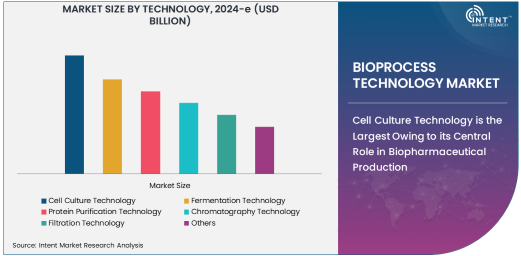
Cell Culture Technology is the Largest Owing to its Central Role in Biopharmaceutical Production
Cell culture technology is the largest segment in the bioprocess technology market, owing to its central role in the production of biologics, vaccines, and therapeutic proteins. This technology involves cultivating cells in controlled environments to produce proteins, antibodies, and other biological products. It is particularly vital for the biopharmaceutical industry, where cell culture serves as the foundation for the large-scale production of monoclonal antibodies, vaccines, and recombinant proteins.
The advantages of cell culture technology, including scalability, high productivity, and the ability to produce complex biologics, make it a preferred method for biopharmaceutical manufacturers. The growing demand for monoclonal antibodies and gene therapies further boosts the use of cell culture technology, cementing its position as the largest and most critical technology in the market.
Biopharmaceutical Production is the Largest Owing to Increasing Demand for Biologic Drugs
Biopharmaceutical production is the largest application in the bioprocess technology market, driven by the rising global demand for biologic drugs, vaccines, and personalized therapies. This sector includes the production of therapeutic proteins, monoclonal antibodies, gene therapies, and other biologics that require precise, scalable, and efficient manufacturing processes. Bioprocess technologies such as cell culture, fermentation, and protein purification are integral to the production of these high-value products.
As the prevalence of chronic diseases and cancers rises, the demand for biologic therapies continues to increase. The need for more efficient and cost-effective production technologies to meet this demand ensures that biopharmaceutical production remains the largest application within the market, driving the growth of bioprocess technologies.
Pharmaceuticals & Biotechnology is the Largest Owing to High Biologics Demand
The pharmaceuticals and biotechnology industry is the largest end-user segment for bioprocess technologies, largely due to the increasing demand for biologic drugs and vaccines. The sector’s growth is fueled by innovations in biologics, particularly monoclonal antibodies, gene therapies, and cell-based therapies. These technologies require highly specialized and efficient bioprocessing solutions, including cell culture, protein purification, and filtration technologies, to ensure the high quality and yield of the final products.
With the rapid expansion of the biologics market, pharmaceutical and biotechnology companies are increasingly adopting advanced bioprocess technologies to streamline their manufacturing processes and meet the rising demand for biologic treatments. This makes pharmaceuticals and biotechnology the largest and most significant end-user industry in the bioprocess technology market.
North America is Largest Owing to Strong Biopharmaceutical and Biotechnology Sectors
North America is the largest region in the bioprocess technology market, driven by the region's dominant biopharmaceutical and biotechnology sectors. The United States, in particular, is home to many leading pharmaceutical and biotechnology companies, which are at the forefront of developing and manufacturing biologics, vaccines, and gene therapies. North America’s strong healthcare infrastructure, coupled with its emphasis on innovation and regulatory support, makes it the global leader in bioprocess technology adoption.
The region’s ongoing investment in R&D and its commitment to advancing the production of biologics ensure that North America will maintain its leadership position in the market. As the demand for biologics and personalized medicine continues to grow, North America is expected to remain the largest market for bioprocess technologies, setting the pace for innovation and development worldwide.

Leading Companies and Competitive Landscape
The bioprocess technology market is competitive, with prominent players such as Thermo Fisher Scientific, Sartorius AG, Merck KGaA, Danaher Corporation, and GE Healthcare leading the development and commercialization of bioprocessing solutions. These companies offer a broad range of products, including cell culture systems, fermentation technologies, protein purification tools, and chromatography systems, catering to the diverse needs of the pharmaceutical, biotechnology, and healthcare industries.
The competitive landscape is characterized by significant investment in research and development, as companies seek to improve existing technologies and create new, more efficient solutions for biologic production. Partnerships, mergers, and acquisitions are also common as companies expand their portfolios and capabilities to meet the growing demand for high-quality, cost-effective biomanufacturing technologies. As the biologics market continues to expand, these leading companies will play a critical role in shaping the future of the bioprocess technology market.
Recent Developments:
- In January 2025, Thermo Fisher Scientific launched a new cell culture system to enhance protein production in biopharmaceuticals.
- In December 2024, Sartorius Stedim Biotech expanded its fermentation technology offerings to address increasing demand in vaccine production.
- In November 2024, GE Healthcare unveiled a state-of-the-art chromatography system for improving the purification of therapeutic proteins.
- In October 2024, Merck KGaA collaborated with several biotech companies to streamline bioprocess development through new filtration technologies.
- In September 2024, Lonza Group introduced a cutting-edge bioreactor for large-scale biopharmaceutical manufacturing.
List of Leading Companies:
- Thermo Fisher Scientific
- GE Healthcare
- Merck KGaA
- Sartorius Stedim Biotech
- Lonza Group
- Pall Corporation
- Danaher Corporation
- W. L. Gore & Associates
- Bio-Rad Laboratories
- Meissner Filtration Products
- 3M
- Becton Dickinson and Company
- Entegris, Inc.
- Fujifilm Diosynth Biotechnologies
- MilliporeSigma
Report Scope:
|
Report Features |
Description |
|
Market Size (2024-e) |
USD 20.5 billion |
|
Forecasted Value (2030) |
USD 34.9 billion |
|
CAGR (2025 – 2030) |
9.3% |
|
Base Year for Estimation |
2024-e |
|
Historic Year |
2023 |
|
Forecast Period |
2025 – 2030 |
|
Report Coverage |
Market Forecast, Market Dynamics, Competitive Landscape, Recent Developments |
|
Segments Covered |
Bioprocess Technology Market By Technology (Cell Culture Technology, Fermentation Technology, Protein Purification Technology, Chromatography Technology, Filtration Technology), By Application (Biopharmaceutical Production, Vaccine Production, Cell Therapy Production, Protein Production, Monoclonal Antibodies Production), By End-Use Industry (Pharmaceuticals & Biotechnology, Food & Beverages, Cosmetics, Chemical Industry, Agriculture) |
|
Regional Analysis |
North America (US, Canada, Mexico), Europe (Germany, France, UK, Italy, Spain, and Rest of Europe), Asia-Pacific (China, Japan, South Korea, Australia, India, and Rest of Asia-Pacific), Latin America (Brazil, Argentina, and Rest of Latin America), Middle East & Africa (Saudi Arabia, UAE, Rest of Middle East & Africa) |
|
Major Companies |
Thermo Fisher Scientific, GE Healthcare, Merck KGaA, Sartorius Stedim Biotech, Lonza Group, Pall Corporation, Danaher Corporation, W. L. Gore & Associates, Bio-Rad Laboratories, Meissner Filtration Products, 3M, Becton Dickinson and Company, Entegris, Inc., Fujifilm Diosynth Biotechnologies, MilliporeSigma |
|
Customization Scope |
Customization for segments, region/country-level will be provided. Moreover, additional customization can be done based on the requirements |
|
1. Introduction |
|
1.1. Market Definition |
|
1.2. Scope of the Study |
|
1.3. Research Assumptions |
|
1.4. Study Limitations |
|
2. Research Methodology |
|
2.1. Research Approach |
|
2.1.1. Top-Down Method |
|
2.1.2. Bottom-Up Method |
|
2.1.3. Factor Impact Analysis |
|
2.2. Insights & Data Collection Process |
|
2.2.1. Secondary Research |
|
2.2.2. Primary Research |
|
2.3. Data Mining Process |
|
2.3.1. Data Analysis |
|
2.3.2. Data Validation and Revalidation |
|
2.3.3. Data Triangulation |
|
3. Executive Summary |
|
3.1. Major Markets & Segments |
|
3.2. Highest Growing Regions and Respective Countries |
|
3.3. Impact of Growth Drivers & Inhibitors |
|
3.4. Regulatory Overview by Country |
|
4. Bioprocess Technology Market, by Technology (Market Size & Forecast: USD Million, 2023 – 2030) |
|
4.1. Cell Culture Technology |
|
4.2. Fermentation Technology |
|
4.3. Protein Purification Technology |
|
4.4. Chromatography Technology |
|
4.5. Filtration Technology |
|
4.6. Others |
|
5. Bioprocess Technology Market, by Application (Market Size & Forecast: USD Million, 2023 – 2030) |
|
5.1. Biopharmaceutical Production |
|
5.2. Vaccine Production |
|
5.3. Cell Therapy Production |
|
5.4. Protein Production |
|
5.5. Monoclonal Antibodies Production |
|
6. Bioprocess Technology Market, by End-Use Industry (Market Size & Forecast: USD Million, 2023 – 2030) |
|
6.1. Pharmaceuticals & Biotechnology |
|
6.2. Food & Beverages |
|
6.3. Cosmetics |
|
6.4. Chemical Industry |
|
6.5. Agriculture |
|
7. Regional Analysis (Market Size & Forecast: USD Million, 2023 – 2030) |
|
7.1. Regional Overview |
|
7.2. North America |
|
7.2.1. Regional Trends & Growth Drivers |
|
7.2.2. Barriers & Challenges |
|
7.2.3. Opportunities |
|
7.2.4. Factor Impact Analysis |
|
7.2.5. Technology Trends |
|
7.2.6. North America Bioprocess Technology Market, by Technology |
|
7.2.7. North America Bioprocess Technology Market, by Application |
|
7.2.8. North America Bioprocess Technology Market, by End-Use Industry |
|
7.2.9. By Country |
|
7.2.9.1. US |
|
7.2.9.1.1. US Bioprocess Technology Market, by Technology |
|
7.2.9.1.2. US Bioprocess Technology Market, by Application |
|
7.2.9.1.3. US Bioprocess Technology Market, by End-Use Industry |
|
7.2.9.2. Canada |
|
7.2.9.3. Mexico |
|
*Similar segmentation will be provided for each region and country |
|
7.3. Europe |
|
7.4. Asia-Pacific |
|
7.5. Latin America |
|
7.6. Middle East & Africa |
|
8. Competitive Landscape |
|
8.1. Overview of the Key Players |
|
8.2. Competitive Ecosystem |
|
8.2.1. Level of Fragmentation |
|
8.2.2. Market Consolidation |
|
8.2.3. Product Innovation |
|
8.3. Company Share Analysis |
|
8.4. Company Benchmarking Matrix |
|
8.4.1. Strategic Overview |
|
8.4.2. Product Innovations |
|
8.5. Start-up Ecosystem |
|
8.6. Strategic Competitive Insights/ Customer Imperatives |
|
8.7. ESG Matrix/ Sustainability Matrix |
|
8.8. Manufacturing Network |
|
8.8.1. Locations |
|
8.8.2. Supply Chain and Logistics |
|
8.8.3. Product Flexibility/Customization |
|
8.8.4. Digital Transformation and Connectivity |
|
8.8.5. Environmental and Regulatory Compliance |
|
8.9. Technology Readiness Level Matrix |
|
8.10. Technology Maturity Curve |
|
8.11. Buying Criteria |
|
9. Company Profiles |
|
9.1. Thermo Fisher Scientific |
|
9.1.1. Company Overview |
|
9.1.2. Company Financials |
|
9.1.3. Product/Service Portfolio |
|
9.1.4. Recent Developments |
|
9.1.5. IMR Analysis |
|
*Similar information will be provided for other companies |
|
9.2. GE Healthcare |
|
9.3. Merck KGaA |
|
9.4. Sartorius Stedim Biotech |
|
9.5. Lonza Group |
|
9.6. Pall Corporation |
|
9.7. Danaher Corporation |
|
9.8. W. L. Gore & Associates |
|
9.9. Bio-Rad Laboratories |
|
9.10. Meissner Filtration Products |
|
9.11. 3M |
|
9.12. Becton Dickinson and Company |
|
9.13. Entegris, Inc. |
|
9.14. Fujifilm Diosynth Biotechnologies |
|
9.15. MilliporeSigma |
|
10. Appendix |
A comprehensive market research approach was employed to gather and analyze data on the Bioprocess Technology Market. In the process, the analysis was also done to analyze the parent market and relevant adjacencies to measure the impact of them on the Bioprocess Technology Market. The research methodology encompassed both secondary and primary research techniques, ensuring the accuracy and credibility of the findings.
.jpg)
Secondary Research
Secondary research involved a thorough review of pertinent industry reports, journals, articles, and publications. Additionally, annual reports, press releases, and investor presentations of industry players were scrutinized to gain insights into their market positioning and strategies.
Primary Research
Primary research involved conducting in-depth interviews with industry experts, stakeholders, and market participants across the E-Waste Management ecosystem. The primary research objectives included:
- Validating findings and assumptions derived from secondary research
- Gathering qualitative and quantitative data on market trends, drivers, and challenges
- Understanding the demand-side dynamics, encompassing end-users, component manufacturers, facility providers, and service providers
- Assessing the supply-side landscape, including technological advancements and recent developments
Market Size Assessment
A combination of top-down and bottom-up approaches was utilized to analyze the overall size of the Bioprocess Technology Market. These methods were also employed to assess the size of various subsegments within the market. The market size assessment methodology encompassed the following steps:
- Identification of key industry players and relevant revenues through extensive secondary research
- Determination of the industry's supply chain and market size, in terms of value, through primary and secondary research processes
- Calculation of percentage shares, splits, and breakdowns using secondary sources and verification through primary sources
.jpg)
Data Triangulation
To ensure the accuracy and reliability of the market size, data triangulation was implemented. This involved cross-referencing data from various sources, including demand and supply side factors, market trends, and expert opinions. Additionally, top-down and bottom-up approaches were employed to validate the market size assessment.
NA