
As per Intent Market Research, the Bioprocess Containers Market was valued at USD 4.1 billion in 2024-e and will surpass USD 7.3 billion by 2030; growing at a CAGR of 10.2% during 2025 - 2030.
The bioprocess containers market is witnessing significant growth, driven by the increasing demand for disposable, flexible solutions in the production of biologics, vaccines, and other biopharmaceutical products. These containers are an essential component of biomanufacturing processes, offering crucial benefits such as reduced risk of contamination, enhanced scalability, and lower operational costs. As the pharmaceutical and biotechnology industries continue to focus on improving production efficiency and flexibility, bioprocess containers are becoming an integral part of modern manufacturing workflows.
The rise in personalized medicine, gene therapies, and biologics is contributing to the expanding use of bioprocess containers in cell culture, protein purification, and vaccine production. These containers provide a safe, sterile environment for handling critical biological materials, while minimizing the need for cleaning and sterilization between uses. As demand for biologics continues to grow, the market for bioprocess containers is expected to expand rapidly, with a focus on improving product quality, reducing time-to-market, and enhancing cost-effectiveness in the manufacturing process.
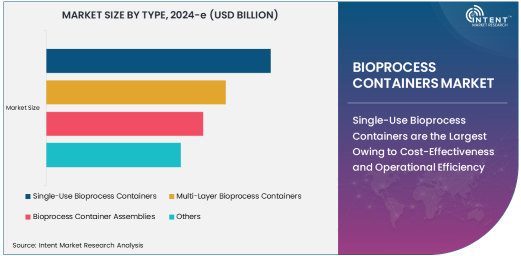
Single-Use Bioprocess Containers are the Largest Owing to Cost-Effectiveness and Operational Efficiency
Single-use bioprocess containers are the largest subsegment in the market, owing to their significant advantages in terms of cost-efficiency, flexibility, and scalability. These containers are widely adopted across various stages of the biomanufacturing process, including cell culture, protein purification, and vaccine production. The key benefits of single-use bioprocess containers, such as eliminating the need for cleaning, sterilization, and validation, make them an attractive option for biopharmaceutical companies looking to streamline operations and reduce capital expenditures.
As the demand for biologic drugs and vaccines continues to rise, the need for more efficient and scalable production methods becomes critical. Single-use bioprocess containers provide an ideal solution for meeting this demand, offering companies a means to rapidly scale up production while maintaining the highest levels of sterility and quality. These factors ensure that single-use bioprocess containers will remain the dominant subsegment in the bioprocess containers market.
Biopharmaceutical Production is the Largest Owing to Growing Demand for Biologic Drugs
Biopharmaceutical production is the largest application in the bioprocess containers market, driven by the increasing demand for biologics, including monoclonal antibodies, vaccines, and gene therapies. The production of biologics requires highly controlled environments, where bioprocess containers play a critical role in maintaining sterility and ensuring the quality of biological materials throughout the manufacturing process. These containers are used in various applications such as cell culture, media preparation, and the storage of therapeutic products.
As the global demand for biologic therapies continues to grow, particularly in oncology, immunology, and rare diseases, the need for efficient, scalable, and cost-effective production methods becomes more pressing. Biopharmaceutical production, therefore, remains the largest application driving the growth of the bioprocess containers market, with companies focusing on increasing their capacity to meet the rising demand for biologic drugs.
Pharmaceuticals & Biotechnology is the Largest Owing to Innovation and Growth in Biologics
The pharmaceuticals and biotechnology industry is the largest end-user sector for bioprocess containers. The growth of biologics, vaccines, and cell-based therapies is fueling the demand for innovative biomanufacturing solutions, including bioprocess containers. These industries require reliable and scalable containers to support the production of high-value biopharmaceutical products, such as therapeutic proteins, monoclonal antibodies, and gene therapies.
Pharmaceutical and biotechnology companies are increasingly adopting single-use bioprocess containers to reduce production costs and improve operational flexibility. With ongoing innovation in biologic drug development and the rising prevalence of chronic diseases, this end-user industry will remain the largest driver of the bioprocess containers market in the coming years.
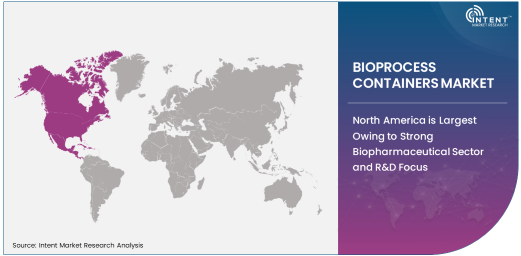
North America is Largest Owing to Strong Biopharmaceutical Sector and R&D Focus
North America is the largest region in the bioprocess containers market, owing to its dominant position in the biopharmaceutical sector and strong focus on research and development. The U.S., in particular, is home to many leading pharmaceutical and biotechnology companies, which are at the forefront of developing and manufacturing biologic drugs, vaccines, and gene therapies. The region’s advanced healthcare infrastructure, coupled with high levels of investment in R&D, supports the growth of the bioprocess containers market.
In addition to the biopharmaceutical industry, North America’s emphasis on innovation in personalized medicine and biologics production further drives the demand for bioprocess containers. As companies in the region continue to push the boundaries of biomanufacturing, North America will maintain its leadership in the global bioprocess containers market, ensuring continued growth and technological advancement.
Leading Companies and Competitive Landscape
The bioprocess containers market is highly competitive, with key players such as Thermo Fisher Scientific, Sartorius AG, Merck KGaA, and Danaher Corporation leading the development and commercialization of advanced bioprocessing solutions. These companies offer a wide range of single-use bioprocess containers, multi-layer containers, and bioprocess container assemblies designed to meet the diverse needs of the biopharmaceutical, biotechnology, and healthcare industries.
The competitive landscape is characterized by a strong emphasis on innovation, with companies continuously improving the design, material compatibility, and functionality of bioprocess containers to enhance the efficiency of manufacturing processes. Partnerships and collaborations between biopharmaceutical companies, research institutions, and technology providers are also common, as they work together to develop more advanced and efficient solutions for biomanufacturing. As the demand for biologic products continues to rise, the bioprocess containers market will see further innovation, ensuring that leading companies remain at the forefront of this rapidly evolving industry.
Recent Developments:
- In January 2025, Thermo Fisher Scientific introduced a new single-use bioprocess container designed to enhance vaccine production efficiency.
- In December 2024, Sartorius Stedim Biotech expanded its range of multi-layer bioprocess containers to cater to large-scale biopharmaceutical manufacturing needs.
- In November 2024, Pall Corporation announced a partnership with a major pharmaceutical company to co-develop advanced bioprocess container systems.
- In October 2024, GE Healthcare acquired a bioprocess container manufacturer to strengthen its product portfolio in the biopharmaceutical sector.
- In September 2024, Merck KGaA launched an innovative bioprocess container assembly aimed at improving protein purification and drug development processes.
List of Leading Companies:
- Thermo Fisher Scientific
- Sartorius Stedim Biotech
- GE Healthcare
- Merck KGaA
- Lonza Group
- Pall Corporation
- Danaher Corporation
- W. L. Gore & Associates
- Saint-Gobain Performance Plastics
- Entegris, Inc.
- Meissner Filtration Products
- Bio-Rad Laboratories
- 3M
- Becton Dickinson and Company
- Kabbage BioTech
Report Scope:
|
Report Features |
Description |
|
Market Size (2024-e) |
USD 4.1 billion |
|
Forecasted Value (2030) |
USD 7.3 billion |
|
CAGR (2025 – 2030) |
10.2% |
|
Base Year for Estimation |
2024-e |
|
Historic Year |
2023 |
|
Forecast Period |
2025 – 2030 |
|
Report Coverage |
Market Forecast, Market Dynamics, Competitive Landscape, Recent Developments |
|
Segments Covered |
Bioprocess Containers Market By Type (Single-Use Bioprocess Containers, Multi-Layer Bioprocess Containers, Bioprocess Container Assemblies), By Application (Cell Culture, Biopharmaceutical Production, Drug Discovery & Development, Protein Purification, Vaccine Production), By End-Use Industry (Pharmaceuticals & Biotechnology, Healthcare, Food & Beverages, Chemical & Cosmetics) |
|
Regional Analysis |
North America (US, Canada, Mexico), Europe (Germany, France, UK, Italy, Spain, and Rest of Europe), Asia-Pacific (China, Japan, South Korea, Australia, India, and Rest of Asia-Pacific), Latin America (Brazil, Argentina, and Rest of Latin America), Middle East & Africa (Saudi Arabia, UAE, Rest of Middle East & Africa) |
|
Major Companies |
Thermo Fisher Scientific, Sartorius Stedim Biotech, GE Healthcare, Merck KGaA, Lonza Group, Pall Corporation, Danaher Corporation, W. L. Gore & Associates, Saint-Gobain Performance Plastics, Entegris, Inc., Meissner Filtration Products, Bio-Rad Laboratories, 3M, Becton Dickinson and Company, Kabbage BioTech |
|
Customization Scope |
Customization for segments, region/country-level will be provided. Moreover, additional customization can be done based on the requirements |
|
1. Introduction |
|
1.1. Market Definition |
|
1.2. Scope of the Study |
|
1.3. Research Assumptions |
|
1.4. Study Limitations |
|
2. Research Methodology |
|
2.1. Research Approach |
|
2.1.1. Top-Down Method |
|
2.1.2. Bottom-Up Method |
|
2.1.3. Factor Impact Analysis |
|
2.2. Insights & Data Collection Process |
|
2.2.1. Secondary Research |
|
2.2.2. Primary Research |
|
2.3. Data Mining Process |
|
2.3.1. Data Analysis |
|
2.3.2. Data Validation and Revalidation |
|
2.3.3. Data Triangulation |
|
3. Executive Summary |
|
3.1. Major Markets & Segments |
|
3.2. Highest Growing Regions and Respective Countries |
|
3.3. Impact of Growth Drivers & Inhibitors |
|
3.4. Regulatory Overview by Country |
|
4. Bioprocess Containers Market, by Type (Market Size & Forecast: USD Million, 2023 – 2030) |
|
4.1. Single-Use Bioprocess Containers |
|
4.2. Multi-Layer Bioprocess Containers |
|
4.3. Bioprocess Container Assemblies |
|
4.4. Others |
|
5. Bioprocess Containers Market, by Application (Market Size & Forecast: USD Million, 2023 – 2030) |
|
5.1. Cell Culture |
|
5.2. Biopharmaceutical Production |
|
5.3. Drug Discovery & Development |
|
5.4. Protein Purification |
|
5.5. Vaccine Production |
|
6. Bioprocess Containers Market, by End-Use Industry (Market Size & Forecast: USD Million, 2023 – 2030) |
|
6.1. Pharmaceuticals & Biotechnology |
|
6.2. Healthcare |
|
6.3. Food & Beverages |
|
6.4. Chemical & Cosmetics |
|
7. Regional Analysis (Market Size & Forecast: USD Million, 2023 – 2030) |
|
7.1. Regional Overview |
|
7.2. North America |
|
7.2.1. Regional Trends & Growth Drivers |
|
7.2.2. Barriers & Challenges |
|
7.2.3. Opportunities |
|
7.2.4. Factor Impact Analysis |
|
7.2.5. Technology Trends |
|
7.2.6. North America Bioprocess Containers Market, by Type |
|
7.2.7. North America Bioprocess Containers Market, by Application |
|
7.2.8. North America Bioprocess Containers Market, by End-Use Industry |
|
7.2.9. By Country |
|
7.2.9.1. US |
|
7.2.9.1.1. US Bioprocess Containers Market, by Type |
|
7.2.9.1.2. US Bioprocess Containers Market, by Application |
|
7.2.9.1.3. US Bioprocess Containers Market, by End-Use Industry |
|
7.2.9.2. Canada |
|
7.2.9.3. Mexico |
|
*Similar segmentation will be provided for each region and country |
|
7.3. Europe |
|
7.4. Asia-Pacific |
|
7.5. Latin America |
|
7.6. Middle East & Africa |
|
8. Competitive Landscape |
|
8.1. Overview of the Key Players |
|
8.2. Competitive Ecosystem |
|
8.2.1. Level of Fragmentation |
|
8.2.2. Market Consolidation |
|
8.2.3. Product Innovation |
|
8.3. Company Share Analysis |
|
8.4. Company Benchmarking Matrix |
|
8.4.1. Strategic Overview |
|
8.4.2. Product Innovations |
|
8.5. Start-up Ecosystem |
|
8.6. Strategic Competitive Insights/ Customer Imperatives |
|
8.7. ESG Matrix/ Sustainability Matrix |
|
8.8. Manufacturing Network |
|
8.8.1. Locations |
|
8.8.2. Supply Chain and Logistics |
|
8.8.3. Product Flexibility/Customization |
|
8.8.4. Digital Transformation and Connectivity |
|
8.8.5. Environmental and Regulatory Compliance |
|
8.9. Technology Readiness Level Matrix |
|
8.10. Technology Maturity Curve |
|
8.11. Buying Criteria |
|
9. Company Profiles |
|
9.1. Thermo Fisher Scientific |
|
9.1.1. Company Overview |
|
9.1.2. Company Financials |
|
9.1.3. Product/Service Portfolio |
|
9.1.4. Recent Developments |
|
9.1.5. IMR Analysis |
|
*Similar information will be provided for other companies |
|
9.2. Sartorius Stedim Biotech |
|
9.3. GE Healthcare |
|
9.4. Merck KGaA |
|
9.5. Lonza Group |
|
9.6. Pall Corporation |
|
9.7. Danaher Corporation |
|
9.8. W. L. Gore & Associates |
|
9.9. Saint-Gobain Performance Plastics |
|
9.10. Entegris, Inc. |
|
9.11. Meissner Filtration Products |
|
9.12. Bio-Rad Laboratories |
|
9.13. 3M |
|
9.14. Becton Dickinson and Company |
|
9.15. Kabbage BioTech |
|
10. Appendix |
A comprehensive market research approach was employed to gather and analyze data on the Bioprocess Containers Market. In the process, the analysis was also done to analyze the parent market and relevant adjacencies to measure the impact of them on the Bioprocess Containers Market. The research methodology encompassed both secondary and primary research techniques, ensuring the accuracy and credibility of the findings.
.jpg)
Secondary Research
Secondary research involved a thorough review of pertinent industry reports, journals, articles, and publications. Additionally, annual reports, press releases, and investor presentations of industry players were scrutinized to gain insights into their market positioning and strategies.
Primary Research
Primary research involved conducting in-depth interviews with industry experts, stakeholders, and market participants across the E-Waste Management ecosystem. The primary research objectives included:
- Validating findings and assumptions derived from secondary research
- Gathering qualitative and quantitative data on market trends, drivers, and challenges
- Understanding the demand-side dynamics, encompassing end-users, component manufacturers, facility providers, and service providers
- Assessing the supply-side landscape, including technological advancements and recent developments
Market Size Assessment
A combination of top-down and bottom-up approaches was utilized to analyze the overall size of the Bioprocess Containers Market. These methods were also employed to assess the size of various subsegments within the market. The market size assessment methodology encompassed the following steps:
- Identification of key industry players and relevant revenues through extensive secondary research
- Determination of the industry's supply chain and market size, in terms of value, through primary and secondary research processes
- Calculation of percentage shares, splits, and breakdowns using secondary sources and verification through primary sources
.jpg)
Data Triangulation
To ensure the accuracy and reliability of the market size, data triangulation was implemented. This involved cross-referencing data from various sources, including demand and supply side factors, market trends, and expert opinions. Additionally, top-down and bottom-up approaches were employed to validate the market size assessment.
NA