
As per Intent Market Research, the Automated Data Platform Market was valued at USD 5.1 billion in 2024-e and will surpass USD 10.1 billion by 2030; growing at a CAGR of 12.2% during 2025 - 2030.
The automated data platform market is experiencing rapid growth as businesses increasingly recognize the importance of data-driven decision-making. Automated data platforms are designed to streamline data collection, integration, and processing, offering advanced capabilities such as data analytics, business intelligence, and predictive analytics. These platforms enable organizations to handle vast amounts of data efficiently, ensuring that businesses can leverage insights for strategic planning and operational optimization. With the rise of big data, cloud computing, and artificial intelligence, automated data platforms have become critical tools for businesses seeking to stay competitive in today’s data-driven economy.
The adoption of automated data platforms is also fueled by the growing need for improved data governance, enhanced security, and compliance with data privacy regulations. As organizations seek to manage their data more effectively and securely, platforms that offer automated data integration, real-time processing, and predictive capabilities are becoming increasingly valuable. Industries such as healthcare, BFSI (banking, financial services, and insurance), retail, and manufacturing are leading the adoption of these platforms, which are helping to drive the market’s growth. The shift toward digital transformation and the need for scalable, agile data solutions are expected to continue propelling the automated data platform market forward.
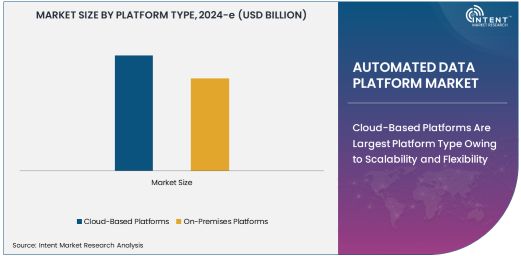
Cloud-Based Platforms Are Largest Platform Type Owing to Scalability and Flexibility
Cloud-based platforms are the largest platform type in the automated data platform market, owing to their scalability, flexibility, and cost-effectiveness. Cloud platforms offer businesses the ability to store and process large volumes of data without the need for significant on-premises infrastructure, making them an attractive option for organizations seeking to reduce costs and streamline operations. Cloud-based platforms also allow for seamless integration with other cloud services, making it easier for businesses to leverage additional tools and technologies such as machine learning, data analytics, and business intelligence.
The scalability of cloud platforms is particularly beneficial for organizations that experience fluctuating data demands, as these platforms can scale up or down depending on the volume of data being processed. Furthermore, cloud-based platforms offer enhanced collaboration capabilities, enabling teams to access data and insights from anywhere, at any time. This flexibility and ease of use have made cloud-based platforms the preferred choice for most businesses, particularly as more organizations embrace digital transformation and shift to cloud-first strategies.
Hybrid Cloud Deployment Model Is Fastest Growing Owing to Increased Need for Flexibility and Data Security
The hybrid cloud deployment model is the fastest-growing deployment model in the automated data platform market, driven by the need for increased flexibility and enhanced data security. A hybrid cloud approach combines the benefits of both public and private clouds, allowing organizations to manage sensitive data on private infrastructure while leveraging the scalability and cost-efficiency of public cloud platforms for less sensitive data and applications. This flexibility enables businesses to optimize their data management strategies based on the specific needs of their workloads.
The hybrid cloud model is particularly appealing to industries such as healthcare, BFSI, and manufacturing, which handle sensitive customer or patient data and must comply with stringent data privacy regulations. By using a hybrid cloud model, these organizations can ensure that their most sensitive data is kept secure on private servers, while still benefiting from the public cloud’s computational power and resources for other operations. As businesses seek to balance security, flexibility, and cost, the hybrid cloud model is expected to continue gaining traction in the automated data platform market.
Data Integration Is Largest Application Owing to Its Central Role in Data Management
Data integration is the largest application in the automated data platform market, owing to its central role in enabling businesses to combine and process data from multiple sources. Data integration platforms allow organizations to efficiently aggregate data from disparate systems, ensuring that all relevant data is accessible and usable for decision-making. As businesses increasingly rely on data-driven strategies, the need for effective data integration solutions has grown, making this the dominant application in the market.
Data integration is particularly important as businesses continue to generate vast amounts of data from various sources, including customer interactions, IoT devices, and internal systems. Automated data platforms that specialize in data integration help organizations eliminate data silos, ensuring that data is accessible and actionable across the organization. With the growing importance of data in driving business decisions, data integration platforms are essential for ensuring that businesses have a unified view of their data, making them critical to the success of digital transformation initiatives.
BFSI Is Largest End-User Industry Owing to Data Sensitivity and Regulatory Requirements
The BFSI (banking, financial services, and insurance) industry is the largest end-user in the automated data platform market, owing to the sector’s need to manage vast amounts of sensitive data while complying with stringent regulatory requirements. Data security, privacy, and compliance are top priorities for BFSI organizations, as they handle highly sensitive financial data and are subject to strict regulations such as the General Data Protection Regulation (GDPR) and the Payment Card Industry Data Security Standard (PCI DSS). Automated data platforms provide the tools necessary to securely manage and process this data while ensuring compliance with these regulations.
In addition to regulatory concerns, BFSI organizations rely heavily on data analytics and business intelligence to make informed decisions, manage risk, and improve customer experiences. Automated data platforms enable these organizations to integrate data from various sources, analyze it in real time, and derive actionable insights. The need for secure, efficient data management and analytics solutions has made BFSI the largest end-user industry in the automated data platform market, and this trend is expected to continue as the sector increasingly embraces digital transformation.
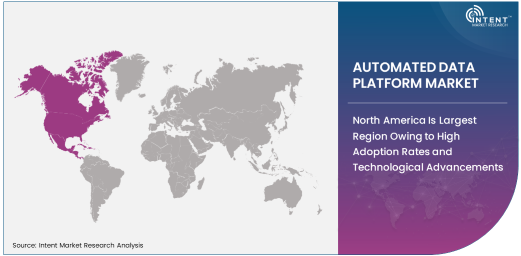
North America Is Largest Region Owing to High Adoption Rates and Technological Advancements
North America is the largest region in the automated data platform market, owing to its high adoption rates of advanced data technologies, strong digital infrastructure, and large-scale investments in data analytics and business intelligence. The United States, in particular, has seen widespread adoption of automated data platforms across various industries, including BFSI, healthcare, and retail, driven by the need for data-driven decision-making and operational efficiency. The region’s advanced technological ecosystem and high level of innovation also contribute to its dominance in the market.
North America is home to numerous leading tech companies that develop and deploy automated data platforms, further fueling market growth. The region’s strong focus on digital transformation and the growing emphasis on data security and governance have made it an attractive market for automated data platform providers. As businesses in North America continue to prioritize data integration, predictive analytics, and business intelligence, the region is expected to maintain its position as the largest market for automated data platforms.
Leading Companies and Competitive Landscape
The automated data platform market is highly competitive, with several leading players driving innovation and shaping the industry’s future. Key companies in this market include Microsoft, IBM, Google Cloud, Amazon Web Services (AWS), and SAP. These companies offer a range of cloud-based and hybrid cloud data platforms that cater to diverse industry needs, including data integration, business intelligence, and predictive analytics. As the market continues to grow, these companies are focused on expanding their product portfolios, enhancing the capabilities of their platforms, and incorporating emerging technologies such as artificial intelligence and machine learning.
The competitive landscape is also marked by strategic partnerships, mergers, and acquisitions, as companies seek to enhance their capabilities and offer more comprehensive solutions to their customers. In addition, the rise of smaller, specialized players focusing on niche applications such as data security and governance is contributing to the market’s evolution. As businesses increasingly rely on data for decision-making, the automated data platform market is expected to see continued innovation, with leading companies playing a key role in driving the development of next-generation data solutions.
Recent Developments:
- In December 2024, Microsoft Corporation launched a new version of its Azure data platform with enhanced machine learning and data governance capabilities.
- In November 2024, Amazon Web Services (AWS) introduced a new automated data integration tool designed to help businesses integrate on-premises and cloud data seamlessly.
- In October 2024, IBM Corporation partnered with Cloudera to enhance its AI-driven data platforms for improved predictive analytics and real-time data processing.
- In September 2024, Oracle Corporation unveiled an upgraded version of its autonomous database that integrates advanced data security features.
- In August 2024, Snowflake Inc. expanded its platform’s capabilities by adding more data automation and machine learning tools for better decision-making support.
List of Leading Companies:
- Microsoft Corporation
- Amazon Web Services, Inc.
- IBM Corporation
- Oracle Corporation
- Google LLC
- SAP SE
- Snowflake Inc.
- Cloudera, Inc.
- MongoDB, Inc.
- Teradata Corporation
- Databricks
- Informatica
- HPE (Hewlett Packard Enterprise)
- Dell Technologies
- Cisco Systems, Inc.
Report Scope:
|
Report Features |
Description |
|
Market Size (2024-e) |
USD 5.1 billion |
|
Forecasted Value (2030) |
USD 10.1 billion |
|
CAGR (2025 – 2030) |
12.2% |
|
Base Year for Estimation |
2024-e |
|
Historic Year |
2023 |
|
Forecast Period |
2025 – 2030 |
|
Report Coverage |
Market Forecast, Market Dynamics, Competitive Landscape, Recent Developments |
|
Segments Covered |
Automated Data Platform Market By Platform Type (Cloud-Based Platforms, On-Premises Platforms), By Deployment Model (Public Cloud, Private Cloud, Hybrid Cloud), By Application (Data Integration, Business Intelligence, Data Analytics, Data Security and Governance, Predictive Analytics), By End-User Industry (BFSI, Healthcare, Retail, Manufacturing, IT and Telecommunications) |
|
Regional Analysis |
North America (US, Canada, Mexico), Europe (Germany, France, UK, Italy, Spain, and Rest of Europe), Asia-Pacific (China, Japan, South Korea, Australia, India, and Rest of Asia-Pacific), Latin America (Brazil, Argentina, and Rest of Latin America), Middle East & Africa (Saudi Arabia, UAE, Rest of Middle East & Africa) |
|
Major Companies |
Microsoft Corporation, Amazon Web Services, Inc., IBM Corporation, Oracle Corporation, Google LLC, SAP SE, Snowflake Inc., Cloudera, Inc., MongoDB, Inc., Teradata Corporation, Databricks, Informatica, HPE (Hewlett Packard Enterprise), Dell Technologies, Cisco Systems, Inc. |
|
Customization Scope |
Customization for segments, region/country-level will be provided. Moreover, additional customization can be done based on the requirements |
|
1. Introduction |
|
1.1. Market Definition |
|
1.2. Scope of the Study |
|
1.3. Research Assumptions |
|
1.4. Study Limitations |
|
2. Research Methodology |
|
2.1. Research Approach |
|
2.1.1. Top-Down Method |
|
2.1.2. Bottom-Up Method |
|
2.1.3. Factor Impact Analysis |
|
2.2. Insights & Data Collection Process |
|
2.2.1. Secondary Research |
|
2.2.2. Primary Research |
|
2.3. Data Mining Process |
|
2.3.1. Data Analysis |
|
2.3.2. Data Validation and Revalidation |
|
2.3.3. Data Triangulation |
|
3. Executive Summary |
|
3.1. Major Markets & Segments |
|
3.2. Highest Growing Regions and Respective Countries |
|
3.3. Impact of Growth Drivers & Inhibitors |
|
3.4. Regulatory Overview by Country |
|
4. Automated Data Platform Market, by Platform Type (Market Size & Forecast: USD Million, 2023 – 2030) |
|
4.1. Cloud-Based Platforms |
|
4.2. On-Premises Platforms |
|
5. Automated Data Platform Market, by Deployment Model (Market Size & Forecast: USD Million, 2023 – 2030) |
|
5.1. Public Cloud |
|
5.2. Private Cloud |
|
5.3. Hybrid Cloud |
|
6. Automated Data Platform Market, by Application (Market Size & Forecast: USD Million, 2023 – 2030) |
|
6.1. Data Integration |
|
6.2. Business Intelligence |
|
6.3. Data Analytics |
|
6.4. Data Security and Governance |
|
6.5. Predictive Analytics |
|
7. Automated Data Platform Market, by End-User Industry (Market Size & Forecast: USD Million, 2023 – 2030) |
|
7.1. BFSI |
|
7.2. Healthcare |
|
7.3. Retail |
|
7.4. Manufacturing |
|
7.5. IT and Telecommunications |
|
8. Regional Analysis (Market Size & Forecast: USD Million, 2023 – 2030) |
|
8.1. Regional Overview |
|
8.2. North America |
|
8.2.1. Regional Trends & Growth Drivers |
|
8.2.2. Barriers & Challenges |
|
8.2.3. Opportunities |
|
8.2.4. Factor Impact Analysis |
|
8.2.5. Technology Trends |
|
8.2.6. North America Automated Data Platform Market, by Platform Type |
|
8.2.7. North America Automated Data Platform Market, by Deployment Model |
|
8.2.8. North America Automated Data Platform Market, by Application |
|
8.2.9. North America Automated Data Platform Market, by End-User Industry |
|
8.2.10. By Country |
|
8.2.10.1. US |
|
8.2.10.1.1. US Automated Data Platform Market, by Platform Type |
|
8.2.10.1.2. US Automated Data Platform Market, by Deployment Model |
|
8.2.10.1.3. US Automated Data Platform Market, by Application |
|
8.2.10.1.4. US Automated Data Platform Market, by End-User Industry |
|
8.2.10.2. Canada |
|
8.2.10.3. Mexico |
|
*Similar segmentation will be provided for each region and country |
|
8.3. Europe |
|
8.4. Asia-Pacific |
|
8.5. Latin America |
|
8.6. Middle East & Africa |
|
9. Competitive Landscape |
|
9.1. Overview of the Key Players |
|
9.2. Competitive Ecosystem |
|
9.2.1. Level of Fragmentation |
|
9.2.2. Market Consolidation |
|
9.2.3. Product Innovation |
|
9.3. Company Share Analysis |
|
9.4. Company Benchmarking Matrix |
|
9.4.1. Strategic Overview |
|
9.4.2. Product Innovations |
|
9.5. Start-up Ecosystem |
|
9.6. Strategic Competitive Insights/ Customer Imperatives |
|
9.7. ESG Matrix/ Sustainability Matrix |
|
9.8. Manufacturing Network |
|
9.8.1. Locations |
|
9.8.2. Supply Chain and Logistics |
|
9.8.3. Product Flexibility/Customization |
|
9.8.4. Digital Transformation and Connectivity |
|
9.8.5. Environmental and Regulatory Compliance |
|
9.9. Technology Readiness Level Matrix |
|
9.10. Technology Maturity Curve |
|
9.11. Buying Criteria |
|
10. Company Profiles |
|
10.1. Microsoft Corporation |
|
10.1.1. Company Overview |
|
10.1.2. Company Financials |
|
10.1.3. Product/Service Portfolio |
|
10.1.4. Recent Developments |
|
10.1.5. IMR Analysis |
|
*Similar information will be provided for other companies |
|
10.2. Amazon Web Services, Inc. |
|
10.3. IBM Corporation |
|
10.4. Oracle Corporation |
|
10.5. Google LLC |
|
10.6. SAP SE |
|
10.7. Snowflake Inc. |
|
10.8. Cloudera, Inc. |
|
10.9. MongoDB, Inc. |
|
10.10. Teradata Corporation |
|
10.11. Databricks |
|
10.12. Informatica |
|
10.13. HPE (Hewlett Packard Enterprise) |
|
10.14. Dell Technologies |
|
10.15. Cisco Systems, Inc. |
|
11. Appendix |
A comprehensive market research approach was employed to gather and analyze data on the Automated Data Platform Market. In the process, the analysis was also done to analyze the parent market and relevant adjacencies to measure the impact of them on the Automated Data Platform Market. The research methodology encompassed both secondary and primary research techniques, ensuring the accuracy and credibility of the findings.
.jpg)
Secondary Research
Secondary research involved a thorough review of pertinent industry reports, journals, articles, and publications. Additionally, annual reports, press releases, and investor presentations of industry players were scrutinized to gain insights into their market positioning and strategies.
Primary Research
Primary research involved conducting in-depth interviews with industry experts, stakeholders, and market participants across the E-Waste Management ecosystem. The primary research objectives included:
- Validating findings and assumptions derived from secondary research
- Gathering qualitative and quantitative data on market trends, drivers, and challenges
- Understanding the demand-side dynamics, encompassing end-users, component manufacturers, facility providers, and service providers
- Assessing the supply-side landscape, including technological advancements and recent developments
Market Size Assessment
A combination of top-down and bottom-up approaches was utilized to analyze the overall size of the Automated Data Platform Market. These methods were also employed to assess the size of various subsegments within the market. The market size assessment methodology encompassed the following steps:
- Identification of key industry players and relevant revenues through extensive secondary research
- Determination of the industry's supply chain and market size, in terms of value, through primary and secondary research processes
- Calculation of percentage shares, splits, and breakdowns using secondary sources and verification through primary sources
.jpg)
Data Triangulation
To ensure the accuracy and reliability of the market size, data triangulation was implemented. This involved cross-referencing data from various sources, including demand and supply side factors, market trends, and expert opinions. Additionally, top-down and bottom-up approaches were employed to validate the market size assessment.
NA