
As per Intent Market Research, the Attention Bias Modification Treatment App Market was valued at USD 118.2 million in 2024-e and will surpass USD 267.9 million by 2030; growing at a CAGR of 14.6% during 2025 - 2030.
The Attention Bias Modification (ABM) treatment app market is growing rapidly, driven by the increasing prevalence of mental health disorders such as anxiety, post-traumatic stress disorder (PTSD), and depression. Attention bias modification is a form of cognitive training that targets the maladaptive attentional biases associated with these conditions. With the rise in smartphone usage and digital health solutions, ABM apps are becoming more accessible to individuals seeking mental health support outside traditional clinical settings. These apps provide a convenient and cost-effective way for individuals to access evidence-based treatments and self-regulation tools, contributing to the market's growth.
Additionally, as awareness of mental health issues continues to rise and the stigma surrounding seeking treatment decreases, more people are turning to digital interventions for relief. ABM apps, which are often designed to be used independently or in conjunction with therapy, allow users to engage in personalized treatment plans that target specific cognitive processes. With advancements in app technology, including more sophisticated algorithms and user-friendly interfaces, the demand for ABM apps is expected to increase, further fueling the market’s expansion.
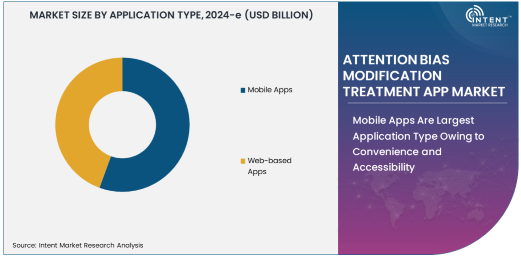
Mobile Apps Are Largest Application Type Owing to Convenience and Accessibility
Mobile apps are the largest application type in the ABM treatment app market, driven by their convenience, accessibility, and widespread use among individuals seeking mental health support. Mobile apps allow users to access attention bias modification techniques at any time and from anywhere, offering a high level of flexibility. The growing adoption of smartphones has made these apps easily accessible to a wide audience, eliminating barriers to seeking mental health support, such as time constraints and geographical limitations. Additionally, mobile apps are typically more affordable than in-person therapy, making them an attractive option for individuals seeking cost-effective treatment options.
The popularity of mobile apps is also bolstered by their integration with other digital health tools, such as mood trackers and personalized feedback systems, which enhance the user experience and support progress tracking. As users continue to prioritize convenience and flexibility in managing their mental health, mobile apps will remain the dominant platform for ABM treatments, with the market expanding in response to increasing demand.
Cognitive Behavioral Therapy (CBT) Apps Are Fastest Growing Product Type Owing to Proven Efficacy
Cognitive Behavioral Therapy (CBT) apps are the fastest-growing product type in the ABM treatment app market, owing to the proven efficacy of CBT in treating a wide range of mental health disorders, including anxiety, depression, and PTSD. CBT is a structured, time-limited therapy that helps individuals identify and challenge negative thought patterns, making it particularly effective for addressing the attentional biases associated with these conditions. The success of CBT in clinical settings has translated well into digital formats, with apps providing users with the tools to engage in cognitive exercises, thought record keeping, and behavioral experiments.
The growth of CBT apps is also supported by their accessibility and affordability, which makes them an attractive option for individuals who may not have access to traditional therapy due to financial or logistical barriers. These apps typically offer interactive exercises and personalized feedback, helping users apply CBT techniques in real-life situations. As mental health treatment becomes increasingly digital, the demand for CBT apps is expected to continue rising, further establishing their dominance in the market.
Individuals with Anxiety Disorders Are Largest End-User Owing to High Prevalence of Condition
Individuals with anxiety disorders are the largest end-users of ABM treatment apps, as anxiety is one of the most common mental health conditions globally. Anxiety disorders, which include generalized anxiety disorder, social anxiety disorder, and panic disorder, are characterized by heightened sensitivity to perceived threats and maladaptive attention bias. ABM treatment targets these attentional biases, helping individuals retrain their focus and reduce anxiety symptoms. The high prevalence of anxiety disorders, coupled with the increasing demand for accessible mental health solutions, makes individuals with anxiety disorders the primary user group for ABM apps.
These individuals often seek alternative treatments due to the stigma surrounding traditional therapy or because of difficulties accessing in-person treatment. ABM apps provide a viable solution by offering evidence-based interventions that can be used independently or in conjunction with therapy. As the awareness of anxiety disorders continues to grow and digital health solutions become more accepted, the demand for ABM apps for anxiety is expected to increase, solidifying this group as the largest end-user segment.
Direct-to-Consumer (DTC) Is Largest Distribution Channel Owing to Easy Access and Market Reach
Direct-to-Consumer (DTC) is the largest distribution channel in the ABM treatment app market, as it allows for easy access and broad market reach. DTC distribution enables app developers to offer their products directly to users via app stores, bypassing traditional healthcare providers and making it easier for individuals to access ABM treatments without the need for a prescription or referral. This distribution model has proven successful, particularly for individuals seeking mental health support in the privacy and convenience of their own homes. It also provides users with a wide range of app options, allowing them to choose the app that best fits their needs and preferences.
The DTC model is further supported by the increasing prevalence of self-management and self-care in the mental health space, with individuals seeking digital solutions that can complement or replace traditional in-person therapy. As the demand for mental health apps continues to rise, the DTC channel is expected to maintain its dominance, offering users easy access to ABM treatments at an affordable cost.
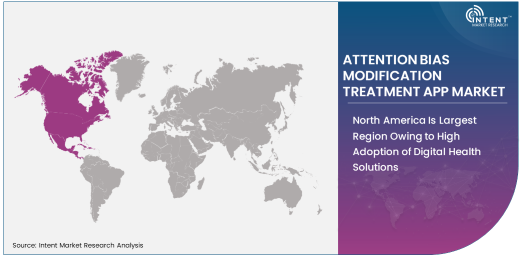
North America Is Largest Region Owing to High Adoption of Digital Health Solutions
North America is the largest region in the ABM treatment app market, driven by the high adoption of digital health solutions and a strong focus on mental health awareness. The United States and Canada are key contributors to the market, with a well-established infrastructure for digital health products and a growing acceptance of technology-driven mental health interventions. The increasing prevalence of mental health conditions, such as anxiety, depression, and PTSD, along with the rise in smartphone usage, has created a strong demand for ABM treatment apps in the region. Moreover, the availability of both free and subscription-based apps ensures that users have access to a variety of treatment options.
North America also benefits from a robust healthcare system, with many individuals increasingly turning to digital health solutions as an alternative to traditional therapy. This trend, coupled with high levels of internet connectivity and mobile device penetration, positions North America as the leading region for ABM treatment app adoption. As mental health continues to gain attention in public discourse, the demand for ABM apps is expected to remain strong in North America.
Leading Companies and Competitive Landscape
The Attention Bias Modification Treatment App market is highly competitive, with a growing number of companies offering digital solutions aimed at improving mental health outcomes. Key players include apps like MindDoc, Woebot Health, and Headspace, which provide users with a variety of mental health tools, including CBT-based interventions, mindfulness exercises, and anxiety-reducing techniques. These companies focus on developing evidence-based treatments that can be easily accessed through mobile platforms, catering to the increasing demand for accessible and affordable mental health solutions.
The competitive landscape is also shaped by ongoing advancements in AI, machine learning, and personalization technologies, which are used to enhance the effectiveness of ABM apps and deliver a more tailored experience to users. Companies are also exploring partnerships with healthcare providers and insurers to further integrate their digital health solutions into broader mental health care strategies. As the market expands, continued innovation and user-centered design will be key to maintaining a competitive edge.
Recent Developments:
- In December 2024, Headspace Inc. introduced a new attention bias modification program aimed at improving mental health treatment for users with anxiety.
- In November 2024, Pear Therapeutics partnered with healthcare providers to integrate its ABMT app into traditional therapy settings.
- In October 2024, Happify, Inc. launched a new mental health app that combines ABMT and mindfulness techniques for comprehensive anxiety relief.
- In September 2024, Talkspace expanded its digital therapy offerings with a new ABMT app specifically targeting PTSD symptoms.
- In August 2024, Woebot Health received funding to further develop and scale its ABMT app for depression treatment.
List of Leading Companies:
- Headspace, Inc.
- Calm.com, Inc.
- Pear Therapeutics, Inc.
- Happify, Inc.
- BetterHelp
- Talkspace
- Woebot Health, Inc.
- Big Health
- Mindstrong Health
- Anxiety Coaches, Inc.
- SilverCloud Health
- OSMO Health
- MyTherapy
- BioBeats
- CureMetrix
Report Scope:
|
Report Features |
Description |
|
Market Size (2024-e) |
USD 118.2 million |
|
Forecasted Value (2030) |
USD 267.9 million |
|
CAGR (2025 – 2030) |
14.6% |
|
Base Year for Estimation |
2024-e |
|
Historic Year |
2023 |
|
Forecast Period |
2025 – 2030 |
|
Report Coverage |
Market Forecast, Market Dynamics, Competitive Landscape, Recent Developments |
|
Segments Covered |
Attention Bias Modification Treatment App Market By Application Type (Mobile Apps, Web-based Apps), By Product Type (Cognitive Behavioral Therapy (CBT) Apps, Mindfulness-based Apps, Exposure Therapy Apps), By End-User (Individuals with Anxiety Disorders, Individuals with PTSD, Individuals with Depression, Healthcare Providers), By Distribution Channel (Direct-to-Consumer (DTC), Healthcare Providers/Clinics, Online Therapy Platforms) |
|
Regional Analysis |
North America (US, Canada, Mexico), Europe (Germany, France, UK, Italy, Spain, and Rest of Europe), Asia-Pacific (China, Japan, South Korea, Australia, India, and Rest of Asia-Pacific), Latin America (Brazil, Argentina, and Rest of Latin America), Middle East & Africa (Saudi Arabia, UAE, Rest of Middle East & Africa) |
|
Major Companies |
Headspace, Inc., Calm.com, Inc., Pear Therapeutics, Inc., Happify, Inc., BetterHelp, Talkspace, Woebot Health, Inc., Big Health, Mindstrong Health, Anxiety Coaches, Inc., SilverCloud Health, OSMO Health, MyTherapy, BioBeats, CureMetrix |
|
Customization Scope |
Customization for segments, region/country-level will be provided. Moreover, additional customization can be done based on the requirements |
|
1. Introduction |
|
1.1. Market Definition |
|
1.2. Scope of the Study |
|
1.3. Research Assumptions |
|
1.4. Study Limitations |
|
2. Research Methodology |
|
2.1. Research Approach |
|
2.1.1. Top-Down Method |
|
2.1.2. Bottom-Up Method |
|
2.1.3. Factor Impact Analysis |
|
2.2. Insights & Data Collection Process |
|
2.2.1. Secondary Research |
|
2.2.2. Primary Research |
|
2.3. Data Mining Process |
|
2.3.1. Data Analysis |
|
2.3.2. Data Validation and Revalidation |
|
2.3.3. Data Triangulation |
|
3. Executive Summary |
|
3.1. Major Markets & Segments |
|
3.2. Highest Growing Regions and Respective Countries |
|
3.3. Impact of Growth Drivers & Inhibitors |
|
3.4. Regulatory Overview by Country |
|
4. Attention Bias Modification Treatment App Market, by Application Type (Market Size & Forecast: USD Million, 2023 – 2030) |
|
4.1. Mobile Apps |
|
4.2. Web-based Apps |
|
5. Attention Bias Modification Treatment App Market, by Product Type (Market Size & Forecast: USD Million, 2023 – 2030) |
|
5.1. Cognitive Behavioral Therapy (CBT) Apps |
|
5.2. Mindfulness-based Apps |
|
5.3. Exposure Therapy Apps |
|
6. Attention Bias Modification Treatment App Market, by End-User (Market Size & Forecast: USD Million, 2023 – 2030) |
|
6.1. Individuals with Anxiety Disorders |
|
6.2. Individuals with PTSD |
|
6.3. Individuals with Depression |
|
6.4. Healthcare Providers |
|
7. Attention Bias Modification Treatment App Market, by Distribution Channel (Market Size & Forecast: USD Million, 2023 – 2030) |
|
7.1. Direct-to-Consumer (DTC) |
|
7.2. Healthcare Providers/Clinics |
|
7.3. Online Therapy Platforms |
|
8. Regional Analysis (Market Size & Forecast: USD Million, 2023 – 2030) |
|
8.1. Regional Overview |
|
8.2. North America |
|
8.2.1. Regional Trends & Growth Drivers |
|
8.2.2. Barriers & Challenges |
|
8.2.3. Opportunities |
|
8.2.4. Factor Impact Analysis |
|
8.2.5. Technology Trends |
|
8.2.6. North America Attention Bias Modification Treatment App Market, by Application Type |
|
8.2.7. North America Attention Bias Modification Treatment App Market, by Product Type |
|
8.2.8. North America Attention Bias Modification Treatment App Market, by End-User |
|
8.2.9. North America Attention Bias Modification Treatment App Market, by Distribution Channel |
|
8.2.10. By Country |
|
8.2.10.1. US |
|
8.2.10.1.1. US Attention Bias Modification Treatment App Market, by Application Type |
|
8.2.10.1.2. US Attention Bias Modification Treatment App Market, by Product Type |
|
8.2.10.1.3. US Attention Bias Modification Treatment App Market, by End-User |
|
8.2.10.1.4. US Attention Bias Modification Treatment App Market, by Distribution Channel |
|
8.2.10.2. Canada |
|
8.2.10.3. Mexico |
|
*Similar segmentation will be provided for each region and country |
|
8.3. Europe |
|
8.4. Asia-Pacific |
|
8.5. Latin America |
|
8.6. Middle East & Africa |
|
9. Competitive Landscape |
|
9.1. Overview of the Key Players |
|
9.2. Competitive Ecosystem |
|
9.2.1. Level of Fragmentation |
|
9.2.2. Market Consolidation |
|
9.2.3. Product Innovation |
|
9.3. Company Share Analysis |
|
9.4. Company Benchmarking Matrix |
|
9.4.1. Strategic Overview |
|
9.4.2. Product Innovations |
|
9.5. Start-up Ecosystem |
|
9.6. Strategic Competitive Insights/ Customer Imperatives |
|
9.7. ESG Matrix/ Sustainability Matrix |
|
9.8. Manufacturing Network |
|
9.8.1. Locations |
|
9.8.2. Supply Chain and Logistics |
|
9.8.3. Product Flexibility/Customization |
|
9.8.4. Digital Transformation and Connectivity |
|
9.8.5. Environmental and Regulatory Compliance |
|
9.9. Technology Readiness Level Matrix |
|
9.10. Technology Maturity Curve |
|
9.11. Buying Criteria |
|
10. Company Profiles |
|
10.1. Headspace, Inc. |
|
10.1.1. Company Overview |
|
10.1.2. Company Financials |
|
10.1.3. Product/Service Portfolio |
|
10.1.4. Recent Developments |
|
10.1.5. IMR Analysis |
|
*Similar information will be provided for other companies |
|
10.2. Calm.com, Inc. |
|
10.3. Pear Therapeutics, Inc. |
|
10.4. Happify, Inc. |
|
10.5. BetterHelp |
|
10.6. Talkspace |
|
10.7. Woebot Health, Inc. |
|
10.8. Big Health |
|
10.9. Mindstrong Health |
|
10.10. Anxiety Coaches, Inc. |
|
10.11. SilverCloud Health |
|
10.12. OSMO Health |
|
10.13. MyTherapy |
|
10.14. BioBeats |
|
10.15. CureMetrix |
|
11. Appendix |
A comprehensive market research approach was employed to gather and analyze data on the Attention Bias Modification Treatment App Market. In the process, the analysis was also done to analyze the parent market and relevant adjacencies to measure the impact of them on the Attention Bias Modification Treatment App Market. The research methodology encompassed both secondary and primary research techniques, ensuring the accuracy and credibility of the findings.
.jpg)
Secondary Research
Secondary research involved a thorough review of pertinent industry reports, journals, articles, and publications. Additionally, annual reports, press releases, and investor presentations of industry players were scrutinized to gain insights into their market positioning and strategies.
Primary Research
Primary research involved conducting in-depth interviews with industry experts, stakeholders, and market participants across the E-Waste Management ecosystem. The primary research objectives included:
- Validating findings and assumptions derived from secondary research
- Gathering qualitative and quantitative data on market trends, drivers, and challenges
- Understanding the demand-side dynamics, encompassing end-users, component manufacturers, facility providers, and service providers
- Assessing the supply-side landscape, including technological advancements and recent developments
Market Size Assessment
A combination of top-down and bottom-up approaches was utilized to analyze the overall size of the Attention Bias Modification Treatment App Market. These methods were also employed to assess the size of various subsegments within the market. The market size assessment methodology encompassed the following steps:
- Identification of key industry players and relevant revenues through extensive secondary research
- Determination of the industry's supply chain and market size, in terms of value, through primary and secondary research processes
- Calculation of percentage shares, splits, and breakdowns using secondary sources and verification through primary sources
.jpg)
Data Triangulation
To ensure the accuracy and reliability of the market size, data triangulation was implemented. This involved cross-referencing data from various sources, including demand and supply side factors, market trends, and expert opinions. Additionally, top-down and bottom-up approaches were employed to validate the market size assessment.
NA