
As per Intent Market Research, the Atezolizumab Market was valued at USD 2.5 billion in 2024-e and will surpass USD 4.0 billion by 2030; growing at a CAGR of 8.2% during 2025 - 2030.
The atezolizumab market is rapidly gaining momentum as a critical player in the field of oncology. This monoclonal antibody, which targets the PD-L1 protein, plays a significant role in cancer treatment by enhancing the body's immune response against tumor cells. Unlike traditional treatments such as chemotherapy, atezolizumab is a form of immunotherapy that works by inhibiting the interaction between PD-L1 and PD-1, allowing the immune system to recognize and eliminate cancer cells more effectively.
The demand for atezolizumab is increasing in response to the global rise in cancer incidence and the growing preference for targeted therapies that offer more precise and less invasive treatment options. Its effectiveness has been well-documented in treating a range of cancers, including non-small cell lung cancer (NSCLC), bladder cancer, breast cancer, and melanoma, leading to a significant uptake in clinical practice. The growing awareness among healthcare professionals about the benefits of immunotherapy, combined with the advancements in drug research, are pivotal factors contributing to the robust growth of this market.
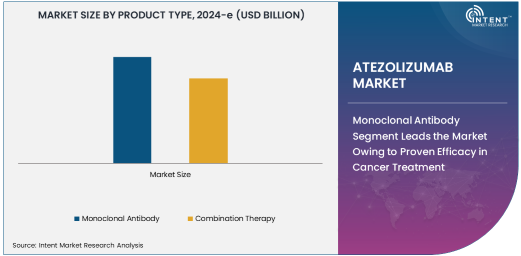
Monoclonal Antibody Segment Leads the Market Owing to Proven Efficacy in Cancer Treatment
The monoclonal antibody segment is the largest and most dominant in the atezolizumab market, largely because of its proven efficacy as a treatment for various types of cancer. Atezolizumab, as a PD-L1 inhibitor, works by blocking the immune checkpoint, which allows the body’s immune cells to better detect and attack tumor cells. This therapeutic action has shown significant results in cancers such as non-small cell lung cancer (NSCLC), where it has become a cornerstone in both first-line and subsequent-line therapies for advanced stages of the disease.
In addition to its effectiveness in treating lung cancer, atezolizumab’s monoclonal antibody formulation has demonstrated a solid safety profile compared to traditional chemotherapy, which often comes with severe side effects. Its ability to target cancer cells more precisely while minimizing damage to healthy tissues has made it a preferred choice in clinical settings. As more research continues to validate its use in various cancers, the monoclonal antibody segment is expected to remain the market leader, further cementing its place as a mainstay in the immuno-oncology space.
Cancer Treatment Application Dominates the Market Owing to Rising Cancer Incidence
The cancer treatment application holds the largest share in the atezolizumab market, driven by the increasing global cancer burden and the shift towards precision medicine. Atezolizumab has been approved for a range of cancers, including non-small cell lung cancer (NSCLC), bladder cancer, breast cancer, melanoma, and more, where it has demonstrated a significant impact on patient outcomes. It has become an essential component in the treatment of metastatic cancers, where conventional treatments like chemotherapy have limited efficacy and high toxicity.
As the number of cancer cases continues to rise globally, the need for effective and targeted therapies like atezolizumab has become even more urgent. Furthermore, the growing acceptance of immunotherapy and its proven benefits in enhancing survival rates and quality of life for cancer patients are expected to drive further growth in the cancer treatment application. This segment is set to remain dominant, as atezolizumab continues to expand into new cancer indications and combination therapies.
Non-Small Cell Lung Cancer (NSCLC) Leads the Market Owing to High Incidence and Treatment Demand
Within the cancer treatment application, non-small cell lung cancer (NSCLC) stands out as the largest segment. NSCLC represents approximately 85% of all lung cancer cases, and the increasing global prevalence of the disease is a key driver of the demand for atezolizumab. The drug has proven highly effective in treating both advanced and metastatic stages of NSCLC, particularly when used in combination with chemotherapy.
Atezolizumab has been approved as a first-line therapy for patients with metastatic NSCLC who do not have EGFR or ALK mutations, making it a critical treatment option for a substantial portion of NSCLC patients. The growing incidence of NSCLC, coupled with the success of atezolizumab in clinical trials, ensures that this segment will continue to drive market growth. As treatment guidelines evolve and new combinations are explored, atezolizumab's role in NSCLC will only expand, cementing its position as the largest segment in the market.
Bladder Cancer and Breast Cancer Segments Growing Steadily Due to Expanded Indications
The bladder cancer and breast cancer segments are experiencing steady growth, fueled by expanding indications and the increasing use of atezolizumab in combination therapies. In bladder cancer, atezolizumab is approved for use in patients with locally advanced or metastatic urothelial carcinoma who have not responded to traditional treatments. Its ability to enhance immune responses against cancer cells in the bladder has led to its adoption as a key treatment option.
Similarly, atezolizumab is being increasingly used in the treatment of triple-negative breast cancer (TNBC), a subtype of breast cancer that is known for its aggressive nature and poor prognosis. Clinical trials have shown that atezolizumab, when combined with chemotherapy, significantly improves survival outcomes for TNBC patients. As more clinical data becomes available, these segments are expected to experience continued growth, as they represent critical areas where atezolizumab can provide new therapeutic options for patients with limited treatment choices.
Hospitals End-User Segment Holds the Largest Share Due to High Treatment Volume
The hospitals segment is the largest end-user category for atezolizumab, owing to the central role hospitals play in cancer treatment. Hospitals are the primary settings for administering advanced cancer therapies, including atezolizumab, as they offer the infrastructure, expertise, and monitoring necessary for these complex treatments. Atezolizumab is frequently used in hospital oncology departments for the treatment of cancers like NSCLC, bladder cancer, and breast cancer, where it is integrated into treatment regimens for both newly diagnosed and relapsed patients.
Hospitals also serve as key hubs for clinical trials, where new uses of atezolizumab are continuously explored. With the growing number of cancer patients requiring treatment and the increasing shift toward immunotherapy, hospitals are expected to maintain their dominant position in the atezolizumab market. The expansion of hospital networks and the increasing availability of atezolizumab in hospital settings globally will continue to drive the demand for this immunotherapy.
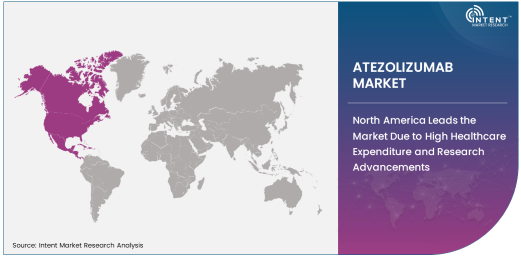
North America Leads the Market Due to High Healthcare Expenditure and Research Advancements
North America leads the atezolizumab market, primarily due to the high healthcare expenditure, advanced medical infrastructure, and robust research ecosystem in the region. The United States, in particular, plays a significant role, with atezolizumab being widely adopted in clinical practice for various cancers, including NSCLC, bladder cancer, and breast cancer. The region’s early adoption of cutting-edge therapies, coupled with substantial healthcare investments, positions North America as the dominant market for atezolizumab.
Moreover, North America’s strong research capabilities continue to drive innovations in immuno-oncology, facilitating the development of new indications and combination therapies for atezolizumab. As cancer incidence rates rise in the region, and as the demand for more effective, less toxic treatment options increases, North America is expected to maintain its leadership in the atezolizumab market for the foreseeable future.
Leading Companies and Competitive Landscape
The competitive landscape of the atezolizumab market is shaped by a few major players who dominate the industry due to their strong portfolios of oncology treatments, extensive research pipelines, and the successful commercialization of immunotherapies. The leading company in the atezolizumab market is Roche (the developer of atezolizumab), which has a significant share in the immuno-oncology space. Roche’s robust presence in oncology, combined with its continued investment in cancer research, positions it as the leading player in the atezolizumab market. Roche has developed a comprehensive approach to treating cancers like NSCLC, bladder cancer, breast cancer, and melanoma with atezolizumab, and the company continues to explore new therapeutic combinations and applications to further solidify its position in the market.
In addition to Roche, Bristol-Myers Squibb and Merck & Co. are two other key players in the oncology sector, with their own immune checkpoint inhibitors like nivolumab and pembrolizumab, respectively. While these companies primarily focus on different PD-1/PD-L1 inhibitors, their presence in the immuno-oncology market puts them in direct competition with Roche in terms of research and market share. Moreover, these competitors are investing heavily in clinical trials to investigate the efficacy of their drugs in combination with atezolizumab for better treatment outcomes.
Recent Developments:
- In December 2024, Genentech (Roche) announced new positive results from a Phase III clinical trial for atezolizumab in combination with chemotherapy for lung cancer.
- In November 2024, Merck & Co. launched a partnership with Gilead Sciences to explore atezolizumab as part of a combination therapy for various cancers.
- In October 2024, Bristol-Myers Squibb received FDA approval for a new combination regimen involving atezolizumab for bladder cancer treatment.
- In September 2024, Pfizer Inc. announced advancements in clinical trials combining atezolizumab with targeted therapies for triple-negative breast cancer.
- In August 2024, AstraZeneca expanded its portfolio by incorporating atezolizumab in combination therapies for melanoma treatment.
List of Leading Companies:
- Genentech (Roche)
- Bristol-Myers Squibb
- Merck & Co.
- Pfizer Inc.
- Novartis AG
- Amgen Inc.
- AstraZeneca
- Eli Lilly and Company
- Johnson & Johnson
- Gilead Sciences
- Sanofi
- AbbVie Inc.
- GlaxoSmithKline (GSK)
- Boehringer Ingelheim
- Takeda Pharmaceuticals
Report Scope:
|
Report Features |
Description |
|
Market Size (2024-e) |
USD 2.5 billion |
|
Forecasted Value (2030) |
USD 4.0 billion |
|
CAGR (2025 – 2030) |
8.2% |
|
Base Year for Estimation |
2024-e |
|
Historic Year |
2023 |
|
Forecast Period |
2025 – 2030 |
|
Report Coverage |
Market Forecast, Market Dynamics, Competitive Landscape, Recent Developments |
|
Segments Covered |
Atezolizumab Market By Product Type (Monoclonal Antibody, Combination Therapy), By Application (Cancer Treatment, Non-Small Cell Lung Cancer (NSCLC), Bladder Cancer, Breast Cancer, Melanoma), By End-User (Hospitals, Clinics, Research Institutions) |
|
Regional Analysis |
North America (US, Canada, Mexico), Europe (Germany, France, UK, Italy, Spain, and Rest of Europe), Asia-Pacific (China, Japan, South Korea, Australia, India, and Rest of Asia-Pacific), Latin America (Brazil, Argentina, and Rest of Latin America), Middle East & Africa (Saudi Arabia, UAE, Rest of Middle East & Africa) |
|
Major Companies |
Genentech (Roche), Bristol-Myers Squibb, Merck & Co., Pfizer Inc., Novartis AG, Amgen Inc., AstraZeneca, Eli Lilly and Company, Johnson & Johnson, Gilead Sciences, Sanofi, AbbVie Inc., GlaxoSmithKline (GSK), Boehringer Ingelheim, Takeda Pharmaceuticals |
|
Customization Scope |
Customization for segments, region/country-level will be provided. Moreover, additional customization can be done based on the requirements |
|
1. Introduction |
|
1.1. Market Definition |
|
1.2. Scope of the Study |
|
1.3. Research Assumptions |
|
1.4. Study Limitations |
|
2. Research Methodology |
|
2.1. Research Approach |
|
2.1.1. Top-Down Method |
|
2.1.2. Bottom-Up Method |
|
2.1.3. Factor Impact Analysis |
|
2.2. Insights & Data Collection Process |
|
2.2.1. Secondary Research |
|
2.2.2. Primary Research |
|
2.3. Data Mining Process |
|
2.3.1. Data Analysis |
|
2.3.2. Data Validation and Revalidation |
|
2.3.3. Data Triangulation |
|
3. Executive Summary |
|
3.1. Major Markets & Segments |
|
3.2. Highest Growing Regions and Respective Countries |
|
3.3. Impact of Growth Drivers & Inhibitors |
|
3.4. Regulatory Overview by Country |
|
4. Atezolizumab Market, by Product Type (Market Size & Forecast: USD Million, 2023 – 2030) |
|
4.1. Monoclonal Antibody |
|
4.2. Combination Therapy |
|
5. Atezolizumab Market, by Application (Market Size & Forecast: USD Million, 2023 – 2030) |
|
5.1. Cancer Treatment |
|
5.2. Non-Small Cell Lung Cancer (NSCLC) |
|
5.3. Bladder Cancer |
|
5.4. Breast Cancer |
|
5.5. Melanoma |
|
5.6. Others |
|
6. Atezolizumab Market, by End-User (Market Size & Forecast: USD Million, 2023 – 2030) |
|
6.1. Hospitals |
|
6.2. Clinics |
|
6.3. Research Institutions |
|
7. Regional Analysis (Market Size & Forecast: USD Million, 2023 – 2030) |
|
7.1. Regional Overview |
|
7.2. North America |
|
7.2.1. Regional Trends & Growth Drivers |
|
7.2.2. Barriers & Challenges |
|
7.2.3. Opportunities |
|
7.2.4. Factor Impact Analysis |
|
7.2.5. Technology Trends |
|
7.2.6. North America Atezolizumab Market, by Product Type |
|
7.2.7. North America Atezolizumab Market, by Application |
|
7.2.8. North America Atezolizumab Market, by End-User |
|
7.2.9. By Country |
|
7.2.9.1. US |
|
7.2.9.1.1. US Atezolizumab Market, by Product Type |
|
7.2.9.1.2. US Atezolizumab Market, by Application |
|
7.2.9.1.3. US Atezolizumab Market, by End-User |
|
7.2.9.2. Canada |
|
7.2.9.3. Mexico |
|
*Similar segmentation will be provided for each region and country |
|
7.3. Europe |
|
7.4. Asia-Pacific |
|
7.5. Latin America |
|
7.6. Middle East & Africa |
|
8. Competitive Landscape |
|
8.1. Overview of the Key Players |
|
8.2. Competitive Ecosystem |
|
8.2.1. Level of Fragmentation |
|
8.2.2. Market Consolidation |
|
8.2.3. Product Innovation |
|
8.3. Company Share Analysis |
|
8.4. Company Benchmarking Matrix |
|
8.4.1. Strategic Overview |
|
8.4.2. Product Innovations |
|
8.5. Start-up Ecosystem |
|
8.6. Strategic Competitive Insights/ Customer Imperatives |
|
8.7. ESG Matrix/ Sustainability Matrix |
|
8.8. Manufacturing Network |
|
8.8.1. Locations |
|
8.8.2. Supply Chain and Logistics |
|
8.8.3. Product Flexibility/Customization |
|
8.8.4. Digital Transformation and Connectivity |
|
8.8.5. Environmental and Regulatory Compliance |
|
8.9. Technology Readiness Level Matrix |
|
8.10. Technology Maturity Curve |
|
8.11. Buying Criteria |
|
9. Company Profiles |
|
9.1. Genentech (Roche) |
|
9.1.1. Company Overview |
|
9.1.2. Company Financials |
|
9.1.3. Product/Service Portfolio |
|
9.1.4. Recent Developments |
|
9.1.5. IMR Analysis |
|
*Similar information will be provided for other companies |
|
9.2. Bristol-Myers Squibb |
|
9.3. Merck & Co. |
|
9.4. Pfizer Inc. |
|
9.5. Novartis AG |
|
9.6. Amgen Inc. |
|
9.7. AstraZeneca |
|
9.8. Eli Lilly and Company |
|
9.9. Johnson & Johnson |
|
9.10. Gilead Sciences |
|
9.11. Sanofi |
|
9.12. AbbVie Inc. |
|
9.13. GlaxoSmithKline (GSK) |
|
9.14. Boehringer Ingelheim |
|
9.15. Takeda Pharmaceuticals |
|
10. Appendix |
A comprehensive market research approach was employed to gather and analyze data on the Atezolizumab Market. In the process, the analysis was also done to analyze the parent market and relevant adjacencies to measure the impact of them on the Atezolizumab Market. The research methodology encompassed both secondary and primary research techniques, ensuring the accuracy and credibility of the findings.
.jpg)
Secondary Research
Secondary research involved a thorough review of pertinent industry reports, journals, articles, and publications. Additionally, annual reports, press releases, and investor presentations of industry players were scrutinized to gain insights into their market positioning and strategies.
Primary Research
Primary research involved conducting in-depth interviews with industry experts, stakeholders, and market participants across the E-Waste Management ecosystem. The primary research objectives included:
- Validating findings and assumptions derived from secondary research
- Gathering qualitative and quantitative data on market trends, drivers, and challenges
- Understanding the demand-side dynamics, encompassing end-users, component manufacturers, facility providers, and service providers
- Assessing the supply-side landscape, including technological advancements and recent developments
Market Size Assessment
A combination of top-down and bottom-up approaches was utilized to analyze the overall size of the Atezolizumab Market. These methods were also employed to assess the size of various subsegments within the market. The market size assessment methodology encompassed the following steps:
- Identification of key industry players and relevant revenues through extensive secondary research
- Determination of the industry's supply chain and market size, in terms of value, through primary and secondary research processes
- Calculation of percentage shares, splits, and breakdowns using secondary sources and verification through primary sources
.jpg)
Data Triangulation
To ensure the accuracy and reliability of the market size, data triangulation was implemented. This involved cross-referencing data from various sources, including demand and supply side factors, market trends, and expert opinions. Additionally, top-down and bottom-up approaches were employed to validate the market size assessment.
NA